
You are currently browsing Sandeep Baliga’s articles.

I got to attend the Sargent-Sims Nobel Prize celebration dinner at the UofC thanks to my wife. Feelings of alienation were dissipated by the sight of Marco Battaglini and Steve Coate who are pretending to be macroeconomists these days. And Golosov was wearing his macro hat that night. So, I began feeling comfortable, if not exactly at home.
Some of my wife’s grad student cohort were also attending. They turned out to be very nice and they all recalled friendly dinners and student group interactions from days of old. Harvard wasn’t so friendly. I wondered why supposedly cutthroat Chicago types weren’t as competitive as the Harvard pinko liberals. It turns out surviving the first year at Chicago was so hard – a substantial chunk of the class was kicked out (is this still the case?) – that they had to stick together to “beat the system”. A sort of communism was the byproduct. At Harvard, it was less draconian and the natural tendency of economists is to be competitive – we study the benefits of competition after all. We ended up as (over-)confident mini-entrepreneurs.
The dinner finished with a bunch of speeches. Marty Eichenbaum recalled the heady days as a grad student on the frontline of the Minnesota revolution. Tao Zha described the bittersweet experience of working with both Sargent and Sims – Sargent withdrew their accepted joint paper at AER after it received withering criticism from Sims and Sims withdrew their nearly accepted joint paper at Econometrica. These guys have high standards. Lucas identified the key scientific contributions made by Sims and Sargent. Ed Prescott gave a surreal speech comparing Prescott-Sargent-Sims-Wallace to the back line of some famous Notre Dame football team from the 1920s (the “Four Horsemen of Notre Dame”). The front line, “the mules”, were the Minnesota grad students who actually fought in the Revolution. (Sidenote: It is better to be horseman than a mule – see Mort Kamien entry below). Hansen’s speech started with the observation that he was a mule!
Finally, we had Sargent and Sims or rather Sims then Sargent. Sims pointed out there were some earlier Horsemen of the Apocalypse. He mapped the Minnesota four into their Biblical counterparts as follows: Sargent=Conquest, Sims=Pestilence, Prescott=War and Wallace=Death (I may have inverted these!). Sargent had a second-mover advantage which he employed to great effect. He recalled a conference at Urbana-Champaign organized by In-Koo Cho. Hansen and Sargent arrived at the airport at same time as Sims. Sims had rented a car and went to get it while Hansen and Sargent wrote a couple of their joint papers in the airport. He returned and went inside to get them, leaving the car running with key inside. The doors had an autolock feature and they couldn’t get back in! Hansen and Sargent got a taxi and left Sims to deal with the mess on is own. With that the dinner was over.
My colleague Mort Kamien passed away last week.
I first met Mort in 1997 when I was on the job market. I had encountered his work much earlier as an undergraduate via his textbook Dynamic Optimization, co-authored with Nancy Schwartz. It is always a great event when you meets someone whose work you know from undergraduate education – such work automatically rises to the classic level. So, it was a privledge to meet Mort then and to become his colleague.
On a personal level, what I will remember about Mort is his humor. He grew up in Brooklyn and I had only come across people like him in Woody Allen movies. He was an exotic creature to someone who grew up in England. He was always interested in what the young people were doing research-wise. He would always ask me about my kids and how my wife, Anna, was doing in her work.
On the research side, Mort had great taste. He could judge research and people very well. He always wanted to hire according to the “best athlete” criterion rather than pick a field and then have that constrain your choices. He valued creativity and said it was better to write the first paper in a field rather than the final word. I guess I have these values because of him.
I an in England as I write this. My thoughts are with his wife and son.
At every OxBridge college, there is a Wine Committee. Many people want to get on it but first you have to serve on the Use of Space Committee. It might be fun if the latter plotted how the College could go to Mars. But what the committee really does is meet bi-monthly to decide where to put the photocopier. You grumble and serve as there is a chance you get on the Wine Committee.
Kellogg, as far as I am aware (!), has no Wine Committee so this cannot be used to give incentives. Monetary incentives are weak. This leaves moral suasion as the main instrument. For example, if a Dean looks miserable when he or she asks you to do something, you are likely to say yes. They look very, very sad after all, and so you would feel terrible if you refused them. To make Deans credibly miserable, they should be treated badly. QED.
This leaves open the question of why anyone would then want to become Dean. No-one has asked me (and no-one ever will!) so I have no practical experience. I guess moral suasion and guilt also operate there but am less clear as to the exact mechanism (e.g. “This institution has done so much for me, I should serve.”).
But I do have a solution that could make everyone happy – start a Wine Committee. Regular visits and tastings with wine distributors are enough to make many of us serve on the “where should the photocopiers be in the new building committee”. Then, we can treat the deans well, as they deserve, without unraveling incentives and run everything more efficiently.
The paper ….“Prospect Theory”… spawned a sub-field of economics known as behavioral economics. This field attracted the interest of a Harvard undergraduate named Paul DePodesta. With a mind prepared to view markets and human decision-making as less than perfectly rational, DePodesta had gone into sports management, been hired by Billy Beane to work for the Oakland A’s, and proceeded to exploit the unreason of baseball experts. A dotted line connected the Israeli psychologists to what would become a revolution in sports management. ..
Spookier still:
I soon realized that Tversky’s son had been a student in a seminar I’d taught in the late 1990s at the University of California, Berkeley….My former student Oren Tversky put me in touch with his mother, Barbara, who put me onto the papers left behind by her husband…..Then one afternoon I came upon a letter dated June 4, 1985, from Bill James. The baseball analyst whose work was then being blithely ignored by professional baseball people had wanted help answering a question that vexed him: Why were baseball professionals forever attempting to explain essentially random and therefore inexplicable events? “Baseball men, living from day to day in the clutch of carefully metered chance occurrences, have developed an entire bestiary of imagined causes to tie together and thus make sense of patterns that are in truth entirely accidental,” James wrote. “They have an entire vocabulary of completely imaginary concepts used to tie together chance groupings. It includes ‘momentum,’ ‘confidence,’ ‘seeing the ball well,’ ‘slumps,’ ‘guts,’ ‘clutch ability,’ being ‘hot’ and ‘cold,’ ‘not being aggressive’ and my all time favorite the ‘intangibles.’ By such concepts, the baseball man gains a feeling of control over a universe that swings him up and down and tosses him from side to side like a yoyo in a high wind.” It wasn’t just baseball he was writing about, James continued. “I think that the randomness of fate applies to all of us as much as baseball men, though it might be exacerbated by the orderliness of their successes and failures.”

Got my new shipment of Navarro wines. I went straight to the Pinot Noir. Totally delicious. Usual cherry and fruit notes but there’s also some dryness that is Old World. Navarro hit a rough spot last year because forest fires tainted their crop. The wines literally tasted smoky. They were interesting but the smokiness made the wines one dimensional. Navarro is back on peak form with this offering.
A firm selling complementary products may cut the price of one to encourage sales of the other. This effect can be so strong that one of the products is sold as a loss leader:
A recent analysis from IHS iSuppli determined that Amazon’s $79 Kindle e-reader, which is the online retailer’s cheapest Kindle thus far, costs $84.25 to make…..Even if Amazon pays more to build the $79 Kindle than it sells it for, the company has several other ways to bring in money from the device. This Kindle model includes ads that show up as screensavers and at the bottom of the device’s home screen. And Amazon sees all the devices in the Kindle family — and the free Kindle apps it offers for mobile devices and computers — as a way to spur more sales of its digital e-books, music, games and apps.
Murphy is still playing a key role in the negotiations:
This round of negotiations is being conducted with small groups on each side. Stern was joined by Silver, the San Antonio Spurs owner Peter Holt — who heads the N.B.A.’s labor relations committee — and the league’s top two lawyers, Rick Buchanan and Dan Rube. Representing the union were Fisher and the executive director Billy Hunter, along with the union’s outside counsel Jeff Kessler, its outside economist, Kevin Murphy, and its lead attorney, Ron Klempner.
Will we have to dig out the kids’ D Rose shirts out from the back of the closet soon?
In graduate school I read the masterful Introduction to Joel Mokyr’s edited volume on the British Industrial Revolution. But I did not make the Steve Jobs connection. Malcolm Gladwell did:
One of the great puzzles of the industrial revolution is why it began in England. Why not France, or Germany? Many reasons have been offered. Britain had plentiful supplies of coal, for instance. It had a good patent system in place. It had relatively high labor costs, which encouraged the search for labor-saving innovations. In an article published earlier this year, however, the economists Ralf Meisenzahl and Joel Mokyr focus on a different explanation: the role of Britain’s human-capital advantage—in particular, on a group they call “tweakers.” They believe that Britain dominated the industrial revolution because it had a far larger population of skilled engineers and artisans than its competitors: resourceful and creative men who took the signature inventions of the industrial age and tweaked them—refined and perfected them, and made them work.
In 1779, Samuel Crompton, a retiring genius from Lancashire, invented the spinning mule, which made possible the mechanization of cotton manufacture. Yet England’s real advantage was that it had….. Richard Roberts, also of Manchester, a master of precision machine tooling—and the tweaker’s tweaker. He created the “automatic” spinning mule: an exacting, high-speed, reliable rethinking of Crompton’s original creation. Such men, the economists argue, provided the “micro inventions necessary to make macro inventions highly productive and remunerative.”
Was Steve Jobs a Samuel Crompton or was he a Richard Roberts? In the eulogies that followed Jobs’s death, last month, he was repeatedly referred to as a large-scale visionary and inventor. But Isaacson’s biography suggests that he was much more of a tweaker. He borrowed the characteristic features of the Macintosh—the mouse and the icons on the screen—from the engineers at Xerox PARC, after his famous visit there, in 1979. The first portable digital music players came out in 1996. Apple introduced the iPod, in 2001, because Jobs looked at the existing music players on the market and concluded that they “truly sucked.” Smart phones started coming out in the nineteen-nineties. Jobs introduced the iPhone in 2007, more than a decade later, because, Isaacson writes, “he had noticed something odd about the cell phones on the market: They all stank, just like portable music players used to.” The idea for the iPad came from an engineer at Microsoft, who was married to a friend of the Jobs family, and who invited Jobs to his fiftieth-birthday party.
Here is the paper Gladwell mentions. Ralf Meisenzahl and Joel Mokyr conclude:
Are there any policy lessons from this for our age? The one obvious conclusion one can draw from this is that a few thousand individuals may have played a crucial role in the technological transformation of the British economy and carried the Industrial Revolution. The average level of human capital in Britain, as measured by mean literacy rates, school attendance, and even the number of people attending institutes of higher education are often regarded as surprising low for an industrial leader. But the useful knowledge that may have mattered was obviously transmitted primarily through apprentice-master relations, and among those, what counted most were the characteristics of the top few percentiles of highly skilled and dexterous mechanics and instrument-makers, mill-wrights, hardware makers, and similar artisans. This may be a more general characteristic of the impact of human capital on technological creativity: we should focus neither on the mean properties of the
population at large nor on the experiences of the “superstars” but on the group in between. Those who had the dexterity and competence to tweak, adapt, combine, improve, and debug existing ideas, build them according to specifications, but with the knowledge to add in what the blueprints left out were critical to the story. The policy implications of this insight are far from obvious, but clearly if the source of technological success was a small percentage of the labor force, this is something that an educational policy would have to take into account.
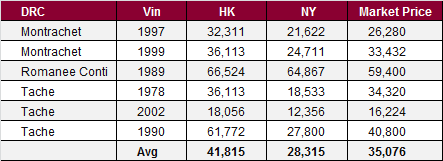 Prices are in british pounds/case of high end Burgundy. Why aren’t the producers shifting stock to Hong Kong? Also, it costs about $40 to ship a case from New York City to Hong Kong so buyers can easily resell or transport their purchase abroad. There must be some tax implication but surely it can’t justify this spread.
I just caught the first episode, “Heat and Meat”, of the new season of Next Iron Chef. There were two parts to the competition. In the first part, chefs worked in pairs cooking a pig (the meat) over an open fire (the heat) in the wilderness. In the second part, the two chefs in the losing team had to face each other in a sudden death cookoff. If you get to choose your teammate, one obvious strategy is to pick the best chef standing. This maximizes your chance of winning outright and hence avoiding the elimination round. In fact, chef-contestant Spike got to pick the teams and did exactly this by picking Marcus Samuelsson whom he took to be the best chef. (I missed the start of the episode so I do not know how Spike got chosen to be in this powerful position).
Things did not work out as Spike hoped. Marcus and Spike ended up at the bottom of the pile. Spike then lost to Marcus in “battle scallop”.
What did Spike do wrong? Obviously, picking the best chef as your partner carries a big risk – if you end up in the elimination round, you will likely lose. Better to hedge by choosing a worse chef. This increases the chance you get into the elimination round but also decreases the chance you do not make it out of the round. Spike should have picked Alex Guarnaschelli. She is a good cook but she gets tense and nervous. A good partner for round 1 and also a weak competitor in round 2. Perfect.
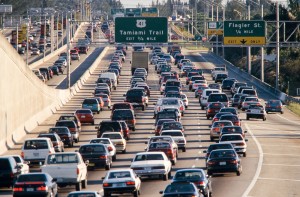
Traffic could cause roads: greater traffic leads to greater expenditure on roads. Or roads could cause traffic: greater supply of roads leads to more driving and hence traffic. Which way is it?
This is studied by Duranton and Turner in a forthcoming paper in AER. They use an instrumental variables approach to identify causation. A 1947 plan envisaged a highway network connecting existing population centers. Importantly for this study, tha plan was based on existing population centers not forecast traffic demand. Hence, the impact of the greater availability of roads on traffic can be studied (while controlling for factors such as population). The authors find:
For interstate highways in metropolitan areas we find that VKT (vehicle kilometers traveled)
increases one for one with interstate highways, confirming the ‘fundamental law of highway congestion’
Provision of public transit also simply leads to the people taking public transport being replaced by drivers on the road. Therefore:
These findings suggest that both road capacity expansions and extensions to public transit are not
appropriate policies with which to combat traffic congestion. This leaves congestion pricing as the main
candidate tool to curb traffic congestion.
I leave it to Paul Krugman to advice Greece. I’ll stick to Greeks. In a couple of weeks from now, while everyone is at the rally complaining about the austerity plan, the government will shut down all banks. They will get out of the euro. On Monday, Greek ATMs will issue euronotes with a picture of Plato photoshopped onto them. They will be called drachmas. Plato’s picture will cause the value of the note to fall to a fraction of the value of the euro. So, in the next couple of weeks, following the simplest prescription of Hirschman’s Exit, Voice and Loyalty, Greeks should move all their bank accounts abroad. Of course, the country that gave us Plato, Aristotle, Pythagoras and, my personal favorite, Thucydides, does not need my shallow advice. Via the Daily Mail:
Fat-cat Greeks have secretly shifted more than €228billion euros out of their country’s crisis-hit banks and into accounts in Switzerland, according to a report.
The big money is fleeing the country as rich Greeks fear the possible re-introduction of their old currency, the drachma, would instantly halve the value of their euros if they are left in Greek banks.
Netflix has increases prices. What should Redbox, the kiosk DVD rental firm do? Thye could cut or maintain prices and gain share. Or they could raise prices, lose some sales and gain margin. Redbox has decided to raise prices:
The new rental rate will be $1.20 per day, instead of the current $1 daily rate. Redbox prices will remained unchanged for Blu-ray discs at $1.50 per day and video games at $2 per day.
Why don’t companies do this more often? One explanation:
[I]t spooked investors, especially because Redbox appears to be picking up customers still stewing over the higher prices at Netflix. Coinstar’s shares plunged 10 percent in Thursday’s extended trading.
To outsiders, sales are more observable than profits/unit, because variable costs are kept private by firms but sales figures are publicized. The market can see lower sales but has a harder time calculating the profit implications – lower sales could mean higher profits. Or stock market analysts are crazy short termists.
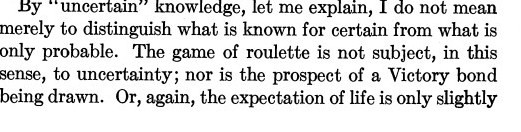
All Cambridge (U.K.) undergrads have (had?) to struggle through a chapter by chapter reading of Keynes’ General Theory of Employment, Interest and Money. Some come out of this confirmed Keynesians and even Marxists and then go on to work in the City of London. This rich irony comes at the cost of some confusion for hordes of the intellectual elite as the book is extremely hard to read. It turns out that Keynes offered a lucid synopsis of his theory in the QJE in a reply to his critics. My only quibble is that I wish he had used the odd equation here or there – he speaks in equations but does not dare spell them out presumably for fear of losing his reader. But here is a spectacular passage on uncertainty vs risk:

Why does it matter? Because it affects demand for money and hence the interest rate:
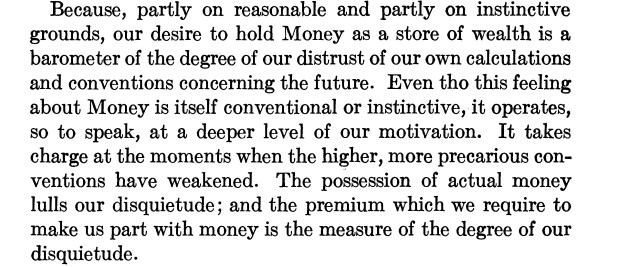
The whole article is full of amazing insights. i’s are not dotted or t’s crossed. Many papers remain to be written.
(Hat Tip: Nabil Al-Najjar)
Here is the gist of the new mortgage plan:
The changes, which will take effect over several months, will let people qualify for new loans no matter how far the values of their homes have fallen, so long as they have made at least six consecutive monthly payments. The plan also will reduce borrowers’ fees, for example, by dispensing with the need for an appraisal in many cases and by automatically transferring mortgage insurance to the new loan.
Fannie Mae and Freddie Mac generally require refinancing lenders to assume responsibility for any problems with the original loan because in making the new loan they are relying in part on that original documentation. That has made lenders reluctant to refinance loans for which they are not already responsible. That provision will now be waived, in exchange for a fee.
But the program still applies only to loans that Fannie and Freddie acquired before May 31, 2009. It does not reduce the amount that borrowers owe. And only borrowers with less than 20 percent equity in their homes are eligible; those with more equity must seek a refinancing through the standard and more expensive channels, although the government is considering making some of the same changes, like reducing fees, for those borrowers.
One of my favorite colleagues, Debbie Lucas, who has now moved to MIT Sloan, co-authored a study of the impact of a large scale mortgage refinancing plan while she was at the CBO:
Relative to the status quo, the specific program analyzed here is estimated to cause an additional 2.9 million mortgages to be refinanced,
resulting in 111,000 fewer defaults on those loans and estimated savings for the GSEs and FHA of $3.9 billion on their credit guarantee exposure, measured on a fair-value basis. Offsetting those savings, federal investors in MBSs, including the Federal Reserve, the GSEs, and the Treasury, would experience an estimated fair-value loss of $4.5 billion. Therefore, on a fair-value basis, the specific program analyzed here would have an estimated cost to the federal government of $0.6 billion….Because the estimated gains and losses are small relative to the size of the housing market, the mortgage market, and the overall economy, the effects on those markets and the economy would be small as well.
The plan Debbie studied is larger than the one being implemented right now. Something more radical is necessary to have a big impact. It might have to allow borrowers to write down their principal. Who has the guts to propose a bailout of homeowners? Ironically, Glenn Hubbard, advisor to Mitt Romney.

Social Choice Theorists are going to see an experiment in action as San Francisco votes for a new mayor using rank-order voting. Here is how it works:
Each voter lists up to three candidates in ranked order: First, second and third choice.
If one candidate gets more than 50 percent of the first-place votes in the first round of counting, he’s the winner and there’s no need to look at the second and third choices.
But if no one has a majority, the candidate with the fewest number of votes is eliminated from the future count and his second-choice votes are distributed to the remaining candidates.
If still no one cracks the 50 percent mark, then the candidate with the second-lowest vote total is eliminated and his second-place votes are distributed. If the voters’ second choice already was eliminated, it’s the third-choice vote that goes back into the pool.
This continues until one candidate has a majority of the remaining votes. Last November, it took 20 rounds before Malia Cohen finally was elected as supervisor from San Francisco’s District 10.
There are two strategic issues. First, there must be an incentive for strategic voting via Gibbard-Satterthwaite/Arrow. Hence, sincere voting and strategic voting will differ. Second, the candidate positions and in fact the issue of who enters as a candidate is a key factor in the rationale for switching to rank order voting in the first place. Some voters must hope that third party candidates can now enter and have a chance of winning. Others must hope that more centrist policies are adopted by the candidates in the hope of being voters’ second or third choice.
I assume there are many formal theory papers in political science on this but am not familiar with them…anyone have any ideas?
The price of a 6.5oz bottle of Coca Cola stayed fixed at 5c from 1886 to 1959. Daniel Levy and Andrew Young document this fact and ask why this might have been the case in a period that saw two world wars and the Great Depression. They offer two technological explanations for price rigidity:
First, we demonstrate that an installed base of vending machines with nickel-only capability, and the
evolution of the technology that could accommodate multiple type coins and change making,
imposed an important constraint on the ability of the Coca-Cola Company to adjust the Coke’s
price. Second, at the 5¢ price per serving, the smallest price increase compatible with the
consumer still using a single coin was a 100 percent jump to 10¢. A monetary transaction
technology for smaller price adjustment while keeping consumer “inconvenience costs” low in
terms of the number of coins needed for purchasing a bottle of Coca-Cola, was not available.
How can you get around these technological constraints?
You could lobby your friends:
Woodruff [Coca Cola CEO] submitted a request in 1953 to the newly elected President Dwight Eisenhower (his hunting companion and friend) himself, to get the U.S. Department of Treasury mint a new 7 1/2-cent coin.
Eisenhower forwarded the request to the Treasury Department officials who did not like the idea.
Or ingeniously in an early example of mechanism design, you could randomize bottle delivery while retaining the nickel technology in the vending machine:
“Instead of offering one ‘Coke’ for 6¢ the coin cooler offers 8 ‘Cokes’ for 45¢,
which is only 5.625¢ (5 5/8¢) per bottle. [The] coin cooler [delivers] either an
empty bottle or no bottle at all for one nickel in every nine deposited. This
absence of ‘Coke’ is called an official blank. Please be warned that, if you fail to
deposit nine nickels, at worst you will strike the blank and have to deposit
another nickel for your ‘Coke.’ At best you will miss the blank (8 times out of 9)
and your ‘Coke’ will cost only a nickel, but as stated, on the average ‘Coke’ sells
for 5.625¢ per bottle—the only price at which it is offered”
The plan might actually have been tried out in Chicago and Canada!
(Hat Tip: Tilman Klumpp and Xuejuan Su)
Bruce Riedel who ran President Obama’s AfPak review now favors containment over engagement with Pakistan as I mentioned in Part 1. He thinks military aid should be reduced sharply and substituted with reduced tariffs and the like. How is the Pakistani army going to respond? In the past, scientist A Q Khan sold nuclear secrets to countries that are hostile to the United States. Was the Pakistani Army complicit in the nuclear trade? That information is not in the public domain.
What is to stop the Pakistani Army employing or reverting to nuclear trade under containment? Again, thinking of the United States as the Principal and the Pakistani Army as the Agent, the principal has to come up with some way to give incentives to the agent. With commitment, the obvious instrument is a threat, e.g. the United States will attack/invade Pakistan if they observe a sign of nuclear trade. If the threat is credible, the Pakistani Army will not engage in nuclear trade and the United States will not have to carry out its threat. But the threatened action is costly and it is impossible to commit to carry out the threat in the scenario where it is meant to be implemented. Hence, there would be a credibility issue even if Pakistan were not nuclear. The fact they are nuclear makes the threat incredible. Indeed, it is hard to see any “stick” that can credibly be used to give incentives.
That leaves “carrots”. The United States can make a transfer to the Pakistani Army if and only if there is no sign they are engaging in nuclear trade. It is credible to take the carrot away if there is a sign of trade. If there is no sign of nuclear trade, it is credible to make the transfer because the Pakistani Army has a credible threat of start nuclear trade if a transfer is not forthcoming – after all they get surplus from nuclear trade. If the transfer is large enough and signals of nuclear trade are more likely if nuclear trade actually occurs, the Pakistani Army will play along with its part in the equilibrium too.
This logic is familiar from the efficiency wage model of Shapiro and Stiglitz – if the principal cannot use sticks, she must use carrots and ends up giving surplus to the agent. But here I only want to point out an irony: under the old regime of engagement, the United States paid the Pakistani Army to take a costly effort and hunt down terrorists; in the (possible) new regime of containment, the Unites States pays the Pakistani Army not to go take the profitable action of engaging in nuclear trade. Either way, a transfer is made.
Bruce Riedel who ran President Obama’s AfPak review now favors containment over engagement:
It is time to move to a policy of containment, which would mean a more hostile relationship. But it should be a focused hostility, aimed not at hurting Pakistan’s people but at holding its army and intelligence branches accountable. When we learn that an officer from Pakistan’s Inter-Services Intelligence, or ISI, is aiding terrorism, whether in Afghanistan or India, we should put him on wanted lists, sanction him at the United Nations and, if he is dangerous enough, track him down. Putting sanctions on organizations in Pakistan has not worked in the past, but sanctioning individuals has — as the nuclear proliferator Abdul Qadeer Khan could attest.
It is useful to think of the US-Pakistan game as a principal-agent relationship. The US (principal) would like to “pay for performance” and make a transfer if and only if the Pakistani army (agent) capture terrorists and quash the Taliban. Performing this task is costly for Pakistan for many reasons. For one, they use the terrorists as proxies in their fight against India. But if the US values elimination of terrorists enough, there is a transfer or sequence of transfers that are large enough to persuade Pakistan to work hard on America’s behalf. For the transfer scheme to work, the US has to be able to commit to pay. If Pakistan is too successful, then the US has no incentive continue paying them. Knowing this, Pakistan does not want to work too hard on America’s behalf. Do enough work to keep the money rolling in but not enough to kill off the goose laying golden eggs.
This delicate balancing act can tip one way or another with random events. After one huge such event, the capture of Osama Bin Laden, the relationship has gone sour. Perhaps, we are in a new phase, that is the gist of Riedel’s column. But how should this be managed? I need to think about part 2….
Ba Le is well known – I found out about it from Check Please of all places. Despite it’s fame, lines are short and service is fast. The location in Uptown makes it a little out of the way I guess.
The shop mainly sells Vietnamese Bahn’ Mi sandwiches so if you are looking for Pho you’ll have to find somewhere else on Argyll Street. We’ve gotten the Vegetarian, Chicken and BBQ Pork bahn’ mi – all were good and popular even with the kids. The spring rolls from the fridge are also very good. The hot appetizers should be avoided. The smoothies aren’t so great either. There is a large choice of Vietnamese desserts, various combinations of beans, corn and tapioco in coconut milk. I’ve had some I loved and some I hated but I can never remember which ones were good! I still make the longish drive from Evanston so by revealed preference the good outweighs the bad, especially now I’ve learned what to avoid.
Kevin Murphy is a John Bates Clark Medal winner, he has a MacArthur “Genius” Award and is a superstar in the economics profession. But the green-eyed monster has finally stirred because I found out he is consulting for the basketball players in the current labor negotiations.
Teams pay a luxury tax if they go over a salary cap specified by the league. The revenue generated by the tax is transferred to the other teams. If the luxury tax is too high, teams will not go over the salary cap and the labor market for payers will be moribund. But if it is low, the rich teams will go over the salary cap and the poorer teams will get the revenue this generates and will themselves compete to hire players. The labor market for players will be active. There is some threshold luxury tax below which the market is active and above which it is inactive. The players want a tax that is below the threshold. Who might be able to work out this threshold? Kevin Murphy:
[An ESPN reporter] asked a union official how they know where that player-friendly effect stops, and where the de facto hard cap kicks in.
His answer was that their economist Kevin Murphy had the task of predicting how owners would spend under the last CBA, back when it was new. Looking back, they realize his work was, the official says, “pretty much perfect.”
Who is the consultant to the teams I wonder?
(HT: MR)
Tom Sargent on why he joined NYU:
”I need other people to do my best work. Economics is like sports — the real stuff is being done by young guys, and you have to work hard to keep up with them. Old guys like me are like boxers — we’ve seen a lot of moves, but our reflexes are slower. There are a lot of young guys here to keep me sharp.”
To add to this: when someone comes up with some supposedly “new” moves, old guys can tell whether they are reinventing the wheel or whether it is a really new move. Zvi Griliches used to play this role at Harvard. Does this knowledge help you to come up with some really new moves yourself? I’m not sure.
John Gruber of M.I.T. who helped design Romney’s healthcare plan in Massachusetts. In an interview with MSNBC, he says:
Romney is “the father of health-care reform…. think he is the single person most responsible for health care reform in the United States. … I’m not trying to make a political position or a political statement, I honestly feel that way. If Mitt Romney had not stood up for this reform in Massachusetts … I don’t think it would have happened nationally. So I think he really is the guy with whom it all starts.
On the “individual mandate” which stipulates that everyone buy insurance or face a penalty:
“This was a big decision to be made and Governor Romney clearly stated that he believed without an individual mandate healthy people could just free ride on the system.”
On Romney’s claim that the Massachusetts law led to no tax increases:
[Gruber] also noted that the Massachusetts law didn’t require any increase in taxes only because it received federal health-care funds that defrayed the costs of the new law.
These comments are bad for Romney – they weaken him against Obama and Perry. They are good for Perry. Are they good for Obama? This depends on whether Perry or Romney would be stronger against Obama…
Unreleased ad with Steve Jobs voiceover:
This year’s votes in the Kellogg/NU poll:
Last year’s Kellogg/NU poll predicted the winner of the 2010 prize, if you decoded its message carefully. It seemed there was “inside information”. I am having a harder time this year. There are a large number of I.O. economists at Kellogg/NU. But, even given that, Tirole garners a huge number of votes..is this reflecting inside information or bias? Another dramatic change is the increase in votes for econometricians – Hausman, White, Hansen and Manski. This seem the closest to inside information so maybe this predicts an econometrics prize. My personal favorite is Robert Wilson. I have always loved his research and leadership. I also played Diplomacy at his home when I attended SITE once during grad school. This makes him my intellectual and sentimental choice. A prize for him perhaps joint with Kreps, Holmstrom and/or Milgrom would be great. If that does not work out, if Bob Weber and I split the prize, that would be fine with me.
Why would a narrow elite ever extend the vote to the masses? Perhaps the hand of the elite is forced by the threat of revolution. To convince the masses that the elite is committed to giving them surplus, the elite extend the franchise. This is argument of Acemoglu and Robinson.
Lizzeri and Persico have a quite different argument which has particular resonance for Britain’s Age of Reform in the nineteenth century. Suppose only a fraction of the population can vote. Two parties, the Whigs and the Tories compete for their vote. The parties can either offer a public good or a transfer with revenue generated via taxation. When the enfranchised group is a small elite, there is an incentive to tax the entire population and then target transfers to swing voters in the elite. That way a party can give them as much as they would get with pubic good provision and get into power. The mass of the elite that is not targeted gets no transfer.
When the franchise is extended pork barrel politics is not as powerful as the taxable endowment is not large enough to offer the now larger majority enough to compensate them for zero pubic good production. Each political party can at least get a 50% chance of getting elected by offering public goods. Hence, an extension of the franchise leads to less pork barrel politics and more public good production. Some members of the elite are indifferent to this change and others – those who were not receiving transfers when the franchise was small – strictly prefer it. Hence, extension of the franchise Pareto-dominates a small franchise. The franchise can be extended even when there is no threat of revolution by the disenfranchised masses.
The Pareto-domination property does not obtain in general (when voters are ideological and pubic good production is not zero-one) but the majority of the elite prefers extension of the franchise. In nineteenth century Britain, members of the elite clamoured for the extension of the franchise. There was less pork barrel transfer and more public good production after the franchise was extended.
Students anywhere can watch my old friend Ben Polak teach his famous Yale class. They can’t get a Yale grade for the class but that possibility is coming ever closer: A professor at Stanford is teaching a robotics class and everyone can sign up, do the assignments, take the exams and get a certificate of “accomplishment. Prospective employers do not know whether your friend took the exam for you. This means the certificate has little value. But surely it is only a matter of time before some verification mechanism is set up and this problem is dealt with.
The implications of this change are multifold but I just want to focus on one: the impact on the research university. Universities produce research as well as teaching and this other dimension is often forgotten in all the discussion of virtual teaching. Here is one possible sequence of events:
1. Virtual teaching cannibalizes face-to-face teaching. Tuition goes down and courses become quite cheap.
2. This destroys tuition-based universities which turn into vast teaching factories. A few universities try an “elite” approach with tiny classes taught by excellent teachers.
3. Endowment based universities continue to survive. Researchers become concentrated in these universities. They compete for government funding and do mainly PhD teaching.
4. A “top heavy” university structure emerges with a handful of research universities and a number of vast teaching universities.
This analysis assumes there is weak complementarity between research and teaching. If there is strong complementarity, the teachers have to be researchers to keep courses up to date, exciting etc. This will make step 2 above more difficult and leave a structure like today’s but with universities having virtual counterparts and huge scale.
Dodd-Frank contained the so-called Durbin amendment which capped debit card fees that could be charged to merchants. And now banks are charging $5/month to card holders because
[A]s Jamie Dimon, chief executive of JPMorgan Chase, put it after passage last year of the Dodd-Frank Act, “If you’re a restaurant and you can’t charge for the soda, you’re going to charge more for the burger.”
But if you can charge for the burger, why weren’t you charging for it in the first place? There is a good reason why a bank could charge for the debit card: It is tied to a checking account and the cost of switching to a new bank will mean that the bank can get away with a small fee without much drop off in demand deposits. So to paraphrase Dimon:
“If you’re a restaurant and you can charge for a burger, you’re going to charge for it, whether the soda is free or not.”
Suppose you are going to fly Delta from O’Hare to Atlanta. You could buy a ticket now for price p or try to get a ticket later at the last minute. After all, later on you will have a more accurate picture of your willingness to pay for the flight. Luckily for you, Delta has adopted a bidding system where you can compensate another passenger who gets bumped to seat you. How does the bidding procedure affect Delta’s incentives to overbook or underbook the flight? How does it affect the initial price p?
First, there is some “marginal consumer” who is indifferent between paying p for the flight now or waiting and taking their chances in the bidding system. Consumers with “higher” signals than the marginal consumer strictly prefer to buy at price p and are left with surplus. Consumers with “lower” signals strictly prefer to wait and take their chances. Opening up the bidding system increases the value of the ticket to the marginal buyer: now he has the option of reselling it and capturing some of the rents from people who find they desperately need to go to Atlanta after all. This extra rent is simply recaptured by the seller by raising the price p. This has the additional benefit that more rent is extracted from consumers with higher signals. Finally, to make the resale market active, Delta had better overbook the flight.
 Cheap Talk
