
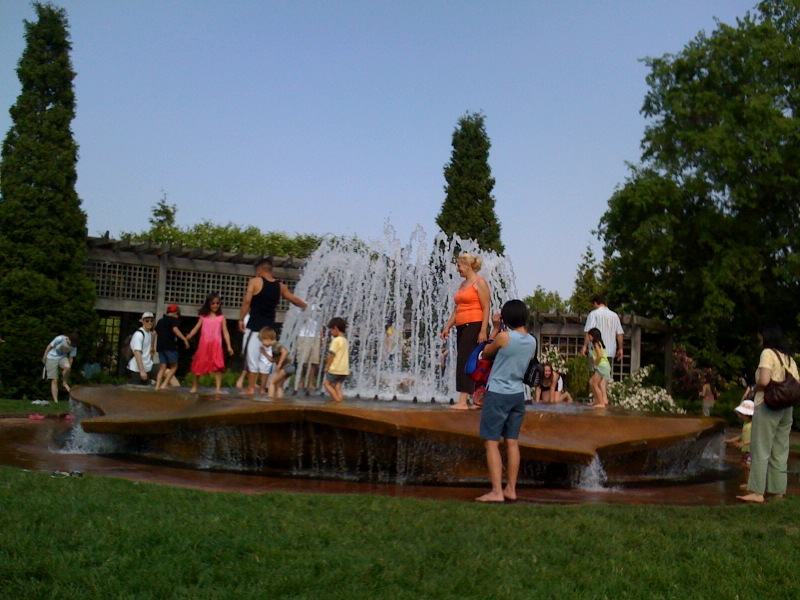
Here is a good metaphor for a problem Mother Nature has to solve. A small child is playing on the equipment at the playground. The child knows what she is physically capable of but doesn’t know what is safe. If Nature knew about swings and see-saws and monkey bars she would just encode their riskiness into the genes of the child and let the child do the optimization.
But these things came along much too recently for Nature to know about them. Fortunately Nature knows that whatever is in the child’s world was pretty likely also in the parents’ world and by now the parents have learned what is safe. So Nature can employ the parent as her agent.
But in this family-firm, the child is a specialist too. For one thing she has up-to-the-minute information about her physical abilities which change too quickly for the parents to keep track of. But just as importantly the child is the cheapest source of information about what’s in front of her. Nature could press the parent into service again to investigate the set of possible activities available to the child, but this would be costly to the parent (for whom this carrier of only half of his genes is just one of many priorities) and so would require extra incentives and anyway that information is more directly accessible to the child.
So Nature’s organizational structure utilizes a tidy division of labor. The child’s job is to identify the feasible set and the parent’s job is to veto all the alternatives that are too dangerous. One last constraint explains the reckless kid. The child cannot communicate the feasible set to the parent. This leads to the third-best solution. The child just picks something nearby, say the rope bridge, and starts climbing on it. The parent is stationed nearby ready to intervene whenever the child’s first choice is too dangerous.
And thus the seeds of much later conflict are sown.


1 comment
Comments feed for this article
June 8, 2010 at 9:47 am
Daniel
Why not the following alternative theory?
It doesn’t seem hard to understand why evolutionary pressures may induce “excessive risk-seeking” attitudes by young people. The number of offspring in hunter gatherer societies seems to be highly concentrated with most males never having kids and a few of them having kids with several women. Therefore, nature’s payoff (from a reproductive point of view) seems to be highly skewed. Then, just like an investor who owns a call option, it may be optimal for nature to induce more risk-taking behavior.
But then why would parents prefer to limit their kids’ risk-taking behavior? I can think of one evolutionary and one non-evolutionary explanation.
The evolutionary explanation has to do with externalities. The parent usually has more than one son. Excessive risk taking by the son reduces the chances that the other son will be able to mate, causing a negative externality. Since the siblings share 50% of their genes with each other but 100% with themselves, nature would induce them to take more risk than the parent would prefer (since the parent shares 50% with both). Hence, it is evolutionarily optimal for nature to design parents who limit their sons’ risk-taking behavior when they have more than one son and they may compete in the same pool.
The nonevolutionary explanation is quite basic. Several behaviors that probably made evolutionary sense among hunter gatherers lead to severe mistakes in a modern society. It may be that parents have learned that engaging in excessive risk-taking is dangerous and need to teach their kids to refrain from that in the same way that parents need to toilet train their kids.