
You are currently browsing the monthly archive for October 2009.
I heard an interview with Reggie Jackson and Bob Gibson (former baseball greats) on NPR’s Fresh Air this weekend. They spent a lot of time talking about pitching inside and “brushing back” hitters. Reggie Jackson, a hitter, conceded that these were “part of the game.”
There is a mundane sense in which this is true, namely that not even the best pitcher has flawless control and sometimes batters get hit. But Reggie was even talking about intentional beanballs. In what sense is this part of the game?
The penalty for throwing inside is that, if you hit the batter, he gets a free base. (And your teammate might get beaned at the next opportunity.) The problem is that this penalty trigger is partly controlled by the opposition. Other things equal it gives the batter an incentive to stand a bit closer to the plate. In order to discourage this, the pitcher must establish a reputation for throwing inside when a batter crowds the plate. In that sense, intentionally throwing at the hitter is unavoidable strategy, part of the game.
So, one way to short-circuit this effect is to change the condition for giving a free base to something that is exogenous, i.e. independent of any choice made by the batter. For example, the batter gets a free base any time the ball sails more than some fixed distance inside of the plate, whether or not it actually hits the batter. Modern technology could certainly detect this with minimal error.
Whatever the merits of the claims made about Fox News by Obama’s communications team, it can be good strategy to pick a fight with your critics. To the very long list of reasons, add this one. If you can make them so angry that they lose the will to say anything at all nice about you, then you have won a major victory. For then they will have lost all (remaining) credibility.
One of the tenets of rational expectations is that the expectation of a future event can move markets now.
Superfreakonomics is not even out yet. But a couple of pages from one chapter related to global warming have found their way onto the internet (perhaps a whole chapter was posted earlier?). And they’ve created a little warming for Levitt at the hands or blogs of Brad DeLong and Paul Krugman.
It’s hard to really make head or tail of it without reading it or seeing a real review. Tim Hartford has one and interestingly even he is skeptical of the global warming chapter. Well, I’ve put in my pre-order at Amazon and look forward to writing about Superfreakonomics.
In the ever-growing signs that I am getting very old, this article made me realize that the incoming undergraduate class at Northwestern grew up reading Harry Potter. Wonder if they’ve heard of the Human League and Ultravox. Oh Vienna.
Net neutrality refers to a range of principles ensuring non-discriminatory access to the internet. A particularly contentious principle urges prohibition of “managed” or “tiered” internet service wherein your internet service provider is permitted to restrict or degrade service. ISPs argue that without such permission they are unable to earn sufficient return on investment in network capacity and would be deterred from making such improvements.
One argument is based on congestion. Managed service controls congestion, raising the value to users and allowing providers to capture some of this value with access fees. This is a logical argument and one I will take up in a later post, but here I want to discuss another aspect of managed service: price discrimination.
Enabling providers to limit access, say by bandwidth caps, opens the door to “tiered” service where users can buy additional bandwidth at higher prices. This generally raises profits and so we should expect tiered service if net neutrality is abandoned. What effect does the ability to price discriminate have on an ISP’s incentive to invest in capacity?
It can easily reduce that incentive and this undermines the industry argument against net neutrality. Here is a simple example to illustrate why. Suppose there is a small subset of users who have a high willingness to pay for additional bandwidth. Under net neutrality, all users are charged the same price for access, and none have bandwidth restrictions. An ISP then has only two choices. Set a high price and sell only to the high-end users, or set a low price and sell to all users. When the high-end users are relatively few, profits are maximized with low prices and wide access. It is reasonable to think of this as describing the present situation.
Suppose tiered access is now allowed. This gives the ISP a new range of pricing schemes. The ISP can offer a low-price service plan with a bandwidth cap alongside a high-priced unrestricted plan. As we vary the cap associated with the low-end plan, we can move along a continuum from no cap at all to a 100% cap. These two extremes are equivalent to the two price systems available under net neutrality.
Often one of these in-between solutions will be more profitable than either of the two extremes. The reason is simple. The bandwidth cap makes the low-end plan less attractive to high-end users and as a result the ISP can raise the price of un-capped access to high-end users. It’s true that low-end users will pay less for capped service but often the trade-off is favorable to the ISP and total profits increase.
The upshot of this is that total bandwidth is lower, not higher, when an ISP unconstrained by net-neutrality uses the profit-maximizing tiered-service plan. Couched in the industry’s usual terms, the ISP’s incentive to increase network capacity is in fact reduced by moving away from net neutrality.
(Of course it can just as easily go the other way. For example, it may be that presently only the high-end users are being served because to lower price enough to attract the low end users, the ISP would lose too much profit from the high-end. In that case, allowing tiered service would induce the ISP to raise capacity and offer a capped service to previously excluded low-end users without significantly reducing profits from the high-end. Note however, this is not typically how industry lobbyists frame their argument.)
Sara Silverman wants to end world hunger (and get those disturbing images off her 48inch plasma TV). Her solution: sell the Vatican and use the proceeds to feed the world.
This is good, but only second best. The buyer who values the Vatican the most is in fact its current occupant. So selling the Vatican would lower its value. (It is true that the new owner knows he can sell it back to the Pope and takes this into account when deciding how much to offer. However, this adds needless transaction costs, plus the Pope will have bargaining power in the resale which would not be internalized by the buyer.)
A better idea is to give the Vatican directly to the poor and allow then to charge the Pope rent. Subject to this small ammendment, I wholly endorse the following (although the bit about the Holocaust may require the consent of more than just Ms Silverman and me.)
Nobel Laureate Eric Maskin gives an extended interview at The Browser arguing that economic theory was indeed equipped to see and understand the roots of the financial crisis. Its a unique interview because Eric picks 5 or so academic articles, discusses them in detail and weaves together a story of the crisis based on these. The story has some standard ingredients: bank runs, moral hazard, liquidity crises, and contagion. He illustrates each of these with a specific paper. The story also has some non-standard ingredients, such as leverage cycles described in a paper by Fostel and Geanakoplos.
The interview concludes thusly,
Q: So policymakers, especially people in Congress, need to read these papers.
A: Yes, or at least understand what’s in them. I think most of the pieces for understanding the current financial mess were in place well before the crisis occurred. If only they hadn’t been ignored. We’re not going to eliminate financial crises altogether, but we can certainly do a better job of preventing and containing them.
Highly recommended.
An old paper by Akerlof modeled procrastination in a simple way. Suppose that doing a task today involves costs that are more salient today than the costs that would be incurred from doing the task tomorrow. (Hyperbolic discounting is the modern way of introducing this disparity.) And suppose you are naive in that you are bad at predicting your behavior in the future. Then every day you will make an optimal plan for when to do the costly task and every day your optimal plan will be to do it tomorrow. So it will never get done.
Unless there is a deadline. The day of the deadline you will know that the task will not get done tomorrow if you don’t do it today, so that is the day when you will finally do it. Ryan Sager describes an experiment with a similar finding. In fact the same effect holds with enjoyable tasks, not just pure costs. (Jennie and I never visited many of the tourist sites of San Francisco until a month before we moved away from the Bay Area.)
Take an experiment conducted by two marketing professors, Suzanne Shu and Ayelet Gneezy, set to be published in a forthcoming issue of the Journal of Marketing Research (and written up in the May Atlantic by Virginia Postrel). Shu and Gneezy gave 64 undergraduates coupons for a slice of cake and a beverage at a local French pastry shop. Half got a certificate that expired in three weeks, half got one that expired in two months. While students were sure they were more likely to use the certificate with the more generous timeframe, the results were clear: The shorter timeframe made the students much more likely to redeem their certificates; 10 of the 32 students (31%) redeemed the three-week certificates, only two of the 32 students (6%) redeemed the two-month certificates.
You can imagine that the coupon is lost with some probability every day until it is used. Thus, the longer deadline means less chance of getting to the moment of truth. Here is a link to the original research.
Ernst Fehr, heavy favorite in much of the betting on the Nobel Memorial Prize, is giving a talk today at MIT Economics. If you click on link to paper, you see that one of the papers he is presenting has several citations of the work of Elinor Ostrom.
The Senate Finance Committee is voting today and everyone is focusing on Republican Senator, Olympia Snowe. Will she vote for the bill now or wait to make a decision till a final bill reaches for the Senate floor? The final bill will be a compromise between many bills passed in the Senate.
Snowe may care about getting plum Senate Committee assignments etc but assume she wants to influence the final bill as much as possible. For example, Snowe does not favor the public option but the “trigger” where a public health plan will kick in if insurance companies raise premiums.
If Snowe does not vote for the bill now, the Democrats will interpret her strategy as the Grassley strategy of delaying and wearing the opposition down. This will lead to a more left-wing bill in the final compromise solution as they will not care about keeping her on board. If she votes for it now, the Democrats will want to be careful not to alienate her in the final bill.
Not voting for the Senate Finance Bill, hoping to have more influence on the final product, will actually reduce her influence as Democrats will infer that Snowe acted in bad faith over the last few months. Snowe will have more influence by voting for Senate Finance Bill. Let’s see what happens….
I read the Nobel “Scientific Background” to find out what her research is about. Turns out a much better summary is the video here at EatMeDaily.
Ed Glaeser does a great job describing the work of the two Nobel Laureates. But I’m with Jeff and Levitt is never having heard of or read the work of Elinor Ostrom. Looking at the Nobel Committee’s blurb, you do get the feeling of familiarity, as if you’ve read it subconsciously. That’s partly because Ostrom works on a classical economic issue, the free-rider problem that arises when players use common property resources. The main reason though is that she uses experiments and field work to evaluate her theories.
Many researchers (e.g. Ernst Fehr) use experiments and some simple theory to study how cooperation may arise in the absence of monetary incentives. Others (eg Kremer and Duflo) do field research in development. Someone might ask “were these researchers the first to study these issues”? The Nobel Committee takes this question very seriously. And the answer, if I read the Nobel report correctly, appears to be “No,” as Ostrom pioneered this sort of thing. While that may be true, it is odd that Ostrom’s name is not on mainstream courses in econ courses. Williamson would appear on reading lists for contract theory. Many Econ Departments do not have courses in experimental economics and I wonder if Ostrom would appear on them anyway? This would make her different from John Nash – he is a mathematician not an economist but his solution concept is used every day by many, many researchers in the economics (not mathematics) and his existence proof for equilibrium provides a key approach economists still use (and again it would be old hat for mathematicians).
No-one finds it strange that Williamson won the Prize. Names that would normally be paired with Williamson are: Alchian, Demsetz, Grossman, Hart, Holmstrom, Kreps, Milgrom, Tirole etc, etc. All of these individuals have made significant contributions to the “theory of the firm” and more broadly to contract theory, decision theory, game theory and industrial organization. Perhaps they are being saved for future Prizes. For example, the Nobel blurb is careful not to give too much credit to Williamson for the “hold up” problem. But why wait for the future, why not now? It seems more natural than Ostrom to me. I’m puzzled.
Not game theory, but research about and even within games. Hit or miss:
One of the most high-profile projects (and most obvious recent failures) was Indiana University’s Arden: The World Of William Shakespeare, which reportedly had a grant of $250,000. It was an experimental MMO which came about via the work of Professor Ed Castronova, author of Synthetic Worlds. Castronova wondered whether the creation of a genuinely educational MMO was possible, and set up the student development project to find out. Having spent thousands of dollars on Arden it was shut down. Castronova cited “a lack of fun”.
via BoingBoing.
This prize is long overdue. The theory of the firm is one of the big ideas in economics and as far as I can tell the Nobel committee was right to trace it back to Williamson.
A firm is a container for a bunch of highly idiosyncratic, repeated, informal transactions. A great thought experiment is to wonder why these transactions are not conducted through a market, making the firm dissolve away. Instead of giant firms building and selling cars, why aren’t there a bunch of tiny firms each doing a tiny part with all of their interaction governed by the market or by contract? There are three main reasons why.
First, its costly to use the market. If the chassis firm is going to be buying axles from the axle firm all the time, it would save transaction costs by just integrating. Then it can “procure” axles with a memo.
Second, the contracts would be impossibly complicated and unwieldy. Imagine writing a complete blueprint for the car, breaking it down into individual instructions for every actor who is supposed to contribute, laying out the timing when each party is supposed to arrive and do his part, describing payments as a function of the performance of each interdependent action, etc. That is probably already impossible, but imagine you could do that. Now suppose that a supply shock requires you to use different materials for the chassis. This would require a coordinated change in many parts of the car, to keep structural integrity, balance, etc. The entire volume of contracts would have to be re-written.
The third reason is the one that adds richness to the theory of the firm. Most of the transactions that occur within firms require parties to make investments that only make sense within the context of that specific firm. The party making the investment has little or no option to recover the value of the investment outside the firm. When the chassis firm contracts with the firm building auto bodies, it writes down minute specifications that must be met. The bodies produced could not be sold to any other chassis maker. The firm building auto bodies must invest in the machinery that can make these specific bodies. Once sunk that investment has no value outside of the specific relationship with the chassis firm.
The reason this adds richness to the theory is that it explains which transactions must be encompassed within firms. Transactions that require relation-specific investments would be crippled if conducted across firm boundaries. Once the die is cast for building these specific auto bodies, the chassis firm has no reason to pay a price that compensates for the sunk cost because there is no outside option. This hold-up problem implies that the auto body firm has poor incentives to make the investment in the first place, unless it integrates with the chassis firm and becomes a claimaint to the profits of the integrated firm.
I never heard of her.
A city in Taiwan is trying to keep the streets clean by offering cash for collected dog poo.
City officials in Taichung, which has a population of one million, said on Wednesday the environmental protection bureau would give vouchers worth 100 Taiwan dollars ($3) for every kilo of dog poo collected. In areas of the city especially affected, the reward will be for every half-kilo.
In related news, Taichung is witnessing a sudden surge in demand for high-fiber dog food which is now being sold in convenient single-serving sizes priced at 99 Taiwan dollars.
Might as well throw my hat in the ring and reveal my predictions:
Lucid Angus De Rough Angus Deaton
Baron P Partha Hoody Partha Dasgupta
PM Big Cash Paul Milgrom
Jam Jean J Professor Wack Jean Tirole
Smug OO Murda Oliver Hart
Kid BH Wrath Bengt Holmstrom
Here, via Michael Nielsen. For example:
- Twitter’s user growth is no longer accelerating. The rate of new user acquisition has plateaued at around 8 million per month.
- Over 14% of users don’t have a single follower, and over 75% of users have 10 or fewer followers.
- 38% of users have never sent a single tweet, and over 75% of users have sent fewer than 10 tweets.
- 1 in 4 registered users tweets in any given month.
- Once a user has tweeted once, there is a 65% chance that they will tweet again. After that second tweet, however, the chance of a third tweet goes up to 81%.
- If someone is still tweeting in their second week as a user, it is extremely likely that they will remain on Twitter as a long-term user.
- Users who joined in more recent months are less likely to stop using the service and more likely to tweet more often than users from the past.
Here is a pie-chart:
 Have I mentioned that you should be following me on twitter? (I am talking to you Sandeep.)
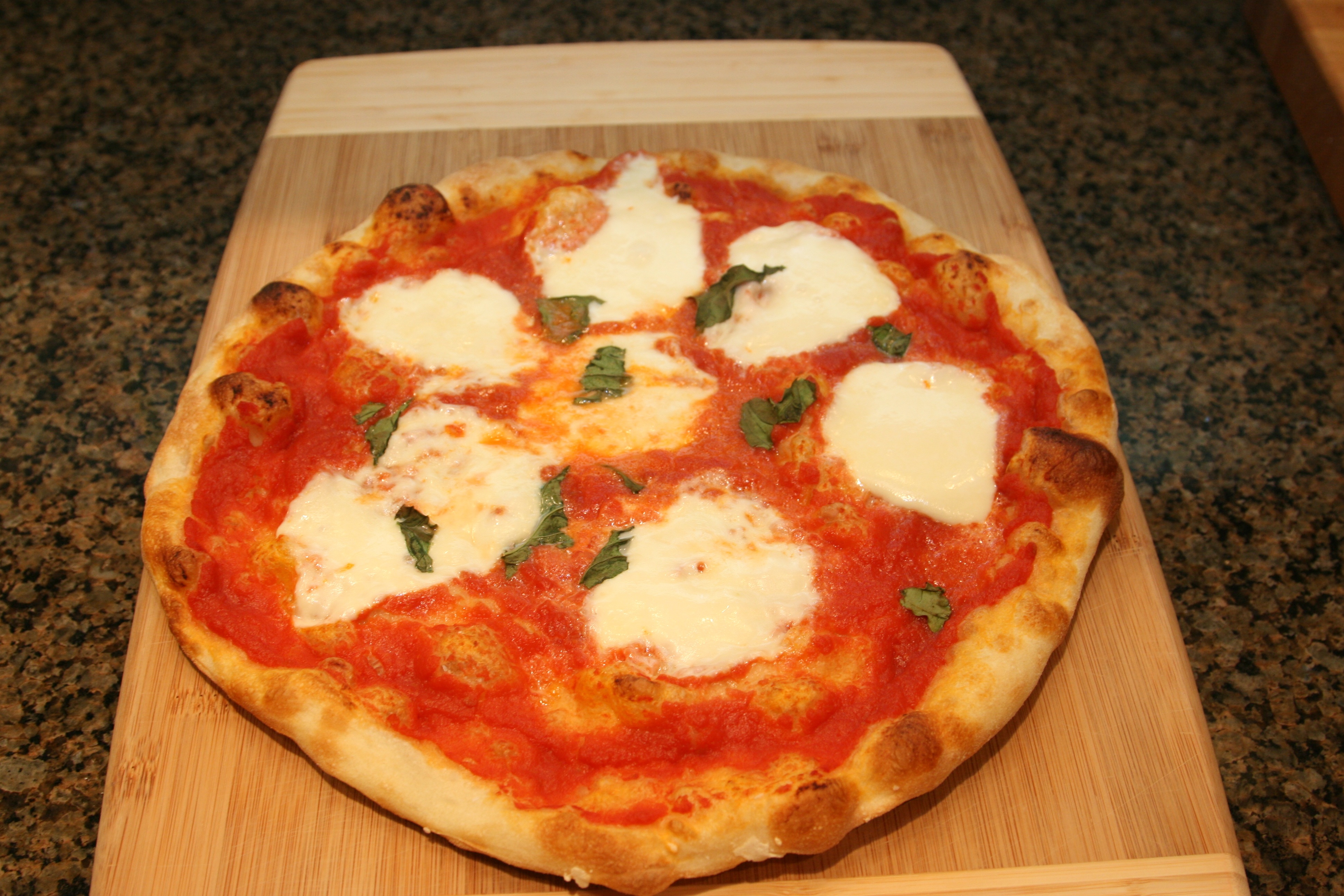
You can make pizza at home if you have an oven that will break 500F. And if you can, you should. Its easy to make good pizza and its fun. You need a pizza stone, peel, and a good stand mixer to do the kneading. Some things I have learned over time.
- Start with margherita (tomato sauce, mozzarella, basil). Once you make a good margherita you will realize there is not much point in making anything else.
- Use mozzarella di bufalo. It truly makes a big difference (naturally though there is variation in quality.)
- To make the sauce, use canned, peeled, san marzano tomatoes, remove the seeds and puree. Simmer in a skillet until there is no visible water pooling in the sauce and it sticks to a spoon. This takes longer than you would expect so be patient. (You do this while the dough is rising.) Add only salt. No garlic, no onion, etc.
- No-knead dough recipes are popular recently and they work for many things but not pizza dough. Yes it is convenient, but there is a simple reason it doesn’t work. To form gluten without kneading you add a lot more water than you normally would. Pizza cooks very fast. That short time is not enough to get enough moisture out of the dough to get the bite that you want on the edges. Water holds the temperature of the dough down because water cannot be raised above boiling temperature (think about it.)
I want to keep mine semi-secret so I can claim I was right whatever happens. So, I typed in my predictions into the website My Rap Name.com which then garbled them. So, here are my predictions:
Lucid Angus De Rough
Baron P Partha Hoody
PM Big Cash
Jam Jean J Professor Wack
Smug OO Murda
Kid BH Wrath
Maybe I’ll give he real names Monday if I can reconstruct them!
Shiller tops the poll. Igal Hendel garnered 5 votes.
- According to my mother, this doesn’t make it any less gross.
- Reason #17 I stick to the groomed parts. (via meanderings.)
- Babies, insurance, and dragons.
This terrifying story about E Coli is enough to make even the most ardent baconatarian consider veganism. Cargill produced hamburgers made by mixing up ground beef from different suppliers from all over the world. You could test for E Coli when the slaughterhouse’s meat arrives but:
Unwritten agreements between some companies appear to stand in the way of ingredient testing. Many big slaughterhouses will sell only to grinders who agree not to test their shipments for E. coli, according to officials at two large grinding companies. Slaughterhouses fear that one grinder’s discovery of E. coli will set off a recall of ingredients they sold to others.
If you violate this unwritten agreement then:
The food safety officer at American Foodservice, which grinds 365 million pounds of hamburger a year, said it stopped testing trimmings a decade ago because of resistance from slaughterhouses. “They would not sell to us,” said Timothy P. Biela, the officer. “If I test and it’s positive, I put them in a regulatory situation. One, I have to tell the government, and two, the government will trace it back to them. So we don’t do that.”
The downside is obvious:
The potential pitfall of this practice surfaced just weeks before Ms. Smith’s patty was made. A company spot check in May 2007 found E. coli in finished hamburger, which Cargill disclosed to investigators in the wake of the October outbreak. But Cargill told them it could not determine which supplier had shipped the tainted meat since the ingredients had already been mixed together.“Our finished ground products typically contain raw materials from numerous suppliers,” Dr. Angela Siemens, the technical services vice president for Cargill’s meat division, wrote to the U.S.D.A. “Consequently, it is not possible to implicate a specific supplier without first observing a pattern of potential contamination.”
Why not avoid this altogether, use a whole piece of meat and grind it yourself? Because:
In all, the ingredients for Ms. Smith’s burger cost Cargill about $1 a pound, company records show, or about 30 cents less than industry experts say it would cost for ground beef made from whole cuts of meat.
On the other hand, Costco does test the input:
The retail giant Costco is one of the few big producers that tests trimmings for E. coli before grinding, a practice it adopted after a New York woman was sickened in 1998 by its hamburger meat, prompting a recall.
Craig Wilson, Costco’s food safety director, said the company decided it could not rely on its suppliers alone. “It’s incumbent upon us,” he said. “If you say, ‘Craig, this is what we’ve done,’ I should be able to go, ‘Cool, I believe you.’ But I’m going to check.”
Costco said it had found E. coli in foreign and domestic beef trimmings and pressured suppliers to fix the problem. But even Costco, with its huge buying power, said it had met resistance from some big slaughterhouses. “Tyson will not supply us,” Mr. Wilson said. “They don’t want us to test.”
So, why the difference between Costco and Cargill? One company has a brand that is easily recognizable to consumers and the other doesn’t. The branded product/firm faces a bigger reputational risk in terms of lost sales if it doesn’t do a careful job. Hence, it has better incentives to monitor its product and ensure it is of high quality. The court of public opinion has lower standards for conviction than the court of legal opinion. Indeed, the deliberate lack of testing of inputs allows all parties to try to shift blame to another player to create reasonable doubt.
You would hope that the public opinion that can punish the retail end of the supply chain would filter back to through the whole supply chain. But that does not seem to happen. Consumer flight while it can be fatal to a retailer with a bad reputation is not well coordinated enough to exert pressure to the supplier. Back to my Cheerios.
Since I am willing to pay $X that means my opportunity cost of not buying is -$X, thus my willingness to pay is indeed $X. That appears to be what Google CEO Eric Schmidt is saying in the following deposition transcript talking about Google paying X=$1.65 billion for YouTube, a $1billion premium over what he estimated YouTube to be worth. From an article at cnet.
Baskin: So you orally communicated to your board during the course of the board meeting that you thought a more correct valuation for YouTube was $600 million to $700 million; is that what you said, sir?
Mancini objects to characterization of the testimony.
Schmidt: Again, to help you along, I believe that they were worth $600 million to $700 million.
Baskin: And am I correct that you were asking your board to approve an acquisition price of $1.65 billion; correct?
Schmidt: I did.
Mancini objects.
Baskin: I’m not very good at math, but I think that would be $1 billion or so more than you thought the company was, in fact, worth.
Mancini objects.
Schmidt: That is correct.
Later…
Baskin: Can you tell us what reasoning you explained?
Schmidt: Sure, this is a company with very little revenue, growing quickly with user adoption, growing much faster than Google Video, which was the product that Google had. And they had indicated to us that they would be sold, and we believed that there would be a competing offer–because of who Google was–paying much more than they were worth. In the deal dynamics, the price, remember, is not set by my judgment or by financial model or discounted cash flow. It’s set by what people are willing to pay. And we ultimately concluded that $1.65 billion included a premium for moving quickly and making sure that we could participate in the user success in YouTube.
We decided to check out another ‘hood of Boston. Haven’t been to the South End for over a decade. Area has this weird feel of gentrification meets recession, i.e. cool, expensive furniture stores that were largely empty. For dinner, we went to Ginger Park which was equally empty. It has a dramatic wavy, bent wood ceiling. Food was quite good. Some Indian snack food (lentil fritters), good Asian noodles and dumplings and more sophisticated dishes like tea-smoked duck. I get annoyed by people who talk about restaurant service as much as food but I’m getting old and crotchety so here goes: Our server was incompetent and yet confident and smug, qualities that often go together. But I would still go back. It didn’t have a good wine list. After we left, we took a stroll on Tremont and stopped in at Aquitaine for a glass of wine. That was fun. Atmosphere was great and the barman recommended a great wine, Château Peyremorin 05 Haut-Medoc (earthy, barnyard, and balanced). Will definitely go back and try the food.
It is one of the most basic premises of economics and decision theory. If you give a decision-maker better information about the consequences, he will make better choices.
This principle underlies one of the least controversial forms of paternalism: subsidizing information to improve welfare. It is uncontroversial because unlike policies which restrict or direct behavior, it doesn’t take a stand on what is good for the decision-maker. More information helps her achieve her desired outcomes, whatever they may be.
In New York City, fast food chains were required to conspicuously publish calorie counts for all of their offerings. This will enable customers to make better decisions, presumably in terms of health consequences. According to the theory, any change in behavior in response to the new information is evidence that the policy was a success. It reveals that people made use of the information.
…when the researchers checked receipts afterward, they found that people had, in fact, ordered slightly more calories than the typical customer had before the labeling law went into effect, in July 2008.
Here is the conclusion drawn by an author of the study:
“I think it does show us that labels are not enough,” Brian Elbel, an assistant professor at the New York University School of Medicine and the lead author of the study, said in an interview.
My mother tells me that where she lives there are cameras that will catch you if you don’t come to a complete stop at the octagonal sign. Your license plates will be photographed and you will be sent a bill in the mail. The fine is close to $500. That’s a lot more than I remember it.
Quiz: suppose the technology improves for detecting whether a violation has taken place. Should the fine increase, decrease or stay constant?
From Not Exactly Rocket Science:
In the Old English of Beowulf, seven different rules competed for governance of English verbs, and only about 75% followed the “-ed” rule. As the centuries ticked by, the irregular verbs became fewer and far between. With new additions to the lexicon taking on the standard regular form (‘googled’ and ’emailed’), the irregulars face massive pressure to regularise and conform.
Today, less than 3% of verbs are irregular but they wield a disproportionate power. The ten most commonly used English verbs – be, have, do, go say, can, will, see, take and get – are all irregular. Lieberman found that this is because irregular verbs are weeded out much more slowly if they are commonly used.
To get by, speakers have to use common verbs correctly. More obscure irregular verbs, however, are less readily learned and more easily forgotten, and their misuse is less frequently corrected. That creates a situation where ‘mutant’ versions that obey the regular “-ed” rule can creep in and start taking over.
There is a story in the Wall Street Journal about user ratings on web sites such as Amazon or eBay. It seems that raters are unduly generous with their stars.
One of the Web’s little secrets is that when consumers write online reviews, they tend to leave positive ratings: The average grade for things online is about 4.3 stars out of five.
And some users are fighting back:
That’s why Amazon reviewer Marc Schenker in Vancouver has become a Web-ratings vigilante. For the past several years, he has left nothing but one-star reviews for products. He has called men’s magazine Maxim a “bacchanalia of hedonism,” and described “The Diary of Anne Frank” as “very, very, very disappointing.”
I have noticed that Amazon reviewers are highly polarized with 5 stars being the most common with 1 star reiews coming in second. And in fact it makes a lot of sense. Say you think that a product is over-rated at 4.3 stars and you think that 4 stars is more appropriate. If there are more than just a few ratings, then to bring the average down to 4 you would have to give the lowest possible rating.
Once enough ratings have already been counted, subsequent raters will be effectively engaging in a tug of war. Those that want to raise the average will give 5 stars and those that want to reduce it will give 1.
Economists have often wondered why people tip. We have lots of sophisticated explanations for why rational (i.e. selfish) people pretend to be altruistic. A leading explanation, the reputation model, relies on some repeated game concern but how would that apply in a one shot waiter game? The puzzle is, of course, easily resolved if one allows homo economicus to have a heart. Warm, mushy feelings for waiters can easily explain tipping, even if you both know your relationship is the restaurant equivalent of the one night stand.
As our well-educated and well-read readers know, the heart is a complicated thing and often responds to incentives in odd ways. Larry David is the dark Jane Austen of our cynical time and his (second!) magnum opus, Curb Your Enthusiasm, is the warped Sense and Sensibility. I enjoyed the Seinfeld non-Reunion episode. There were so many treasures in one half hour but the business lunch between Larry and Jason Alexander was my favorite bit. Larry and Alexander go dutch and Larry suggests they coordinate the tip. He wishes to avoid the embarrassment of under-tipping. It is just obvious to Larry that other people’s opinion matters so he must tip. Note it is not morality but image and hence self-image that guide Larry. He certainly does not want to tip low when his Dutch partner tips high. But if your partner tips low, there is still an incentive to tip high, because it is quite natural that you want your image to be better than your partner’s. In other words, there is a dominant strategy to tip high…a Prisoner’s Dilemma of tipping. Once we open up the heart of homo economicus, not only is there an incentive to tip, but to overtip. No wonder Larry wants to collude and coordinate tips.
How does it all work out? I don’t want to give any more away than I already have. I’ll let you watch the episode and enjoy it for yourself.
 Cheap Talk