house

Alchemy coffee in Wilmette is in a strange location for a coffee shop.  Its in a standalone little shack in an area which does not attract a lot of foot traffic and is not along many natural commuting routes.  Its the kind of place you would drive by and never know there’s a coffee shop there except that you never even drive by there.

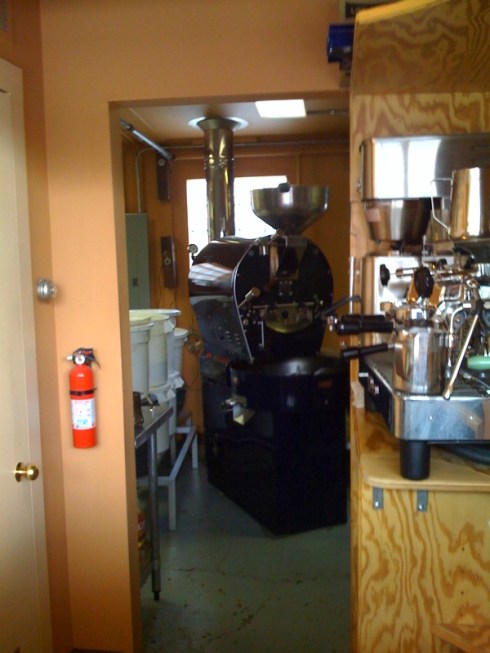
The place is owned and run by exactly one guy and he sells exactly two things, the main thing being coffee.  His tiny shop has only one table and a small bar.  There isnt much room for any more than that because most of the space is taken up by this gleaming machine which sits right in the middle of the shop.

front

Its a coffee roaster.  All of his coffee is roasted right there in that machine and you can usually buy coffee that has been roasted less than 24 hours ago.  If you love coffee, you know that coffee loses aroma and flavor very quickly after roasting and so this kind of freshness is a big deal.    He puts a few pounds in bags on the counter but if you tell him what you want it for (espresso, drip coffee, french press) and a little about your tastes, he will disappear behind the machine for moment and come back with a blend put together on the spot.

Business is not brisk.  I’ve been in there about three times and I have seen him sell a few lattes, but not much more than that.  But each time I have gone there for beans I told him in abstract terms what I wanted and he came pretty close to assembling the perfect blend.  The other thing he sells:  scones.  And he is about as obsessed with his scones as he is with his coffee.

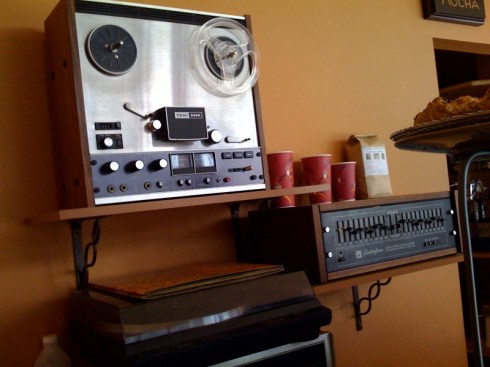
The guy is old school: cash only and here’s the sound system.

reel

Keepin it reel in Wilmette.

Back home:

img_6281_2

The vintage is supposed to be good but not great.  It comes on the heels of the super-strong 2005 and the dramatic run-up of prices that was sustained through the solid 2006 and 2007 vintages.  Now it appears that the market for 2008 futures will not clear at these prices and the adjustment is not happening.  But there are no “menu costs” here.  One possible explanation is given here.

David Sokolin, a fine wine dealer in Bridgehampton, New York, notes another potential pitfall. “If the producers cut prices sufficiently for the 2008 en primeur to move their product, they could undermine the prices of the 2007 vintage,” he said. That would hurt merchants and investors holding the back vintage, because their stocks of those wines would lose value. All of the first-growth, or highest ranked, producers — Château Lafite Rothschild, Château Margaux, Château Latour, Château Haut-Brion and Château Mouton-Rothschild — declined interview requests, citing the press of business before the start of the tastings.

Sounds like 2008 Premier Cru is a toxic asset.

The fundamental tension between technical skills and creativity in economic theory?

Actually, no.   This is my half-remembered quote from a judge in the new “reality show” on the Food Network.  Four chefs have to cook an appetizer, a main course and a dessert using ingredients that are presented to them.   For example, these might be anchovies, jam and a lemon.  They open up the hamper with the ingredients and then have half an hour to cook something with them and anything else they find in the pantry. In each round, one contestant is “chopped” by the three judges.

On last night’s show, there was a chef from a Gordon Ramsey restaurant at the London hotel in NYC.  His food looked great, displayed great  knife skills but was safe and unadventurous.  Hence, the quote above from the judge.  The other guy who was left standing by the end was tattooed from head to toe.  He dropped meat on the floor in one round and then cooked it without washing it. And then he made a chestnut cream saboyon quesadilla for dessert.  It was too mushy looking and there was too much quesadilla.  The other guy made something generic that I can’t remember right now.

Of course, the technical guy won.  But no-one slept with him, I guess, and the tattooed guy probably got laid.  Who really won?

Not what you think.

I found this place because it won an award on a Chicago food chat site.  And the first time I went there I met a colleague from the Econ Dept who  must have seen the same blog.  Small world.

Anyway, when you go to most Indian restaurants, the stuff they serve – the radioactively orange chicken tikka etc – is North Indian.  And for some reason it’s usually cooked by Nepalese chefs. ( There’s got to a story there about some Maoist chef exodus but I don’t know it.)  It can be good but you miss the other regional cuisine your mother makes…at least, my mother.

Uru-Swati serves South Indian food (as well as some other generic things).  So you get good dosas and idlis, things Indians normally have for breakfast but could easily be a nice light lunch. (Well, maybe it’s not light because the dosa will be cooked in ghee!  Idlis, a kind of steamed dumpling,  are good for you.)

But better than all of this – they serve Indian street snacks.  Bhel Puri, Sev Puri, Chole Bhatura…  If you’re tempted by these on an Indian street, you’ll soon regret it as your system gets cleaned out if you know what I mean!  You can eat them safely at this restaurant and imagine Goa outside the window rather than the  ten degree Chicago weather.  The parathas are also excellent.  Try the muli paratha which come stuffed with a kind of shredded radish, served with dal and pickle.

UPDATE:  Check out this NYT story about just this kind of food


A debate is going on between Lawrence Lessig and Congressman John Conyers about a bill that Conyers is sponsoring. The bill would repeal an existing rule for NIH funding that requires funded research to be published in Open Acess journals.  In addition it would generally prevent federal agencies from imposing these restrictions in the future. A good place to start is here and here are Lessig and Conyers. (hat tip: sandeep.)

There is some debate about the legal issues but to me those issues appear to be a red herring clouding the main dispute.  There is probably one point of agreement: for-profit journals will be hurt.  The disagreement is whether or not this is a good thing.

Requiring open-access publication obviously fulfills the aim of getting the maximum social benefit from dissemination of publicly-funded research.  The marginal cost of distribution is zero, so the efficient price is zero.  But the bill’s proponents argue that a dissemination is only one of the services provided by journals.  Far more important is the evaluation and editing of submitted articles by the peer-review process.  They worry that a zero price means that open-access journals have insufficient incentive to invest in this process.  The result is that it becomes harder for outsiders to distinguish good, credible research from bad, sloppy research.

I have two points to add to this.  First, as an editor of an Open Access journal and a member of editorial boards for many commercial journals I can testify that the publisher’s revenues are not being used effectively (or in most cases, at all) in providing incentives for editors and reviewers to do a good job.  To the extent that the peer-review system works, it works because reviewers have external incentives like reputation, prestige, and plain old scientific integrity.  And these incentives work at least as well in the Open Access world.  (In fact, they seem to work even better since reviewers feel better about their work when it is serving the public interest and not the profits of publishers.)

Second, even if you disagree with the above it remains an empirical question which market structure would best provide material incentives for peer-review.  Open Access publishing prevents the use of distortionary prices for raising the funds to pay reviewers.  The alternative is a model in which authors pay for peer-review with submission fees.  Of course this is also distortionary because the social benefit of having a manuscript carefully evaluated may outweigh the author’s willingness to pay.

But let’s remember:  we are debating a policy about public funding of research.  Basic research is publicly funded precisely because the social benefit of the research outweighs the researcher’s private incentive.  Given this, the funding agency maximizes the value of its subsidy by funding not only the research itself but its dissemination.  This is achieved by requiring Open Access publishing and earmarking some of the funds to pay for peer-review.

(Not an April Fool’s gag.)

Sandeep and I will make a brief appearance in Mark Bazer’s comedy show The Interview Show at the Hideout in Chicago on Friday April 3 at 6:30. I just glanced at the sketch and it appears that because this is a comedy show I will be wearing a tie, whereas in my day job as an economist I usually opt for shorts, T-shirt, and flipflops.  I may have to borrow one from Sandeep who teaches in the Business School.

Luigi Zingales was kind enough to reply to my jokey post about him below.  He directed me to an op-ed of his, with Oliver Hart.  They present an extremely cleaver idea of how to use Credit Default Swaps to prevent large financial institutions (LFIs) from taking on too much risk and not having enough money on hand to pay their debts.

The idea is something like the following.  Suppose a Credit Default Swap CDS pays off if Citibank, say, fails.  Different traders of the Citibank CDS has different information about the chance that Citibank may fail.  The price of the Citibank CDS aggregates that information.  The price will be high if the chance of failure are high.  Hence, a regulator can monitor the Citibank CDS price and step in to force the LFI to cover it loans or be taken over. For details, see their op-ed.

I guess the only issue is that CDSs got a bad name because they were chopped up, traded and re-traded till the final object was so complex and mixed-up that no-one could evaluate its risk.  I suppose this is avoided in the Hart-Zingales plan as a CDS would have a verifiable name to correspond to the institution that it insures.

Continuing to make bold moves in the first 100 days of his administration, Obama will announce this week two blockbuster appointments to senior positions at the Department of Treasury.

Freakonomist

Sure to raise eyebrows will be the appointment of University of Chicago economist Steve Levitt to Tim Geithner’s team. Rarely venturing into the realm of policy,  the author of Freakonomics is better known –and often derided– for research focusing more on cute trivialities like cheating by Sumo wrestlers.

Ironically, his foray into Sumo-economics appears to be exactly why he is getting the call.  As readers of Freakonomics know, Levitt made headlines when he used the same statistical analysis to expose widespread cheating by teachers in the Chicago Public Schools.  How does this help the Department of Treasury you ask?  Stress Tests.  The big headline of Geithner’s first announcement as Treasury Secretary was the promise  to screen out banks doomed to fail.  Strangely, Treasury has since been mum on the results from the stress tests. Now we know the reason:  it turns out all the banks are getting passing marks and the suspicious Treasury Secretary is calling on Levitt to bring his Sumo-scrutiny to bear on the banks.

Colleagues at the University of Chicago economics department are cheering the move.  “I could not think of a better choice than Steve Levitt to move to Washington and help the Obama team” says Nobel Laureate James Heckman, adding that he expects the job to occupy Levitt for two full Obama administration terms. “We will miss him, but he has an important job to do.”

When we finally reached Levitt, he was at McDonalds headquarters at Oak Brook, IL.  Some of their franchises have been cheating by hiding Big Mac revenues that they have to share with McDonalds.  Levitt has found a way to benchmark performance that can reveal suspiciously underperforming locations.  “This is what economists call ‘moral hazard,’ ” Levitt said over a carton of Chicken McNuggets. “Look, economics is not rocket science.  Think of the US Government as like McDonalds, a bank and a toxic asset are just like a franchisee and a Big Mac.  Once you see it that way, its simple.”

Former Bushie

Joe Lieberman supported John McCain during the election, made a speech at the Republican Convention and said Obama was not ready for the Presidency.  And yet Obama later forgave him because he knew Lieberman’s vote was going to be crucial in the Senate.

Now, Obama has shown the same pragmatic streak in inviting Greg Mankiw to join his administration.  Mankiw was the head of Bush II’s Council of Economic Advisors.  He has so far played a role on the sidelines, an informal referee of the contest between Obama and his right-wing critics.  Mankiw is often skeptical of Obama’s plans but at the same time he does not fully endorse their antithesis.  This ambiguity has suited Mankiw well, as he has been courted by both sides of the political spectrum.  Finally, he has chosen his prom date and decided to join the Obama administration.  He will serve alongside his old Harvard colleague Larry Summers as Co-Director of the National Economic Council.

Why did Obama choose Mankiw for this post?

Mankiw said, “Well, in all modesty, I must point out that I proposed something like the Geithner plan – of course, I call it the Mankiw plan (!) – last October.  There are some differences in the details but the principles are the same.  I’m looking forward to improving the plan and being involved in its implementation.  Whenever you are asked to serve your country, I think you should do it, even if there are  ideological differences with some of the people involved.”

The additional intellectual heft of having Mankiw on board will certainly help in the coming months.  Mankiw is also quite familiar with the rump of the Republican party that is still left standing in Congress.  He is one of the rare individuals who has a good relationship with both John Boehner and Mitch McConnell.  McConnell and Mankiw were bridge partners and they have the camaraderie and preternatural ability to wordlessly communicate that comes from expertize at that genteel but vicious game.  But Mankiw can also be a populist and is a great expositor of complex ideas, a fact that Obama hopes will help in persuading at least some House Republicans to occasionally vote for some of his economic plans.

There is another factor at play.  True to predictions, Larry Summers has proved hard to control within the West Wing.  Orzag and Geithner have not been able to do it.   In any case, they are fantastically busy trying to implement Obama’s healthcare policies and manage the financial crisis.  Furman and Goolsbee , who were both students in Cambridge, are in awe of their former teacher and find it hard to contradict him.  Summers and Mankiw respect each other, or at least Mankiw respects Summers!  Obama has watched Biden and Clinton argue over Afghanistan policy.  As a lawyer, Obama has always favored the “team of rivals” approach and wants to replicate it in economic policy.

Only one thing stands in the way.  Mankiw has amassed a huge fortune by selling economics textbooks all over the world.  He is incorporated in Switzerland as a Verein for tax purposes. A verein is an association of independent businesses and each international textook is an independent “firm” within the Mankiw Verein.  This has several tax advantages and seems to be all quite legal. But with the current furor over AIG bonuses the administration wants to tread carefully.

Jeff and Sandeep

Bought it on sale.  Totally regret it.  It tastes unstructured, flavors are not integrated and there’s huge coconut aftertaste – OAK!

I casually switched on the T.V. to watch the news.  I wasn in time for a fight: Luigi was beating up on some unlucky lady from an investment firm on Chicago Tonight.  Luigi of course likes the idea that G.M. be taken over by Fiat.   We’re not typing on Olivetti computers.  We have Neopolitan pizza here in Chicago and everyone makes pasta at home.  But we will all be driving Cinquacentos.

But seriously, it was nice to see a Finance Professor say that Wall Street is too close to the administration and Goldman Sachs’ interests are not America’s interests.

Forget the money and the academic respect.  The Nobel Prize in Economics brings you this musical tribute if you are Paul Krugman.  Who’s doing the songs for Eric Maskin and Roger Myerson?  Maybe Jeff and I will try to find good rhymes for Maskin monotonicity and the Revelation Principle. Perhaps the Nobel Committee can do the “general interest” and press announcements in a rap or reggae format?  Just throwing some ideas out there.

(Hat Tip: Tomas Sjöström for the YouTube link.)

Because we hate them both, it is instinctual to hate the idea of a merger.  And indeed it is being looked at by the Justice Department.  There is a clear economic benefit of this merger:  eliminating double-marginalization. A monopoly causes an inefficiency because it sets price over marginal cost, resulting in too little output.  Live Nation is a monopoly but it sells its product through an intermediary, Ticketmaster, which is itself a monopoly.  That means that the “price” charged to Ticketmaster becomes Ticketmaster’s marginal cost, and Ticketmaster will fix an additional Monopoly markup over that.  This second source of inefficiency would be eliminated if Ticketmaster and Live Nation were to merge.

(This is somewhat over-simplified because they most likely use a more complicated contract than a price, but unless they use a very clever kind of contract, there will still be elements of double-marginalization.  And this very clever contract effectively creates a merger anyway.)

So when you read this post from Trent Reznor you should downplay his worries that the merger will result in an increase in ticket prices.  The auctions he imagines are already happening.  Nevertheless his other points are very interesting and worth a read.

And I would not worry that this vertical merger will shut out competition for ticket distribution.  First of all, Ticketmaster was doing fine at that already, and second, the only reason we cared about the Ticketmaster monopoly was the double marginalization.

The only argument I can see against the merger is that it throws up an barrier to competition with Live Nation for concert promotion.   You could certainly draw some graphs and show that this is a concern theoretically, but I don’t believe that the merger would be held up for this.

I went to see  a jazz  concert in Evanston a few weeks ago.  The band leader, a sax player, is a high-school friend of a colleague of mine at Kellogg.  The band did a Coltrane tribute.  All jazz players are in awe of Coltrane it seems, and none can escape his gravitational pull.  They also did a few songs of their own that were quite good.  There was little that was really original.  But I still left feeling moved because the sax player played with deep emotion with no hint of self-consciousness or cynicism.  On an extremely cold and snowy night, it left me with a feeling of melancholia that felt just right.

The Bad Plus makes “postmodern” jazz, the reverse of music played by the band in Evanston.  It can be original, very clever, self-knowing and ironic.  It is emotionally detached.  For it to work, all these sarcastic elements have to come together, otherwise you feel bored or disgusted by your own cynicism for listening to the stuff.

This CD is not successful.  Jeff is right – the recording is muddy and the singing swamps everything else.  It belongs in the same category as the Barolo I described below.

One song, a cover of Pink Floyd’s Comfortably Numb, sticks out for me, for a personal reason. I saw it performed by Dar Williams at the Steppenwolf.  I got dragged to the show but in the end I really enjoyed it.  I do like Dar’s songs but I also enjoyed the audience which seemed to be made up largely of lesbian couples.  Apparently, Dar maintained a sexual ambiguity for a few years.  This allowed her to satisfy listeners of all sexual orientations.  (It’s related in some way to paper I have on Saddam’s use of ambiguity about his weapons’ status to prevent escalation of war and also deter enemies at the same time.  The same principle is there but I can’t see the formal connection.)

I know Jeff would like to hang out with more lesbians but  as economists, we never really have the opportunity.  So the Bad Plus took me back to that night and I was happy, till the next song began.

A recent Slate article “The messy room dilemma: when to ignore behavior, when to change it”  by tackles the important topic of when you should ignore your child’s undesirable behavior and when you should intervene.  The authors use a series of intriguing percentages to suggest that many childhood behaviors will change on their own if you just wait long enough.  Here’s an excerpt:

Many unwanted behaviors, including some that disturb parents, tend to drop out on their own, especially if you don’t overreact to them and reinforce them with a great deal of excited attention. Take thumb sucking, which is quite common up to age 5. At that point it drops off sharply and continues to decline. Unless the dentist tells you that you need to do something about it right now, you can probably let thumb sucking go. The same principle applies for most stuttering. Approximately 5 percent of all children stutter, usually at some point between ages 2 and 5. Parents get understandably nervous when their children stutter, but the vast majority of these children (approximately 80 percent) stop stuttering on their own by age 6. If stuttering persists past that point or lasts for a period extending more than six months, then it’s time to do something about it.

There are a lot more behaviors, running the range from annoying to unacceptable, in this category. Approximately 60 percent of 4- and 5-year-old boys can’t sit still as long as adults want them to, and approximately 50 percent of 4- and 5-year-old boys and girls whine to the extent that their parents consider it a significant problem. Both fidgeting and whining tend to decrease on their own with age, especially if you don’t reinforce these annoying behaviors by showing your child that they’re a surefire way to get your (exasperated) attention. Thirty to 40 percent of 10- and 11-year-old boys and girls lie in a way that their parents identify as a significant problem, but this age seems to be the peak, and the rate of problem lying tends to plummet thereafter and cease to be an issue. By adolescence, more than 50 percent of males and 20 percent to 35 percent of females have engaged in one delinquent behavior—typically theft or vandalism. For most children, it does not turn into a continuing problem.

The logic would seem to be don’t worry about the thumb sucking, the stuttering, the lying and so on. It will probably go away on its own and look there are many statistics to back this up … but this is a total fallacy. Suppose all of the statistics are completely accurate.  It still doesn’t follow that they suggest you should just ignore behavior that you deem to be a problem.

I am guessing that most parents faced with unwanted behaviors like thumb sucking, stuttering, lying, and certainly, theft or vandalism intervene in some way, possibly many parents even “reinforce them with a great deal of excited attention.”  The percentages reflect the impact of this intervention as well — 50% of adolescent boys do something delinquent, their parents justifiably freak out and only a small number do it again.  This decidedly does not argue for doing nothing when you are concerned about your child’s behavior.  We don’t know what fraction of young vandals would become repeat offenders if their parents ignored their behavior.  All we know is that when the typical kid misbehaves and his or her parents react in a typical fashion, the behavior eventually goes away most of the time.  The statistics are mute on whether this is because of, or in spite of, parental intervention.

Genetic evolution is a clumsy way to adapt to a changing environment.  Our genes were presumably shaped by very different conditions than we face now.  Why wouldn’t natural selection favor organisms who can adapt to current conditions and pass on these adaptations to their children?  Wouldn’t we be more fit if Lamarck was right and if so, why was he so wrong?

Turns out he wasn’t so wrong after all.

This was the first evidence, now confirmed multiple times, that an experience of the mother (what she eats) can reach into the DNA in her eggs and alter the genes her pups inherit. “There can be a molecular memory of the parent’s experience, in this case diet,” says Emma Whitelaw of Queensland Institute of Medical Research, who did the first of these mouse studies. “It fits with Lamarck because it’s the inheritance of a trait the parent acquired. There is even some evidence that the diet of a pregnant mouse can affect not only her offspring’s coat color, but that of later generations.”

That is from an article in Newsweek on epigenetics.  Here is more.  And here is a blog about epigenetics.

This raises the theoretical question:  if you were to design the system of inheritance, where would it be optimal to draw the line between those characteristics that should be hard-wired in genes and those that can adapt at higher frequencies?  And wouldn’t that depend on the environment?  So would the line be hard-wired or epigenetic?  And which side of the line is that trait on?

Ever notice how when you are in a crowded resataurant, say, and there is a general rumble of conversation and you are enjoying your lunch and not paying attention to any of it and then suddenly a word or phrase jumps out?  It is usually a phrase that you have some special familiarity with like maybe the name of somebody you know or a subject you have some connection to. As soon as you hear it, it grabs your attention and yanks you out of your daydream.

It is as if in the background your brain all along has been monitoring everything going on around you and filtering all of the noise until it notices something relevant it wakes up and tunes in.  That’s very interesting because it means that there is so much information that you are processing without ever being conscious of it.  That’s a lot of untapped processing power going on in everyone’s head at all times.  (This is saying more than the usual observation that our senses take in a lot of information that we do not process.  Because in order for your brain to do this, it has to actually interpret the words that it is taking in and connect it to stored memories.  So this is real thinking and learning that is happening without us paying attention.)

But here’s the really interesting thing.  Your brain is taking you ever-so-slightly back in time.  When this happens (pay close attention the next time it happens to you) you do not have the sense that ‘oh while i was busy studying my salad someobody just said “Garrison Keillor” .’  Instead you hear the phrase in real time.  It is as if your brain knew in advance that something interesting was about to be said and woke you up just in time to hear it.  But of course that is an illusion.

“At the violet hour, the evening hour that strives

Homeward, and brings the sailor home from the sea,

The typist home at teatime, clears her breakfast, lights

Her stove, and lays out food in tins.” T S Eliot, The Wasteland

The American T S Eliot poignantly captures an English sadness that can only be dealt with by a long visit to the pub.  The typist was living at a time when nice women didn’t go to pubs and probably had a some sherry at home instead.  Luckily for us, there are now many drinking establishments much more sophisticated than pubs.  The Violet Hour in Bucktown in Chicago is one of them.  It seems not be named after the Eliot poem which is a little too depressing for upbeat America, even the pre-depression America we appear to be living in.  It is unmarked and you enter through a velvet curtain that hides the bustling bar where we can drink at the violet hour (or earlier!). I had a Juliet and Romeo – Gin, Mint and rose water – and was very happy with it.  And the tempura green beans were great with it.  Some of the drinks were very slow in coming so they gave them to us for free. The Violet Hour has a happy buzz.  Despite the speakeasy motif, it has a comfortable lack of pretension that I associate with the Midwest.  Good company with a good drink.  I was very happy that night, quite unlike the main protagonists in the Wasteland.

A recurrent topic on Al Roth’s excellent blog Market Design.  The latest news is that legislation has passed in Singapore which may open the door to monetary compensation for organ donors.  (I say “may” because the reports are somewhat murky.  See the article for details.)

Whether or not the new laws truly legitimize organ sales, markets have a way of organizing themselves around and in-between the cracks of legislation.  I wonder if the following transaction would be considered taboo.  I need a kidney, you have a spare.  By law, I cannot pay you for the kidney and you would not give it to me without compensation.  So instead I buy five minutes of primetime network TV air, say in the middle of American Idol, to broadcast my documentary about you telling the world what a heroic human being you are, how you saved my life and where to send you donations.

I could imagine that the amount of donations exceed the cost of airtime.

Update: Al Roth has a new post clarifying the Singapore legislation.

What’s your favorite crisis euphemism?

In trying to rebrand dodgy financial in­struments, treasury secretaries like Paul­son and Timothy Geithner are continuing a recent tradition. So much of the finance sector’s innovation in the past 30 years, it turns out, wasn’t developing new stuff, but rather developing new ways of talking about pre-existing stuff. In the 1980s, la­beling risky debt offerings as junk bonds was an intentionally ironic feint (pros knew that the instruments pos­sessed real value). But as junk bonds went mainstream in the 1990s, they evolved into “high-yield debt”—their liability be­came an asset. Frank Partnoy, a reformed derivatives trader who teaches law at the University of San Diego, recalls that at Morgan Stanley in the 1990s, “we were constantly coming up with new acronyms” to describe similar financial in­struments. The goal: to present products, some of which had been discredited, in a more favorable light.

I like “distressed assets.”  Clearly the poor damsels need to be rescued from those nasty banks.  Or is the image rather one of “gently used” furniture?

The article is “Bubblespeak” and it’s at Slate.com. (nod to Language Log.)

It is a bit square to go to Union Square Cafe.  It’s been around for years and I guess it’s  now a “bridge and tunnel” crowd kind of place to go.  I’m even more uncool than the visitors from Jersey, flying in all the way from Chicago.  And even though I read the Dining section of the New York Times religiously, I go back to the old standbys when I have to make a reservation. Actually, I have only eaten there once before – and at the bar (!) – because it’s so popular.  This time I got a reservation easily, got the time I wanted and got shown to the table after a few minutes.  There’s definitely a recession.  Everything in New York seemed more subdued.

The food was either simple and easy to make at home, like the Cara Cara ornage and fennel salad, or simple but time-consuming, like the ravioli of wild greens.  Both were delicious and I am going to try to make the first dish tonight and hope that it really is simple.  We had the Château Deyrem Valentin (1999).  I rarely have the patience to wait ten years to drink a bottle of wine.  I might have more self-control from now on because I saw the benefits of bottle aging.  Smooth, subtle tannins; no oak; a lingering, long finish.  Old World wine.

My first use of Ariel Rubinstein’s International Cafe Guide was a big success.  Think Coffee on Mercer and 4th, just half a block south of the Economics and Politics Departments, is a great place to think which is what Rubinstein wants.    There is free wifi (this may distract from thinking!), it’s not too loud and I always found a table easily even though it’s busy. But it’s also a great place to drink which is more of what I’m after.  The coffee is delicious and they are great at latte art.

The most painful decision in the publication game is the rejection that could easily have gone the other way.  These are more heartbreaking that the clear rejections where you know you had no hope of getting in.  Part of the pain comes from the fact that you now have to submit to a totally different journal and start all over again with new referees.

Well, now there is an idea whose time has finally come – the simultaneous submission to multiple journals.  I must point out that this basic idea is at the heart of the BE Press Journal in Theoretical Economics, of which I am a Co-Editor.  I can do this in all modesty as the idea came not from me but from Aaron Edlin and his fellow journal creators.  Something like this has been adopted by the American Economic Review (AER), which now has five field journals (Econometrica will soon have two, including one currently Co-Edited by Jeff).

The procedure adopted by the AER is that if you submit to one of their field journals you can transfer your referee reports to the field journal.  More importantly, you can ask to have your original referees’ cover letters to the original Editor also transferred.  The cover letters presumably have an honest opinion of the paper that is very useful to the new Editor.

If this all works out, you avoid the problem of having to start over again.  Plus, you save on total refereeing time as new sets of referees do not have to comment on the paper.  (This is the other time-consuming part of academic life!)

But there is a missing market still.  Referees may say: This paper is not appropriate for AER but may be appropriate for Econometrica.  And they may be right.  But you cannot transfer AER reports to Econometrica or vice-versa.  This sort of transfer would also be huge in terms of increasing referee and author welfare.  Jeff should work on it.

The opposite poles of Alfred Hitchcock  movies are for me defined by  Vertigo and To Catch a Thief.  Vertigo is relentlessly frightening and you are tense watching it.  To Catch a Thief has strong elements of humor, beautiful scenery and Cary Grant and Grace Kelly flirting a lot.  David Mamet is now the main producer of the first style.  And now Tony Gilroy is a candidate for a producer of something like the second style, with his new movie Duplicity.  A.O. Scott gives it a glowing review.   There is not even a trace of violence in it so it’s even lighter that To Catch a Thief.  I had a lot of fun but I don’t want to oversell it.  Look at the reader comments to Scott”s review!    If you set expectations wrongly, people are disappointed.  But one of the comments has it spot on:  The outside option to seeing Duplicity is I Love You, Man.  Unless, you want to do Dinner and No Movie, Duplicity is your best option.

You are the household’s representative agent.  You watch two programs:  the Daily Show (broadcast in standard definition 4×3) and Good Eats (on the Food Network-HD, widescreen.)  Exercise: find a  utility function for which the following is the optimal shape of your television.  (via kottke)

notch-tv

Hint I think you will have a hard time coming up with one. Below the fold.

Read the rest of this entry »

This story reports that Pakistan’s secret service, the ISI, puts different terrorist groups into different categories:

American officials said that the S Wing provided direct support to three major groups carrying out attacks in Afghanistan: the Taliban based in Quetta, Pakistan, commanded by Mullah Muhammad Omar; the militant network run by Gulbuddin Hekmatyar; and a different group run by the guerrilla leader Jalaluddin Haqqani.

Dennis C. Blair, the director of national intelligence, recently told senators that the Pakistanis “draw distinctions” among different militant groups.

“There are some they believe have to be hit and that we should cooperate on hitting, and there are others they think don’t constitute as much of a threat to them and that they think are best left alone,” Mr. Blair said.

The Haqqani network, which focuses its attacks on Afghanistan, is considered a strategic asset to Pakistan, according to American and Pakistani officials, in contrast to the militant network run by Baitullah Mehsud, which has the goal of overthrowing Pakistan’s government.

Note that the main distinction is whether the terrorism is aimed inwards into the country or outwards against others, as my earlier post suggests.

(I have taken to titling my posts in the style of an Alinea dish.)

I was reading one recent morning to my 2 year old boy a story from Frog and Toad.  In this story, Toad is grumpy about Winter but Frog talks him into coming for a sleigh ride.  Once the sleigh gets going really fast, Toad begins to forget all of his complaints and enjoy the ride.  Unbeknownst to Toad, Frog is knocked off the back of the sleigh as the sleigh starts to hurtle faster and faster down the hill.  Despite the sleigh being without a driver and completely out of control, Toad begins to feel more and more secure and at peace with the Winter.

Of course, something is going to happen to bring it all crashing down on Toad.  In fact, what happens is not that the sled crashes into a tree, at least not yet.  What happens is a crow flies by and upon hearing Toad describe what a wonderful ride he and Frog are having, points out to Toad that Frog is not behind him anymore.  Its only after learning that there is nobody at the wheel does Toad panic and cause the sleigh to crash.

This is a recurrent theme in children’s literature.  I think the quintessential expression of it is from the cartoons, especially the roadrunner/coyote cartoons.  Here is the image.  Coyote is chasing roadrunner through some rugged canyonland along a steep ridge and the chase brings Coyote to a cliff.  He is so focussed on finally nabbing the roadrunner that he does not notice that he has run off the cliff.  He keeps running.  In mid-air.  But then at some point he looks down and notices that there is no ground beneath his feet and at that moment that he falls to back to Earth.  (At which point he turns to the next page in his ACME catalog and the chase is on again…)

If you run off a cliff you should make sure you are running fast and that the opposing cliff is not too far.  It also helps to be like the roadunner: looking down is not in his nature and he always makes it to the other side.

I think of Obama’s first 100 days as running off a cliff.  We have a pretty good running start.  So far we are not looking down.  I hope we get to the other side before somebody does.  And please, pay no attention to the crows.

I’m glad to see that someone else has our problems with the Community Supported Agriculture boxes we got monthly this winter.  It was the endless sweet potato that got to me.  We in the Midwest are looking forward to Spring and hope eventually we even get Summer.

When will the median voter in a country support terrorist activity?  It depends on whether the terrorism is directed inwards into the country, or outward against an opponent.

For example, the terror acts emanating from Pakistan and directed towards India or vice-versa might be supported by the average citizen in each country.  India and Pakistan have a Cold War mentality that makes the average citizen hostile towards the other nation.  Democratic leaders who fight cross-border terrorism may alienate the voters.  A dictator can survive in power even without the average citizen’s approval.  This implies that an outsider like the U.S. which does not want cross-border terrorism (perhaps it also generates attacks on the U.S.) favors a dictatorship in Pakistan over democracy.  This is the kind of rationale behind a preference for Musharraf over Nawaz Sharif.

But there is a second effect.  If a leader starts fighting terrorists, they can turn violence inwards.  Al Qaeda in Iraq started fighting not only the US forces but attacking the population.  Eventually, the population turned on Al Qaeda in Iraq.  At that point,   a democratic leader has a better incentive to control terrorism than a dictator.  The dictator may fear for his own life and is not subject to election.  He has all the incentive not to eliminate terrorism.  If he deal with it too effectively, it eliminates his main reason for being in power in the first place.  A democratic leader has to respect the wishes of the average citizen to survive in power.  If the average citizen suffers from inward-directed terrorism, a democratic leader has to deal with it to survive in power.  This effect favors democracy over dictatorship if the objective is to eliminate terrorism.

There are two countervailing effects in even this simple theory.  In any program of democratization to reduce terrorism, we have to make sure the median citizen in the country being democratized shares our preferences.  This is the simple fact that was overlooked when Palestinian elections were encouraged and the American administration was surprised as Hamas won the election.

And the same for food critics/wine tasters.  Also, wine tasters generally drink in moderation whereas chefs and food critics have been known to carry a little extra weight.

In both cases, the choice of profession has revealed a taste for the respective delicacy.  Winemakers love the taste of wine, chefs love the taste of food.  And, as demonstrated by wine tasters, you can taste without consuming, and you can partake without consuming to excess.  The wine tasters manage to achieve this but the chefs do not.

Evolution has given us taste as an incentive to acquire necessary nutrients.  Pleasant taste is our reward for consuming.  Presumably, sometimes we might prefer to consume less (maybe more) than what Mother Nature would prefer, so she gives us the sense of taste so that we internalize her preference.  But we try to find ways to manipulate her incentive scheme and get this taste without consuming a lot, or even at all, viz. the wine taster.

Mother Nature is perfectly content to allow us to taste but not consume wine if we see fit.  But when it comes to food, she insists that she knows better than us and she will not let us get away with just a nibble.  As with the taste of wine, the taste of food draws us in, and we expect to have just a taste.  But once the food is in front of us, the trap is set and she deploys her most powerful weapon: temptation that cannot be overcome.

An evolutionary explanation of time-inconsistency and a preference for commitment, a’la Samuelson and Swinkels.