
The City of Oakland, Calfornia has become the first city to specifically tax the sale of medical marijuana. And The State of California is considering legislation to legalize the sale of (non-medical) marijuana an impose a tax of $50 per ounce. My sources estimate the current retail price to be about $300 per ounce. This is an early stage but that would put the tax at roughly the same rate as cigarettes in California (87 cents per pack which retails at around $7).
Other taxes are being considered:
Republican state Sen. Jack Murphy’s proposed “pole tax” would have charged patrons of strip clubs a $5 entrance fee. The bill was not approved.
1. Basque Separatist Group E.T.A.:
More crucial than its theoretical debates, however, was its commitment to a particular model of armed action, which remains dominant today. This is the “spiral of action-repression-action,” which operates along the following lines: 1) ETA carries out a provocative violent action against the political system; 2) the system responds with repression against “the masses”; 3) the masses respond with a mixture of panic and rebellion, Paddy Woodsworth, World Policy Journal.
2. Brazilian Terrorist Group, ALN:
The rebellion of the urban guerrilla and his persistance in intervening in political questions is the best way of insuring popular support for the cause which we defend. We repeat and insist on repeating–it is the way of insuring popular support. As soon as a reasonable portion of the population begins to take seriously the actions of the urban guerrilla, his success is guaranteed.
The government has no alternative except to intensify its repression. The police networks, house searches, the arrest of suspects and innocent persons, and the closing off of streets
make life in the city unbearable. The military dictatorship embarks on massive political persecution. Political assassinations and police terror become routine.In spite of all this, the police systematically fail. The armed forces, the navy and the air force are mobilized to undertake routine police functions, but even so they can find no way
to halt guerrilla operations or to wipe out the revolutionary organization, with its fragmented groups that move around and operate throughout the country. The people refuse to collaborate with the government, and the general sentiment is that this government is unjust, incapable of solving problems, and that it resorts simply to the physical liquidation of its opponents. The political situation in the country is transformed
into a military situation in which the “gorillas” appear more and more to be the ones responsible for violence, while the lives of the people grow worse, Carlos Marighella, MiniManual of the Urban Guerrilla.
3. Al Qaeda strategy:
Force America to abandon its war against Islam by proxy and force it to attack directly so that the noble ones among the masses….will see that their fear of deposing the regimes because America is their protector is misplaced and that when they depose the regimes, they are capable of opposing America if it interferes. Abu Bakr Naji, The Management of Savagery ( p. 24)
Quoting an interview with a Somali Pirate in Wired. (Tricorne tip: Snarkmarket.)
1. Bargaining Power of Pirates
Often we know about a ship’s cargo, owners and port of origin before we even board it. That way we can price our demands based on its load. For those with very valuable cargo on board then we contact the media and publicize the capture and put pressure on the companies to negotiate for its release.
2. Bargaining Power of Foreign Negotiators
Armed men are expensive as are the laborers, accountants, cooks and khat suppliers on land. During long negotiations our men get tired and we need to rotate them out three times a week. Add to that the risk from navies attacking us and we can be convinced to lower our demands.
3. Intensity of Competitive Rivavlry
The key to our success is that we are willing to die, and the crews are not.
4. The Value of Hostages
Hostages — especially Westerners — are our only assets, so we try our best to avoid killing them. It only comes to that if they refuse to contact the ship’s owners or agencies. Or if they attack us and we need to defend ourselves.
5. The Threat of the Navy
Whenever we reach an agreement for the ransom, we send out wrong information to mislead the Navy about our exact location. We don’t want them to know where our land base is so that our guys on the ship can manage a safe escape. We have to make sure that the coast is clear of any navy ships before we leave. That said, there is no guarantee that we won’t be shot or arrested, but this has only happened once when the French Navy captured some of our back up people after the pirates left the Le Ponnant.
Bears are smart and they can teach and learn. And they can eat you. Colbert is right:
Mindhacks has an interesting article about the use of robots in war. We know the U.S. is using pilotless drones to attack suspected terrorists in the mountain range between Afghanistan and Pakistan. This can save lives and presumably there are technological capabilities that are impossible for a human to replicate. But the possibility of human error is replaced by the possibility of computer error and, Mindhacks points out, even lack of robot predictability.
I went to a military operations research conference to present at a game theory session. Two things surprised me. First, game theory has disappeared from the field. They remember Schelling but are unaware that anything has happened since the 1960s. Asymmetric information models are a huge surprise to them. Second, they are aware of computer games. They just want to simulate complex games and run them again and again to see what happens. Then, you don’t get any intuition for why some strategy works or does not work or really an intuition for the game as a whole. And what you put in is what you get out: if you did not out in an insurgency movement causing chaos then it’s not going to pop out. This is also a problem for an analytical approach where you may not incorporate key strategic considerations into the game. Cliched “Out-of the-Box” thinking is necessary. Even a Mac can’t do it.
So, as long as there is war, men will go to war and think about how to win wars.
(Hat tip: Jeff for pointing out article)
At Volokh Conspiracy, Ilya Somin writes:
This week, many of my former students will be undergoing the painful experience of taking the Virginia bar exam. My general view on bar exams is that they should be abolished, or at least that you should not be required to pass one in order to practice law. If passing the exam really is an indication of superior or at least adequate legal skills, then clients will choose to hire lawyers who have passed the exam even if passage isn’t required to be a member of the bar. Even if a mandatory bar exam really is necessary, it certainly should not be administered by state bar associations, which have an obvious interest in reducing the number of people who are allowed to join the profession, so as to minimize competition for their existing members.
What changes would we see if it was no longer necessary to pass the bar in order to practice law? We can analyze this in two steps. First, hold everything else about the bar exam fixed and ask how the market will react to making it voluntary.
The first effect would be to encourage more entry into the profession. Going to law school is not as much of a risk if you know that failing the bar is not fatal. There would be massive entry into specialized law education. Rather than go to a full-fledged law school, many would take a few practical courses focused on a few services. Traditional law schools would respond by becoming even more academic and removed from practice.
Eventually the bar will be taken only by high-level lawyers who work in novel areas and whose services require more creativity and less paper pushing. But the bar will no longer be the binding entry barrier to these areas. The economic rationale for the entry barrier is to create rents for practicing lawyers so that they have something to lose. This keeps them honest and makes their clients trust them.
Now reputation will provide these rents. Law firms, even moreso than now, will consist of a few generalist partners who embody all of the reputation of the firm and then an army of worker-attorneys. All of the rents will go to the partners. The current path of associate-promoted-to-partner will be restricted to only a very small number of elites.
As a result of all this, competition actually decreases at the high end.
All of these changes will alter the economics of the bar exam itself. Since the bar is no longer the binding entry barrier, bar associations become essentially for-profit certification intermediaries. This pushes them either in the direction of becoming more selective, extracting from further increases in rents at the high end or less selective and becoming effectively a driver’s license that everyone passes (and pays a nominal fee.) Which direction is optimal depends on elasticities. Probably they will offer separate high-end and low-end exams.
My bottom line is that banning the bar increases welfare but perhaps for different reasons than Somin has in mind. Routine services will become more competitive and this is good. Increased concentration at the high end is probably also good because market power means less output and for the kinds of lawyering they do, reduced output is welfare-improving.
This question is posed but not answered by Isaiah Sheffer in song:
The governing body of international swimming competition FINA is instituting a ban on the high-tech swimsuits that have been used to set a flurry of new world records.
In the 17 months since the LZR Racer hit the market and spawned a host of imitators, more than 130 world records have fallen, including seven (in eight events) by Michael Phelps during the Beijing Olympics.
Phelps, a 14-time Olympic gold medalist, applauded FINA’s proposal that racing suits be made of permeable materials and that there be limits to how much of a swimmer’s body could be covered. The motion must be approved by the FINA Bureau when it convenes Tuesday.
I see two considerations at play here. First, they may intend to put asterisks on all of the recent records in order to effectively reinstate older records by swimmers who never had the advantage of the new suits. For example,
Ian Thorpe’s 2002 world best in the men’s 400 meters freestyle final was thought to be as good as sacred but Germany’s Paul Biedermann swam 3 minutes 40.07 to beat the mark by one hundredth of a second and take gold.
Its hard to argue with this motivation, but it necessitates a quick return to the old suits in order to give current swimmers a chance to set un-asterisked records while still at their peak. However the ban does not go into effect until 2010.
Don’t confuse this with the second likely motivation which is to put a halt to a technological arms race. That is also the motivation behind banning performance-enhancing drugs. The problem with an arms race is that every competitor will be required to arm in order to be competitive and then the ultimate result is the same level playing field but with the extra cost of the arms race.
On the other hand, allowing the arms race avoids having to legislate and litigate detailed regulations. If we just gave in and allowed performance-enhancers then we would have no drug tests, no doping boards, no scandals. If we ban the new swimsuits we still have to decide exactly which swimsuits are legal. And we go back to chest- and leg-hair shaving. Plastic surgery to streamline the skin?
Swimsuits don’t cause harm like drugs do. Since the costs are relatively low, there is a legitimate argument for allowing this arms race and avoiding having to navigate a new thicket of rules.
The world is divided into creators and collectors. Creators have the ability to conjure up inspiration and bring something new into the world. There are not many creators. The rest of us can be collectors.
Fortunately for us the world creates things for us and we get to experience them. That’s a beautiful life by itself, but for those of us who want to be creative, it also provides us with a diverse supply of themes, ideas, examples, scenarios, characters… that we can put into our collections. Then we can categorize, analyze, and recombine them into something that is just as uniquely our own as the brand new things that creators create.
Pharmaceutical research is a great analogy. There are two ways to create a new physical substance for some purpose. The first is to focus on the purpose and devote resources to try to synthesize something new. The second is to gather articles existing in nature and see what they do and how they work and try to utilize them in a new way.
The second approach is easier because you are just collecting stuff that already exists. Plus, the stuff in nature is certain to be better than what can be created now because it has been under development for eternity. On the other hand, collecting is less focused on any one purpose. What you wind up with is just what you find. The best you can do is direct your search.
(Incidentally, arguments for enviornmental conservation based on genetic diversity translate to arguments for cultural conservation to preserve memetic diversity.)
To be a good collector you decide on themes you are interested in and have some feel for. Then you keep these themes in your mind and you go around your life always looking for specimens that fit your themes. And you write them down. (I email myself.) It is a life of constant awareness, of intense passivity.
How many of us could write great novels? Almost none of us could sit down now and create a novel. But all of us have many years left to collect that novel and write it when the collection is complete. Decide today what your novel is about.
I already mentioned this book in an earlier post related to the Prisoner’s Dilemma. But that is just one of the techniques suggested by the author who was an interrogator in Iraq. Here are some others:
(1) We Know All: “We have all the information and we can get you.” Tell the subject some bit of information that proves you know something. Entice him to reveal more to cross-check what you claim you already know.
(2) The Threat: “If you do not tell me something, I’m going to send you to Abu Gharib.” Self-explanatory.
(3) You’re Totally Screwed: “We control him. If he does not talk, he’s going to swing.” Self-explanatory too.
(4) Fear Down: “Show him the true consequences and then give him an out and become his savior.” e.g. Explain death penalty obtains for organizing terrorist attacks. Then say that if subject works with friendly interrogator to give information, all will be well.
(5) Love of Family: Reunite subject with loved family member and then use the (huge) favor you have granted to obtain information
(6) More broadly, Alexander suggests creating empathy and a cycle of mutual cooperation to get information.
Apart from (5), all are basically incentive based schemes used to either reward a subject for information (carrot) or punish him if he does not give information (stick).
What is not crystal clear in the book is whether the rewards promised (e.g. a lighter sentence) are actually ever granted. There is one case described in detail where one prisoner wants a divorce from young wife number two as she is too expensive. The interrogator draws up fake documents and pretends to start the divorce proceedings. He then gets information but sends the prisoner off to Abu Gharib anyway. This strongly suggests that the rewards offered are not ever given out. It’s not like a Mafia informant program where you go into witness protection after giving up the gang.
The prisoners are confused and tired so maybe this leads them to believe the interrogator’s promises. But can it really work on the truly committed senior terrorists? It’s pretty obvious where it’s all heading. Why give information, whether the interrogator uses empathy or fear, when you know your fate does not depend on what you say?
At Marginal Revolution Alex Tabarrok takes an interesting perspective on the minimum wage increase. Consider an employer who pays more than the minimum wage. How would that employer be affected?
Indeed, these employers will benefit from an increase in the minimum wage because it will raise the costs of their rivals.
(Based on this conclusion, he looks suspiciously on claims by some employers that they are cheering the minimum wage for moral reasons.)
While it is true that a rise in the minimum wage will raise the costs of their rivals, this is not the end of the story, and looking one step further can reverse the conclusion. Firms have to compete for workers and if my rival must pays a higher wage, then my own workers now find her to be a more attractive employer at the margin. To restore the balance, I will typically have to raise my own wage.
For example, this would be true if I have to compete with my rival for workers but workers have a higher disutility of working for me.
Now this assumes that the minimum wage does not create a shortage of jobs for my rival, i.e. excess supply of labor. There is good empirical evidence that the minimum wage does not have this effect.
However, if the rival has elastic demand for labor, then the conclusion can be reversed yet again. Increasing the minimum wage cuases the rival to employ fewer workers which increases labor supply for me and allows me to lower my wage. So in addition to raising my rival’s costs, the minimum wage lowers my own costs.
Note however that in the equilibrium of this last model there is a shortage of minimum wage jobs. This means that the marginal high-wage worker would prefer to quit and go work for the minimum-wage firm but is unable to because there are no vacancies there. That doesn’t sound very realistic.
One of the simplest and yet most central insights of information economics is that, independent of the classical technological constraints, transactions costs, trading frictions, etc., standing in the way of efficient employment of resources is an informational constraint. How do you find out what the efficient allocation is and implement it when the answer depends on the preferences of individuals? Any institution, whether or not it is a market, is implicitly a channel for individuals to communicate their preferences and a rule which determines an allocation based on those preferences. Understanding this connection, individuals cannot be expected to faithfully communicate their true preferences unless the rule gives them adequate incentive.
As we saw last time there typically does not exist any rule which does this and at the same time produces an efficient allocation. This result is deeper than “market failure” because it has nothing to do with markets per se. It applies to markets as well as any other idealized institution we could dream up.
So how are we to judge the efficiency of markets when we know that they didnt have any chance of being efficient in the first place? That is the topic of this lecture.
Let’s refer to the efficient allocation rule as the first-best. In the language of mechanism design the first-best is typically not feasible because it is not incentive-compatible. Given this, we can ask what is the closest we can get to the first best using a mechanism that is incentive compatible (and budget-balanced.) That is a well-posed constrained optimization problem and the solution to that problem we call the second best.
Information economics tells us we should measure existing institutions relative to the second best. In this lecture I demonstrate how to use the properties of incentive-compatibility and budget balance to characterize the second-best mechanism in the public goods problem we have been looking at. (Previously the espresso machine problem.)
I am particularly proud of these notes because as you will see this is a complete characterization of second-best mechanisms (remember: dominant strategies)for public goods entirely based on a graphical argument. And the characterization is especially nice: any second-best mechanism reduces to a simple rule where the contributors are assigned ex ante a share of the cost and asked whether they are willing to contribute their share. Production of the public good requires unanimity.
For example, the very simple mechanism we started with, in which two roomates share the cost of an espresso machine equally, is the unique symmetric second-best mechanism. We argued at the beginning that this mechanism is inefficient and now we see that the inefficiency is inevitable and there is no way to improve upon it.
Here are the notes.
Why won’t Obama clarify what he wants in terms of health care reform? He identifies principles (e.g. no tax on the middle class) rather than details. And Congress seems to be confused about what to do. Why is he not stepping in to fill the gap? This is all I can think of:
(1) History: Clinton spelled out what he wanted and it was killed by the so-called “Harry and Louise” ads and Congress. If you define your plan clearly, it is easier for other players to coordinate against it. If you keep it vague, they do not what to shoot at. Obama is using vagueness strategically to keep his opponents guessing – a kind of a “mixed strategy” in an informal sense.
(2) Buy-in: By allowing Congress to make up the health care plan, he hopes to get them to buy into it and pass it.
(3) Guaranteed win: If you define your objective, it is easier for your opponents to show you lost. If you keep your objective vague, you can claim a larger set of outputs as a “win”.
The drawback is obvious: maybe what comes out of Congress is going to a big mess with lots of pork and horrible inefficiencies. A little direction could prevent that.
But the biggest mystery is the trivial one: Why the hell, if you’re so good at using intentional vagueness, did you answer the question about racial profiling so clearly? You know the Foxosphere and ANBCBSNBCNN channels are going to focus on that..or is that what you wanted you devious, devious guy…?
90 minutes, interspersed with Jarrett recordings spanning decades. The interview covers early influences, the american quartet, the trio, what he looks for in “sidemen”, obeying the left hand and his recent solo work. Jarrett seems particularly enthused about recent solo performances with a legendary London 2008 recording due out this fall.
Smartphones are valuable because they make it possible to substitute tasks over time and across locations. As a result we are freer to be where we want to be when we want to be even if we have work to do. So when you see, say a parent thumbing away on his iPhone at an otherwise family function, before you judge him remember that without his iPhone he might not be there at all.
How should a behavioral finance proponent buy wine? One basic point of research in behavioral finance is that there are exploitable arbitrage opportunities in free markets.
Richard Thaler is one of the founding fathers of behavioral finance. He is also a wine aficionado. According to this old article in Wine Spectator, Thaler applies his research to his hobby. Acutely aware of the winner’s curse – overpaying for an object at auction – he makes bids by fax rather than turning up at the live auction. He’s scared of getting carried away by the thrill of winning and overpaying for the wine. The faxed bid can be more thought out and less emotional. He also does not go by ratings as he does not believe anyone can forecast how wine will age, just like Jim Cramer can’t know what the future holds for the stocks. Thaler does not buy wine futures, suggesting they are overpriced like IPOs in financial markets. Nice simple translations to employ by yourself when you buy wine.
The usual economist counterpoint to behavioral finance is that arbitrage opportunities can’t survive in the long run because rational investors would enter and prices would change till arbitrage is impossible. Behavioral finance is predicated on the idea that this is simply not true for some reason. I hope this translates into wine markets too as I am following Thaler’s advice for my own modest collection. Unlike stocks and bonds, even if I’m wrong, at least I can drink the wine and enjoy it. All you can do with your G.M. stock is use it to light a fire.
The stakes are formidable. Experts estimate that contraband accounts for 12 percent of all cigarette sales, or about 657 billion sticks annually. The cost to governments worldwide is massive: a whopping $40 billion in lost tax revenue annually. Ironically, it is those very taxes — slapped on packs to discourage smoking — that may help fuel the smuggling, along with lax enforcement and heavy supply. (A pack of a leading Western brand that costs little more than $1 in a low-duty country like Ukraine can sell for up to $10 in the U.K.) That potential profit offers a strong incentive to smugglers.
I have argued that legalization of marijuana would not ease the drug war, and might even intensify it. This series of articles about black market tobacco provides a possible preview of the incentives that would be created by a regulated and taxed market for marijuana. Legalization may just replace the current war on drugs with a battle to protect tax revenues on legal marijuana and to protect monopoly power by legitimate producers.
In sync with increased regulation and taxes on tobacco in recent years, the black market has thickened.
Yet, despite the exposés, the lawsuits, and the settlements, the massive trade in contraband tobacco continues unabated. Indeed, with profits rivaling those of narcotics, and relatively light penalties, the business is fast reinventing itself. Once dominated by Western multinational companies, cigarette smuggling has expanded with new players, new routes, and new techniques. Today, this underground industry ranges from Chinese counterfeiters that mimic Marlboro holograms to perfection, to Russian-owned factories that mass produce brands made exclusively to be smuggled into Western Europe. In Canada, the involvement of an array of criminal gangs and Indian tribes pushed seizures of contraband tobacco up 16-fold between 2001 and 2006.
Salakot salute: Terry Gross.
Never ask a woman if she is pregnant right? The explanation given to me is that if it turns out she is not pregnant you are in big trouble. But, what if I keep quiet and she really is pregnant. Then she’s thinking “he doesn’t think I am pregnant. That means he thinks I am actually fat in real life. Bastard.” So I am not sure I agree with the conventional wisdom here.
Maybe you are just being cautioned against equivocation. If you ask then you don’t know and whatever the answer is, your uncertainty reveals that you considered it a possibility that she’s fat. Under this theory the right strategy is to use your best judgement and just come out and pronounce it with no hesitation.
The financial markets are deregulated, banks are “too big to fail”, interest rates were kept low by Alan Greenspan etc…are these the only issues that caused the financial crisis?
Malcolm Gladwell has a very interesting article suggesting overconfidence played a role in causing the bubble that eventually burst. The main protagonist in the story is Jimmy Cayne, former C.E.O. of Bear Stearns. The man was sometimes confident and perhaps over confident:
The high-water mark for Bear Stearns was 2003. The dollar was falling. A wave of scandals had just swept through the financial industry. The stock market was in a swoon. But Bear Stearns was an exception. In the first quarter of that year, its earnings jumped fifty-five per cent. Its return on equity was the highest on Wall Street. The firm’s mortgage business was booming. Since Bear Stearns’s founding, in 1923, it had always been a kind of also-ran to its more blue-chip counterparts, like Goldman Sachs and Morgan Stanley. But that year Fortune named it the best financial company to work for. “We are hitting on all 99 cylinders,’’ Jimmy Cayne told a reporter for the Times, in the spring of that year, “so you have to ask yourself, What can we do better? And I just can’t decide what that might be.’’ He went on, “Everyone says that when the markets turn around, we will suffer. But let me tell you, we are going to surprise some people this time around. Bear Stearns is a great place to be.’’
Gladwell connects overconfidence to success at some games people play in nature and refers to work by biological anthropologists. This all seems quite interesting and I can see chasing it up for fun. But he then goes on to try to connect Cayne’s overconfidence to his success at bridge – appreantly he is an excellent player and it helped him get his job at Bear Stearns. This is a disconnect. Bridge is a zero-sum game. Behavioral biases such as overconfidence lead people to make mistakes and hence lose out more than people who judge hands correctly. If Cayne is good at bridge, he must judge probabilities accurately rather than exaggerating his odds of success. This then implies that he is less likely to be overconfident than others working in finance who are perhaps bad at bridge and poker as they are overaggressive.
So, while Gladwell may have a point to make, he does not do it convincingly as his main example concerns a protagonist who is less likely to be overconfident as he is good at zero-sum games.
Via BoingBoing, here is a lovely list of kludges under the heading of “worst evolutionary designs.” My favorite
6 Shark-fetus teeth. A few shark species have live births (instead of laying eggs). The Jaws juniors grow teeth in the womb. The first sibling or two to mature sometimes eat their siblings in utero. Mmm … siblings.
I mention viviparous sharks in my paper “Kludged” becuase most sharks lay eggs and requires a large and coordinated mutation to switch to live birth without producing a fatal misfit. This example shows that whatever doesn’t kill it only makes it more kludgey.
Kids are taught that when crossing the street, they should check for oncoming cars by looking left, then right, then left again. Why left again? Isn’t that redundant? You already looked left.
You could imagine that the advice makes sense because during the time he was looking right, cars appeared coming from the left that he did not see when he first looked left. But then wasn’t the first left-look a waste? Maybe not because at the first step if he saw cars coming from the left then he knows that he doesn’t have to look right yet. But then shouldn’t he insert a look-right at the beginning in hopes that he can pre-empt an unnecessary look-left?
I thought for a while and in the end I could not come up with a coherent explanation for the L-R-L again sequence. When you can’t find an example, you prove the counter-theorem. Here it is.
Take any stochastic process for arrival of cars. Consider the L-R-L again strategy. Consider the first instance when the strategy reveals that it is safe to cross. Let t be the moment of that instance that the L-R-L again strategy looks to the left for the second time.
Now, consider the alternative strategy R-L. This strategy begins by looking right, then when there is no car coming from the right it looks left and if there is no car coming from the left he crosses. If he is using R-L there are two possibilites.
- The traffic from the right is not clear until time t. In this case, by definition of t, he will next look left and see no traffic and cross.
- The traffic from the right clears before t. Here, he looks left and either sees clear traffic and crosses or sees traffic. In the latter case he is now in exactly the same situation as if he was following L-R-L from the beginning. He waits until the traffic from the left clears and then re-initializes R-L.
In all cases, he crosses safely no later than he would with L-R-L again, and in one case strictly sooner. That is, the strategy R-L dominates the strategy L-R-L. Three further observations.
- This does not mean that R-L is the optimal strategy. I would guess that the optimal strategy depends on the specific stochastic process for traffic. But this does say definitively that L-R-L is not optimal and is bad advice.
- He might get run over by a car if after looking left for the last time he crosses without noticing that a car has just appeared coming from the right. But this would also happen in all the same states when using L-R-L. Crossing the street is dangerous business.
- I believe that the rationale for the L-R-L advice is based on the presumption that the child will not be able to resist looking left at the beginning. Starting by looking right is very counterintuitive. Under this theory, the longhand for the advice is “Go ahead and look left at the beginning, but when you see that the traffic is clear, make sure you look right as well before crossing. And if you see traffic and have to wait for it to clear, don’t forget to look left again before starting out because a car may have appeared in the time you were looking right.”
Most of classical economic theory is built on the foundation of revealed preference. The guiding principle is that, whatever is going on inside her head, an individual’s choices can be summarized as the optimal choice given a single, coherent, system of preferences. And as long as her choices are consistent with a few basic rationality postulates, axioms, this can be shown mathematically to be true.
Most of modern behavioral economics begins by observing that, oops, these axioms are fairly consistently violated. You might say that economists came to grips with this reality rather late. Indeed, just down the corridor there is a department which owes its very existence to that fact: the marketing department. Marketing research reveals counterexamples to revealed preference such as the attraction effect. Suppose that some people like calling plans with lots of free minutes but high fees (plan A) and others like plans with fewer free minutes but lower fees (plan B). If you add a plan C which is worse on both dimensions than plan A, suddenly everybody likes plan A over plan B because it looks so much better by comparison to plan C.
The compromise effect is another documented violation. Here, we add plan C which has even more free minutes and lower fees than B. Again, everyone starts to prefer B over A but now because B is a compromise between the extreme plans A and C.
Do we throw away all of economic theory becuase this basic foundation is creaking? No, there has been a flurry of research recently that is developing a replacement to revealed preference which posits not a single underlying preference, but a set of preferences and models individual choices as the outcome of some form of bargaining among these multiple motivations. Schizonomics.
Kfir Eliaz and Geoffrey de Clippel have a new paper using this approach which provides a multiple-motivation explanation for the attraction and compromise effects. Add this to papers by Feddersen and Sandroni, Rubinstein and Salant, Ambrus and Rosen, Manzini and Mariotti, and Masatilioglu-Nakajima-Ozbay and one could put together a really nice schizonomics reading list.
The New York Times has a great pub guide to the Cotswolds. The pub! Why has this concept not been imported wholescale into the States? There is the odd gastropub now in Chicago but they do not capture this ambiance:
There are the spacious stripped wood tables, the milky light coming through the frosted windows and the fire smoldering across the room. And my big plate of fresh fish and chips (for the equivalent of $15) is sumptuous. Amid the low murmur of relaxed conversation you can feel the easy comfort, the happiness, of human beings at rest. And with the old plow tackle hanging from the ceiling, and the flagstone floor, and the bushy hops among the beams, there’s a sense of history’s being a friend, of this means of relaxation’s being sanctioned and endorsed through having been enjoyed for centuries. You sense it’s true that Europeans — even the English — still know how to live.
To reach this sense of peace, there has to be good beer (OK – I will now accept that cold lager might be necessary as well as the room temperature English bitter!), no TVs, a sense of welcome and a slow, slow pace. Going into a neighborhood pub where the regulars treat strangers with suspicion is annoying. Remember the movie An American Werewolf in London? That took things to an extreme, turning the strangers who enter the pub into werewolfs, but you get the picture. Americans are more welcoming than the English so the friendly atmosphere should be easier to pull off here. It’s the leisurely pace that is harder to replicate. But I think someone should try.
I have visited and stayed (!) at one of the pubs, the Falkland Arms in Great Tew. It was long ago (March 1999?) and it seems the management has changed. The beer is different and the food seems better. The rooms have also been renovated. That last fact is very important. I remember the shower had the lack of pressure that is typical of England. In addition, it vacillated randomly between being boiling hot and icy cold. My wife, who is hardy, got flu soon afterwards. Hopefully, the showers have been updated from the nineteenth century to at least the twentieth. Next time I visit Oxford, I’m looking forward to heading to the Falkland Arms and enjoying the slow pace of pub life.
The No Trade Theorem says that two traders with common prior beliefs will not find a mutally beneficial speculative trade provided they began with a Pareto efficient allocation. There is in fact a converse. If the traders do not share a common prior, then they can always find such a trade.
My kids demonstrated this experimentally today in the car coming home from Evanston’s Dixie Kitchen and Bait Shop (Recommended by Barack Obama!) Two kids have identical rubber alligator swag from the restaurant. 3 year old believes that 6 year old has his alligator and demands a swap. 6 year old insists that all gators are with their rightful owners. There is common knowledge that they disagree about this and therefore by Aumann’s famous theorem they do not share a common prior.
Dad takes temporary posession of both rubber reptiles. In plain view of the 6 year old, Dad pretends to switch but doesn’t. Sleight of hand deceives 3 year old. Alligators returned to original owners. Viola, Pareto improvement.
I forgot to get my commission.
I apologize to Palin fans – this is actually a post about Lance Armstrong. This Slate article makes a point about Armstrong that has struck me too:
Five months into Armstrong’s comeback, his athletic career has taken a positive turn: He’s just a fraction of a second off the lead in the Tour de France. His bizarre, histrionic behavior while off the bike, though, leaves one to wonder whether this guy is cut out for public life. Lance actually shares a few traits with Sarah Palin. They both react to any criticism with extreme defensiveness. They demonize their enemies while at the same time cultivating nonstop melodramas that keep them in the news. And while they both periodically issue petulant threats to quit, you get the funny feeling that neither one is going away anytime soon.
Before he retired, Armstrong used to come under attack. He responded aggressively and yet in a controlled manner. Perhaps there were media advisors. Twitter seems to have released him for all constraints. I hope twitty Jeff keeps himself under control.
Goldman Sachs and JP Morgan have quickly returned the money they got from the government. The CEO Of JP Morgan sees it as a badge of honor:
Amid the surge, Jamie Dimon, JPMorgan’s chief executive, has cemented his status as one of America’s most powerful and outspoken bankers. He has vocally distanced himself from the government’s financial support, calling the $25 billion in taxpayer money the bank received in December a “scarlet letter” and pushing with Goldman Sachs, Morgan Stanley and others to repay the money swiftly. Those three banks repaid the money last month.
Whether a bank returns the money quickly and even if they never got any of it, the bank gained from the intervention. Why? Because if AIG, to name the key firm, had gone down, the chain of interlinked insurance contracts that it sold would have been worth nothing. This would impact the whole financial system, including Goldman Sachs etc. That’s why credit was coming to a halt as no-one knew the value of the insurance contracts that were supposedly providing a safety net.
So, taxpayers bailing out AIG helped all these banks, even those who did not participate in the government program. (It’s a classic free-rider problem in public good provision.) So, where’s my Goldman bonus since I helped to save the financial system?
My retirement accounts are looking a little better but I’m scared because the Treasury has decided that CIT Group is not “too big to fail”. And my retirement account is too small to save, despite by best efforts.
Let’s hope CIT Group going down is not another Lehman Brothers scenario.
To remind you, reCAPTCHA asks you to decipher two smeared words before you can register for, say, a gmail account. One of the words is being used to test whether you are a human and not a computer. The reCAPTCHA system knows the right answer for that word and checks whether you get it right. The reCAPTCHA system doesn’t know the other word and is hoping you will help figure it out. If you get the test word right, then your answer on the unkown word is assumed to be correct and used in a massive parallel process of digitizing books. The words are randomly ordered so you cannot know which is the test word.
Once you know this, you many wonder whether you can save yourself time by just filling in the first word and hoping that one is the test word. You will be right with 50% probability. And if so, you will cut your time in half. If you are unlucky, you try again, and you keep on guessing one word until you get lucky. What is the expected time from using this strategy?
Let’s assume it takes 1 second to type in one word. If you answer both words you are sure to get through at the cost of 2 seconds of your time. If you answer one word each time then with probability 1/2 you will pass in 1 second, with probability 1/4 you will pass in 2 seconds, probability 1/8 you pass in 3 seconds, etc. Then your expected time to pass is

Is this more or less than 2? Answer after the jump.
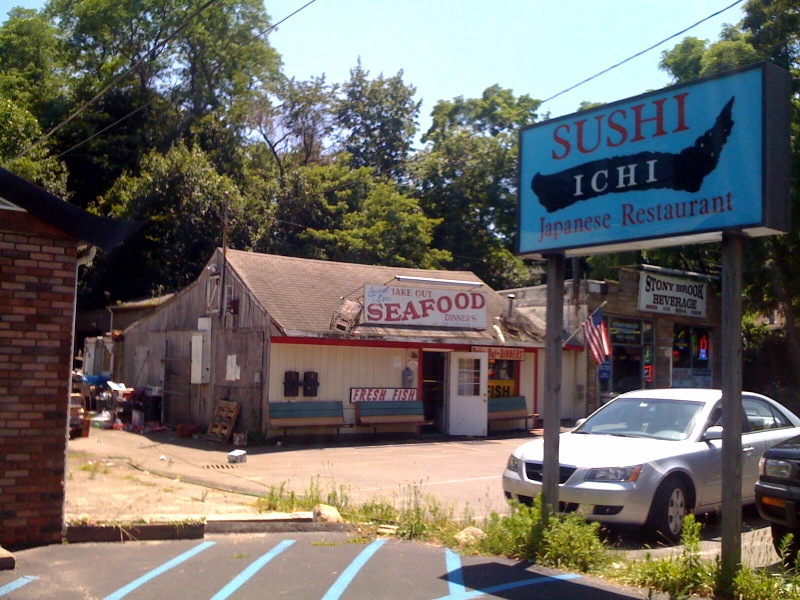
Actually it is in Seatauket, but you won’t notice that you have crossed any boundary. It’s called Sushi Ichi.

Go there for lunch. Tell them how much you want to spend and what kind of -tarian you are. Then ask them to prepare whatever is best to fit those constraints. You won’t be disappointed. It doesn’t hurt that there is a fishmonger right next door.
 Cheap Talk