
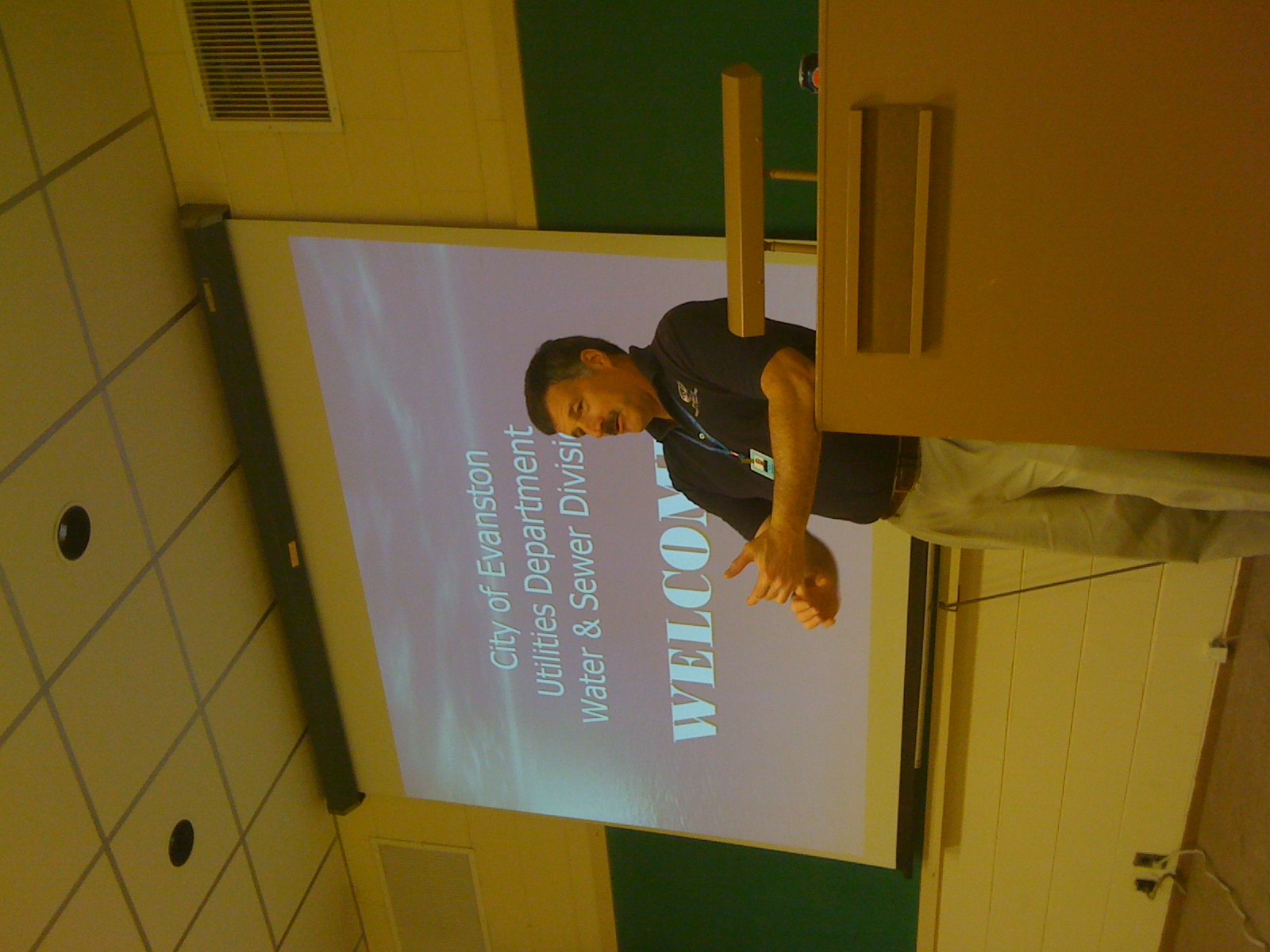
Our water pipes are old in Evanston and need replacing. What does that mean?…….More taxes of course!
But the Water Division of the City of Evanston is managed by sharp dedicated operators who know a thing or two about running a business.
First, they understand good PR. They are running tours of the water treatment facility just north of the NU campus on Lincoln and Sheridan. Our kids wanted to go of course. I thought the whole group traipsing through would be made up of parents and kids. But no! We had retirees asking very technical questions, interested citizens wondering about water purity and funny smells caused by dead algae and a middle-aged couple out on a date. We were all charmed by the head of Evanston Water and his entourage and quite convinced by his arguments for higher taxes.
But he also has another plan. Many of the northern suburbs get their water either from Chicago or Evanston and are tied into long term contracts. As the contracts expire, Evanston and Chicago will compete for business and Evanston is at an advantage. Our cost of production is slightly higher – Chicago can generate greater economies of scale. But Chicago has more large consumers. If it gives one of them a discount, say Morton Grove, then others will clamour for the same deal. Evanston does not face this issue to the same extent. We can safely undercut Chicago’s price to Morton Grove without passing on the same discount to other towns we supply. We have a good old competitive advantage. Then, we can use the profits to upgrade our water system without raising taxes so much.
Another interesting tidbit: Even if we sell water to Skokie at 60c per unit, they charge much more to their citizens. They add a Skokie margin onto the margin Evanston is already charging them: so called double-marginalization. Demand for water is inelastic so double marginalization does not have much effect. But if it were elastic, then prices would be lower and consumer welfare and even profits higher if the Skokie and Evanston Utilities merge and set prices like an integrated monopolist. (This is ignoring the fact that prices are regulated in some way and I do not have the details of exactly how.) Perhaps there are other examples like this where one area sells a public good to another where double marginalization is more important.

Apart from a certain solitary activity, all other sensations caused by our own action are filtered out or muted by the brain so that we can focus on external stimuli. There is a famous experiment which demonstrates an unintended consequence of this otherwise useful system.
You and I stand before each other with hands extended. We are going to take turns pressing a finger onto the other’s palm. Each of us has been secretly instructed to each time try and match the force the other has applied in the previous turn.
But what actually happens is that we press down on each other progressively harder and harder at every turn. And at the end of the experiment each of us reports that we were following instructions and it was the other that was escalating the pressure. Indeed, the subjects in these experiments were asked to guess the instructions given to their counterpart and they guessed that the others were instructed to double the pressure.
What’s happening is that the brain magnifies the sensastion caused by the other’s pressing and mutes the sensation caused by our own. Thus, each of us underestimates the pressure when it is caused by our own action. (In a control experiment the force was mediated by a mechanical device –and not the finger directly– and there was no escalation.) So each subject believes he is following the instructions but in fact each is contributing equally to the escalating pressure.
You are invited to extrapolate this idea to all kinds of social interaction where you are being perfectly polite, reasonable, and accomodating, but he is being insensitive, abrasive, and stubborn.
For while O’Donnell crusaded against masturbation in the mid-1990s, denouncing it as “toying” with the organs of procreation and generally undermining baby making, the facts are to the contrary. Evidence from elephants to rodents to humans shows that masturbating is—counterintuitively—an excellent way to make healthy babies, and lots of them. No one who believes in the “family” part of family values can let her claims stand.
You will find that opening paragraph in an entertaining article in Newsweek (lid lob: linkfilter.) It surveys a variety of stories suggesting that masturbation serves an adaptive role and was selected for by evolution. The stories given (hygiene, signaling (??)) are mostly of the just-so variety, but this is a case where we don’t need to infer exactly the reason. We can prove the evolutionary advantage of masturbation by a simple appeal to revealed preference.
There are lots of ways we can touch ourselves and among these, Mother Nature has revealed a very clear preference. You cannot tickle yourself. Because the brain has a system for distinguishing between stimuli caused by others and stimuli caused by ourselves. Nature puts this system to good use: such a huge fraction of sensory information comes from incidental contact with yourself that it has to be filtered out so that we can detect contact with others.
Mother Nature could have used this same system to put an end to masturbation once and for all: simply detect when its us and mute the sensation. No gain, no Spain. Instead, she made an exception in this case. She must have had a good reason.

The most widely cited study on the effect of cell phone usage on traffic accidents is this one by Redelmeier and Tibshirani in the New England Journal of Medicine. Their conclusion is that talking on the phone leads to a fourfold increase in accident risk.
Their method is interesting. It’s called a case crossover design, and it works like this. We want to know the odds ratio of an accident when you talk on the phone versus when you don’t. Let’s write it like this, where 


But we have no way of estimating numerator or denominator from traffic accident data because we would need to know the counterfactuals of how often people drive (with and without talking on the phone) and don’t have accidents. Case crossover studies are based on a little algebraic trick which transforms the odds ratio into something we can estimate, with just a little more data. Using Bayes’ rule and two lines of algebra, we can rewrite it like this.

From accident data we can estimate the first term on the right-hand-side. We just calculate the fraction of accidents in which someone was talking on the phone. The finesse comes in when we estimate the second term. We don’t want to just estimate the overall frequency of cell phone use because we estimated the first term using a selected sample of people who had accidents. They may be different from the population as a whole. We want the cellphone usage rates for the people in our sample.
Case crossover studies take each person in the data who had an accident and ask them to report whether they were talking on the phone while driving at the same time of day one week before. Thus, each person generates their own control case. It’s a valid control because its the same person, driving at the same time, and on average therefore under the same conditions. These survey data are used to estimate the second term.
It’s really clever and its used a lot in epidemiological studies. (People get sick, some were exposed to some potential hazard, others not. The method is used to estimate the increase in risk of getting sick due to being exposed to the hazard.)
I have never seen it in economics however. In fact, this was the first I ever heard of it. So its natural to wonder why. And it doesn’t take long before you see that it has a serious weakness when applied to data with a lot of heterogeneity.
To see the problem, suppose that there are two types of people. The first group, in addition to being generally accident prone are also easily distracted. Everyone else is a safe driver and talking on cellphones doesn’t make them any less safe. Then our sample of people who actually had accidents would consist disproportionately of the first group. We would be estimating the effect of cell phone use on them alone. If they make up a small fraction of the population then we are drastically overestimating the increase in risk.
It’s fair to say that at best we can use the estimate of 4 as an upper bound on the risk ratio averaging over the entire population. That population average could be zero and still be consistent with the findings from case crossover studies. And there is no simple way to remedy the problems with this method. So I think there is good reason to approach this question from a different direction.
As I described before, if cell phone distractions increase accident risk we would see it by comparing the population of drivers to drivers with hearing impairment, who don’t use cell phones. And it turns out that the data exist. In the NHTSA’s database of traffic accidents, there is this variable:
P18 Person’s Physical Impairment
Definition: Identifies physical impairments for all drivers and non-motorists which may have contributed to the cause of the crash.
And “deaf” is impairment number 9.
The prize has been awarded to Peter Diamond, Dale Mortensen and Chris Pissarides.
First, let me bask in some Nobel glory and say “I called it!”: in a post last week, I used the Kellogg/NU data to predict this prize. This goes to show that “information aggregation and voting” has one data point in its support.
Dale Mortensen is at Northwestern so I know him a little. I remember having a very fun conversation with Dale and his wife and Ed Prescott (before he won the Nobel Prize himself) at a Schwartz dinner at Northwestern. There was a quite lively discussion of the Iraq war led by Dale’s wife. I’ve never met Chris Pissarides. All I can say as someone raised in the U.K. is that it’s great that a professor at L.S.E. won the Prize. L.S.E. is an amazing intellectual, cosmopolitan institution. Hayek and Coase spent formative years there. It’s wonderful that Pissarides got his PhD at LSE and has spent almost his entire career there. I visited MIT last year but I was too intimidated by Diamond to strike up a conversation!
Here is my attempt to offer some explanation of some papers. My choices are somewhat idiosyncratic as they are the papers I have read rather than perhaps their key papers.
Peter Diamond has a classic paper A Model of Price Adjustment in the Journal of Economic Theory in 1971. Diamond shows that even an infinitesimal search cost can lead to monopoly pricing rather than competitive pricing because of a hold up problem. Suppose there is no search cost and two firms are selling an identical good. The logic of (Bertrand) competition means they will both end up pricing at cost. At any higher price, one firm can undercut the other and capture the entire demand rather than half the demand and double its profit.
Instead suppose there is a small search cost e>0 a consumer must pay to discover the price. Pricing at cost is no longer an equilibrium – one firm can raise its price by almost e. The consumer discovers the higher price once he enters the store. But going to the other store to get a lower price involves a transactions cost of e anyway. So, it is better to submit to hold-up and pay the higher price. This logic obtains at all prices lower than the monopoly price. At that point you do not want to raise the price any more as consumers simply stop buying at a rate than makes further price increases lead to lower profits. So, a small search cost reverses the intuition about pricing completely.
Diamond has made seminal contributions to many areas. He has worked on general equilibrium with incomplete markets, the overlapping-generations model and on public finance (Diamond-Mirrlees).
Of Dale Mortensen’s papers, I know Property Rights and Efficiency in Mating, Racing and Related Games in the American Economic Review in 1982. Suppose parties are trading and have to invest ex ante to increase the ex post value of trade. The investment could be search for a trading partner or R-and-D investment etc. If they do not trade, each goes back into the search market to trade with someone else. If they do trade, any surplus they generate is split 50-50. The latter property implies there a kind of tax on ex ante investment and generates underinvestment. In common with Diamond, there is not only search but also ex post hold-up. In Diamond, the price can be increased by the firm behind the veil of secrecy. In Mortensen, ex post haggling over price generates hold-up. The Mortensen model in AER is closely related to the Grossman-Hart model of incomplete contracts and property right allocation and also to last year’s prize to Oliver Williamson.
Pissarides’s AER 1985 paper Short-Run Equilibrium Dynamics of Unemployment, Vacancies, and Real Wages also assumes unemployed workers and firms bargain over wages ex post. Their share of the surplus depends on their outside option which is turn depends on the tightness of the labor market – intuitively, the more workers are unemployed, the lower the wage firms can charge. In fact, in the simple model Pissarides proposes, it is possible to derive explicit solutions relating unemployment to wages and vacancies and even take the model to data. Hence, the Diamond-Mortensen-Pissarides model has become a canonical model with which to study unemployment. It has been extended in many directions by many authors including Mortensen and Pissarides together.
I guess the DMP model is being used to study unemployment dynamics in the current recession and to propose policy responses. A highly timely prize.
(WordPress doesnt allow automatic pushing of updates so you will have to click refresh to see updates.)
And here we are waiting outside the Royal Swedish Academy of Sciences.
The crowd is gathering, everyone here is really tall.
From my understanding, the committee is inside meeting right now, holding the final vote to decide the 2010 Nobel Prize in Economic Sciences.
I am not sure exactly what happens if the committee’s recommendation doesn’t pass this final vote. Maybe then they just put the prize up for auction.
Which of course means that either Milgrom will win, given his expertise, or Mankiw would win, given his textbook riches.
On the other hand if it came down to arm wrestling, Matt Rabin would be the 2010 Laureate.
I am sure Matt would share it. That’s how he rolls.
Can you wear tie-dye to the December ceremony? Do they make tie-dye tuxedos?
Speaking of tie-dye, some guy just brushed by me, whispering “ice-cold Econometricas.”
It’s definitely getting a little grungy out here as the crowd begins to gather. Some people, probably grad students, just rolled out of a VW bus.
They’re apparently doing the whole Nobel tour, they just drove from Norway where the Peace prize was announced. I don’t think they have tickets.
Oh wait its a Saab.
Ok while we are waiting here’s some Nobel trivia for you. Did you know that Alfred Nobel’s original instruction was to give the Prize for research published in the previous year?
They stopped doing that when one of the recipients’ work was discredited after already winning the prize. Now they wait like 10 years before giving the prize.
A little different in economics of course because the publication process already takes 10 years. The work is already established by the time it is published.
Which means of course it is sure to be discredited already by then.
Hey I can hear music inside the building, I think its getting ready to start. Is that John Mayer?
I must tell you I am feeling a little out of sorts. The ligonberries I had for breakfast are messing with me.
Ok we are entering the auditorium!
The crowd is enourmous. There is a definite rumble as the excitement starts to build.
The guy next to me just handed me a bag of peanuts and motioned to pass it on. I thought that was a little strange, but I did it.
Money coming the other way…
Hey this is it! The lights are dimming. There is a giant video screen.
A silhouette of a face has just been projected on the screen. Could that be the 2010 Nobel laureate?
I just noticed the guy next to me is waving a pennant and eating cotton candy. Where did he get that?
The feeling of suspense here is overwhelming. People are actually whistling and cheering. They are doing the wave! There are fireworks in the auditorium.
A streaker! Stenciled across his posterior: “Backward Induction.” Not sure what that means. Must be a physicist, still disgruntled about the whole Economics Nobel thing.
Ernst Fehr just tackled him!
OK, the distraction is over, now the light is blazing white hot from the big screen. Everybody is squinting and shielding their eyes as they try to make out the face.
It’s coming into focus! And now there’s a name below the face.
It seems like the louder the crowd roars the clearer the image becomes. It’s deafening now.
Some people are exploding into cheers, they must be able to make out the name. Ahh… I can see it now. The 2010 Nobel Laureate in Economics is…
Carl Yastrzemski!!!!
?!
Definitely a surprise pick by the Nobel committee! People are scrambling for their laptops to file their reports. This is huge!
I must say I was not expecting this. I am supposed to write a summary of the work and I really am caught off guard by this one.
And here I was worried that I would have a hard time figuring out Dick Thaler’s contribution to economics, sheesh what am I gonna do with Carl Yastrzemski??
I think he may be the first to win the Triple Crown and the Economics Nobel.
OK, its time for the big phone call. On the big screen now you see they are dialing and waiting. The phone is ringing.
Hey my phone is ringing! Gonna answer it.
It’s Sandeep! “Hey Sandeep you are never going to believe this!”
S: “Jeff, did you forget you were going to blog the Nobel announcement?”
J: “No man, I am here, I am on it. Carl Yastrzemski! Can you believe that?”
S: “What are you talking about? Look at the clock man, you overslept. You missed the whole thing. Diamond, Mortensen, and Pissarides got it, exactly as I predicted last week. This is a big day for Northwestern and you missed it! Who the hell is Carl Yastrzemski?”
J: “Overslept? Huh? Wait, I was there. Where am I? Oh man, I thought I set my alarm. They said 11AM.”
S: “GMT you idiot. You know what GMT means don’t you?”
J: “Give-or-take a Minute or Two?”
S: “Aiee! That’s it, I’m taking my kids out of the American public school system today. Bye”
Congratulations to the new laureates!! Way to go Dale!!
I will be live blogging the Nobel announcement. Tune in here just before 11AM GMT.
1. John Lennon at Madison Square Garden in 1972 (requires free membership).
2. Randall Grahm wine maker at Bonny Doon has an award-winning blog.
3. Eating and drinking in South Tyrol.
The District of Columbia is testing a system to allow overseas military personnel submit absentee electronic ballots via the internet. Obviously security is a major concern and the followed a suggestion often made by the security community to open the system to the public and allow white-hat hackers to try and find exploits. Here is the account of one team who participated and found a vulnerability within 36 hours.
By formatting the string in a particular way, we could cause the server to execute commands on our behalf. For example, the filename “ballot.$(sleep 10)pdf” would cause the server to pause for ten seconds (executing the “sleep 10” command) before responding. In effect, this vulnerability allowed us to remotely log in to the server as a privileged user
As a result, deployment of the system has been delayed.
This is exactly the kind of open, public testing that many of us in the e-voting security community — including me — have been encouraging vendors and municipalities to conduct.
But it could have turned out differently. If a black-hat got there first, they could fix the vulnerability after first leaving themselves a backdoor. Then the test comes out looking like a success, it goes live, and …
 Here are votes from some interested subset from NU Econ and Kellogg. NU and Kellogg Management and Strategy have lots of I.O. specialists and Dale Mortensen is in the Economics Department. Plus we have lots of theorists. The closest I have to a coherent story from this data is a prize for “search theory” with Diamond, Mortensen and Pissarides.
Tyler Cowen invites us to ponder this game:
Rejection Therapy is a real life game with one rule: to be rejected by someone every single day, for 30 days consecutive. There are even suggestion cards available for “rejection attempts” (although they are not essential to the game).
I am not sure about rejection as therapy, any more than the general principle that it is therapeutic to expose yourself to new, perhaps uncomfortable experiences all the time.
But rejection is a very simple yardstick by which to judge how often and how hard you are trying, how high you are aiming. We should push those margins as far as they can go, up to the point of negative marginal returns. We have not passed that threshold until the rejection rate is positive.
So, whether or not it is an end in itself, a daily dose of rejection is the hallmark of a life lived to the fullest.
Ariel Rubinstein wrote the Afterword for the 2007 reprinting of the book that launched Game Theory as a field, von Neumann and Morgenstern’s Theory of Games and Economic Behavior. Here is a representative excerpt:
Others (including myself) think that the object of game theory is primarily to study the considerations used in decision making in interactive situations. It identifies patterns of reasoning and investigates their implications on decision making in strategic situations. Accordingto this opinion, game theory does not have normative implications and its empirical significance is very limited. Game theory is viewed as a cousin of logic. Logic does not allow us to screen out true statements from false ones and does not help us distinguish right from wrong. Game theory does not tell us which action is preferable or predict what other people will do. If game theory is nevertheless useful or practical, it is only indirectly so. In any case, the burden of proof is on those who use game theory to make policy recommendations, not on those who doubt the practical value of game theory in the first place.
And, by the way, I sometimes wonder why people are so obsessed in looking for “usefulness” in economics generally and game theory in particular. Should academic research be judged by its usefulness?
Tam o’Shanter Toss: Russ Roberts
If a tree falls in a forest and no one is around to hear it, does it make a sound?
This old philosophical conundrum can be mapped into the dilemma facing the aging academic:
If I publish a paper and nobody reads it, teaches it or cites it, can it ever be a truly great paper?
As with all questions with no Platonic certitude, economists say: Let the market speak and tell us the answer.
Glenn Ellison has studied a more serious version of my question in his paper “How Does the Market Use Citation Data? The Hirsch Index in Economics.” The Hirsch index for an author is the highest number h such that the author has h papers with at least h citations. So, an index of 5 means you have five papers with at least five citations and that you do not have six papers with at least six citations etc.
Glenn points out that the Hirsch index doesn’t do a great job at ranking economists. Nobel prize winner Roger Myerson’s Hirsch index is a mere 32. But he has a few papers with over a thousand citations. Seminal papers in economics tend to get a huge number of citations but most only get a few. So, the plain vanilla Hirsch index needs to be re-evaluated.
Glenn turns to the market to guide his measure. He studies an index of the form h is the highest number such that the author has at least h papers with at least a times h to the power b citations. The plain vanilla Hirsch index sets a=b=1. Glenn estimates a and b in various ways. In one method, he looks at the NRC department rankings and finds the variables a and b that best predict the NRC rank of a (young) economist’s department. To cut a long story short, a=5 and b=2 come out as the best predictors. With this estimation in hand, we can perform various comparisons – Which fields are highly cited? Which economists are highly cited? Etc..
Here are some tasty morsels of information. International finance, trade and behavioral economics are highly cited fields (Table 6). Micro theory and cross-sectional econometrics are the worst and IO does not do too well either. These facts mean Yale and NU, which are strong in these three areas, are under-cited economics departments. But basically one gets the picture that an economists citations are closely connected to the rank of the university where s/he is employed.
Ranking young economists, it is pretty obvious who is going to come out on top: Daron Acemoglu with an index of 7.84 (Table 7). This means Daron has 7.84 papers with roughly 300 citations. Ed Glaeser and Chad Jones are close behind. Once you adjust by field, more theorists start to rank highly: Glenn, Ilya Segal, Stephen Morris and Susan Athey pop up. Also, my friend Aviv Nevo gets a shout out as an underplaced guy.
A few comments:
Most of these people are tenured well before their citations go crazy. Expert opinion not data-mining leads to their tenure. This tells you how well expert opinion predicts citations. Also, to the extent that citations take time, expert opinion will always play a role in tenure decisions. There is a difference between external opinion and internal opinion. The same few people always get asked to write letters and they will do a good job. But internal opinions may be more noisy and depend on the quality of the department. Then, Glenn’s field-adjusted citation measure gives you some idea of a candidate’s quality and might be a valuable input into the tenure decision.
Finally, there are citations and citations. A paper getting regular cites in top journals is better than a paper getting cites in lower tier journals. This can be dealt with by improving the citation index.
At another extreme, some papers may be journalistic, not academic, and then their citations mean less. For example, Malcom Gladwell gets high citations for the Tipping Point but he did not do any of the original scientific research on which his book is based. Of course he writes wonderfully and comes up with amazing examples and he is clearly an intellectual. I bet Harvard would love to have him an as an adjunct professor but they will not give him a tenured professorship.
Despite these caveats, the generalized Hirsch index is an interesting input for academic decision-making.

Poker players know that the eyes never lie. Indeed your eyes almost always signal your intentions for the simple reason that you have to see what you intend to do.
This is an essential difference between communication with eye movement/eye contact and other forms of communication. The connection between what you know and what you say is entirely your choice and of course you will always use this freedom to your advantage. But what you are looking at and where your eyes move are inevitably linked.
Naturally your friends and enemies have learned, indeed evolved to exploit this connection. Even the tiniest changes in your gaze are detectable. As an example, think of the strange feeling of having a conversation with someone who has a lazy eye.
Given that Mother Nature reveals such a strong evolutionary advantage for reading another’s gaze the question then arises why we have not evolved to mask it from those who would take advantage? The answer must be that it would in fact not be to our advantage.
With any form of communication, sometimes you want to be truthful and other times you want to deceive. The physical link between your attention and your gaze means that, for this particular form of communication you can’t have it both ways. Outright deception being impossible, at best Nature could hide our gaze altogether, say by uniformly coloring the entire eye.
But she chose not to. By Nature’s revealed preference, this particular form of honesty is evolutionarily advantageous, at least on average.
Ray Fisman at Slate describes a new paper by David Card, Alexandre Mas, Enrico Moretti and Emanual Saez . These researchers use publicly available salary data for the University of California to study whether workers are disgruntled when they learn they are earning less than their colleagues. The Sacramento Bee has a website which allows anyone to search for salaries by name or institution. The researchers told some employees about the website so they could search for information about their colleagues’ salaries. They then asked all employees about their job satisfaction. Comparing the groups gives an estimate of the impact of knowing salaries on job satisfaction. Fisman reports:
On average, receiving SacBee information via e-mail had little effect on job satisfaction or job-search plans. But when the researchers divided the sample in half—those above the median pay level for comparable individuals in their department and those below—they found low earners were significantly more likely to report low job and wage satisfaction if they received the SacBee e-mail. The SacBee e-mail had an even greater impact on the likelihood of low wage earners responding that they would be looking for a job in the coming year. (One respondent even sent a note to the researchers letting them know that he handed in his resignation shortly after checking his colleagues’ salaries on the SacBee Web site.) Surprisingly, high earners didn’t revel in their relative superiority—exposure to the SacBee Web site had no effect on their job satisfaction or likelihood of looking for a new job. (The researchers also found that both low and high earners expressed greater concern for income inequality in America after poking around the SacBee’s salary database.)
I’ve dressed up this post to look intellectual but really I know and you know that we want the juicy stuff:
1. Fisman’s link to the SacBee website is here.
2. What about other universities? Dan Hamermesh’s Gossip Files provide some more information….
There’s only so much time in the day so we can’t talk about everything. Given the opportunity cost, ideas that are obviously bad aren’t worth talking about, even if you are someone who always considers both sides of every issue. This means that if you discuss an idea you demonstrate that you don’t think it’s obviously bad, even if what you conclude from your discussion is that the idea is obviously bad.
Now if I think that an idea is obviously bad and I hear a friend, or politician, or media outlet engage in a discussion of both sides of that issue, I conclude that they have the wrong priorities, even if they ultimately agree with me on the idea. Therefore, my friends, politicians who want my vote, and media who want me to listen to them will not even bring up ideas that I think are obviously bad. Even if I am wrong.

You can subscribe to a service and receive calls reminding you that you are awesome (ht MR).
You can probably think of people who would buy this service thinking it will bolster their self-esteem. You might even imagine that you yourself would get a little boost from having someone call you personally and tell you that you rock. But you probably think that this is leveraging some kind of behavioral, kludgy, semi-rational wiring in your personality and that you would quickly get de-sensitized to it.
But I disagree. I think that it would be a valuable motivator even for the most hyper-rational among us. Because it’s not a trick at all but really just a way to preserve mindsets over time. Suppose I tell you about something great I did. Then later on, when I am about to take on some challenge, like let’s say I am about to give a big lecture to an intimidating audience, you call me and remind me of the great thing I did. And you add your own interpretation of why it was great and how it shows that I am awesome. I don’t need to believe anything about your motivations, your reminder restores my brain to the state it was in when I myself was thinking about how great I am and why. And if your added color convinces me that you honestly agree with me then all the better.
Simply “writing it down” or memorizing the state of mind is not a perfect substitute. At a very minimum this is simply based on cost-minimization. Someone else is doing the remembering for me and that is worth something. But it’s even more than that.
If you have been following me it will come as no surprise that I have no trouble at all remembering what an stupendous guy I am and all the super-amazing feats of astounding splendifery I have accomplished in my life. Yet even with that overflowing supply of memories of greatness, I still get nervous in the face of a challenge. When that happens I have my daughter repeat something she once said to me at a minor moment of greatness: “you’re so smart daddy.” The memory of that moment is imprinted on the sound of her voice. That sound hooks into the vivid edges of my direct experience of the event. Immediately it’s “oh yeah, that’s how it’s done” and my perspective on the situation is totally new. And yet on the surface all she is doing is duplicating a memory that I had in there already.
Daughters are great, and not just for fueling your ego, but they cost more than $40 a month. By comparison, Awesomeness Reminders look like a pretty good deal.

They say you can’t compare the greats from yesteryear with the stars of today. But when it comes to Nobel laureates, to some extent you can.
The Nobel committee is just like a kid with a bag of candy. Every day (year) he has to decide which piece of candy to eat (to whom to give the prize) and each day some new candy might be added to his bag (new candidates come on the scene.) The twist is that each piece of candy has a random expiration date (economists randomly perish) so sometimes it is optimal to defer eating his favorite piece of candy in order to enjoy another which otherwise might go to waste.
The empirical question we are then left with is to uncover the Nobel committee’s underlying ranking of economists based on the awards actually given over time. It’s not so simple, but there are some clear inferences we can make. (Here’s a list of Laureates up to 2006, with their ages.)
To see that it is not so simple, note that just because X got the prize and Y didn’t doesn’t mean that X is better than Y. It could have been that the committee planned eventually to give the prize to Y but Y died earlier than expected (or Y is still alive and the time has not yet arrrived.)
When would the committee award the prize to X before Y despite ranking Y ahead of X? A necessary condition is that Y is older than X and is therefore going to expire sooner. (I am assuming here that age is a sufficient statistic for mortality risk.) That gives us our one clear inference:
If X received the prize before Y and X was born later than Y then X is revealed to be better than Y.
(The specific wording is to emphasize that it is calendar age that matters, not age at the time of receiving the prize. Also if Y never received the prize at all that counts too.)
Looking at the data, we can then infer some rankings.
One of the first economists to win the prize, Ragnar Frisch (who??) is not revealed preferred to anybody. By contrast, Paul Samuelson, who won the very next year is revealed preferred to kuznets, hicks, leontif, von hayk, myrdal, kantorovich, koopmans, friedman, meade, ohlin, lewis, schulz, stigler, stone, allais, haavelmo, coase and vickrey.
Outdoing Samuelson is Ken Arrow, who is revealed preferred to everyone Samuelson is plus simon, klein, tobin, debreu, buchanan, north, harsanyi, schelling and hurwicz (! hurwicz won the prize 37 years later!), but minus kuznets (a total of 25!)
Also very impressive is Robert Merton who had an incredible streak of being revealed preferred to everyone winning the prize from 1998 to 2006, ended only by Maskin and Myerson (but see below.)
On the flipside, there’s Tom Schelling who is revealed to be worse than 28 other Laureates. Leo Hurwicz is revealed to be worse than all of those plus Phelps. Hurwicz is not revealed preferred to anybody, a distinction he shares with Vickrey, Havelmo, Schultz (who??), Myrdal (?), Kuznets and Frisch.
Paul Krugman is batting 1,000 having been revealed preferred to all (two) candidates coming after him: Williamson and Ostrom.
Similar exercises could be carried out with any prize that has a “lifetime achievement” flavor (for example Sophia Loren is revealed preferred to Sidney Poitier, natch.)
There’s a real research program here which should send decision theorists racing to their whiteboards. We deduced one revealed preference implication. Question: is that all we can deduce or are there other implied relations? This is actually a family of questions that depend on how strong assumptions we want to make about the expiration dates in the candy bag. At one extreme we could ask “is any ranking consistent with the boldface rule above rationalizable by some expiration dates known to the child but not to us?” My conjecture is yes, i.e. that the boldface rule exhausts all we can infer.
At the other end, we might assume that the committee knows only the age of the candidates and assumes that everyone of a given age has the average mortality rate for that age (in the United States or Europe.) This potentially makes it harder to rationalize arbitrary choices and could lead to more inferences. This appears to be a tricky question (the infinite horizon introduces some subtleties. Surely though Ken Arrow has already solved it but is too modest to publish it.)
Of course, the committee might have figured out that we are making inferences like this and then would leverage those to send stronger signals. For example, giving the prize to Krugman at age 56 becomes a very strong signal. This would add some noise.
Finally, the kid-with-a-candy-bag analogy breaks down when we notice that the committee forms bundles. Individual rankings can still be inferred but more considerations come into play. Maskin and Myerson got the prize very young, but Hurwicz, with whom they shared the prize, was very close to expiration. We can say that the oldest in a bundle is revealed preferred to anyone older who receives a prize later. Plus we can infer rankings of fields by looking at the timing of prizes awarded to researchers in similar areas. For example, time-series econometrics (2003) is revealed preferred to the theory of organizations (2009.)
The Bottom Line: There is clear advice here for those hoping to win the prize this year, and those who actually do. If you do win the prize, for your acceptance speech you should start by doing pushups to prove how virile you are. This signals to the world that you were not given the award because of an impending expiration date but that in fact there was still plenty of time left but the committee still saw fit to act now. And if you fear you will never win the prize, the sooner you expire the more willing will the public be to believe that you would have won if only you had stuck around.
A California Classic. Totally delicious. Three distinct phases of the palette. Fruit at first: Strawberry but also Cherry, like a Burgundy. That leaves to be replaced by acid and then finally a long, spicy finish. Lots of Clove and Pepper.
Wish it was a bit lower in alcohol – I hard a hard time waking up this morning!
I believe this wine was one of the original Rhone Rangers – California’s attempt to replicate Rhone style wines. It’s way cheaper ($30 approx.) than a good, reliable CdP and there is considerable complexity and none of the usual fruity, oaky availability of usual California style wines.

- Most family home videos are boring. You film your kid doing something, like tying his shoes for the first time. It seems really exciting the first time, but years later you’ve seen your kid do that every day for years. The video is boring but it’s entertaining to notice things in the background like “hey remember when our yard looked like that before the landscaping?” So the best home videos are of things that are boring now because you currently do them all the time. Someday you will no longer be doing them and the video will bring back memories.
- “Jack of all trades, master of none.” The causality actually goes in the opposite direction than the phrase is usually intended to mean. (Take it from me.)
- Can someone explain to me why I want a ceiling fan to cool my room? The hot air is near the ceiling. I would rather it stay there. Storn, are you reading this?
- Like any other measurement, the “hawkeye” electronic line judge in tennis has confidence intervals. When the human judge calls it in, and the hawkeye’s point estimate is one millimeter out, why does the hawkeye trump?
- For any album there is a finite number N of listenings before it grows on you. All album reviews should begin by stating the smaller of the following two numbers: N or the number of times the reviewer listened to the album (before giving up.)
- Nature gives men a powerful urge for sex with a lexicographic preference for quantity of mates over quality. But when it comes to our sons having sex the preference completely reverses. But both are means to the same end: passing on genes. Puzzle.
Watch the ad and then go to 1.10 minutes for the Simpsons’ prediction….
If Twitter bans the sale of usernames then they take away any incentive to squat. But is the commitment credible?
While Twitter tries to work out how to make money, a Spaniard has sold his username on the site for a six-figure sum.
In 2007 Israel Meléndez set up a Twitter account under his first name. This year he was approached by the state of Israel, which wanted to buy @Israel from him for a quantity of dollars that, he told Spain’s Público newspaper, included “five zeroes”.
The sale went through despite Twitter’s stated policy of preventing username squatting and Meléndez, who runs adult websites for a living, said Twitter itself had advised the Israeli government on how this could be done.
“All the business of getting in contact with Twitter was done by them [Israel],” Meléndez said. “I never saw any emails [between them] and Twitter never contacted me, but if the @Israel account is open and working I imagine it means that Twitter had no problem with the transaction.”
Cell phone use increases the risk of traffic accidents right? But how do we prove that? By showing that a large fraction of accidents involve people talking on cell phones? Not enough. A huge fraction of accidents involve people wearing shoes too.
I thought about this for a while and short of a careful randomized experiment it seems hard to get a handle on this using field data. I poked around a bit and I didn’t find much that looked very convincing. To give you an example of the standards of research on this topic, one study I found actually contains the following line:
Results Driver’s use of a mobile phone up to 10 minutes before a crash was associated with a fourfold increased likelihood of crashing (odds ratio 4.1, 95% confidence interval 2.2 to 7.7, P < 0.001).
(Think about that for a second.)
Here’s something we could try. Compare the time trend of accident rates for the overall population of drivers with the same trend restricted to deaf drivers. We would want a time period that begins before the widespread use of mobile phones and continues until today. Presumably the deaf do not talk on cell phones. So if cell phone use contributed to an increase in traffic risk we would see that in the general population but not among the deaf.
On the other hand, the deaf can use text messaging. Since there was a period of time when cell phones were in widespread use but text messaging was not, then this gives us an additional test. If text messaging causes accidents, then this is a bump we should see in both samples.
Anyone know if the data are available? I am serious.
Each brain-damaged person got a wad of play money, and instructions to gamble on 20 rounds of coin tossing (heads-you-win/tails-you-lose, with some added twists). Other people who had no such brain lesions got the same money and the same gambling instructions.
The brain-damaged gamblers pretty consistently ended up with more money than their healthier-brained competitors. The researchers speculate that when “normal” gamblers encounter a run of unhappy coin-toss results, they get discouraged and become cautious – perhaps too cautious. Not so the people with brain-lesion-induced emotional disfunction. Encountering a run of bad luck, they plough on, undaunted. And then enjoy a relatively handsome payoff. At least sometimes.
Stalin stayed in Moscow during WWII to lead resistance against the approaching German armed forces. He was putting his own life at risk. Why do leaders have to take costly actions to persuade followers to follow?
A seminal paper Leading by Example (jstor link) by Ben Hermalin (AER 1998) has an answer based on a classical signaling model. Suppose a leader wants followers to exert costly effort. The ideal level effort depends on some factor known only to the leader. Stalin might have a better idea as to the chances of success against the Germans; or a C.E.O. might have better information about the state of demand. What if the leader simply tells the followers his information? Of course, this is Cheap Talk. If the leader wants the followers to exert high effort whatever the true state of affairs, the followers cannot believe anything the leader says. For example, Stalin might tell his troops to fight hard whether they have a good chance of beating the Germans or not. Communication breaks down and the followers’ effort cannot be a function of the truth.
The picture changes if the leader can himself exert costly effort and lead by example. Then, he might only be willing to work hard if and only if he thinks the chances of his effort paying off are good. Stalin’s decision to stay in Moscow signals that he believes that his life is likely to be safe as the chances for Soviet success are good. If the Germans have the advantage, he does truly risk his life and would prefer to leave Moscow. As the leader’s incentives to send the signal or not depend on the true state of affairs, his “message” is credible. The followers can then fight hard or work hard if and only if the leader leads by example and works hard himself.
“Actions speak louder than words” and Costly Signaling is more informative than Cheap Talk. Hence leaders must lead by example because words cannot be believed while actions can. This is the heart of Hermalin’s idea.
Once you buy into the framework, it is easy to think of variations. Hermalin does not talk explicitly about competition but let’s add that in. If things are going well for the organization in the product market, then the competition does not matter – you have a good product so you can slack off. More importantly the leader slacks off and the followers do too. If the organization is defunct if the crew does not pull the oars hard, the captain has a good incentive to pitch in and row. So, this is similar to the first Hermalin story except the leader works hard when the going is bad and effort is very important and not when the going is good. The followers do the same.
Another variation: Middle managers looking to get promoted have weird incentives. They want to signal how hard-working they are to their superiors. They want to work hard even when the going is bad. So, the followers cannot filter out the true state from the middle manager’s effort. The followers will slack off. The middle manager cannot be a credible leader by example as signaling to his superiors destroys the credibility of the signal to his juniors. This is a good reason to appoint someone who does not want to be senior manager into the middle position. Hence, looking at the leading by example issue alone, academic department should appoint Chairs who do not have any ambition to rise further in the hierarchy. Many other examples can be given…
This article from Not Exactly Rocket Science discusses an experiment studying “competition” between the left and right sides of the brain. Subjects in the experiment had to pick up an object placed at different points on a table and what was observed was which hand they used depending on where the object was. The article makes this observation in passing.
they always used the nearest hand to pick up targets at the far edges of the table, but they used either hand for those near the middle. Their reaction times were slower when they had to choose which hand to use, and particularly if the target was near the centre of the table.
This much is expected, but it supports the idea that the brain is choosing between possible movements associated with each hand. At the centre of the table, when the choice is least clear, it takes longer to come down on one hand or the other.
I stopped there. Because while this sounds intuitive, there is another intuition that points squarely in the opposite direction. When the object is in the center of the table, that’s when it matters least which hand you use, so there is no reason to spend extra time thinking about it. Right? So…when you have competing intuitions you need a model.
You have to take an action, say “left” or “right” and your payoff depends on the state of the world, some number between -1 and 1. You prefer “right” when the state is positive and “left” when the state is negative and the farther away from zero is the state, the stronger is that preference. When the state is exactly zero you are indifferent.
You don’t know the state with perfect precision. Instead, you initially receive a noisy signal about the state and you have to decide whether to take action right away (and which action) or wait and get a more accurate signal. It’s costly to wait. For what values of the initial signal do you wait? Note that in this model, both of the competing intuitions are present. If your initial signal is close to zero, it is likely that the true state is close to zero so your loss from choosing the wrong action is small. Thus the gain from waiting for better information is small. On the other hand, if your initial signal is far from zero, then the new information is unlikely to affect which action you take so again the gain from waiting is small.
But now we can compute the relative gain. And the in-passing intuition quoted above is the winner.
Consider two possible values of the initial signal, both positive but one close to zero and one close to +1. In either case if you don’t wait you will take action “right.” Now consider the gain from waiting. Take any state x and let’s consider the scenario where waiting would lead you to believe that the state is x. If x is positive then you would still choose “right” and waiting would not gain anything. So fix any negative x and ask what would the gain be if waiting led you to believe that the state is x. The key observation is that for any fixed x, this gain would be the same regardless of which of the initial signals you had.
So the comparison then just boils down to comparing how likely it is to switch to x from the two different initial signals. And this comparison depends on how far to the left x is. Signals very close to -1 are much easier to reach from an initial signal close to zero than from an initial signal close to 1. And these are the signals where the gain is large. On the other hand, for x’s just to the left of zero (where the gain is small), the relative likelihood of reaching x from the two initial signals is closer to 50-50.
Formally, unless the distribution generating these signals is very strange, the distribution of payoff gains after an initial signal close to zero first-order stochastically dominates the distribution of payoff gains when you start close to 1. So you are always more inclined to wait when your initial signal is close to zero.
 Cheap Talk