The now metered and paywall protected NYT reports:

The Obama administration is engaged in a fierce debate over whether to supply weapons to the rebels in Libya, senior officials said on Tuesday, with some fearful that providing arms would deepen American involvement in a civil war and that some fighters may have links to Al Qaeda.

Why?

Even if fighters do not have links to Al Qaeda or Hezbollah, what is there to guarantee that they are or will remain friendly to the Western allies?  Gaddafi while historically unfriendly had finally been seduced with Mariah Carey concerts and Coca Cola. Arming the rebels might fulfill a short term objective of regime change but at the cost of creating an armed future enemy.  What’s the debate?

Suppose I want you to believe something and after hearing what I say you can, at some cost, check whether I am telling the truth.  When will you take my word for it and when will you investigate?

If you believe that I am someone who always tells the truth you will never spend the cost to verify.  But then I will always lie (whenever necessary.)  So you must assign some minimal probability to the event that I am a liar in order to have an incentive to investigate and keep me in check.

Now suppose I have different ways to frame my arguments.  I can use plain language or I can cloak them in the appearance of credibility by using sophisticated jargon.  If you lend credibility to jargon that sounds smart, then other things equal you have less incentive to spend the effort to verify what I say.  That means that jargon-laden statements must be even more likely to be lies in order to restore the balance.

(Hence, statistics come after “damned lies” in the hierarchy.)

Finally, suppose that I am talking to the masses.  Any one of you can privately verify my arguments.  But now you have a second, less perfect way of checking. If you look around and see that a lot of other people believe me, then my statements are more credible.  That’s because if other people are checking me and many of them demonstrate with their allegiance that they believe me, it reveals that my statements checked out with those that investigated.

Other things equal, this makes my statements more credible to you ex ante and lowers your incentives to do the investigating.  But that’s true of everyone so there will be a lot of free-riding and too little investigating.  Statements made to the masses must be even more likely to be lies to overcome that effect.

Drawing: Management Style II: See What Sticks from www.f1me.net

Two cars are for sale on the used car lot.  Car A has 62,847 miles on it and is listed for $7500.  Car B has 89,113 miles on it and is listed for $5600.  Which car would you buy?

Did you think about it?  OK, now your answer is not really important, but without looking back again at the numbers, answer this question:  what was the third digit of the mileage reading of the two cars?  You probably don’t remember because you probably didn’t pay close attention.

Apparently this inattention has been priced into the used car market.  For example, used cars with 39,900 miles on the odometer sell for significantly more than cars with 40,000 miles but not much less than cars with 39,000 miles.  This is the starting point of a paper by Nicola Lacetera, Devin Pope, and Justin Syndor.  They go on to estimate a structural model of attentiveness through the magnitude of the price discontinuities.

In fact, as they observe, sellers seem to understand this effect very well.  Here is a graph showing the volume of used cars sold wholesale at different odometer readings.  There is a huge spike in volume at the right end of an interval and a huge drop on the other side.

Indeed you could imagine that this kind of effect manifests even in a world where most buyers have unlimited attentiveness. Everybody knows that the price drops at the 1,000 mile mark so used cars with 31,100 miles are leased to rental agencies until they reach the 31,900 mark.  The only used cars for sale with 31,100 miles on them are the lemons that the seller is willing to part with at the price that older cars are selling for.  Buyers know this so they treat all cars with between 31,000-31,999 miles as equivalent to the oldest car in that range.

(The next time you see zeros roll over on your odometer you will understand why that always feels like a watershed event.  Your car is only a mile older but it just took a discrete drop in value.)


The New York Times paywall has gone up.  Many people I know are disgusted by the idea of paying for something that they’ve gotten used to getting for free.  Does the paywall make economic sense for the NYT?

A newspaper makes money both from paying customers who buy the paper (print or online) and from advertising revenue.   There is a tension between the two: If the newspaper charges customers, this reduces readership and hence advertising revenue.  It may make sense to give away the newspaper for free, maximize readership and extract profits from advertising.  In this scenario, the paywall might be a mistake, driving away readers and hence advertisers.

Online dissemination of news has other ramifications.  Many HuffPo “articles” are simply links to the NYT with some salacious or provocative headline pasted on.  People clicking through from HuffPo generate yet more readers and hence advertising revenue.  This gives the NYT extra incentive to produce interesting news stories go generate more links and profits.  But HuffPo also gets more readers and revenue because people know they can go there to get aggregated information from lots of sources.   HuffPo does not have to hire John Burns or David Sanger to go to dangerous places and do actual reporting.  They are free-riding off the work done by NYT reporters.  The NYT does not internalize the positive externality it exerts on HuffPo and other sites.  This effect leads to underinvestment in journalism by the NYT.

Should the NYT charge HuffPo to link to its stories?  If the extra readership and advertising revenue compensates the NYT for the positive externality it exerts on HuffPo, there is no issue. But if not, a payment from HuffPo to the NYT can increase profits for both firms by encouraging jointly optimal story production.  It is hard to tell if anything like this is part of the plan but it seems not?

We are entering a new world and we will see if it all collapses or changes the equilibrium.

How do you get deadbeat dads to pay child support?  You threaten them with incarceration if they don’t pay.  But if the punishment has its intended effect you will find that the only deadbeats who actually receive the punishment are those for whom the punishment is pointless because they don’t have the money to pay.  They are the turnips.

“Deadbeats,” according to Sorensen, are parents who could pay but choose not to. “Turnips” — invoking the phrase, “You can’t get blood out of a turnip” — are parents who don’t have the money to pay. So what percentage of nonpaying parents are deadbeats and what percentage are turnips? Sorenson says most of those who end up in jail are low-income, and thus, “more likely to be a turnip than a deadbeat.”

Is that a bug or a feature?  That’s part of what the Supreme Court will decide in a case that was argued last week.

In January I made a prediction and kept it a secret.  Now I can tell you what it was.

For fun I wanted to see how well I could predict the Economics PhD job market. As a simple test I tried to predict who would be selected for the Review of Economic Studies Tour, a kind of all-star team of new PhDs. Here was my predicted list

  1. Gharad Bryan (Yale)
  2. Matt Elliot (Stanford)
  3. Neale Mahoney (Stanford)
  4. Alex Torgovitsky (Yale)
  5. Glen Weyl (Harvard)
  6. Alex Wolitzky (MIT)
  7. Alessandra Voena (Stanford)
  8. Kei Kawai (Northwestern)

And here is the actual list (the RES Tour website is here.)

  1. Alex Wolitzky (going to Stanford?)
  2. Daniel Keniston (MIT, going to Yale)
  3. Mar Reguant (MIT, going to Stanford GSB)
  4. Kei Kawai (going to Princeton?)
  5. Alex Torgovitsky (coming to NU)
  6. Alessandra Voena (going to Chicago?)
  7. Peter Koudijs (Pompeu Fabra, going to Stanford GSB)

So I got 4 out of 8.  (There are usually 7 people, and I predicted 7 originally, but I updated it the next day adding Kawai to the list.  I had been so involved in recruiting students from other schools that I had completely forgotten about our own star student Kei Kawai and as soon as I remembered him I added him to the list.)

I previously blogged about Torgovitsky, Mahoney, and Koudijs.

You can see why I wanted to keep the prediction a secret until the market was over.  You can verify my prediction by cutting and pasting the text in this file and generating its unique SHA1 hash (a digital signature) with this web tool and cross check that it is the hash that I originally posted here, and that I tweeted here, and that is reproduced below.

f502acfb48395d6ab223ca30803f98b9bd6fd6ce

(Here is the original prediction before I added Kawai, and here is the hash for that one.)

I did this as an experiment to see how easy it is to predict job market outcomes.  At the time I made this prediction I had read the files of each of these candidates and interviewed most of them.  I didnt know where else they had interviews and I made the prediction before the stage of flyout interviews so I had little information about how their job market was going overall.

Getting half right is about what I expected.  To me this is evidence that the market is hard to predict even after having interviewed the candidates. In particular I take it as evidence against the cynical view that the market herds on certain candidates early in the process.  Indeed I would not have changed my prediction much even a week or two later when flyout schedules were in place.

Incidentally the Review Tour rosters say something about the strength of PhD programs.  Here’s a breakdown of the last 6 years and where the tourists received their PhDs:

MIT 12
Harvard 7
NWU 4
Yale 3
Stanford 3
Stanford GSB 2
BU, Duke, LSE, Michigan, NYU, Penn, Princeton, Ohio State, Stern, UPF, UCL —  1 each

Northwestern is doing very well!  (In addition to producing stars, we also do well hiring them.  3 from the tour in the past 6 years, including Alex Torgovitsky this year, an outstanding hire.)

Also I understand that a team is at work creating the web tool that I suggested here for creating and managing secret predictions.  If and when it hits I will announce it here.

Wendy:  There’s chard on your face.

Ray: Chard?

Wendy:  The greens.  It’s chard right?  I think the server said it was chard.  I think he said something like “embellished with pearls of chard.”

Ray: Better than shards of pearls.

Wendy:  Anyway there’s a pearl on your chin, you might want to wipe it off.  Oh hey, how was that new exhibition you went to?

Ray:  Ah yes, the Alpha-Beam Installation.

Wendy:  What was that?

Ray:  You’ve heard of I-beams right?  Well, this guy built massive steel beams with cross-sections for every letter of the alphabet.

Wendy:  Q-beams.

Ray:  And P-beams, and Z-beams, etc.  And punctuation beams.  The semi-colon beam was an engineering feat in itself.

Wendy:  Cool.

Ray:  Yeah right, and he wrote poetry with his beams. Gargantuan, industrial poetry.  A single haiku took up the space of football stadium.

Wendy:  I love it.

Ray:  I guess, but come on how is that art?

Wendy:  Oh, don’t be such a douchebag.

Ray:  Listen, it may sound cliche, but really anybody could have done that.  Even I could have done that.  I’m no artist, and if I could have done that, it’s not art.

Wendy:  But you didn’t do it.  On the other hand, he did.  Because it’s art and because you are not an artist.

Ray:  Ok, I’ve heard that one before, but I’m telling you that argument just doesn’t work.  Sure I didn’t make alphanumeric pillars and arrange them into rhymes and sure I never would have dreamed of doing something like that but that doesn’t make him any more of an artist than me.  Think of the thousands of other self-styled artists working in obscurity picking completely random things and not using them for their intended purpose.  One of these guys gets plucked out of his basement and placed in an art museum handing out free cheese and wine to 7 of his friends from high school.  It’s not enough to point out that he did it and not us.  Because there’s a thousand things we did and he didn’t.  Your argument gives me no way of distinguishing between a world where this guy has some innate ability to sense which particular non-functional scrap of architecture has the power to move people and a world where everybody is repeating pre-school art projects and one gets picked at random to fill up a vacant wharehouse.

Wendy: You would be such a bore if it weren’t for the hilarious food on your face.

  1. How cannibals hook up.
  2. Ralph Steadman plank grills Hunter S. Thompson.
  3. Stupid Man Commercials. I actually starred in one of these when I was like 4.  EasyJack pancakes.  “Make it snappy Mom!!”  Hasn’t made it to YouTube yet.
  4. What kind of porn do women like?

This is an easy one: North Korea thinks (1) the US is out to exploit and steal resources from other countries and hence (2)  Libya was foolish to giving away its main weapon, its nascent nuclear arsenal, which acted as a deterrent to American ambition. Accordingly,

“The truth that one should have power to defend peace has been confirmed once again,” the [North Korean] spokesperson was quoted as saying, as he accused the U.S. of having removed nuclear arms capabilities from Libya through negotiations as a precursor to invasion.

“The Libyan crisis is teaching the international community a grave lesson,” the spokesperson was quoted as saying, heaping praise on North Korea’s songun, or military-first, policy.

In a perceptive analysis, Professor Ruediger Franks adds two more examples that inform North Korean doctrine.  Gorbachev’s attempts to modernize the Soviet Union led to its collapse and the emancipation of its satellite states.  Saddam’s agreement to allow a no-fly zone after Gulf War I led inexorably to Gulf War II and his demise.  The lesson: Get more nuclear arms and do not accede to any US demands.

Is there a solution that eliminates nuclear proliferation?  Such a solution would have to convince North Korea that their real and perceived enemies are no more likely to attack even if they know North Korea does not have a nuclear deterrent.  Most importantly, the US would have to eliminate North Korean fear of American aggression.  In a hypothetical future where the North Korean regime has given up its nuclear arsenal, suppose the poor, half-starved citizens of North Korea stage a strike and mini-revolt for food and shelter and the regime strikes back with violence.  Can it be guaranteed that South Korea does not get involved?  Can it be guaranteed that Samantha Power does not urge intervention to President Obama in his second term or Bill Kristol to President Romney in his first? No.  So, we are stuck with nuclear proliferation by North Korea.  The only question is whether North Korea can feel secure with a small arsenal.

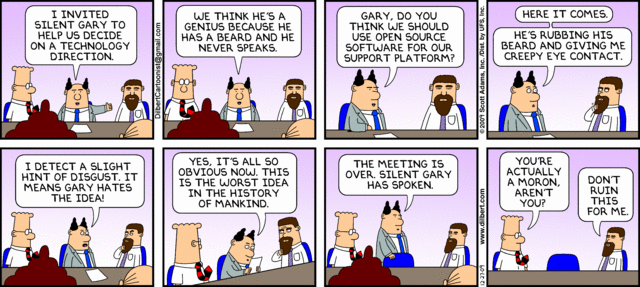
Tomas Sjostrom and I offer one option for reducing proliferation in our JPE paper Strategic Ambiguity and Arms Proliferation.  If North Korea can keep the size and maturity of its nuclear arsenal hidden, we can but guess at its size and power.  It might be large or quite small – who knows.  This means even if the arsenal is actually small, North Korea can still pretend it is big and get some of the deterrent power of a large arsenal without actually having it.  The potential to bluff afforded by ambiguity of the size of weapons stockpiles affords strategic power to North Korea.  It reduces North Korea’s incentive to proliferate.  And this in turn can help the U.S. particularly if they do not really want to attack North Korea but fear nuclear proliferation.  Unlike poker and workplace posturing à la Dilbert, nuclear proliferation is not a zero-sum game.  Giving an opponent the room to bluff can actually create a feedback loop that helps other players.


4. Do you act more or less rationally in your marriage than in other areas of your life?

You should never ask a decision theorist such a question since we make a living by redefining the word “rational.”  I think it means “doing whatever seems most appropriate at the time” and is therefore tautological.  So, no, I’m not rational in any respect.

That’s from a funny interview with Bart by the MILTTMPHDFTPAM(TMRPOTSIHTA) at Spousonomics.

If I was nominating for the MacArthur fellowships…

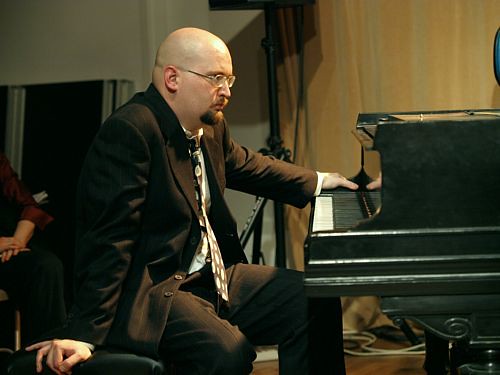
In advance of The Bad Plus’ world premiere of The Rite of Spring, Ethan Iverson drops this monster blog post about Stravinsky, 20th century music, and writing. You should read the whole thing.

On a piece called the Ebony Concerto:

While the Ebony Concerto is not jazz, it is a deconstructed big band piece, and therefore a great introduction to Stravinsky for a jazz musician.

It is barely a concerto, though, for the clarinetist is featured only occasionally.  In the middle movement, the soloist only plays a couple of phrases!  Clearly Stravinsky didn’t trust the work’s commissioner, Woody Herman.

On the box it is Benny Goodman, a real virtuoso.  But he didn’t play the middle movement; Charles Russo stood in instead.

But perhaps because the star was out of the room, it’s the best movement.   It is played much slower than the given tempo marking, the saxophones use a real jazz sound and phrase with some swing, and the hapless harpist plays a huge wrong note the second time through.  (Perfect.)  The final result is possibly the bluesiest classical recording in existence.

On deciphering Stravinsky’s odd meters:

Mystic circle
Gah! This is two bars of four, not a bar of five and a bar of four!  The best musical point would be make that dry ostinato as grooving, secure, and mysterious as possible — a target that much harder to reach when you have to count a silent “1” and come in on “2” of a bar of five.

Nabokov and Stravinsky

As Andriessen and Schönberger suggest, Nabokov was Stravinsky’s opposite number, a displaced Russian aristocrat enthralled with Paris and America.   Many of Stravinky’s and Nabokov’s most celebrated works seem to wander up the same skewed Escher-esque print: “First, you are a perfect technician.  Then you parody the effect of technique in an amused way.  In doing so, you reveal a new, utterly sincere emotion that requires mastering a new technique.  After perfecting this technique, you parody it in an amused way.  In doing so, you reveal a new emotion that requires mastering a new technique….”

On Stravinsky’s influence

In The Rest is Noise, Alex Ross says that The Rite of Spring “prophesied a new type of popular art–low-down yet sophisticated, smartly savage, style and muscle intertwined.”

Part of the story of Alex’s book is how that prophesy didn’t really come true.  It came true for a lot of thrilling American folkoric music:  jazz, rock, hip-hop, musical theatre, etc., etc., etc…but the populist side of classical music never took off.

Reid made me laugh:  In rehearsal, I mentioned that Peter Schickele had said The Rite of Spring was so influential that the much of 20th century classical music could be called “The Rewrite of Spring.”  Reid shook his head. “No: The Rite hasn’t been influentialenough.”


With the new social-network aware webapp, Getupp:

Getupp is a neat webapp that helps you set your goals and share them publicly so you’re held accountable to the world. To make sure keep your commitments, Getupp can notify your Facebook friends if you break a commitment so you can be sure everyone will find out that you’re a slacker.

I have a personal commitment to write a blog post every day.  Each day that I fail I am going to write a blog post to let you know that I failed.

Eighty percent of the carrots in the US are produced by Bolthouse and Grimmway Farms.  It is a billion dollar business.  Moving from one duopoly to another, the new CEO of Boltway, Jeff Dunn, is a former Coke executive.  Life is sunny and profitable in a duopoly but every business has its cloudy days in the current recession.  The declining sales of baby carrots are blocking out sunshine in the carrot duopoly.

“Baby” carrots are just adult carrots whittled down to baby size.  A farmer can plant more seeds per acre and get more yield growing baby carrots.  They also sell better so demand is higher.  Baby carrots are the “cash cow” of carrots.  It turns out they are a “normal good”: demand declines as income declines.  Regular carrots on the other hand seem to be an “inferior good”: demand is stable or even increases during a recession.  But they are less profitable.

How should the farms reshuffle sales back towards baby carrots?  To a Coke executive the idea comes easily: market them like junk food and de-emphasize the health benefits.  So,

Display ads, printed up for supermarkets, presented baby carrots as “the original orange doodle,” and billboards suggested never fear carrots and beer. Maybe most provocatively, Bolthouse installed baby-carrot vending machines, wrapped in eat ’em like junk food graphics, at a pair of high schools.

For this and more read a great article in Fast Company.

I got this tweet from @gappy3000

In this NYT discussion on US inequality http://nyti.ms/fIIb1N nobody mentions the Benaou-Tirole paper. Depressing. http://bit.ly/fbUek8

I won’t rectify the omission but I will talk about an earlier paper “Social Mobility and Redistributive Politics” by Thomas Piketty which has a similar idea and is based on a much simpler logic.  The idea is that these three characteristics seem to come in a bundle:

  1. Wealthy family
  2. Belief that individual effort matters for success
  3. Opposition to redistributive social policy

and that less wealthy families are characterized by support for redistribution and the belief that family background (i.e. social class) matters more for success.

Piketty developed a simple theory for why these distinct worldviews can coexist in the same world even though one of them must be wrong and even though all households have the same intrinsic preference for equity. It’s based on the observation that there is an identification problem in sorting out whether family background or individual success matters and once a family falls into one of these categories, no amount of experience can change that.

To see the problem, suppose that your family’s history has led you to believe that individual effort matters very little for success.  Then you have little incentive to work hard and you will be relatively unsuccessful.  You will notice that some people are successful but you will attribute that to the luck of their social class. (However it easily could be that you are wrong and their success is due to their hard work.) Indeed even in your own family history you will record some episodes of upward mobility, but because your family doesn’t work hard you rightly attribute that to luck too.  In a world with such inequality and where effort matters little you see a strong moral justification for redistribution and little incentive cost.

On the other hand if your family has learned, and teaches you, that effort matters you will optimally work hard.  You will be more successful than average and you will attribute this to your hard work.  (It easily could be that you are wrong and in fact the source of your success is just your social class.) You will see that other families are less successful on average and as a result you see the same moral reason for redistribution, but you think that effort matters and, understanding how redistribution reduces the incentive to work hard, you favor less redistribution than the median voter.

How does this contribute to the debate in the link above?  This indeterminacy in attitudes toward redistribution means that differences across countries and over time are essentially arbitrary and due to factors that we can call culture. Inequality is high in the United States and low in Europe.  You are tempted to say “and yet there is less outrage about inequality in the US than there is in Europe” but in fact you should say “precisely because there is…”

Homburg Haul to Pierre Yared who first told me about the Piketty paper.

The AER has been going for a hundred years.  (Some scholars who sent in papers at AER’s inception are still going through the “revise and resubmit” process.)

To mark the anniversary, a distinguished panel has picked the Top 20 articles published in the last 100 years.  Peter Diamond has three articles on the list and Joseph Stiglitz has two. We can now start the debate of what should be on the list. To fully account for the value added, if an article is proposed, the proposer should also identify which article should be knocked off the current list.  To get the ball rolling, I propose Shapiro-Stiglitz to replace the Cobb-Douglas production function.  A functional form does not deserve a place on this list, even if the form is canonical.  Shapiro-Stiglitz actually have an idea, a theory of involuntary unemployment.  More broadly, they provide a simple model of the principal agent model under moral hazard with limited liability, a fundamental model.

But to drop the science and get to the nub of the matter: What is a publication in AER actually worth in terms of salary?  Bob Margo estimates the impact of AER articles in his contribution to the anniversary volume.  In passing, Bob mentions an article which estimates the salary impact of an AER publication. The author Raymond Sauer finds:

“The full return to a 10-AEQ-page article in the top journal is thus estimated to be a 3.8 percent increase in salary.” (AEQ means the article is adjusted for page size to correspond to AER page length.)

Sauer’s article would not survive the “structural estimation” or “instrumental variation” schools of thought.  But he does give us an idea of the payoff to learning the magic taught by the wizards and witches at these schools.

You probably heard about the Facebooks of China. Facebook and Twitter are blocked there and filling the vacuum are some homegrown social networks. Obviously the biggest issue with this in the particular instance of China is freedom of information and expression, so the thought experiment I will propose requires a little abstraction to focus on a separate issue.

Sites like Renren and Kaixin001 are microcosms of today’s changing China — they copy from the West, but then adjust, add, and, yes, even innovate at a world-class level, ultimately creating something unquestionably modern and distinctly Chinese. It would not be too grand to say that these social networks both enable and reflect profound generational changes, especially among Chinese born in the 1980s and 1990s. In a society where the collective has long been emphasized over the individual, first thanks to Confucian values and then because of communism, these sites have created fundamentally new platforms for self-expression. They allow for nonconformity and for opportunities to speak freely that would be unusual, if not impossible, offline. In fact, these platforms might even be the basis for a new culture. “A good culture is about equality, acceptance, and affection,” says Han Taiyang, 19, a psychology major at Tsinghua University who uses Renren constantly. “Traditional thinking restrains one’s fundamental personality. One must escape.”

Goods (like social networks) that have bandwagon effects create the greatest value when the size of the market is largest. But that same effect can cause convergence on a bad standard. One argument, very narrow of course, for trade barriers is to prevent that from happening. We allow each country to develop critical mass in their own standard in isolation before we reduce trade barriers and allow them to compete.

  1. Whenever I visit some place to give a talk, when I depart why is the host always more conservative than me in suggesting how early I should leave to make it to the airport on time?  More conservative even that I bet they are for themselves?
  2. Twitter tells me who I should follow.  But what I really want to know is who are the people Twitter suggests should follow me.
  3. What is the point of posting the schedule of Arrivals on airport monitors that are past the security lines?  Anybody who has access past that point is waiting for a departing flight, not an arrival.
  4. When Kellogg builds its new building I will suggest that all offices have showers built into them.  Since my best thoughts come when I am in the shower, I would like to spend most of my day there.
  5. Why has 80s music been pretty much passed over when it comes to “Classic Rock” playlists?
  6. Why are roads that run alongside expressways always called Frontage Road?
  7. You can talk about price discrimination and loyalty programs, but these are second order compared to the real reason behind Frequent Flier programs. Since business travelers don’t fully internalize the price of the flights they book, airlines compete for them with kickbacks in the form of frequent flier miles.

Grading still hangs over me but teaching is done.  So, I finally had time to read Kiyotaki Moore.  It’s been on my pile of papers to read for many, many years.  But it rose to the top because, first,  my PhD teaching allowed me to finally get to Myerson’s bargaining chapter in his textbook and Abreu-Gul’s bargaining with commitment model and, second, because Eric Maskin recommends it as one of his key papers for understanding the financial crisis.  So, some papers in my queue were cleared out and Kiyotaki-Moore leaped over several others.

I see why the paper has over 2000 cites on Google Scholar.

The main propagation mechanism in the model relies on the idea that credit-constrained borrowers borrow against collateral.  The greater the value of collateral “land” , the greater the amount they can borrow.  So, if for some reason next period’s price of land is high, the greater is the amount the borrower can borrow against his land this period.   Suppose there is an unexpected positive shock to the productivity of land.  This increases the value of land and hence its price.  This capital gain increases borrowing.  An increase in the value of land increases economic activity.  It also increases demand for land and hence the price of land.  This can choke off some demand for land.  The more elastic the supply of land, the smaller is the latter dampening effect.  So there can be a significant multiplier to a positive shock to technology.

(Why are borrowers constrained in their borrowing by the value of their land and rather than the NPV of their projects? Kiyotaki-Moore rely on a model of debt of Hart and Moore to justify this constraint.  While Hart-Moore is also in my pile, I did not finally have time to read it.  I did note they have an extremely long Appendix to justify the connection between collateral and borrowing!  The main idea in Hart Moore is that an entrepreneur can always walk away from a project and hold it up.  As his human capital is vital for the project’s success, he will be wooed back in renegotiation.  The Appendix must argue that he captures all the surplus above the liquidation value of the land.  Hence, the lender will only be willing to lend up to value of collateral to avoid hold up.)

But how do we get credit cycles?   As the price of land rises, the entrepreneurs acquire more land.  This increases the price of land.  They also accumulate debt.   The debt constrains their ability to borrow and eventually demand for land declines and its price falls.  A cycle.  Notice that this cycle is not generated by shocks to technology or preferences but arises endogenously as land and debt holdings vary over time!  I gotta think about this part more….

Boston being a center for academia as well as professional sports, Harvard and MIT faculty and students are leading the way in the business of sports consulting.

And some of those involved aren’t that far away from being kids. Harvard sophomore John Ezekowitz, who is 20, works for the NBA’sPhoenix Suns from his Cambridge dorm room, looking beyond traditional basketball statistics like points, rebounds, assists, and field goal percentage to better quantify player performance. He is enjoying the kind of early exposure to professional sports once reserved for athletic phenoms and once rare at institutions like Harvard and MIT. “If I do a good job, I can have some new insight into how this team plays, what works and what doesn’t,” says Ezekowitz. “To think that I might have some measure of influence, however small, over how a team plays is a thrill.” It’s not a bad job, either. While he doesn’t want to reveal how much he earns as a consultant, he says that not only does he eat better than most college students, the extra cash also allows him to feed his golf-club-buying habit.

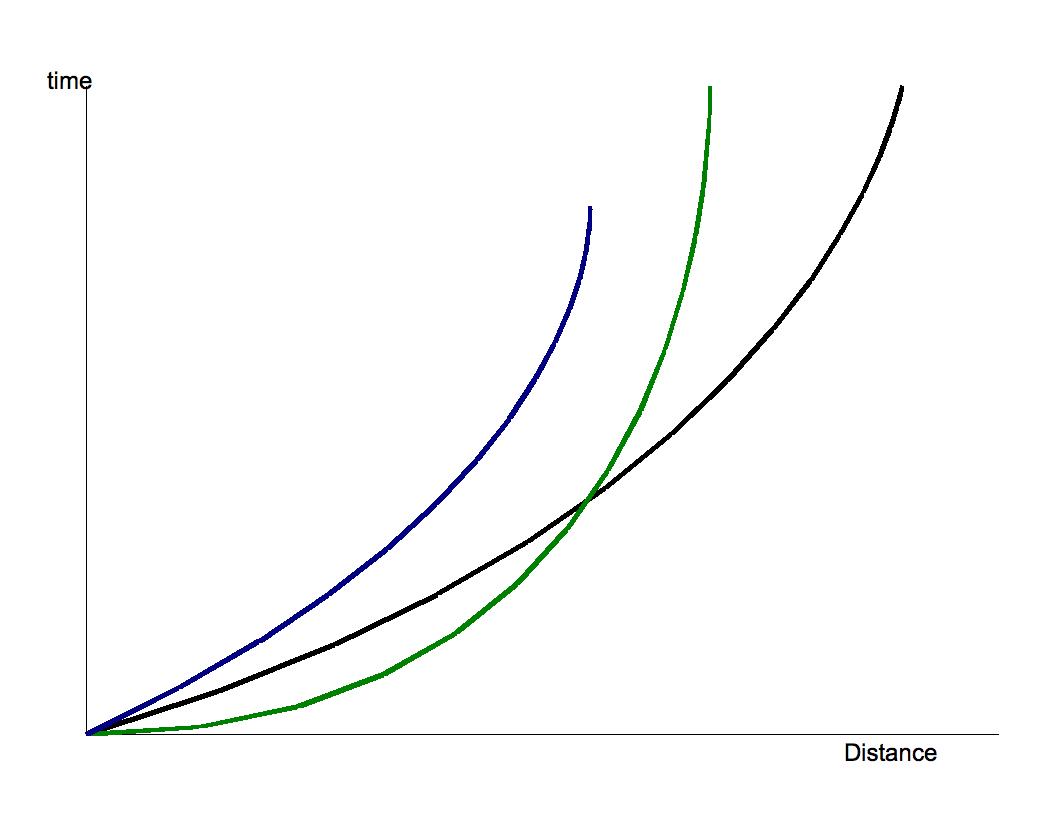
Almost every kind of race works like this:  we agree on a distance and we see who can complete that distance in the shortest time.  But that is not the only way to test who is the fastest.  The most obvious alternative is to switch the roles of the two variables:  fix a time and see who can go the farthest in that span of time.

Once you think of that the next question to ask is, does it matter?  That is, if the purpose of the race is to generate a ranking of the contestants (first place, second place, etc) then are there rankings that can be generated using a fixed-time race that cannot be replicated using an appropriately chosen fixed-distance race?

I thought about this and here is a simple way to formalize the question.  Below I have represented three racers.  A racer is characterized by a curve which shows for every distance how long it takes him to complete that distance.
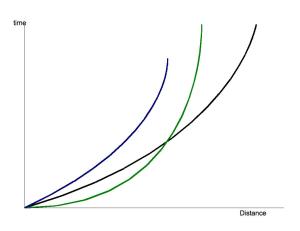
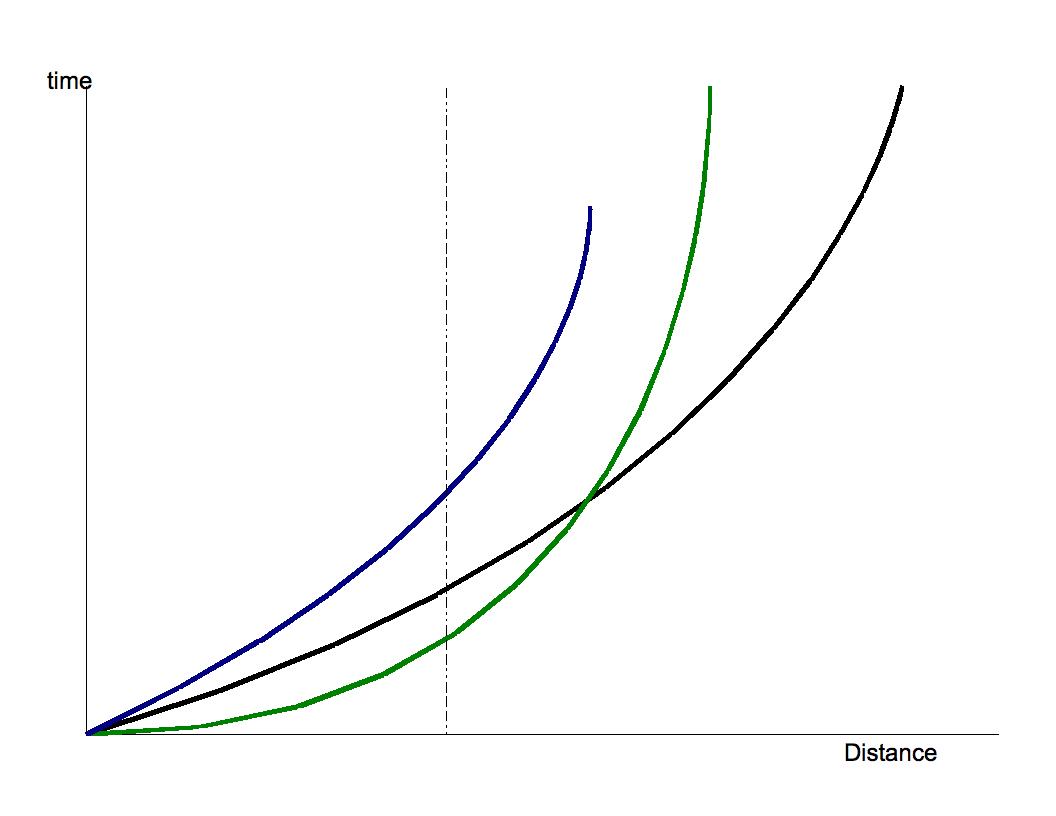
Now a race can be represented in the same diagram.  For example, a standard fixed-distance race looks like this.
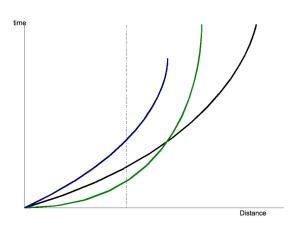
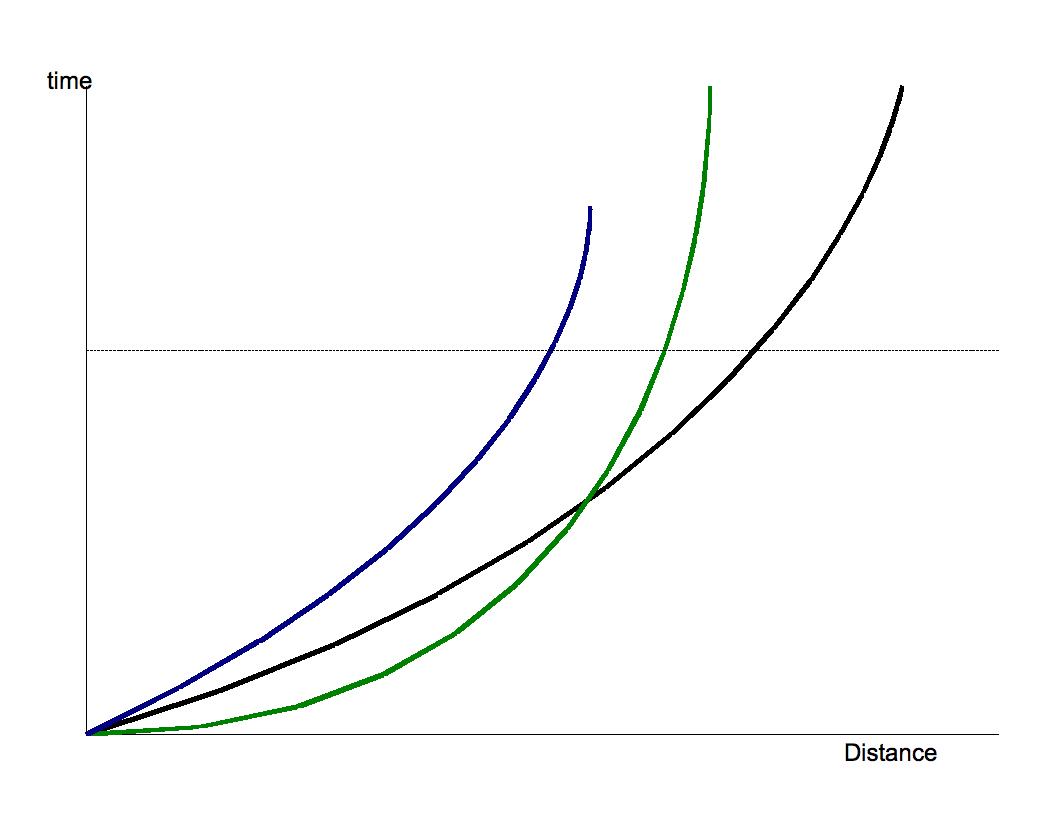
The vertical line indicates the distance and we can see that Green completes that distance in the shortest time, followed by Black and then Blue.  So this race generates the ranking Green>Black>Blue.  A fixed-time race looks like a horizontal line:
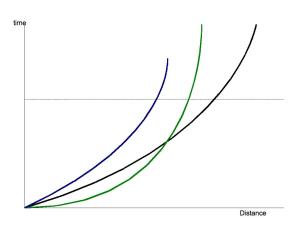
To determine the ranking generated by a fixed-time race we move from right to left along the horizontal line.  In this time span, Black runs the farthest followed by Green and then Blue.

(You may wonder if we can use the same curve  for a fixed-time race. After all, if the racers are trying to go as far as possible in a given length of time they would adjust their strategies accordingly. But in fact the exact same curve applies.  To see this suppose that Blue finishes a d-distance race in t seconds. Then d must be the farthest he can run in t seconds.  Because if he could run any farther than d, then it would follow that he can complete d in less time than t seconds.  This is known as duality by the people who love to use the word duality.)

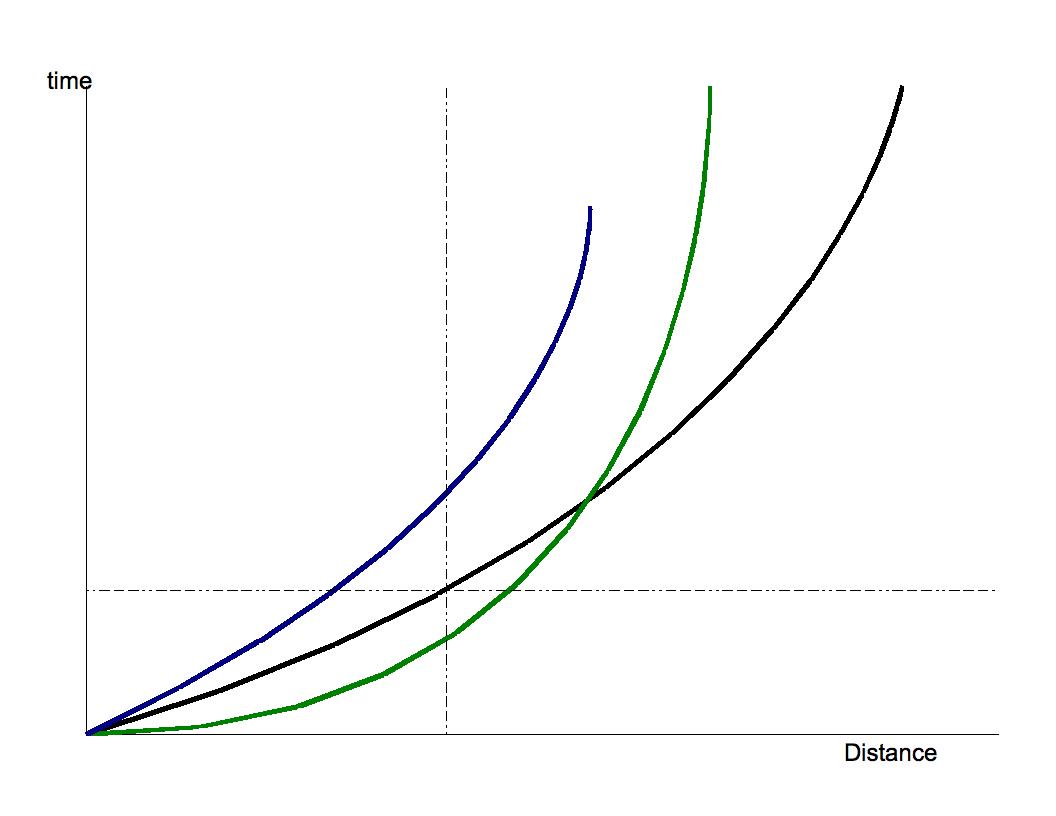
OK, now we ask the question.  Take an arbitrary fixed-time race, i.e. a horizontal line, and the ordering it generates.  Can we find a fixed-distance race, i.e. a vertical line that generates the same ordering?  And it is easy to see that, with 3 racers, this is always possible.  Look at this picture:

To find the fixed-distance race that would generate the same ordering as a given fixed-time race, we go to the racer who would take second place (here that is Black) and we find the distance he completes in our fixed-time race.  A race to complete that distance in the shortest time will generate exactly the same ordering of the contestants.  This is illustrated for a specific race in the diagram but it is easy to see that this method always works.

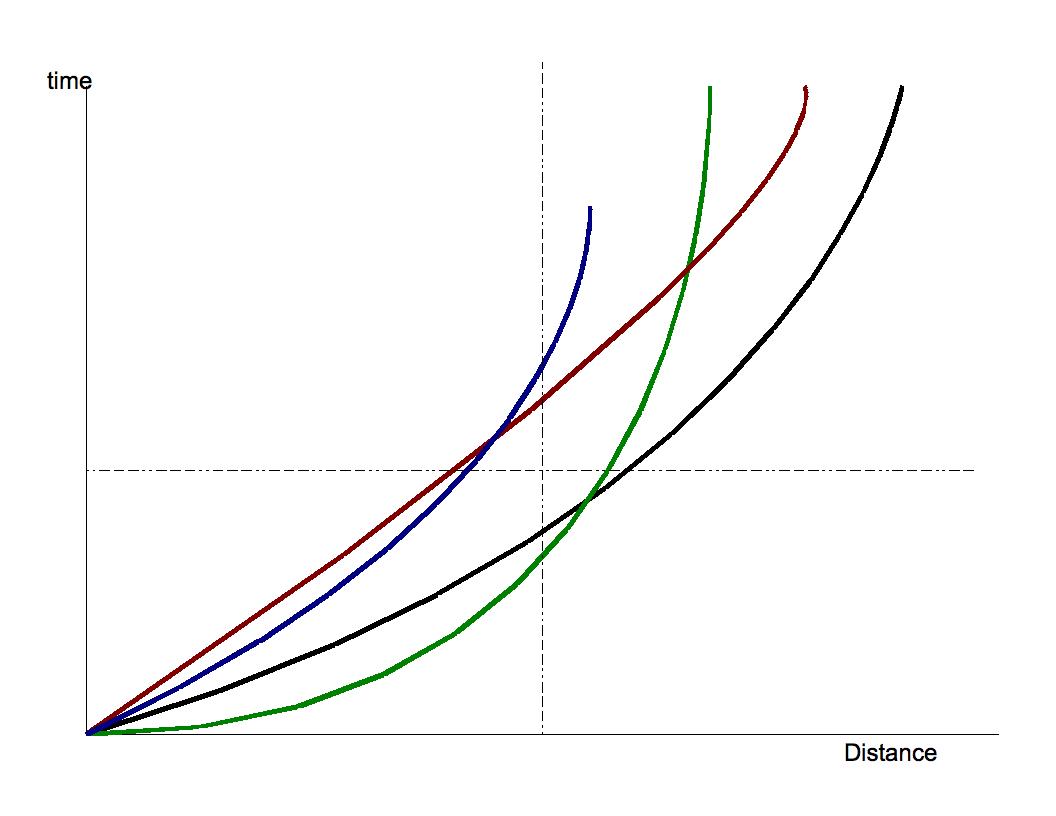
However, it turns out that these two varieties of races are no longer equivalent once we have more than 3 racers.  For example, suppose we add the Red racer below.


And consider the fixed-time race shown by the horizontal line in the picture.  This race generates the ordering Black>Green>Blue>Red.  If you study the picture you will see that it is impossible to generate that ordering by any vertical line. Indeed, at any distance where Blue comes out ahead of Red, the Green racer will be the overall winner.

Likewise, the ordering Green>Black>Red>Blue which is generated by the fixed-distance race in the picture cannot be generated by any fixed-time race.

So, what does this mean?

  1. The choice of race format is not innocuous.  The possible outcomes of the race are partially predetermined what would appear to be just arbitrary units of measurement.  (Indeed I would be a world class sprinter if not for the blind adherence to fixed-distance racing.)
  2. There are even more types of races to consider.  For example, consider a ray (or any curve) drawn from the origin.  That defines a race if we order the racers by the first point they cross the curve from below. One way to interpret such a race is that there is a pace car on the track with the racers and a racer is eliminated as soon as he is passed by the pace car.  If you play around with it you will see that these races can also generate new orderings that cannot be duplicated. (We may need an assumption here because duality by itself may not be enough, I don’t know.)
  3. That raises a question which is possibly even a publishable research project: What is a minimal set of races that spans all possible races? That is, find a minimal set of races such that if there is any group of contestants and any race (inside or outside the minimal set) that generates some ordering of those contestants then there is a race in the set which generates the same ordering.
  4. There are of course contests that are time based rather than quantity based.  For example, hot dog eating contests.  So another question is, if you have to pick a format, then which kinds of feats better lend themselves to quantity competition and which to duration competition?

Ever since I read a great review of 2008 Oregon Pinot Noirs in the NYT, I’ve been on the lookout in local wine stores.  I can’t find many from the NYT list.  So I tried the Torii Mor on  a whim   It’s just over $20 and excellent value.  Classic cherry fruit but with plenty of acid and a dry finish.  Well balanced.  On this evidence, I’m going to try any 2008 Oregon Pinot Noir I can find in this price range.

  1. Everybody hates Phil Collins
  2. I don’t think my Twitter persona is represented here.
  3. Qaddafi chic.
  4. 82 tattoos of Julia Roberts.
  5. Chatroulette performance art.
  6. Missing Lones Smith.

The forward looking agent forecasts trends in consumer demand, spots market opportunities and readies his organization for a great leap forward.  But any decision is plagued with unforeseen contingencies.  By necessity, any agent must also be backward looking, putting our fires as they appear. This sucks attention from looking forward and the organization may atrophy and lose its edge.

These two extremes manifest themselves in different ways at different points in an organization’s history.  A firm that is just starting out will be forward looking by definition.   There is no history, no fires to put out.  Either the young firm dies – its products are unpopular – or it succeeds.  That’s when the trouble starts.  Success also breeds emergencies and crises large and small.  Now attention is diverted.  A young organization that reaches middle age it may not survive into old age.  If optimization of extant decisions is the main activity, there is no time left to prepare for the next wave of technology, consumer demand…etc.

If the organization reaches old age, it is because it has learned to deal with unforeseen contingencies.  It has set up frameworks, codes of practice and procedures that can simply be activated when a fire appears.  This creates room for forward looking strategy analysis.

To summarize, a young organization is more forward-looking than a middle-aged organization.  An old organization may also be more innovative than a middle-aged organization. We do not have a way to rank young and old organization with this bare-bones theory.  There are, of course, many other theories.  The “replacement effect” is one obvious alternative.

My daughter’s 4th grade class read The Emperor’s New Clothes (a two minute read) and today I led a discussion of the story.  Here are my notes.

The Emperor, who was always to be found in his dressing room, commissioned some new clothes from weavers who claimed to have a magical cloth whose fine colors and patterns would be “invisible to anyone who was unfit for his office, or who was unusually stupid.”

Fast forward to the end of the story. Many of the Emperor’s most trusted advisors have, one by one, inspected the clothes and faced the same dilemma. Each of them could see nothing and yet for fear of being branded stupid or unfit for office each bestowed upon the weavers the most elaborate compliments they could muster.  Finally the Emperor himself is presented with his new clothes and he is shocked to discover that they are invisible only to him.

Am I a fool? Am I unfit to be the Emperor? What a thing to happen to me of all people! – Oh! It’s very pretty,” he said. “It has my highest approval.” And he nodded approbation at the empty loom. Nothing could make him say that he couldn’t see anything.

The weavers have succesfully engineered a herd. For any inspector who doubts the clothes’ authenticity, to be honest and dispel the myth requires him to convince the Emperor that the clothes are invisible to everybody.  That is risky because if the Emperor believes the clothes are authentic (either because he sees them or he thinks he is the only one who does not) then the inspector would be judged unfit for office.  With each successive inspector who declares the clothes to be authentic the evidence mounts, making the risk to the next inspector even greater.  After a long enough sequence no inspector will dare to deviate from the herd, including the Emperor himself.

The clothes and the herd are a metaphor for authority itself.  Respect for authority is sustained only because others‘ respect for authority is thought to be sufficiently strong to support the ouster of any who would question it.

But whose authority?  The deeper lesson of the story is a theory of the firm based on the separation of ownership and management.  Notice that it is the weavers who capture the rents from the environment of mutual fear that they have created.  They show that the optimal use of their asset is to clothe a figurehead in artificial authority and hold him in check by keeping even him in doubt of his own legitimacy.  The herd bestows management authority on the figurehead but ensures that rents flow to the owners who are surreptitiously the true authorities.

The swindlers at once asked for more money, more silk and gold thread, to get on with the weaving. But it all went into their pockets. Not a thread went into the looms, though they worked at their weaving as hard as ever.

The story concludes with a cautionary note.  The herd holds together only because of calculated, self-interested subjects.  The organizational structure is vulnerable if new members are not trained to see the wisdom of following along.

“But he hasn’t got anything on,” a little child said.

“Did you ever hear such innocent prattle?” said its father. And one person whispered to another what the child had said, “He hasn’t anything on. A child says he hasn’t anything on.”

“But he hasn’t got anything on!” the whole town cried out at last.

Herds are fragile because knowledge is contagious.  As the organization matured everyone secretly has come to know that the authority is fabricated. And later everyone comes to know that everyone has secretly come to know that.  This latent higher-order knowledge requires only a seed of public knowledge before it crystalizes into common knowledge that the organization is just a mirage.

And after that, who is the last member to maintain faith in the organization?

The Emperor shivered, for he suspected they were right. But he thought, “This procession has got to go on.” So he walked more proudly than ever, as his noblemen held high the train that wasn’t there at all.

Non-state actors with extreme agendas try to influence state actors.  This class overviews a potpourri of models that explore why a player might join a non state organization, the logic of non state actor strategy and the costs and benefits of torture.

Iannaccone has a classic paper on religious sects and their purpose and strategy.  It has been applied to terrorism by Eli Berman.  Such organizations provide public goods (healthcare, childcare etc) which are non-rival and excludable.  They are club goods.  And individual who joins such an organization is tempted to free-ride and and use his labor on privately productive secular activities.    A religious sect might then prohibit secular activities and will require sect members to wear some kind of uniform to make monitoring easier. Also, a sect would like to admit members who have bad outside options to minimize the free-rider problem.  Requiring a sacrifice, a costly signal, can help to identify the ideal member.

There are many theories for the logic of non state actor strategy.  The simplest is that terrorists seek to impose large costs on some “occupier” and drive them out.  Another is the opposite: terrorists seek to inflame a perceived enemy (a secondary audience). This in turn influences a primary audience whose support is necessary to achieve the non state actor’s ends.  This is in effect a three player game where the extremist inflames a primary audience by changing the behavior of a secondary audience.  This is only worth doing if the primary audience is suggestible.  It might for example signal that the chances for peace are good if only extremism could be ignored.

Finally, what if a potential terrorist is in custody and may have valuable information that can save lives?  He might break under torture.  A cost-benefit analysis, a favorite of moral philosophers, recommends torture if the value of lives saved is large even though torture is morally reprehensible.  But the same cost-benefit calculation subverts the process of torture. If the suspect starts talking, the value of his remaining information outweighs the costs of torture.  If he is silent and probably innocent, it recommends stopping.  But this undercuts the rationale for torture: the terrorist should stay silent as this is his best hope of escape.  But then the value of torture is minimal as information is unlikely to be conceded.

Here are the slides.

The increasing rate of litigation means that there is a far higher chance that doctors will be asked in court to explain the exact meaning of NFN (Normal for Norfolk), FLK (Funny looking kid) or GROLIES (Guardian Reader Of Low Intelligence in Ethnic Skirt).

Dr Fox recounts the tale of one doctor who had scribbled TTFO – an expletive expression roughly translated as “Told To Go Away” – on a patient’s notes.  He told BBC News Online: “This guy was asked by the judge what the acronym meant, and luckily for him he had the presence of mind to say: ‘To take fluids orally’.”

Read the article to find out what LOBNH means, what the Dirt Bag Index measures, and what it takes to be deemed Pumpkin Positive.  You may need a reference to understand your own medical records.

Barretina bungle:  Mallesh Pai

Barack Obama was not the first to wear flip flops in the Oval Office:

That and other flip flop trivia here.

I wore exclusively flip flops up until the time I moved to the Midwest.  My standby ride was the 99 cent pair found at the pharmacy checkout line. They would disintegrate in about a month but 12 bucks for a year of footwear is like Divine Grace. As a bonus, that day when the stem blows out and you wind up dragging the rubber carcass around is bound to attract some fun conversations.

My high water mark came in the 9th grade which saw the greatest innovation in flip flop history:  Cheap Charlie’s Sole Suckers. These are nothing more than slabs of polyurethane that you literally glue to the bottom of your feet.  No flipping, no flopping. (Also, it turns out no running, skateboarding, stepping in puddles, or being victimized by the dreaded flat tire else you destroy the fragile adhesive and spend the rest of the day barefoot and sticking to dirt, shag carpet, NoDoz, PeeChees, Djarums, NoSkote, bus fare, bottlecap rebuses, Rocky Horror rice, Galaga, duct tape, Space Shuttle debris, jacuzzi bubbles, and hall passes.)

I passed through the flojo phase, and now I am a shamelessly gentrified Reef-o-phile once the temperature rises above 60F which in Chicago is the day before it rises above 80F.

Porkpie plié:  Courtney Conklin Knapp.

I am always surprised in Spring how suddenly there are cars parked on the residential streets in my town where just a month ago the streets were empty. These are narrow streets so a row of cars turns it into a one-lane street that supposed to handle two-way traffic.  And that is when we have to solve the problem of who enters the narrowed section first when two cars are coming in opposite directions on the street.

On my street cars are only allowed to park on the North side.  So if I am headed West I have to move to the oncoming traffic side to pass the row of parked cars.  If I do that and the car coming in the opposite direction has to stop for just a second or two, the driver will be understanding (a quick royal wave on the way by helps!) But if she has to wait much longer than that she is not going to be happy.  And indeed the convention on my street would have me stop and wait even if I arrive at the bottleneck first.

But of course, from an efficiency point of view it shouldn’t matter which side the cars are parked on.  Total waiting time is minimized by a first-come first-served convention.  And note that there aren’t even distributional conseqeuences because what goes West must go East eventually.

Still the payoff-irrelevant asymmetry seems to matter.  For example, a driver headed West would never complain if he arrives second and is made to wait.  And because of the strict efficiency gains this is not the same as New York on the left, London on the right. The perceived property right makes all the difference. And even I, who understands the efficiency argument, adhere to the convention.

Of course there is the matter of the gap. If the Westbound driver arrives just moments before the Eastbound driver then in fact he is forced to stop because at the other end he will be bottled in.  There won’t be enough room for the Westbound driver to get through if the Eastbound driver has not stopped with enough of a gap.

And once you notice this you see that in fact the efficient convention is very difficult to maintain, especially when it’s a long row of cars.  The efficient convention requires the Westbound driver to be able to judge the speed of the oncoming car as well as the current gap.   And the reaction time of the Eastbound driver is an unobservable variable that will have to be factored in.

That ambiguity means that there is no scope for agreement on just how much of headstart the Eastbound driver should be afforded.  Especially because if he is forced to back up, he will be annoyed with good reason. So for sure the second best will give some baseline headstart to the Eastbound driver.

Then there’s the moral hazard problem.  You can close the gap faster by speeding up a bit on the approach.  And even if you don’t speed up, any misjudgement of the gap raises the suspicion that you did speed up, bolstering the Eastbound driver’s gripe.  Note that the moral hazard problem is not mitigated by a convention which gives a longer headstart to the Eastbound driver.  No matter what the headstart is, in those cases where the headstart is binding the incentive to speed up is there.

All things considered, the property rights convention, while inefficient from a first-best point of view, may in fact be the efficient one when the informational asymmetry and moral hazard problems are taken into account.

  1. Software agents are invading online poker sites and relieving the humans of their money.
  2. The New York Times web site will beat you at rock scissors paper because you are a predictable human. (mm:  Courtney Conklin Knapp)
  3. Tyler Cowen and his computer make each other better at chess.

Following up on Tyler, the suggestion is that there are gains from specialization in computer/human partnerships.  But it is not enough for Tyler and his computer to beat a computer.  Could Tyler and another human player (of strength comparable to his computer partner) do even better?

Now it is interesting to observe that the other comparison is not possible. Would a team of two computers (with strengths comparable to Tyler and his machine) do even better? How would two computers make a team?  If the two computers came up with different ideas how would they decide which one was better?

010101:  I think we should play Re1. I rate it +.30
1110011: I considered that move and at 22 ply I rate it at +0.05, instead I suggest we sac the Knight.
010101: I considered that move and at 22 ply I rate it at -1.8.
1110011: Here take a look at my analysis.
010101:  Yes I am aware of that sequence of moves, I already considered it.  It’s worth +0.05.
1110011: No, +0.30
010101:  No, +0.05

etc.  Any protocol for deciding which is the right analysis should already have been programmed into the original software.  Put differently, if there was a way to map the pair of evaluations (.3,.05) into a better evaluation y, then the position should already have been evaluated at y by each machine individually.

The only benefit of the two computers would be the deeper search in the same amount time.  That is, a two computer team is just two parallel processers but exactly the same evaluation heuristic applied to the final position searched. In that sense the human’s unique ability is to understand when to switch heuristics.  (But why can’t this understanding be programmed into software?)

Exploding food, frog blancmange, one of the oldest pubs in England (note posh accents), Harry Potter’s drink of choice etc.  Creativity run amok with some technical skill – ideal combination for cooking or research.  Gordon Ramsay eat your heart out…