Suppose our minds have a hot state and a cool state.  In the cool state we are rational and make calculated tradeoffs between immediate rewards and payoffs that require investment of time and effort.  But when the hot state takes over we abandon deliberation and just react on instinct.

The hot state is there because there are circumstances where the stakes are too high and our calculations too slow or imperfect.  You are being attacked, the food in front of you smells funky, that bridge looks unstable.  No matter how confident your cool head might be, the hot state grabs the wheel and forces you to do the safe thing.

Suppose all of that is true.  What does that mean when a situation looks borderline and you see that instincts haven’t taken over?  Your cool, calculating head rationally infers that this must be a safer situation than it would otherwise appear.  And you are therefore inclined to take more risks.

But then the hot state better step in on those borderline situations to stop you from taking those excessive risks.  Except that now the borderline has moved a little bit toward the safe end.  Now when the hot state doesn’t take over it means its even more safe, etc.

And of course there is the mirror image of this problem where the hot state takes over to make sure you take an urgent risk.  A potential mate is in front of you but the encounter has questionable implications for the future.  Physical attraction receives a multiplier.  If it is not overwhelming then all of the warning signs are magnified.

Now at the end of 2011, as Tea-Party forces in the House of Representative finally bow to conventional economic wisdom, it may be time for economics professors to toss out some new radical ideas about public finance.  OK, let me try.

We have heard a lot of radical arguments for reducing taxation and reducing government debt, as the alleged keys to strong economic growth.  Actually, however, taxes tend to be a greater percentage of GDP in richer nations.  A reasonable hypothesis is that governments in poor nations may tax less and spend less because they have less fiscal capacity to control waste and corruption in the management of public funds.  Such nations that cannot manage public funds effectively then suffer from a lack of public infrastructure, which in turn may be a basic cause of their poverty.   That is, the greater wealth of rich nations may depend on their governments’ fiscal capacity to provide essential public goods with less waste than poor nations.  A good reliable system for managing public finances is one of the essential pillars of prosperity, as described in a new book by Timothy Besley and Torsten Persson.

The ultimate basis for all controls on public spending is of course political.  The strength of public financial management in America is ultimately based on democratic accountability of our political leaders for what they do with our taxes.  Democracy may not be perfect, but it is better than any other system for deterring corrupt misuse of public funds.

From this perspective, we can argue instead that the key to reviving long-term economic growth may be found in reforms to further improve political controls on public finance in our nation.

When voters are swayed by promises of lower taxes and lower deficits without loss of public services, it is clear that our system of democratic fiscal oversight has some room for improvement.  As the prosperity of our nation depends on the good judgment of a majority of voters, so voters depend on each others’ ability to understand questions of public finance.  That is, voters’ comprehension of public budgets is itself a public good.  We need a system to make sure that voters can understand our public budgets, and it is worth investing public money to develop such understanding.

So my radical proposal has two parts.  First, our federal, state, and local governments should publish their annual budgets online in a form that any high-school graduate can understand.  Second, our public high schools should be required to teach students how to read government budgets.

I know that this may sound impractically idealistic.  But I can recommend at least one good textbook: Dall Forsythe’s Memos to the Governor.  Written by a former budget director of New York state, this short book offers a good introduction to the standard tricks that have been used to make public spending more obscure.

Public officials, however well-intentioned, are under constant pressure to provide more public services for less money and so may feel regularly tempted to simulate such superior productivity by incurring new public debts that are not fully reported in the current year.  Devices for concealing billions of dollars of new debt cannot be fully secret, however, and the readers of Forsythe’s book will be well prepared to watch for them.  A better informed citizenry could prompt greater creativity in inventing new devices for concealment, of course.  But a greater force for clarity and transparency may be unleashed when millions of families have high-schools students who are asking why the public-finance materials have to be so confusing.

So this is my radical proposal:  Before demanding lower taxes or lower deficits, we voters should demand to be better informed about our public financial system.  Then our ability to demand better use of public funds can become a stronger pillar for future growth and prosperity.

I’ve mentioned Navarro Vineyards in the blog.  I’m a member of their wine club – they only sell direct so you cannot find their wine in stores.  Wine Review Online has an interesting interview with a second generation winemaker, Sarah Cahn Bennett, the daughter of the original owners.  For instance, a picture of what it might be like to grown up in idyllic but rural Anderson Valley:

I decided to get my undergraduate degree from Saint Mary’s College in Moraga, because after graduating from Anderson Valley High School with only 17 others, I wasn’t ready for large schools and life outside the Anderson Valley.  After getting my BS in business administration, I applied for the MS program in viticulture and enology at UC Davis.  I got my MS in 2005

From Inside Higher Ed:

In 2011, the association listed 2,836 positions, down only 6 jobs from 2010. The 2011 figures represent a 21 percent increase from the 2009 total, when the impact of the U.S. financial downturn was most evident on hiring in economics. A report by the association suggested that the total this year probably represents an increase in openings even over the 2,881 jobs reported in 2008 because many of those searches were called off after the economy nosedived in the fall of that year.

Via Lones Smith.


Chris Ziegler, retweeted by Tyler Cowen

imagine sitting down at a desk while 250 people line up and tell you, one by one, that kim jong-il has died. that’s twitter.

To which I reply:  imagine logging into Twitter and 250 people line up to tell you that Kim Jon-Il has died, and they can do it using as many characters as they want, and believe me these guys can use a lot of characters, and not only that but after they are done telling you, they are standing there in front of you and you have to have conversation with them and then find some polite way to say get out of here, i need to get some work done.  That’s working in an office.

They were all inspired by Isaac Asimov psychohistorian Hari Seldon:

Imagine you discover a lost manuscript. You read it and it has a profound effect on you. You want as many people as possible to discover it and be affected as you were.

Publishers tell you that there is no market for re-discovered literature. But a big publisher is required for the book to have the scale of distribution it deserves.

After a while you see the solution. This is a lost manuscript and nobody would know if you were to put your own name on it, market it as something brand new and get all the buzz that would come from the reviews and best seller lists.

Would you do it? Would you condemn someone who did?

  1. How to parallel park
  2. The digital divide
  3. Sweet-sounding Christmas album from John Zorn
  4. The Farrelly brothers are making a Three Stooges movie
  5. Consider The Equilibrium via Josh Gans

Yoram Bauman is also an environmental economist.  With this hat on, in the NYT, he says:

Learning about the shortcomings as well as the successes of free markets is at the heart of any good economics education, and students — especially those who are not destined to major in the field — deserve to hear both sides of the story.

Which reminds me of my plan to put in more stuff about common property resources, public goods and externalities into my MBA course next quarter…

A lovely essay by John G on his parents, how he got into economics and his work in the financial sector.

On the importance of collateral:

[E]very businessman knows leverage is important. Even Shakespeare
understood that collateral is more important than the interest rate. Who here
can remember the interest rate Shylock charges Antonio in the Merchant of
Venice? But all of you remember the pound of flesh collateral.

On debt forgiveness:

Imagine a $160,000 loan on a house that is now worth $100,000. Lenders on average get less than
25% of the loan back when a subprime borrower is thrown out of his home,
meaning in this case the lender can expect $40,000. Why? Because it takes years
to throw the family out of the house, during which time the owner does not pay
his taxes or his mortgage, and the house is ruined. If the loan had been written
down to $80,000 the borrower might well have paid all $80,000 back, perhaps by
selling the house, because then there would be $20,000 in it for him. By
demanding everything and then throwing the borrower out when he refuses, the
lender loses even more. As Portia says in very similar circumstances in the
Merchant of Venice “The Quality of mercy is not strained …It helpeth him who
gives and him who takes.” The most catastrophic blunder the American
administration has made is in not coordinating a forgiveness on mortgage loans
by lenders.

When you shop for a gift, your recipient observes only what you bought, and not what alternatives you considered.

Why would price matter more to givers than receivers? Dr. Flynn and his Stanford colleague, Gabrielle Adams, attribute it to the “egocentric bias” of givers who focus on their own experience in shopping. When they economize by giving a book, they compare it with the bracelet that they passed up.

But the recipients have a different frame of reference. They don’t know anything about the bracelet, so they’re not using it for comparison. The salient alternative in their minds may be the possibility of no gift at all, in which case the book looks wonderfully thoughtful.

Click through for an excellent article on giving, touching on the potlatch, the gift registry, and re-gifting.

Michelin has come out with its new Chicago guide, including its lowest level award, the Bib Gourmand.  As last year, a list that includes both Ann Sather, a pancake place, and Frontera Grill, a Mecca (according to me!) is incongruous. This makes me distrust all their other city guides.Are they just making the stuff up for gullible tourists? Are they trying to make you buy the guide just to se their rationalization for having Ann Sather in their guide? I decided to give the Bib Gourmand section a chance and went to Yolo in Skokie just a few miles from Evanston.

The first bit of good news: they have a kids menu.  The second: they seem to specialize in moles.  The third: the food is good!  Finally, it is BYOB, helping to keep down the expense. I’m going again. But is it Frontera Grill? No!  Is it one of the best restaurants in Chicago? Nope.  Should it be on a “good local restaurant” guide?  Definitely yes.

I’m not buying any Michelin guides for Chicago or anywhere else.

A device that blurs photos of you in compromising situations.

In an ad promoting the brand and the new “utility,” provocatively dressed women dance with abandon in a club while the surrounding men (who look distinctly married in some cases) stand at attention, ready to pounce. Meanwhile a screencrawl informs the viewer that in 2011, technological advances and social networks can now turn a night out into… hell. Next, an interloper with a camera snaps a series of pictures illuminating the negative consequences of being caught on film in such a setting. As luck would have it, though, the patrons of this club are protected by Photoblocker, and the resulting snapshots are flooded with white light.

Click the link for the details, including a promotional video.

How did British PM David Cameron steel himself for the historic all-nighter last week in Brussels?

Cameron, it is said, used his tried-and-tested “full-bladder technique” to achieve maximum focus and clarity of thought throughout the gruelling nine-hour session in Brussels. During the formal dinner and subsequent horse-trading into the early hours, the prime minister remained intentionally “desperate for a pee”.

Showing a healthy disdain for ivory-tower types who claim the opposite:

Australian and American researchers examined the “effect of acute increase in urge to void on cognitive function in healthy adults”. After making eight “healthy young adults” drink two litres of water over two hours, the researchers asked them to complete a series of tasks to test their cognitive performance. They concluded from the results that an “extreme urge to void [urinate] is associated with impaired cognition”.


Richard Russo bemoans Amazon’s takeover of retail:

Amazon was encouraging customers to go into brick-and-mortar bookstores on Saturday, and use its price-check app (which allows shoppers in physical stores to see, by scanning a bar code, if they can get a better price online) to earn a 5 percent credit on Amazon purchases (up to $5 per item, and up to three items).

Amazon seems to be using decentralized market intelligence to undercut the competition. Good for consumers but bad for bricks-and-mortar retailers, as Richard Russo explains. But the logic can equally go the other way. Firms can use market intelligence to maintain high prices. If Firm A can immediately observes Firm B’s price cut (and vice versa), it can match the price cut immediately.  This can eliminate the incentive to cut prices and hence allow firms to maintain high prices. A local example:

Over a four-year period beginning in the summer of 1996, the two dominant supermarket chains in the Chicago area charged virtually identical prices for milk, attorneys in a class-action lawsuit accusing Jewel and Dominick’s of price-fixing charged Friday in opening arguments.

So closely aligned were the chains’ pricing structures for the staple that whenever one changed milk prices the other would match it within days, the attorneys alleged….

For example, he said the chains lacked competitive behavior, indicated by a July 1996 memorandum by Dominick’s officials outlining an arrangement with Jewel in which Dominick’s employees would be permitted inside Jewel stores to check prices.

Can Dominick’s and Jewel now use iPhone apps to implement a collusive scheme without hiring employees to visit each other’s stores? There is a large mass of anonymous consumers. The firms offer discounts via apps. It would be in consumers’ interests to collude with each other, reject discounts and refuse to use the apps. But with a large mass of anonymous consumers, collusion is impossible to enforce. The firms can trigger a free-rider problem or prisoner’s dilemma amongst consumers so everyone uses the apps to get discounts. The market intelligence so gathered can be used by the firms to collude.  As a consumer, this is the Orwellian nightmare I fear, the reverse of Richard Russo’s.

(Hat Tip:  Mort Kamien told me about the milk case years ago.  Perhaps he testified against the supermarket chains?)

(Regular readers of this blog will know that I consider that a good thing.)

John Lazarev at Stanford GSB has a nice little theory paper (not his job market paper which is not little and not theory, but also nice.)  It’s a model of market competition which consists of two stages.  In stage one the firms simultaneously and non-cooperatively choose subsets of prices.  The interpretation is that the firm is restricting itself to later choose only prices from the restricted set.  After seeing the restriction sets each firm has chosen the firms then simultaneously choose prices from their respective sets.

This is a stylized model of the way “competition” works between airlines:

Almost every major US airline has independent pricing and yield (revenue) management departments. That operates as follows. The pricing department sets prices for each seating class (e.g. up to 6 non-refundable economy class fares) starting many days from the actual flight. These prices are subsequently updated very rarely. The revenue management department treats the prices as given but decides three times a day which of the fare classes to make available for purchase and which to keep closed. According to industry insiders, these departments do not actively interact with each other. Thus, there exist two stages of decision making. Effectively, the pricing department commits to a subset of prices, while the revenue management department chooses a price from this subset.

Its also a great question for a future prelim.  Construct an equilibrium (subgame-perfect please) in which the firms effectively collude and earn monopoly profits.

Simple.  (I will assume symmetric linear cost homogeneous product price-competition because it makes the argument simple and also quite stark:  standard Bertrand pricing leads to cutthroat competitition and zero profits.) In the first stage each firm restricts to only two prices:  the monopoly price and marginal cost pricing. If nobody deviates from this then all firms set the monopoly price.  If anybody deviates from this by either excluding the monopoly price or including an intermediate price then all firms set the lowest price in their chosen set.  All other deviations are ignored.

Its easy to check that this is a subgame perfect equilibrium and all firms earn monopoly profits.  Lazarev does the same for a more general model of differentiated products price competition.

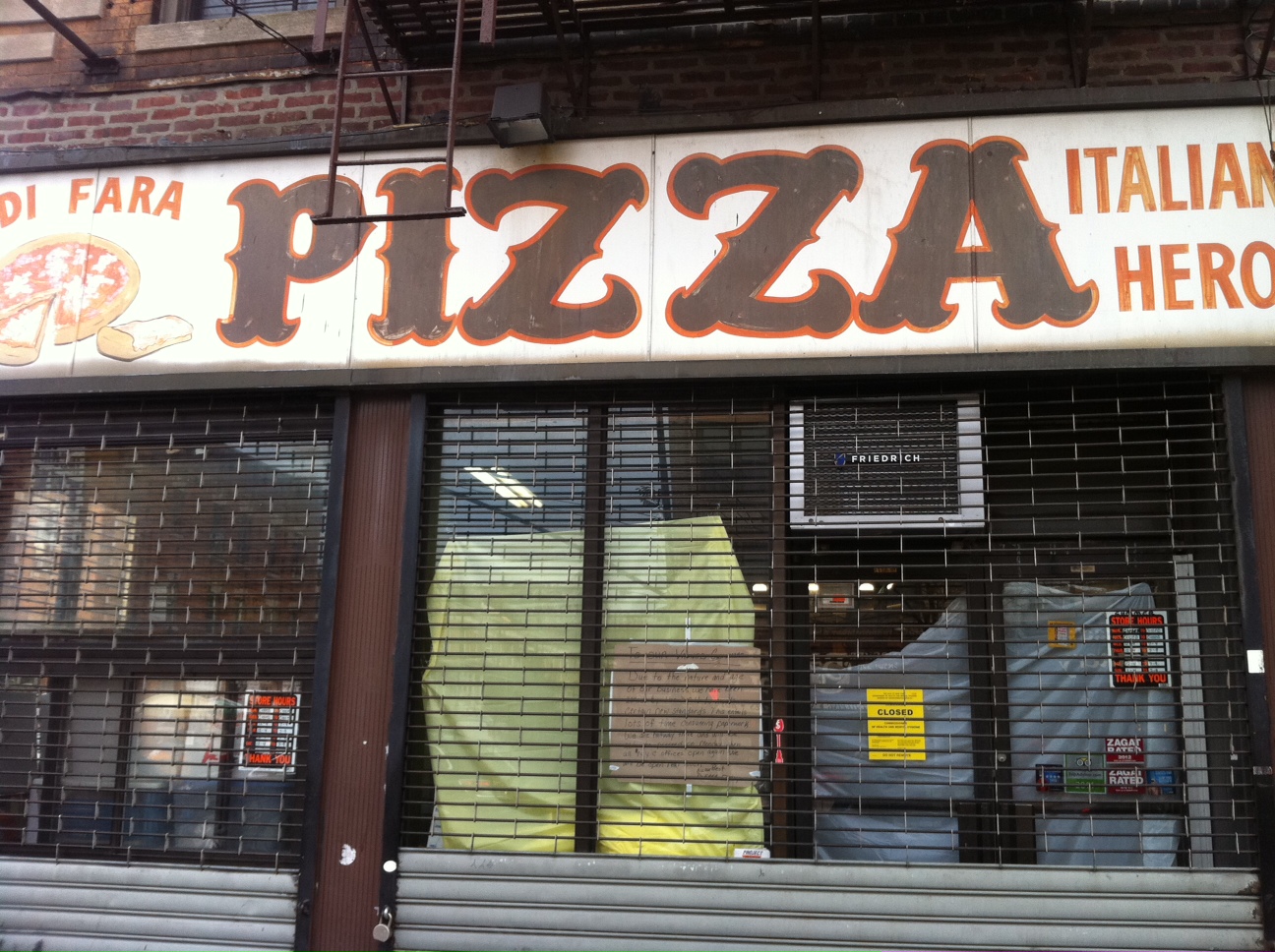
During my recent unexpected visit to New York I tried to make the best of things and hit up a legendary pizza place in Brooklyn, di Fara Pizza.  It’s a real hike from midtown Manhattan but I had an afternoon to kill.  I was hoping it was going to brighten up an otherwise gloomy day, but guess what?

Damn you Health Inspectors!

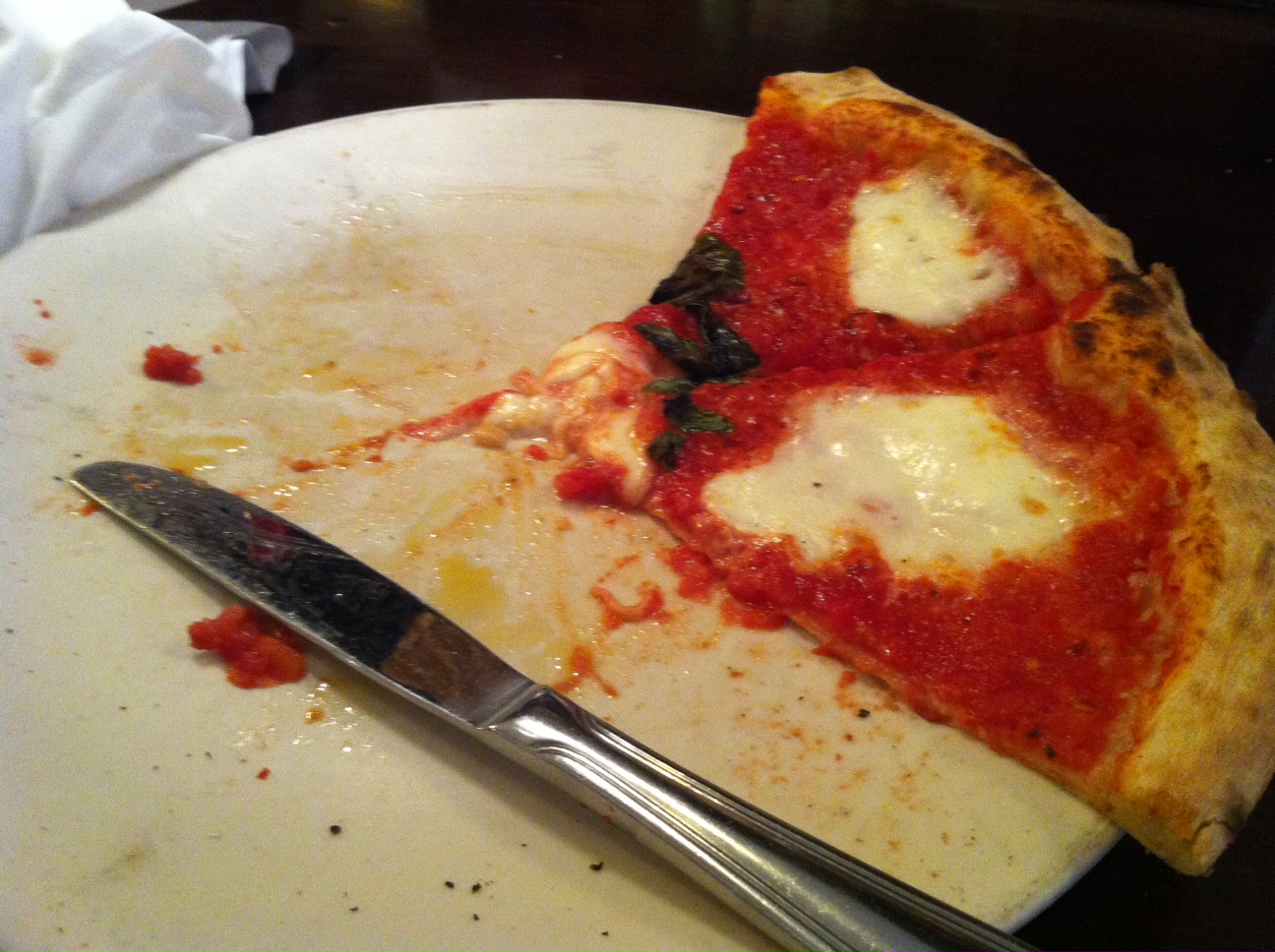
So to make it up to myself I headed back to Manhattan for my go-to Napolitano Pizza, La Pizza Fresca in the Flatiron district.  A second tragedy.  The pizza guy there was a master, and now he has gone.  I didn’t find this out until the pizza was before me but it was obvious immediately.  Same oven, same ingredients, different pizza guy; amazing the difference between superior pizza and just average.  Here’s your picture of the not-, and won’t-be-empty plate:

In the past few weeks Romney has dropped from 70% to under 50% and Gingrich has rocketed to 40% on the prediction markets.  And in this time Obama for President has barely budged from its 50% perch.  As someone pointed out on Twitter (I forget who, sorry) this is hard to understand.

For example if you think that in this time there has been no change in the conditional probabilities that either Gingrich or Romney beats Obama in the general election, then these numbers imply that the market thinks that those conditional probabilities are the same.  Conversely, If you think that Gingrich has risen because his perceived odds of beating Obama have risen over the same period, then it must be that Romney’s have dropped in precisely the proportion to keep the total probability of a GOP president constant.

It’s hard to think of any public information that could have these perfectly offsetting effects.  Here’s the only theory I could come up with that is consistent with the data.  No matter who the Republican candidate is, he has a 50% chance of beating Obama.  This is just a Downsian prediction.  The GOP machine will move whoever it is to a median point in the policy space.  But, and here’s the model, this doesn’t imply that the GOP is indifferent between Gingrich and Romney.

While any candidate, no matter what his baggage, can be repositioned to the Downsian sweet spot, the cost of that repositioning depends on the candidate, the opposition, and the political climate.  The swing from Romney to Gingrich reflects new information about these that alters the relative cost of marketing the two candidates.  Gingrich has for some reason gotten relatively cheaper.

I didn’t say it was a good theory.

Update:  Rajiv Sethi reminded me that the tweet was from Richard Thaler. (And see Rajiv’s comment below.)

The Palestinians cannot get membership in the UN because the United States would use its veto.  But they have other options.  A month ago they were voted in by a wide margin to the United Nations Educational, Scientific and Cultural Organization, UNESCO.  This compelled the United States to cease funding to UNESCO because of an American law that prohibits contributing to any organization that recognizes the Palestinian Liberation Organization which the US considers to be a terrorist arm.

The US has no veto power to prevent entry to UNESCO or 14 other special UN agencies.  Quoting Gwynne Dyer:

If the Palestinians apply for membership in each of these organisations over the next year or so, they will probably get the same 88 percent majority when it comes to a vote on membership. None of the countries that defied the United States and voted Palestine into UNESCO is going to humiliate itself by changing its vote at other UN agencies. And each time, Washington will be forced by law to cease its contributions to that agency.

The United States would not actually lose its membership by stopping its financial support – at least not for a good long while – but it would lose all practical influence on these agencies, which do a great deal of the work of running the world. It would be a diplomatic disaster for Washington…

I thank Sean Brockelbank for the pointer.

You and your partner have to decide on a new venture. Maybe you and your sweetie are deciding on a movie, you and your co-author are deciding on which new idea to develop, or you and your colleague are deciding which new Assistant Professor to hire.

Deliberation consists of proposals and reactions. When you pitch your idea you naturally become attached to it. Its your idea, your creation. Your feelings are going to be hurt if your partner doesn’t like it.

Maybe you really are a dispassionate common interest maximizer, but there’s no way for your partner to know that for sure. You try to say “give me your honest opinion, I promise I have thick skin, you won’t hurt my feelings.” But you would say that even if it’s a little white lie.

The important thing is that no matter how sensitive you actually are, your partner believes that there is a chance your feelings will be hurt if she shoots down your idea. And she might even worry that you would respond by feeling resentful towards her. All of this makes her reluctant to give her honest opinion about your idea. The net result is that some inferior projects might get adopted because concern for hurt feelings gets in the way of honest information exchange.

Unless you design the mechanism to work around that friction. The basic problem is that when you pitch your idea it becomes common knowledge that you are attached to it. From that moment forward it is common knowledge that any opinion expressed about the idea has the chance of causing hurt feelings.

So a better mechanism would change the timing to remove that feature. You and your partner first announce to one another which options are unacceptable to you. Now all of the rejections have been made before knowing which ones you are attached to. Only then do you choose your proposal from the acceptable set.

If your favorite idea has been rejected then for sure you are disappointed. But your feelings are not hurt because it is common knowledge that her rejection is completely independent of your attachment. And for exactly that reason she is perfectly comfortable being honest about which options are unacceptable.

This is going to work better for movies, and new Assistant Professors than it is for research ideas. Because we know in advance the universe of all movies and job market candidates.

Research ideas and other creative ventures are different because there is no way to enumerate all of the possibilities beforehand and reject the unacceptable ones. Indeed the real value of a collaborative relationship is that the partners are bringing to the table brand new previously unconceived-of ideas. This makes for a far more delicate relationship.

We can thus classify relationships according to whether they are movie-like or idea-like, and we would expect that the first category are easier to sustain with second-best mechanisms whereas the second require real trust and honesty.

(inspired by a conversation with +Emil Temnyalov and Jorge Lemus)

“Today’s protest was a lesson for everyone,” said Andrei Medvedev in the evening broadcast of Rossia 1. “It turns out that, to express your dissatisfaction with the authorities, it is possible to gather on a square after getting permission from those same authorities. And to keep order, all you really have to do is give a polite admonition.”

Other strangely unusual goings on described here.  Ushanka shake:  Gary Charness.

  1. Compendium of mind tricks.
  2. “They came for The Tonight Show and they got The Shining.”
  3. “Master PAUL McCARTNEY’s intentions are positive.”
  4. Status of the film adaptation of Cloud Atlas.
  5. Ayn Rand or L. Ron Hubbard?
  6. This link will bring you poems.
  7. Why the long face?

The Missouri Gaming Commission is deciding whether to scrap a voluntary lifetime blacklist for problem gamblers and replace it with a five-year suspension. That would allow nearly 11,000 self-banned gamblers back into the state’s 12 riverboat casinos. The self-exclusion list, implemented in 1996, has been a centerpiece of Missouri’s efforts to manage gambling addiction, and has been emulated in at least eight other states—usually without the lifetime ban.

 Story from the Wall Street Journal here.  I thank Daniel Akst for the pointer.

You can find it here.  Currently there are discussions of recent papers by Scholhofer-Wohl, and by McGrattan and Prescott and even some current job market papers like Draca and Bigio.

There is also a Twitter feed.

Forget about Twitter as a medium for organizing protests, it is surprisingly effective as an actual protest forum.  Yesterday there was a story on NPR about a flurry of protest tweets that, within just hours, got JCPenney to remove from their racks a controversial t-shirt with the slogan “I’m too pretty to do homework so I have my brother do it for me.”  (I am not 100% sure but I think the parents were worried about the message this was sending to boys. Boys can be pretty too and they shouldn’t always be doing so much homework.)

Electronic communications and social networking change the power structure of protests.  One subtle reason is that the act of listening to the protest is no longer public and verifiable.  The organization that you are protesting against would like to commit not to listen to your protest.  If we believe that there is no way to get JCPenney’s ear then no matter how much we care about boys’ self esteem we waste our effort on a futile protest.  In the old days, with the exception of protests so vocal that they make the evening news, this commitment was credible.  Just don’t give out any public channel through which to express your protest.

Now the channel is already there.  But more importantly, the act of listening to the protest is private and not verifiable.  It is impossible to commit not to listen to protests on Twitter.  JCPenney would like to announce to the world that no matter how much we protest on Twitter they are just not paying attention, so don’t bother.  But even if they believed that announcement worked, they would still have an incentive to monitor #JCPenney hashtags on Twitter just in case some protest happened to break out.  We all know that so we don’t believe them when they say they aren’t listening.

So social media change the balance of power of protests because they give the protesters the first-mover advantage.

Ex-News of the World journalist and phone hacking aficionado Paul McMullan describes the public interest thus:

The public interest, he said, added up to no more than the sheer number of copies the News of the World could sell. “Circulation defines the public interest” – which meant that everything was legitimate as long as the public bought the paper. “You have to appeal to what the reader wants – this is what the people of Britain wants. I was simply serving their need,” he said

Hence, if the people are willing to pay to  read about Hugh Grant’s peccadilloes, then it is O.K. to hack into his phone etc. to give the people what they want.  There is a flavor of a free market argument here.  But we know that prices are necessary for the market to work efficiently – the market is not literally free in terms of commodities being free! There are no prices here so there is no reason why giving the public what they want leads to efficiency.  Hugh Grant may value keeping the identity of the mother of his child secret at v while the public values the information at 0<v'<v . In the absence of a price, the information will get revealed even when it is inefficient (i.e it does not maximize social surplus).

Then there is the reverse scenario where details of Hugh’s shenanigans in L.A. are worth v’ to the public and secrecy is worth v to Hugh but v’>v>0. In this case the ex post efficient outcome will be implemented by the media. But there is ex ante inefficiency in gossip production. As Hugh does not capture any or the surplus he generates from cavorting with ladies of the night, he will not cavort at the socially optimal level. To fix this serious problem, Hugh and the Sun, Daily Mail etc have to begin by consulting the seminal work of Ted Groves and Myerson and Satterthwaite. A mechanism of some sort needs to be set up to maximizes second-best social welfare. I am sure someone has already worked this out in some abstract mechanism design context (Cole, Mailath and Postlewaite or Bergemann and Valimaki?). The basic idea should involve “selling the firm to the agent” or setting up transfers so each agent maximizes social surplus. This is hard to do for all agents simultaneously I would guess unless you accept some inefficiency in terms of dropping budget balance or accepting some underinvestment ex ante.  But this is still better than the ad hoc mechanism we have right now where the court system makes transfers to Hugh. This wastes resources and does not result in the optimal scheme.

While we mull over what the answer might be, we can enjoy this McMullan performace:

Beginning in February of 2012 Stanford economist Matt Jackson and computer scientist Yoav Shoham will be offering an online course in game theory.  2 hours of video lectures will be posted each week online and there will be a forum to ask questions of the instructors.  Here is their introductory video.

The website where you can sign up for the course is here. Northwestern/Kellogg should do stuff like this.

In academia, Americans are a small minority of your colleagues.  And so very frequently the conversation turns to the subject of American public schools.  Europeans, Asians, even Canadians are deeply suspicious about the quality of education in American public schools.  All but a few of them put their kids in private schools.

As for the Americans, while they also favor private schools more than the typical non-academic family, still a majority of them happily enroll their kids in public schools.

And the conversation about schools is remarkable because there is general agreement about the facts but polarized opinions about their consequences.  American public schools are less rigorous, less challenging, and less disciplined; they are more focused on socialization, “creativity” and self-esteem.  For the Europeans these are the weaknesses and for Americans these are the strengths.  (Of course I am exaggerating the polarization but not by a lot.)

Having been involved in countless variations of this debate I have finally figured out why its so entrenched:  both sides are right.

Academics are a highly selected set of people.  Many accidents have to happen to produce someone with the qualities and preferences leading them here.  The type of education you had must have matched perfectly the type of person you are for all of that to come together.  And since people come in different types, they require different styles of education to succeed.

This explains a lot when you look backwards through that process.  An American who survived the American public school system and wound up in academia is almost surely someone for whom that system works well.  And a European who succeeded did so precisely because he didn’t go to schools like that.  This is not saying that Europeans wouldn’t benefit from wishy-washy American schools, just that all of the Eurpoeans who would have didn’t get that and so they didn’t turn out as successful as the Europeans whose schools matched their type.

And so European parents look at American schools and rightly see that those schools would have been a disaster for them.  They extrapolate to their kids and conclude, rightly or wrongly, that their kids should avoid American public schools.    American parents, just as rightly, see the opposite.

(Trivia:  I am a product of public schools.  Here are some of my better-known classmates.  See if you can guess which one I got in a fight with in junior high.)

Next Iron Chef is much better than Iron Chef.  The latter almost always has Bobby Flay matching his Southwestern style cuisine against some hapless contestant who usually loses.  Next Iron Chef has more uncertainty, some new faces and some better chefs.  Last night’s episode had fun twists and turns coming out of the mechanism design and a tragic-comic outcome.

First, the chefs had to “bid” for ingredients in a Dutch auction with time allowed for cooking as the “currency”.  There were five chefs and five ingredients.  The lowest bid won for each of the first four ingredients. The chef who “won” the last ingredient was by the rules of the mechanism left with a cooking time of the lowest bid on the first four ingredients minus 5 minutes. The ingredients were revealed one by one. That was the first twist.  The second was that the Chef Anne Burrell had “won” the previous episode and had an advantage coming into this one (more on this below).

Equilibrium analysis for the first twist is not available but instinct suggests very aggressive bidding towards the end since you begin bidding on the fourth ingredient knowing the maximum time you will have with the fifth. This will trigger aggressive bidding all the way through.  This was true for all ingredients except sardines which Anne Burrell won for a bid of 50 minutes.  Chef Alex Guarnaschelli got the last ingredient, lamb chops, with 25 minutes to cook. Since, Chef Anne had about 20 minutes more than the other chefs, she made three sardine dishes.  It is always an error to make multiple dishes in this competition.  The judges seem to use a lexicographic criterion.  They compare your worst dish with the those of the other chefs.  If your worst dish is tied with others’ dishes, then your best dish comes into play and you win. So, doing multiple dishes typically backfires because you cannot spend enough time perfecting each of your dishes so you invariably end up with the worst dish and your best dish gets ignored.  The First Irony is that having more time made Chef Anne think she had to do more dishes (she did three) and one of them was Yuk.

Now the second twist: Chef Anne’s advantage was that she got to taste the other four dishes and decide which was of them was the worst. The theme of the episode was “Risk” and she decided, in my opinion voting honestly according to her preferences, that Chef Jeffrey Zakarian had the least risky dish. The two worst chefs from the first part of the competition face off in the second part. And the loser gets eliminated. Chef Anne got to chose one of the two potential losers. What if Chef Anne had voted strategically? The first instinct is to put the best chef in the knockout round but this is wrong.  This chef will face one of the worst chefs in all likelihood, beat them and come back the next episode.  It is is better to chose the chef you would like to face in case your dish ends up at the bottom.  That chef is Chef Alex in my opinion.  But Chef Anne chose Zakarian who is a star.  And he defeated her in the knockout round.  This is Second Irony.

Who would the judges have chosen if they had leeway? It seems Chef Alex would have been in the knockout round and probably Chef Anne would have dealt with her.  This is Third Irony.  This episode was Shakespearean, as Chef Alex pointed out.