
You are currently browsing the category archive for the ‘Uncategorized’ category.
Models of costly voting give rise to strategic turnout: in a district in which party A has a big advantage, supporters of party A will have low turnout in equilibrium in order to make the election close. That’s because only when the election is close will voters have an incentive to turnout and vote, which is costly.
Looking at elections data it is hard to identify strategic turnout. Low turnout is perfectly consistent with non-strategic voters who just have high costs of voting.
Redistricting offers an interesting source of variation that could help. Suppose that a state has just undergone redistricting and a town has been moved from a district with a large majority for one party into a more competitive district. Non-strategic voters in that town will not change their behavior.
But strategic voters will have different incentives in the new district. In particular we should see an increase in turnout among voters in the town that is new to the district. And this increase in turnout should be larger than any change in turnout observed for voters who remained in the district before and after redistricting.
There are probably a slew of testable implications that could be derived from models of strategic turnout based on whether the new district is more or less competitive than the old one, whether the stronger party is the same or different from the stronger party in the old district, and whether the town leans toward or against the stronger party in the new district.

Consider a Man and a Woman. Time flows continuously and the horizon is infinite. At time 



where 

The closer they get the clearer they can see into one another’s eyes, revealing to each of them the true depth of their love, captured by the state of the world 
In this game, the lovers have common interests. Each wants to kiss if and only if their love is true, i.e. 

Along the equilibrium path their lips move fleetingly close. At close proximity every tiny fluctuation in the speed of approach communicates to the other changes in the private estimates 

But then: does he see doubt in her eyes? Did she blink? He cannot be sure. A bad signal, a discrete drop in his estimate and this causes him to hesitate. And since
But she doesn’t. She sees deeper than that and instead she lurches ahead ever so slightly. He is looking into her eyes: he can see that she believes with all her heart that
His doubts are vanquished. He loves her. She knows that he knows that she loves him too. And at last it is common knowledge that their love is true and they will kiss and in their moment of deepest passion they discover something about their payoff functions they haven’t before. This moment is the first moment in the rest of their lives together. They will not rush. Time is standing still now. Together, as if coordinated by the eternal spirit of amor, they allow 

so that their convergence occurs smoothly but still in finite time.
Happy Anniversary Jennie
(drawing: Chemistry from www.f1me.net)
(It used to be 4 and 5.)
A student in her 5th year who doesn’t have a stellar job market paper is always tempted to stay another year and try to produce something better. This is the ex post incentive of an individual student.
But ex ante the department as a whole would like to enforce a commitment for all students to go on the market in 5, even those whose job market paper at that stage leaves something to be desired. The basic reason is risk aversion. Every year they spend in grad school they produce another signal for the market. Good signals improve their prospects but bad signals make them worse. They would avoid the additional risk by committing to stay only 5 years rather than 6.
Now consider a student whose job market paper in year 5 leaves something to be desired. If she stays another year and produces a good paper, then although she is better off, she raises the bar for her colleagues and thereby strengthens their incentives to stay another year. A department policy that strongly incentivizes students to finish in 5 is needed to prevent the implied unraveling.
But that’s MIT. Then there’s everybody else. Students in other departments have to compete with MIT students for top jobs. At a department like Yale, only the best students will be able to compete for top jobs and this makes them risk loving not risk averse. Instead of wanting to minimize signals, the best Yale students want to produce enough signals in hopes that at least one of them is good enough to give them a shot at a top department job.
So one should expect funding, TAships, and face time with advisors to drop after 5 years at MIT but continue into the 6th year at Yale. (Note: I have no data on this.)
To provide some interpretation, consider a set of equidistant urinals in a washroom and men who enter the room sequentially. Men dislike to choose a urinal next to another urinal which is already in use. If no urinal providing at least basic privacy is available, each man prefers to leave the room immediately. Each man prefers larger distances to the next man compared to smaller distances. The men enter the bathroom one by one in rapid succession, so men will only consider the privacy they have after no further men decides to use a urinal (e.g., the privacy the first man enjoys before the second man enters is too short to influence the first man’s utility).
One of the paper’s main results is that maximizing throughput (Beavis!) of a washroom may, paradoxically, entail restricting total capacity. Consider a wall lined with 5 urinals. The subgame perfect equilibrium has the first gentleman take urinal 2 and the second caballero take urinal 5. These strategies are pre-emptive moves that induce subsequent monsieurs to opt for a stall instead out of privacy concerns. Thus urinals 1, 3, and 4 go unused. If instead urinals 2 and 4 are replaced with decorative foliage, and assuming that gentleman #1 is above relieving himself into same, then the new subgame perfect equilibrium has him taking urinal 1, and urinals 3 and 5 hosting the subsequently arriving blokes. See the example on page 11.
Free cowboy hat tip: Josh Gans
“Improvisational theater” always means comedy. There doesn’t seem to exist any improvisational tragedy/drama. Why? I don’t think its because improvised drama would not be as interesting or entertaining as improvised comedy.
- Its just selection. People become comedians because they are funny in real life. To be funny in real life you have to know how to create humor out of the random events that happen around you. People become dramatic actors if they are good at understanding and reflecting dramatic themes in text.
- Its just training. Improvisation is what you practice if you want to do comedy. Its not a useful skill for dramatic actors (absent an already existing market for improvising tragedians.)
- Improvisation is by its nature funny. Seeing something you don’t expect is usually going to be funny even if it is nominally tragic. Like slipping on a banana peel. So improvised tragedy is just a contradiction in terms.
- To make drama work the players must have a high degree of coordination in terms of the development of the story and that is too hard to achieve through improvisation. By contrast, absurd plotlines add to the comedic effect of improvisation.
- Improvised drama would indeed be no worse than improvised comedy but that’s not the relevant comparison. It would be much worse than scripted drama. In other words drama has a larger range of quality than comedy and to hit the highs you need a script.
- Improvisation inevitably breaks the fourth wall. The audience is wondering “can they do it?” and the actors are self-consciously playing on that tension. Breaking the fourth wall tends to heighten comedy but cheapen drama.
(Plundered from a conversation I had with Chris Romeo.)
Let’s join Harvard Sports Analysis for the post-mortem:
But no one knew that his score would decide the game. Before he ran the ball in, the Giants had 0.94 win probability (per Advanced NFL Stats). After the play, the Giants’ win probability dropped to 0.85. Had he instead taken a Brian Westbrook or Maurice Jones-Drew-esque knee on the goal line, the Giants would have had a 0.96 win probability. Assuming the Patriots used their final time out, the Giants would have had 3rd and Goal from the 1-yard line with around 1:04 left to play. At this point, the Giants could either attempt to score a touchdown or take a knee. Assuming the touchdown try was unsuccessful or that Eli Manning kneeled, the Giants could have let the clock run all the way down to 0:25 before using the Giants’ final time out. With 4th and Goal from the 2 with 25 seconds left to play, the Giants would have a 0.92 win probability, 0.07 higher than after Bradshaw scored the touchdown of his life.
I am not sure about all this though. Shouldn’t Bradshaw have just stood there on the 1 (far away enough that he can’t be pushed in) and then cross over at the last second?
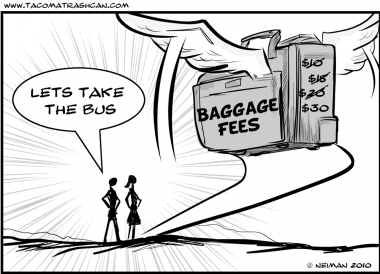
The usual examples we give for the law of unforeseen consequences involve government intervention. For example, rent control helps people who manage to get apartments at subsidized rates. But supply dries up so many people won’t manage to rent. (They will buy a house they can’t afford and cause a mortgage crisis!) But the law of unforeseen consequences should equally apply to the private sector. There is less scrutiny of the private sector by the media. Plus it is hard to get information as it is not in the public domain. Sometimes, the policies adopted by forms are public and we can all see the law operate:
An entire cottage industry has emerged for products that help people evade the baggage-check fees, according to Kate Hanni, director of FlyersRights.org, a consumer group that represents airline passengers. Ms. Hanni uses vacuum-seal bags inside her carry-on bags, she said; the bags, which shrink down to a compact package when air is pulled out by a vacuum cleaner, allow her to fit considerably more items in a carry-on than would normally be possible.
“I can fit three times the amount of clothes in a carry-on than I used to be able to,” she said.
There is also the Scottevest line of travel clothing in which trench coats, vests and other garments are made with large built-in pockets that allow people to carry everything from folded shirts to an iPad.
“You can fit all of your folded shirts, iPad, cellphone, iPod, sunglasses, camera, passport, keys — you can put everything in the jacket that you would put in a carry-on,” Ms. Hanni said. “It’s sort of sweet justice.”
Plus we have more people with carry ons, delays as they board the plane and gate check their bags etc. etc. Surely, some effects were foreseen but were they all?
Candidates S and R are competing in the opposing party’s primary, and your candidate awaits the winner in the general election. Your candidate beats S in the general election with probability s and beats R in the general election with probability r<s. You would like S to win the primary since s>r. But S is currently the underdog, he beats R in the primary with only probability p. Should you spend money to help S?
Every percentage point you can add to S’s chance of winning the primary increases your candidate’s odds in the general election by s-r < 1.
(you win the general election with total probability ps + (1-p) r. an increase in p by one unit increases this probability by s-r.)
If you save your money for the general election, every percentage point you add to your own chance of winning raises your own chance of winning by, well, 1 percentage point.
- The same analysis goes through with any number of candidates in the primary. So you can add G and P and it won’t change anything.
- This is about the marginal value of influencing a 1 percent change in the election probabilities. That value is larger in the general election. But there may be differences in the marginal cost of influencing a primary versus the general.
- In particular, if the primary is a three-candidate race there may be a lumpy return on your investment. For example, if you increase s by a little bit that could cause G to drop out of the race and then hope that a big chunk of his probability of winning goes into increasing p.
- However, with G currently at about 3% probability at Intrade, at most you can get 3 times s-r. For this to outweigh the 1 you get from the general it must be that s-r > 33%
He seems to have mixed feelings:
There are three lanes, with the left two lanes narrowing into one. A slight bit further ahead, the traffic from Gallows Road merges into the right lane, map here.
Many people from the far left lane merge “unethically,” driving ahead as far as they can, and then asking to be let in at the near-front of the queue. The traffic from Gallows Road, coming on the right, merges ethically, as it is a simple feed of two lanes nto one. They have no choice as to when the merge is, although de facto the construction of the intersection puts many of them ahead of the Rt.50 drivers.
The left lane merge is slightly quicker than the right lane merge, in part because not everyone is an unethical merger. Yet it is more irksome to drive in the left lane, because you feel, correctly, that people are taking advantage of you (unless you are an unethical merger yourself, which I am not).
In recent times, I have switched my choice to the right lane.
Scott Ogawa has the floor:
Consider [a] heterogeneous group of people who have different internal temperatures. In the Summer, people who are really hot complain a lot to the building manager, since building is [the] only source of cool. People who are really cold do not complain so much since there is always the “outside option” (literally) as relief. Things switch in the Winter. A complaint-minimizing building manager will jack the heat up in the Winter, and the A/C in the Summer.I have no data, and it is tough to trust how things “feel” since we are not the best judges of absolute temperature. Nevertheless, I have heard many folks say the temperature inside big buildings always seems negatively correlated with outside temperature, which is extra strange given this costs more than a positive correlation.
Scott’s solution is something like this: since people differ in their hot/cold preferences you want some variation in the temperature inside. Most buildings aim for uniformity. If half of the building is warm and the other half is cool, people will pick their favorite side of the building. Keeping the mean temperature constant but adding a mean-preserving spread raises overall welfare due to sorting.
In a very interesting WSJ article (I managed to read it without a subscription), Tom Sargent writes:
Did the federal government do the right thing in refusing to bail out the states in the early 1840s? By doing so, the federal government reset its reputation vis-a-vis the states, telling them in effect not to expect it to underwrite their profligacy. In the short run, that cost the federal government substantially in terms of its reputation with its own creditors. Federal credit abroad suffered along with state credit. But in the long run, the decision exposed state governments to continuing market discipline, making future crises and requests for federal bailouts less likely.
If the federal government had chosen to bail out the states a second time, it probably would have taken greater control over state taxes and revenues in order to prevent yet another bailout situation. Refusal to bail out the states was thus a pivot point in sustaining a federal system in the United States. It led the states to discipline themselves by rearranging their constitutions in ways designed to allow them to retain freedom and responsibility for taxing and spending within their borders.
Europeans today might be tempted to say “yes” to bailouts. Or they might also recall a time when Americans preserved their own federal system by saying “no.”
If you take your placebos on time and never miss a “dose” you are less likely to die.
Here’s the big finding: in the placebo group of 1174 patients, the people who took all of their placebo pills on time (the good adherers), were significantly less likely to die than the patients who missed lots of doses. People who took over 75% as directed were 40% less likely to die than those with less than 75% adherence
Neuroskeptic has the story, and it appears not to be simply because healthy people are also more responsible, they controlled for measures of health.
Cheap Talk is 3 years old today. It feels good. And I am very glad that you are reading.
I try to write three posts per week that are either original ideas or interpretations of research that involves a little original thinking. These usually come Monday-Tuesday-Wednesday in the morning. In the afternoon I post a link or a little thought for fun, nothing heavy. On Thursday I try to revisit a theme, like Thoughts Left Lying Around, or post some reaction to something on another blog. And then on Friday I post the Sordid Links.
When I look back at all of the little ideas I have posted here I am pretty proud. Take a look at the vapor mill tag. There are some real research ideas there, quite a few in fact. It’s amazing to think that without this blog that many ideas would have just gone to waste. (Assuming that blogging them is not a waste.) Makes me think that more people should write blogs.
There have been times when I wondered how long I am going to be able to keep this up. This is not a current events blog, I don’t usually get material from the news, just thoughts that happen at random times and places. Eventually I have to run out of those. But there’s no sign of that yet. I have a pretty safe stock of ideas written down that I flip through at night when I am sitting down to write. I had one just today.
One bummer over the past year is that Google crippled Google Reader and as a result there has been a noticeable sag in the number of rss views. We have over 3,000 subscribers through Google Reader but I think that a lot of people stopped using it after the downgrade. There’s something new called Google Currents for mobile devices. I set up Cheap Talk there but I don’t think many people are using that yet. It’s pretty nice though, you should check it out.
I have three papers now that are based on ideas that would not exist if it were not for the blog. That’s pretty cool.
Naked CDS. Let me define it first. A Credit Default Swap (CDS) is a bet that some debtor, say the government of Argentina, is going to default on their debt. When you buy a CDS you are buying a claim to a payment made in the event that there is a default. When you sell a CDS you are betting that there will be no default and you won’t have to make that payment.
The conventional role of a CDS is an insurance instrument. If you hold Argentinian bonds and are worried about default, you can buy CDS to insure against that risk. (In the event of default you are out one bond but you get compensation in the form of your CDS payout.) Naked CDS refers to an unconventional role: selling a CDS contract to someone who doesn’t actually hold the bond.
There is a very interesting argument that naked CDS can poison the financial well, and I believe it is in this paper by Yeon-Koo Che and Rajiv Sethi. (I haven’t actually read the paper but I discussed it with Ahmad Peivandi and I think I get the gist of it. Fair warning: don’t assume that what follows is an accurate account of the paper, but whether or not it is accurate, it’s an interesting argument.)
Suppose that Argentina needs to issue new bonds in order to roll over its debt. The market for these bonds consists of people who are sufficiently optimistic that Argentina is not going to default. Such people have a demand for bets on the solvency of the Argentinian government. Argentina wants to capitalize on this demand.
In a world without naked CDS the government of Argentina has market power selling bets. You make your bet by purchasing the bonds. Market power enables the Argentinian government to mark up the price of its bonds, selling to the most optimistic buyers, and thus raise more capital for a given issue. This reduces the chance of a default.
A market for naked CDS creates an infinitely elastic, perfectly competitive supply of bets. Someone who is optimistic that there will be no default can now bet their beliefs by selling a naked CDS rather than purchasing bonds. If the Argentinian government tries to exercise its market power, they will prefer to trade competitively priced CDS bets instead. Thus, the market for naked CDS destroys the government’s market power completely. There are welfare effects of this.
- The downside is that the government is less likely to raise enough to roll over its debts and therefore more likely to default.
- But the upside is that people get to make more bets. Without competition from CDS, there are people who are willing to bet at market prices but are excluded due to the exercise of market power. This deadweight loss is eliminated.
But how you evaluate these welfare effects turns on your philosophical stance on the meaning of beliefs. One view is that differences in beliefs reflect differences in information and market prices reflect the aggregated information behind all of the traders’ beliefs. If competition drives the price of bonds down it is because it allows the information behind the pessimists’ beliefs to be incorporated. If you hold this view you are less concerned about 1 because investors who would have bought bonds at marked-up prices must have been at least partially fooled.
Another view is that beliefs are just differences of opinion, more like tastes than information. If the price of beer is low that doesn’t make me like beer any less. If this is your view then you really worry about 1 because those pessimists who drive the price down aren’t any better informed than the optimists. The concern about 1 is a rationale for banning naked CDS. But by the same argument you also care a lot about 2. Every bet between people with different beliefs, people who agree to disagree, is a Pareto improvement.
The bottom line is that arguments against naked CDS based on 1 probably also need to account for 2.
A famous speech from Noah S. “Soggy” Sweat, delivered on the floor of the Mississippi State Legislature, on the possible end to alcohol prohibition in that state.
My friends, I had not intended to discuss this controversial subject at this particular time. However, I want you to know that I do not shun controversy. On the contrary, I will take a stand on any issue at any time, regardless of how fraught with controversy it might be. You have asked me how I feel about whiskey. All right, here is how I feel about whiskey:
If when you say whiskey you mean the devil’s brew, the poison scourge, the bloody monster, that defiles innocence, dethrones reason, destroys the home, creates misery and poverty, yea, literally takes the bread from the mouths of little children; if you mean the evil drink that topples the Christian man and woman from the pinnacle of righteous, gracious living into the bottomless pit of degradation, and despair, and shame and helplessness, and hopelessness, then certainly I am against it.
But, if when you say whiskey you mean the oil of conversation, the philosophic wine, the ale that is consumed when good fellows get together, that puts a song in their hearts and laughter on their lips, and the warm glow of contentment in their eyes; if you mean Christmas cheer; if you mean the stimulating drink that puts the spring in the old gentleman’s step on a frosty, crispy morning; if you mean the drink which enables a man to magnify his joy, and his happiness, and to forget, if only for a little while, life’s great tragedies, and heartaches, and sorrows; if you mean that drink, the sale of which pours into our treasuries untold millions of dollars, which are used to provide tender care for our little crippled children, our blind, our deaf, our dumb, our pitiful aged and infirm; to build highways and hospitals and schools, then certainly I am for it.
This is my stand. I will not retreat from it. I will not compromise.
Vueltiao vibe: Adriana Lleras-Muney. Here is Wikipedia.

Start with a world without rhetorical questions. All questions are interpreted as being genuinely inquisitive. You are considering doing X and someone comes up to you and says “Why on Earth would you want to do X?”
Now two things happen. First, since all questions are genuinely inquisitive, you take his question literally and you start thinking of an answer. Why indeed do you want to do X? The second thing that happens is that, again because the question is genuine, you learn that it’s not obvious to your inquisitor that X is the right thing to do.
That’s compelling information if you happened to be wondering whether X is in fact the right thing to do. And no matter how successful you are at coming up with an answer as to why on Earth you want to do X, that information will make you at least slightly less sanguine about doing X.
And that is why you can’t have a world without rhetorical questions. Because in a world without rhetorical questions, questions are effective rhetoric. Indeed a world without rhetorical questions maximizes the rhetorical value of a question.
In a world where all questions are interpreted as genuine queries, someone who is not genuinely inquisitive but in fact has an agenda most effectively erodes your confidence in X by saying “Why on Earth would you want to do X?” And so questions spontaneously become rhetorical devices.
As these devices are used more and more, the questions are taken less and less literally. In equilibrium the incentive to convert rhetorical arguments into questions continues right up until the point where questions have no rhetorical value over and above just saying outright “X sucks.”
That doesn’t mean that rhetorical questions die away. They must continue to be used just frequently enough so that their value is just degraded enough so that nobody has any (strict) incentive to use them any more than that.
(Drawing: Something About Relationships from www.f1me.net)
This is something I have wondered about for a long time.
When the muscle is stretched, so is the muscle spindle (see section Proprioceptors). The muscle spindle records the change in length (and how fast) and sends signals to the spine which convey this information. This triggers the stretch reflex (also called themyotatic reflex) which attempts to resist the change in muscle length by causing the stretched muscle to contract. The more sudden the change in muscle length, the stronger the muscle contractions will be (plyometric, or “jump”, training is based on this fact). This basic function of the muscle spindle helps to maintain muscle tone and to protect the body from injury.
One of the reasons for holding a stretch for a prolonged period of time is that as you hold the muscle in a stretched position, the muscle spindle habituates (becomes accustomed to the new length) and reduces its signaling. Gradually, you can train your stretch receptors to allow greater lengthening of the muscles.
Some sources suggest that with extensive training, the stretch reflex of certain muscles can be controlled so that there is little or no reflex contraction in response to a sudden stretch. While this type of control provides the opportunity for the greatest gains in flexibility, it also provides the greatest risk of injury if used improperly. Only consummate professional athletes and dancers at the top of their sport (or art) are believed to actually possess this level of muscular control.
This clarified a lot for me.
In many situations, such reinforcement learning is an essential strategy, allowing people to optimize behavior to fit a constantly changing situation. However, the Israeli scientists discovered that it was a terrible approach in basketball, as learning and performance are “anticorrelated.” In other words, players who have just made a three-point shot are much more likely to take another one, but much less likely to make it:
What is the effect of the change in behaviour on players’ performance? Intuitively, increasing the frequency of attempting a 3pt after made 3pts and decreasing it after missed 3pts makes sense if a made/missed 3pts predicted a higher/lower 3pt percentage on the next 3pt attempt. Surprizingly [sic], our data show that the opposite is true. The 3pt percentage immediately after a made 3pt was 6% lower than after a missed 3pt. Moreover, the difference between 3pt percentages following a streak of made 3pts and a streak of missed 3pts increased with the length of the streak. These results indicate that the outcomes of consecutive 3pts are anticorrelated.
This anticorrelation works in both directions. as players who missed a previous three-pointer were more likely to score on their next attempt. A brick was a blessing in disguise.
The underlying study, showing a “failure of reinforcement learning” is here.
Suppose you just hit a 3-pointer and now you are holding the ball on the next possession. You are an experienced player (they used NBA data), so you know if you are truly on a hot streak or if that last make was just a fluke. The defense doesn’t. What the defense does know is that you just made that last 3-pointer and therefore you are more likely to be on a hot streak and hence more likely than average to make the next 3-pointer if you take it. Likewise, if you had just missed the last one, you are less likely to be on a hot streak, but again only you would know for sure. Even when you are feeling it you might still miss a few.
That means that the defense guards against the three-pointer more when you just made one than when you didn’t. Now, back to you. You are only going to shoot the three pointer again if you are really feeling it. That’s correlated with the success of your last shot, but not perfectly. Thus, the data will show the autocorrelation in your 3-point shooting.
Furthermore, when the defense is defending the three-pointer you are less likely to make it, other things equal. Since the defense is correlated with your last shot, your likelihood of making the 3-pointer is also correlated with your last shot. But inversely this time: if you made the last shot the defense is more aggressive so conditional on truly being on a hot streak and therefore taking the next shot, you are less likely to make it.
(Let me make the comparison perfectly clear: you take the next shot if you know you are hot, but the defense defends it only if you made the last shot. So conditional on taking the next shot you are more likely to make it when the defense is not guarding against it, i.e. when you missed the last one.)
You shoot more often and miss more often conditional on a previous make. Your private information about your make probability coupled with the strategic behavior of the defense removes the paradox. It’s not possible to “arbitrage” away this wedge because whether or not you are “feeling it” is exogenous.
I will be there Feb 13-14, and I need to book a hotel. Never been there before. Here is a list of hotels to choose from along the Orange Metro Line, I care more about the neighborhood (walking/hanging/restaurant scene, breakfast joint) than the hotel. Any suggestions?
As reported by Josh Gans:
I was directed to a paper by Mark McCabe and Chris Snyder (here is what used to be the link). It was a paper published in the BE Press journal Economic Analysis and Policy and it was a model of academic journal prices. To my surprise, I couldn’t access it. It was subscriber only. The reason: BE Press’s journals had been acquired by de Gruyter and obviously they had changed the policy.
Indeed I checked, and I cannot access my own article unless I am prepared to pony up $45. The moral of the story is if you think you are publishing in an Open Access journal but your article is not licensed to the public, the publisher has no commitment not to eventually sell it to somebody else who will not honor the original deal. I think the editor of that journal should resign.
Note well: Theoretical Economics is a true Open Access journal. Published articles are publicly licensed under Creative Commons and nobody has the right to close access ever, nor can they acquire that right. It also happens to be the top field journal in economic theory.
Acquired traits passed on to descendants:
“In our study, roundworms that developed resistance to a virus were able to pass along that immunity to their progeny for many consecutive generations,” reported lead author Oded Rechavi, PhD, associate research scientist in biochemistry and molecular biophysics at CUMC. “The immunity was transferred in the form of small viral-silencing agents called viRNAs, working independently of the organism’s genome.”
An interesting theoretical explanation:
According to the CUMC researchers, Lamarckian inheritance may provide adaptive advantages to an animal. “Sometimes, it is beneficial for an organism to not have a gene expressed,” explained Dr. Hobert. “The classic, Darwinian way this occurs is through a mutation, so that the gene is silenced either in every cell or in specific cell types in subsequent generations. While this is obviously happening a lot, one can envision scenarios in which it may be more advantageous for an organism to hold onto that gene and pass on the ability to silence the gene only when challenged with a specific threat. Our study demonstrates that this can be done in a completely new way: through the transmission of extrachromosomal information. The beauty of this approach is that it’s reversible.”
Beanie bow: Courtney Conklin Knapp
Maureen Dowd provides the reminder. Impressive that Newt does not lose his temper or cease to take Ali G seriously.

The way it works now is you write a paper then you send it to a journal and they review it and decide whether to publish it. The basic unit is the paper. What if we made the author the basic unit? Instead of inviting submissions, Econometrica invites applications for the position of author. Some number of authors are accepted and they can write whatever they want and have it published in Econometrica. The term would be temporary, maybe 1 year.
Wouldn’t it be wonderful to just write the paper you want to write, not the paper that the referees want you to write? The quality of papers would unambiguously increase. After all, your acceptance is a done deal, anything you write will be published, why bother writing anything less than the most interesting idea that is currently on your mind.
Quality control is achieved by rotating in the authors currently writing the most interesting stuff. Once the current slate of authors is chosen, there is no need anymore for referees or editors. But if you want peer review, you can have that too. Anyone wishing to prepare a referee report is invited to do so, they can even do it anonymously if they want and even make it open to the public. The journal might even want to append the reports onto the published paper.
Come to think of it, these journals already exist: blogs. Cheap Talk invites you to apply to be an author guest blogger. (Past and current holders of this position include Roger Myerson, Lones Smith and Jeroen Swinkels.)
Defamation is the making of a false statement that creates a negative image of another person. At a superficial level the point of anti-defamation laws are to prevent such false statements. But false statements by themselves are not damaging unless they do harm to the subject’s reputation. For that, the statement must be credible.
If the direct effect of an anti-defamation law is to reduce the number of false statements made, an indirect effect is to enhance the credibility of all of the false statements that continue to be made. Because a member of the public who cannot assess the veracity of a given statement will begin with the presumption that the statement is more likely to be true since a larger fraction of all statements made are true. This of course encourages more false statements, undermining the original direct effect of the law.
Indeed it is impossible to eliminate false damaging statements without making them even more damaging.
Nevertheless, in equilibrium the net effect of an anti-defamation law is to increase the truthfulness of public discourse. The marginal slanderous statement is the one which is just damaging enough to compensate for the expected cost of a lawsuit. When that cost is higher, the previously marginal statement is crowded out.
But that just says that the proportion of statements that are false goes down. Another effect anti-defmation laws are to reduce the number of truthful statements. Even a truthful statement has a chance of being judged false and damaging. There will overall be fewer things said.
Furthermore, since a defamatory statement must be proven to be false and some falsehoods are easier to demonstrate than others, the incidence of anti-defamation laws on various types of lies must be considered. A libelous claim will be made if and only if the cost of the potential lawsuit is outweighed by the value of making it. For statements whose explicit intention is to defame, that value increases as the overall credibility of public discourse increases. Among those statements, the ones that are hardest to prove false will actually be said more and more often.
In fact as long as the speaker is creative enough to think of a variety of different ways to defame, the main effect of anti-defamation laws will be to substitute away from verifiable lies in favor of statements which are more difficult to prove false. This will be so as long as a sufficiently large segment of the public cannot tell the difference between statements that can be verified and statements that cannot.
57 pages and not a single mention of me. Via Ryan Lizza, with a story here.
We believe that $600 billion in stimulus over two years would create 2.5 million jobs relative to what would happen in the absence of stimulus. However, this falls well short of filling the job shortfall and would leave the unemployment rate at 8 percent two years from now. This has convinced the economic team that a considerably larger package is justified.
Faced with a morally ambiguous choice, you are sometimes torn between conflicting motivations. And it can get to the point where you can’t really figure out which one is really driving you. Are you calling your old girlfriend because only she can give you the right advice about your sick cat, or because you just want to hear her voice? Are you recommending your colleague for the committee because he’s the right guy for the job or because you don’t want to do it yourself? Do you write a daily blog because it’s a great way to hash out new ideas or because you just love the attention?
From a conventional point of view its hard to understand how we could doubt our own motivations. At the moment of decision we can articulate at a conscious level what the right objective is. (If not, then on what basis would we have to be suspicious of ourselves?) And we should evaluate all the possible consequences of the action that tempts us in light of that objective and make the best choice.
So self-doubt is a smoking gun showing that this conventional framework omits an important friction. Here’s my theory what that friction is.
Information comes in millions of tiny pieces over time. It is beyond our memory and our conscious capacity to recall and assemble all of those data when called upon to make a decision that relies on it. Instead we discard the details and just store summary statistics. When it comes time to make a decision, the memory division of our decision-making apparatus steps up and presents the relevant summary statistics.
The instinctive feeling that “I should do X” is what it feels like when the reported summary statistics point in favor of X. It has an instinctive quality because it is entirely pre-conscious. Conscious deliberation begins only after that initial inclination is formed.
At that stage your task is to verify whether the proposed course of action is consistent with your current motivation and the specific details of the situation you find yourself in. But that decision is necessarily made with limited information because you only have the summary statistics to go on.
Any divergence between your present frame of mind and the frame of mind that you were in when you recorded and stored those summary statistics can give you cause for doubting your instincts.
That suggests an interesting behavioral framework. The decision maker is composed of two agents, an Advisor and a Decider. The Advisor has all of the information about the payoffs to different actions and he makes recommendations to the Decider who then takes an action. The friction is that the Advisor and Decider’s preferences are different and the difference fluctuates over time. Thus, at any point in time the Decider must resolve a conflict between his own objective and the unknown objective of the Advisor.

And for some reason they always seem to go up at exactly those times when you want to buy. Like Taxis on New Year’s Eve.
Mr. Whaley was using Uber, a service that allows people to order livery cabs through a smartphone application. On New Year’s Eve, Uber, a start-up in the city, adopted a feature it called “surge pricing,” which increases the price of rides as more people request them.
Although New Year’s Eve was very profitable for Uber, customers were not happy. Many felt the pricing was exorbitant and they took to Twitter and the Web to complain. Some people said that at certain times in the evening, rides had spiked to as high as seven times the usual price, and they called it highway robbery.
Informing passengers only ex post may not be the ideal way to implement it though.
Uber’s goal is to make the experience as simple as possible, so customers are not shown their fare until the end of the ride, when it is automatically charged to their credit card. While the app does not show the total fare in dollars when customers book a ride, Uber did show a “surge pricing” multiple to customers booking rides for New Year’s Eve.
The article is an interesting read if for no other reason than the quotes from Dirk Bergemann and Liran Einav. Thanks to Toomas Hinnosaar for the pointer.
 Cheap Talk