
You are currently browsing jeff’s articles.
There are many differences between men and women that create delicate asymmetries in a relationship. But few are as polarizing and mysterious as a man’s appreciation of his own farts.
Beneath the Dutch ovens, pulled fingers, and silent but deadlies, there must be a scientific explanation and I believe that, as usual, it all boils down to evolution and sex.
Monogamy is relatively rare among animals and for good reason. Monogamous males forego the opportunity to have offspring by other mates. This sacrifice in quanitity is evolutionarily beneficial for the male only if monogamy has some offsetting benefits. The obvious benefit would be the male’s investment the survival probability of the offspring in the monogamous relationship. But the return on this investment is always threatened by the female’s incentive for cuckoldry: secretly being impregnated by a superior male and passing on the burden of rearing to the cuckold.
The only way this incentive can be mitigated is the presence of a signature that identifies the child as the true descendant of the monogamous father. There are in principle many ways this signature could have evolved, but natural selection favors solutions that piggyback on existing physiology and minimize incidental costs. The passing of gas makes an ideal signature because of two facts. First, the rapid development of intestinal flora means that infants are already especially gassy. Second, as documented by Professor Hugh Kuddachize of the University of Wafting, the susceptibility to various lactose-feeding bacteria is determined by genes on the Y-chromosome.
That is, a male infant’s farts will smell similar to those of his biological father. This enables the father to determine parenthood at an early stage. And because the mother can’t know in advance whether the child will be male or female, this 50% detection probability is enough to dissuade her from sneaking around. And the father’s pleasure at the smell of his son’s farts is Nature’s incentive mechanism to keep him at home while still shielding him from cuckoldry.
The humorous byproduct of this development of course is that men love the smell of their own farts. And we can now understand the asymmetry. There is no uncertainty about maternal parentage, so no need for any signature. On the other hand, bacterial infection of the intestine is a signal of the child’s health and Nature accordingly programs the mother to respond to the olfactory expression with alarm. The father’s farts carry the same signature and induce the same response.
Understanding our evolutionary origins helps us understand ourselves and in this case it teaches us to appreciate and indeed cherish the gas that keeps the family together.
Growing up in California I didn’t get much experience driving in the snow and I had a steep learning curve when I moved to Chicago. So it’s pretty important to me to make sure that my kids get an early start. My 3 year old made a lot of progress with his driving lessons last fall and so I wanted to strike while the iron was hot and get him out on the road in some snow this winter.
There are certainly some new challenges involved. For safety reasons I wanted him to learn in a car with all-wheel-drive. Only my car has that, but my car is a manual transmission. He’s a big boy but still its a big reach down to that clutch. We figured out that he could see a lot better with a simple convex mirror held at just the right angle.

It takes a lot of practice to do that and shift gears quick enough to get his hands back on the steering wheel, so we had to start early before the big snows hit to make this transition as smooth as possible.
Another big issue with driving in the snow of course is that the car can easily get stuck, especially when you are just learning. Before I’m going to let him take the wheel in a major snow storm I want to make sure he knows how to get the car out of rut when necessary. We are firm believers in teaching our children to be self-sufficient. So we practiced this a lot.

As with every big milestone in a child’s life, there were many ups and downs. Not to mention some real nail-biting moments as you would expect. So you could imagine our pride and emotion when he was finally ready for his first solo ride. (Click here to see video if you are using google reader)
With the help of DressRegistry.com:
Our goal is to lessen the chance that someone attending the same event as you will be wearing the EXACT same dress. We also hope we can be a resource for groups planning events through our message board and marketing partners. While it’s true we can not guarantee that someone else won’t appear in the same dress as you, the more that you (and others like you) use DressRegistry.com the lower that likelihood will be. So please use our site and have fun!
You find your event on their site and post a description and picture of the dress you will be wearing. When other guests check in to the site, they will know which dresses to avoid, in order to prevent dress disasters such as this one (Pink and Shakira, featured on the site):

The site promises “No personal information is displayed” but I wonder if anonymity is a desirable feature in this kind of mechanism. It seems to open the door to all kinds of manipulation:
- Chicken. Suppose you have your heart set on the Cache: green, ankle, strapless (picture here) but you discover that it has already been claimed for the North Carolina Museum of Art Opening Gala. You could put in a second claim for the same dress. You are playing Chicken and you hope your rival will back down. Anonymity means that if she doesn’t and the dress disaster happens, your safe because there’s only she-said she-said. Worried she might not back down? Register it 10 times.
- Hoarding. Not sure yet which dress is going to suit you on that day? Register everything that tickles your fancy, and decide later!
- Cornering the Market. You don’t just want to avoid dress disasters, you want to be the only one wearing your favorite color or your favorite designer or… Register away all the competition.
- Intimidation. Someone has already registered a knock-out dress that’s out of your price range. Register it again. She might think twice before wearing it.

Female digger wasps prey on katydids. But they don’t kill them. They paralyze them and then store them in little holes they dig in the ground. They are preparing nests where they will lay eggs and when the eggs hatch, the larvae will feast on the katydids.
Richard Dawkins and John Brockman observed that it sometimes happens that two digger wasps are unknowingly tending the same nest. Naturally, once they figure this out, there’s going to be a fight. Dawkins and Brockman noticed two things about these fights. First, the wasp that wins is usually the one that has contributed more katydids to the common nest. Second, the duration of the fight is predicted by the number of katydids contributed by the eventual loser.
For Dawkins and Brockman the wasps are revealing a sunk-cost fallacy. Evidently, their willingness to fight is not determined by the total reward, but instead by the individual wasp’s past investment. The more they invested, the more they are willing to fight.
A more nuanced interpretation is that the wasps’ behavior is not a fallacy at all, but a clever hack. The wasps really do care about the total value of the nest, but their best estimate of that value is (proportional to) their own contribution to it. For example, a wasps may be able to “remember” the number of katydids she paralyzed (and she must if she is able to condition her fighting intensity on that number) but not be able to count the number of katydids in the nest. The former is going to be correlated with the latter.
Sunk cost bias: a handy trick.
What would happen if the individual mandate were removed from the health care bill? Republicans are proposing to do that but leave intact the rules on pre-existing conditions. This sounds like disaster because then the equilibrium is for only the already-sick to have “insurance,” meaning premiums are very high, meaning that the healthy prefer not to buy insurance until they are already sick.
This is not a problem of “skyrocketing costs” as some characterize it. If the same number of people get sick, then costs are the same. Its the premiums that skyrocket. The problem with that is that health care insurance is no longer insurance.
But the individual mandate is not the only way to bring the insurance back into health insurance. (And it appears that the penalties are so low that we are headed for this equilbirium anyway. See this article on MR. ) Many employer-based health insurance providers use a system of “open enrollment.” You can sign on to the plan when you join, but if you don’t and then decide later you want to , you must wait until a specific narrow window of time.
I don’t know what the intended purpose of open enrollment is but one effect it has is to give incentives to buy insurance before you get sick. A system like this would work just fine in place of the individual mandate.
Even better: when you turn 21 you are able to buy insurance from any provider regardless of your pre-existing conditions. This right continues as long as you have had insurance continuously. If you chose not to buy insurance in the past (and you could have afforded it) and you wish to buy it now then you cannot be denied coverage due to pre-existing condition. However, insurance companies are not required to offer you the same policy as the main pool.
Update: Austin Frakt argues that the penalties are already high enough to avoid the bad equilibrium.
I’ve been thinking about the Sleeping Beauty problem a lot and I have come up with a few variations that help with intuition. So far I don’t see any clear normative argument why your belief should be anything in particular (although some beliefs are obviously wrong.) My original argument was circular because I wanted to prove that your willingness to be reveals that you assign equal probability but I essentially assumed you assigned equal probability in calculating the payoffs to those bets.
Nevertheless the argument does show that the belief of 1/2 is a consistent belief in that it leads to betting behavior with a resulting expected payoff which is correct. On the other hand a belief of 1/3 is not consistent. If, upon waking, you assign probability 1/3 to Heads you will bet on Tails and you will expect your payoff to be (2/3)2 – (1/3)1 = $1. But your true expected payoff from betting tails is 50 cents. This means that you are vulnerable to the following scheme. At the end of their speech, the researchers add “In order to participate in this bet you must agree to pay us 75 cents. You will pay us at the end of the experiment, and only once. But you must decide now, and if you reject the deal in any of the times we wake you up, the bet is off and you pay and receive nothing.”
If your belief is 1/3 you will agree to pay 75 cents because you will expect that your net payoff will be $1 – 75 cents = 25 cents. But by agreeing the deal you are actually giving yourself an expected loss of 25 cents (50 cents – 75 cents.) If your belief is 1/2 you are not vulnerable to these Dutch books.
Here are the variations.
- (Clones in their jammies) The speech given by the researchers is changed to the following. “We tossed a fair coin to decide whether we would clone you, and then wake up both instances of you. The clone would share all of your memories, and indeed you may be that clone. Tails: clone, Heads: no clone (but still we would wake you and give you this speech and offer.) You (and your clone if Tails) can bet on the coin. In the event of tails, your payoff will be the sum of the payoffs from you and your clone’s bet (and the same for you if you are the clone.)”
- (Changing the odds) Suppose that the stakes in the event of Heads is $1.10. Now those with belief 1/2 strictly prefer to bet Heads (in the original example they were indifferent.) And this gives them an expected loss, whereas the strategy of betting Tails every time would still give an expected gain. This exaggerates the weirdness but it is not a proof that 1/2 is the wrong belief. The same argument could be applied to the clones where we would have something akin to a Prisoner’s dilemma. It is not an unfamiliar situation to have an individual incentive to do something that is bad for the pair.
- Suppose that the coin is not fair, and the probability of Tails is 1/n. But in the event of Tails you will be awakened n times. The simple counting exercise that leads to the 1/3 belief seemed to rely on the fair coin in order to treat each awakening equal. Now how do you do it?
- The experimenters give you the same speech as before but add this: “each time we wake you, you will place your bet BUT in the event of Tails, at your second awakening, we will ignore your choice and substitute a bet on Tails on your behalf.” Now your bet only matters in the first awakening. How would you bet now? (“Thirders” who are doing simple counting would probably say that, conditional on the first awakening, the probability of Heads is 1/2. Is it?)
- Same as 4 but the bet is substituted on the first awakening in the event of Tails. Now your bet only matters if the coin came up Heads or it came up Tails and this is the second awakening. Does it make any difference?
Via Robert Wiblin here is a fun probability puzzle:
The Sleeping Beauty problem: Some researchers are going to put you to sleep. During the two days that your sleep will last, they will briefly wake you up either once or twice, depending on the toss of a fair coin (Heads: once; Tails: twice). After each waking, they will put you to back to sleep with a drug that makes you forget that waking.
The puzzle: when you are awakened, what probability do you assign to the coin coming up heads? Robert discusses two possible answers:
First answer: 1/2, of course! Initially you were certain that the coin was fair, and so initially your credence in the coin’s landing Heads was 1/2. Upon being awakened, you receive no new information (you knew all along that you would be awakened). So your credence in the coin’s landing Heads ought to remain 1/2.
Second answer: 1/3, of course! Imagine the experiment repeated many times. Then in the long run, about 1/3 of the wakings would be Heads-wakings — wakings that happen on trials in which the coin lands Heads. So on any particular waking, you should have credence 1/3 that that waking is a Heads-waking, and hence have credence 1/3 in the coin’s landing Heads on that trial. This consideration remains in force in the present circumstance, in which the experiment is performed just once.
Let’s approach the problem from the decision-theoretic point of view: the probability is revealed by your willingness to bet. (Indeed, when talking about subjective probability as we are here, this is pretty much the only way to define it.) So let me describe the problem in slightly more detail. The researchers, upon waking you up give you the following speech.
The moment you fell asleep I tossed a fair coin to determine how many times I would wake you up. If it came up heads I would wake you up once and if it came up tails I would wake you up twice. In either case, every time I wake you up I will tell you exactly what I am telling you right now, including offering you the bet which I will describe next. Finally, I have given you a special sleeping potion that will erase your memory of this and any previous time I have awakened you. Here is the bet: I am offering even odds on the coin that I tossed. The stakes are $1 and you can take either side of the bet. Which would you like? Your choice as well as the outcome of the coin are being recorded by a trustworthy third party so you can trust that the bet will be faithfully executed.
Which bet do you prefer? In other words, conditional on having been awakened, which is more likely, heads or tails? You might want to think about this for a bit first, so I will put the rest below the fold.
If you are one of the millions of Facebook users who play games like Playfish or Pet Society, you are a datum in Kristian Segerstale’s behavioral economics experiments.
Instead of dealing only with historical data, in virtual worlds “you have the power to experiment in real time,” Segerstrale says. What happens to demand if you add a 5 percent tax to a product? What if you apply a 5 percent tax to one half of a group and a 7 percent tax to the other half? “You can conduct any experiment you want,” he says. “You might discover that women over 35 have a higher tolerance to a tax than males aged 15 to 20—stuff that’s just not possible to discover in the real world.”
Note that these are virtual goods that are sold through the game for (literal) money. And here is the website of the Virtual Economy Research Network which promotes academic research on virtual economies.

Relationships that are sustained by reciprocity work like this. When she cooperates I stay cooperative in the future. When she egregiously cheats, the relationship breaks down. In between these polar cases it depends on how much she let me down and whether she had good reason. Forgiveness is rationed. Too much forgiveness and the temptation to cheat is too great.
This is also how it should work in your relationship with yourself. It takes discipline to keep working toward a long-term goal. Procrastination is the temptation to shirk today with the expectation that you’ll make it up in the future. Thus the only way to reduce the temptation is to change those expectations. Self-discipline is the (promise, threat, expectation) that if I procrastinate now, things will only get worse in the future. Too much self-forgiveness is self-defeating.
I came across a study by psychologists that, at first glance, casts doubt on this theory. Students who procrastinated on their midterm exams were asked whether they forgave (forgifted ?!) themselves. The level of forgiveness was then compared to the degree of procrastination on the final exam. The more self-forgiving students were found to procrastinate less on the final. The psychologists interpreted the finding in this way.
we have to forgive ourselves for this transgression thereby reducing the negative emotions we have in relation to the task so that we’ll try again. If we don’t forgive, we maintain an avoidance motivation, and we’re more likely to procrastinate.
But if we think a bit more, we can square the experiment quite nicely with the theory. The key is to focus on the intermediate zone where forgiveness is metered out depending on the extent of the violation. Forgiveness means that the relationship continues as usual with no punishment. The lack of forgiveness, i.e. punishment, means that the relationship breaks down. In the game with yourself that means that your resolve is broken and you lose the incentive to resist procrastination in the future. Forgiveness is negatively correlated with future procrastination.
(The apparent inversion comes from the fact that the experiment relates forgiveness to future procrastination. A naive reading of the theory is that because forgiveness reduces the incentive to work, forgiveness should predict more procrastination. As we see this is not true going forward. It would be true, however, looking backward. Those who are more likely to forgive themselves are more likely to procrastinate.)
This happened in a dream I had. We were at a large round table having dinner. I was talking about pizza and saying something typically smart-ass about how to make good crust. Krugman was at the other end of the table and overheard. He jumped in just long enough to reduce my pizza thesis to mere crumbs. The rest of the guests looked on in pity.
When the party was over, I bumped into him again on the way out. We had this little conversation:
Krugman: When.
Jeff: When what?
K: No. When, dude.
J: I don’t understand you.
K: I am saying goodbye.
J: That’s how you say goodbye?
K: It’s like instead of saying “see you later,” people say just “later.” you’ve heard that right?
J: Yeah but you said when.
K: Same thing. I could have said “when we meet again,” but I just said “when.”
J: But nobody says that.
K: They do now.
(I blog by sending myself emails when I have an idea. These emails are stored in a separate folder to think about later. Some ideas have gathered dust and I am cleaning them out.)
Bilingual kids have better pronunciation than those who acquire a second language as adults. I have read that this is because of specialization both in the brain and physically in terms of the kinds of sounds we are able to make. But I bet there is another reason: adults know how to read.
Take the hard ‘r’ sound in Spanish. It can be farily well approximated by an English ‘d’ sound which any English speaker has the wiring and hardware to make. But native Enlish speakers do not mispronounce ‘corazon’ by saying ‘codazon.’ Instead, they say ‘core a zone.’ And the reason is presumably that they have seen that word written out and the association between the written ‘r’ and the familiar sound has been highly reinforced. This is also a problem with most vowel sounds.
I would bet that adults would more easily learn fluency in another language if they were taught exclusively orally. Now it would seem that the obvious test case would be Chinese to English and vice versa. I don’t know but I would guess that it would not be possible to write English words phonetically using written Chinese. Despite this “advantage,” native Chinese speakers have a hard time with English fluency. Bad for the theory. But I think that Chinese to English is already too difficult for other reasons to consider this a good test. First of all the sound palettes are very different. Second, the rhythms of the languages are very different, even with good pronunciation.
Instead, to hold other factors constant, I would look to the blind. My guess is that the blind have a weaker association between pronunciation and the written language. (How much of a role does Braille play when a blind person learns a new language? ) The key prediction then would be that among native English speakers who learn Spanish as adults, the blind are more fluent.

Because he is 17 year old Russian high-school student Andrey Ternovskiy. He’s the guy who created Chatroulette by himself, on a whim, in 3 months, and is now in the US fielding offers, meeting with investors, and considering never again returning to Moscow.
Should he sell? Would he sell? To frame these questions it is good to start by taking stock of the assets. He has his skills as a programmer, the codebase he has developed so far, and the domain name Chatroulette.com which is presently a meeting place for 30 million users with an additional 1 million new users per day. His skills, however formidable, are perfectly substitutable; and the codebase is trivially reproduceable. We can therefore consider the firm to be essentially equal to its unique exclusive asset: the domain name.
Who should own this asset? Who can make the most out of it? In a perfect world these would be distinct questions. Certainly there is some agent, call him G, which could do more with Chatroulete.com than Andrey, but in a perfect world, Andrey keeps ownership of the firm and just hires that person and his competitive wage.
But among the world’s many imperfections, the one that gets in the way here is the imperfection of contracting. How does Andrey specify G’s compensation? Since only G knows the best way to build on the asset, Andrey can’t simply write down a job description and pay G a wage. He’d have to ask G what that job description should be. And that means that a fixed wage won’t do. The only way to get G to do that special thing that will make Chatroulette the best it can be is to give G a share of the profits.
If Andrey is going to share ownership with G, who should have the largest stake? Whoever has a controlling stake in the firm will be the other’s employer. So, should G employ Andrey (as the chief programmer) or the other way around? Andrey’s job description is simple to write down in a contract. Whatever G says Chatroullete should do, Andrey programs that. Unlike when Andrey employs G, G doesn’t have to know how to program, he just has to know what the final product should do. And if Andrey can’t do it, G can just fire him and find someone who can.
So Andrey doesn’t need any stake in the profits to be incentivized to do his job, but G does. So G should own the firm completely and Andrey should be its employee. The asset is worth more with this ownership structure in place, so Andrey will be able to sell for a higher price than he could expect to earn if he were to keep it.
As a SoCal transplant to the Midwest I have had two very different experiences with weather. Growing up, I learned a few immutable climate axioms.
- If there is sunshine its going to be warm, if it is cloudy it is going to be cold.
- If there are clouds plus precipitation its going to be even colder.
The beauty of these principles is that you can look out your window and know how to dress. The tragedy of these principles is that they are totally false.
In Chicago, sunshine means on average that it is going to be colder. Especially in the winter. Cloudy days are on average warmer than sunny days. And precipitation, especially snow, means its going to be even warmer than if it was just cloudy.
Eventually I think I figured out why. The true axioms of weather are instead
- How warm or cold it will be depends almost entirely on where the air is coming from.
- Whether there are clouds and how much precipitation there will be depends a lot on where the air is coming from.
#1 is obvious but would be completely lost on a SoCalian because the air pretty much comes from the same place all the time. It blows in from over the Pacific. This being constant, the only thing left to determine the tiny fluctuations in temperature is whether or not the Sun has yet to burn off the marine layer (essentially fog that comes along with water blowing over the ocean.) Naturally therefore sunshine=warmer.
(A variation on this which still confounds the SoCalian is the occasional Santa Ana condition where the air is blowing offshore from the deserts. This keeps the marine layer at bay (sunshine) and the desert air is of course warm.)
In Chicago, the air can be coming from just about anywhere Westish. Air coming from Canada: cold. Air coming from Missouri: warmer. Now, sunshine means that the excess moisture that would have been in the air to form clouds fell to the ground before the air arrived. That is more likely to have happened if the air is coming from Canada because in Canada it is colder and that means the the air can hold less moisture. Hence the correlation sunshine=cold.
Indeed, clouds indicate that the air has moved from some place warmer, where the air could hold moisture. Finally, precipitation means that it was so warm wherever the air is coming from that there is so much moisture in the air that by the time it reaches cold Chicago, it has to fall out of the sky onto me.
File this one under Blogging Something I Know Nothing About, yes. But after the first few times I ran outside in shorts in January because the sky was crystal blue, I have come to depend heavily on this theory. And its working pretty well, at least until I move to Hawaii.
A more appropriate name for DST is daylight consumption time. Shifting the clock re-alloates daylight from an hour when most are sleeping to an hour when almost everyone is awake. And unless our preference for daylight has a discrete jump in the Spring and the Fall, we should be smoothing out this consumption.
Apart from watches (and what is the point of wearing one of those anyway?) nearly all of our timepieces orient themselves relative to a central server. This would enable us to coordinate a smooth addition of time to our clocks, say 1 minute per day over a 60 day period.
Getting out of bed 1 minute earlier each of 60 consecutive days will dramatically reduce the total level of morning grumpiness compared to the current system where it comes in one big, grumpy, lump.
In the old days when our clocks were not synchronized this would not only have been too much of a chore, it would have caused all kinds of mis-coordination due to lack of common knowledge of the current time. (Does she worry that I worry that she forgot to add a minute?) But that problem is gone.
True, there would be a new kind of asynchrony vis-a-vis other countries where consumption of daylight isn’t valued as highly. Under the current system at least they know our local time modulo the little hand. But again, their time servers are smart enough to tell them the right time at whatever locale they are interested in.
Then of course in the fall, we smoothly adjust our clocks back.
The first comes from Eran Shmaya:
I heard this from Marco who heard it from Tzachi. Not sure what to make of it, but that will not deter me from ruminating publicly
There is a sack of chocolate and you have two options: either take one piece from the sack to yourself, or take three pieces which will be given to Dylan. Dylan also has two options: one pieces for himself or three to you. After you both made your choices independently each goes home with the amount of chocolate he collected.
The second from Presh Talwalker:
My friend Jamie is a professional poker player, and he came across a great example along the lines of the Prisoner’s Dilemma.
Here is what he reports:
I played a poker tournament at Caesar’s Palace last night with the
following setup: The buy-in is $65, which gets you 2500 chips. There
is also the option to buy an additional 500 chips for $5 more, giving
you a total of 3000 chips for $70. At 1 cent/chip, this add-on sounds
like a great bargain compared to the 2.6 cents/chip of the regular
buy-in.The kicker is that the house keeps the entire $5 add-on fee; none of
it goes into the prize pool.
Each of these is equivalent to a Prisoners’ Dilemma. That should be obvious in the first case. In the second case, notice that if you buy the additional chips you deflate the value of the others’ chips. (Poker seignorage!) If you were to present either of these examples to students, I would bet that most of them would play the corresponding Defect strategy. And this would make for a great teaching device if you show it to them before teaching the Prisoners’ dilemma. Because the usual framing of the prisoner’s dilemma suggests to students that they ought to be cooperative. This is the main reason students are often confused by the Prisoners’ dilemma.
Now that Roger Myerson is one. Today at Northwestern he presented his new work on A Moral Hazard Model of Credit Cycles. It attracted a huge crowd, not surprisingly, and introduced a whole new class of economists to the joy and sweat of a Roger Myerson lecture.
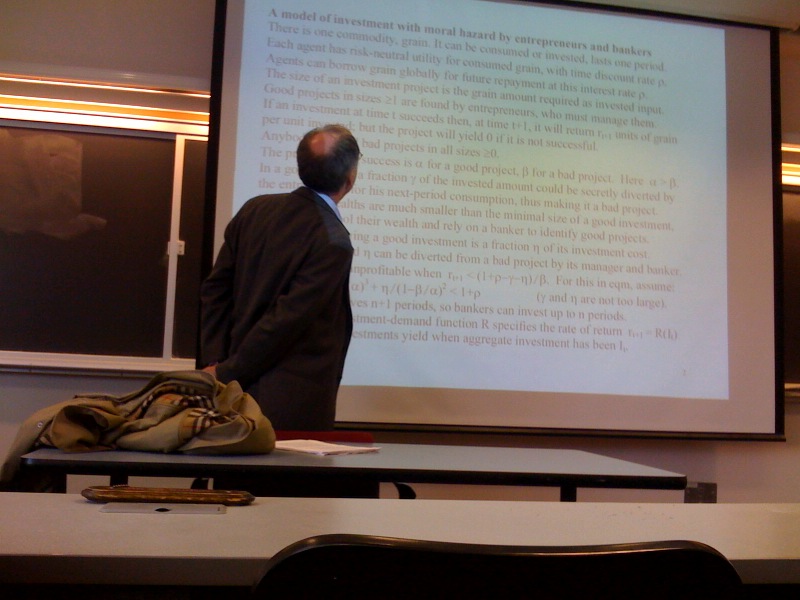 (Roger apparently hasn’t read my advice for giving talks.) Listening to Roger speak is not only thoroughly enlightening and entertaining, its calisthenics for the mind. I once brought a pen and pad to one of his talks and outlined his nested digressions. It is absolutely a thing of beauty when every step down the indentation ladder is paired with a matching step on the way back up. When he finally returns to the original stepping off point, no threads are left hanging.
Keeping track of all this in your head and still following the thread of the talk is a bit like Lucy and Ethel wrapping candy.
Still, I think I got the basic point. Roger has a model of credit cycles that falls out naturally from a well-known feature of dynamic moral hazard. In his model, banks are intermediaries between investors and entreprenuers and they are incentivized via huge bonuses to invest efficiently. These bonuses are paid only when the bankers retire with a record of success.
These backloaded incentives mean that bankers are trusted with bigger funds the closer they are to retirement. That’s when the coming payout looms largest, deterring bankers from diverting the larger sums for their own benefit. Credit cycles are an immediate result. Because bankers handle larger sums near their retirement than those just starting out, their retirement means that total investment must go down. So the business cycle tracks the age demographics of the banking sector.
(It’s the Cocoon theory of business cycles, because if you could extend the lives of bankers you would enhance the power of incentives, lowering the moral hazard rents and increasing investment.)

Presh Talwalker reports:
After a late night out, I found myself at the only eatery still open in the suburbs, the late night haven that is Denny’s. When paying for the meal, I noticed a curious offer on the receipt that read something like:
If your receipt does not list a food or drink you ordered, let us know and you will get the item free plus a $5 gift certificate.
Which, as Presh deduced, is a counter-bribe from Denny’s management so you will rat out your server if he or she bribes you with free food in return for a tip.
My approach to blogging is pretty simple. When I have an idea I email it to myself. My mail server deposits these in a special folder which I then dig through when I am ready to write something. Some ideas don’t get written up and they start to attract dust. I am going to clean the closet and write whatever I can think of about the ideas that piled up. Here is one that Sandeep and I actually talked about some time ago, but I can’t now figure out where I wanted to go with it.
Shouldn’t gang wars end quickly? All you have to do is kill the leader of the rival gang. Instead, at least anectdotally, gang wars are more like wars of attrition. You have the low-level thugs picking each other off and the leaders are relatively safe. Why?
The leader embodies some valuable capital: control of his organization. Even if you could decapitate the rival gang by killing the leader it may be preferred to weaken him by taking out enough of his henchmen. Then you can offer him a deal. Maybe its a merger, maybe its a collusive agreement, but either way the point is that the coalition is more valuable with the opposing hierarchy intact than in disarray. Knowing all of this, each gang leader feels perfectly safe even in the midst of an all-out war.
Under this theory, gang wars break out because a rival has become too powerful and it is no longer clear which is the dominant gang. Its a necessary part of renegotiating the pre-existing power-sharing arrangement in light of a new balance of power.
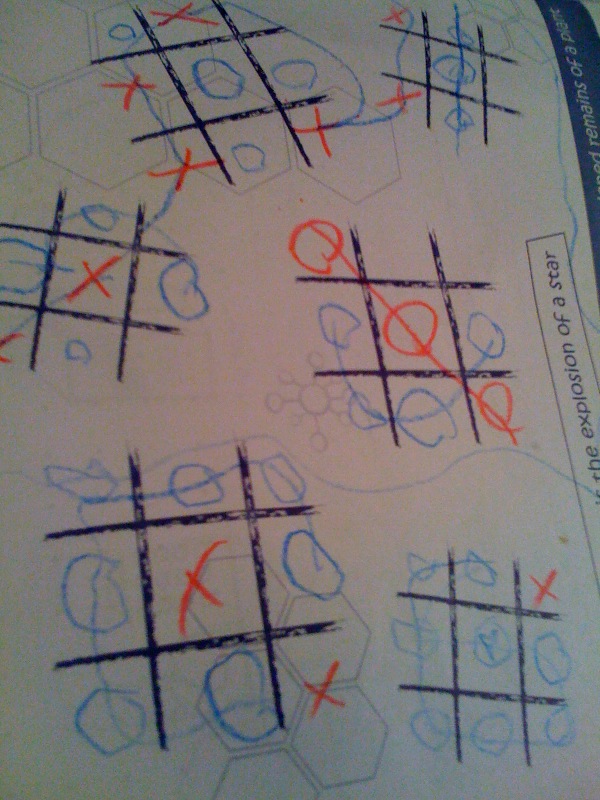
With best play tick-tack-toe is a draw. It comes as a surprise to people however that best play is hard to maintain when you are playing 50 games in succession, especially if you’ve had a few. Most people are willing to bet that they can go 50 games without losing one, many are even willing to give odds. You can make some money this way. (You are betting just that you can win at least one game, its safe to throw a few and that can knock a careful opponent out of his rhythm. And the sheer boredom that sets in around game #37 works to your advantage.)
One warning however. Only wager with with law-abiding adults. I tried this on my 3 year old and he cheats:
Jason Kottke tweeted:
Kids, don’t ever aspire to be the world’s oldest person. Have you not noticed that they’re always dying?
which is a good point but I would bet big money that the world’s youngest person dies more often than the oldest.
It is apparently the Democrats’ intention to use the budget reconciliation process to finalize the health care overhaul. By means of this process, a plain majority of 51 Senators will be required to pass the compromise bill, rather than the 60 that would be required to fight off a Republican filibuster. An arcane Senate rule plays center stage:
So if reconciliation is such a powerful tool, why didn’t the Democrats use it earlier? Because of another restriction, known as the Byrd rule — named for West Virginia Senator Robert Byrd , who introduced it in 1974. The Byrd rule allows the minority party to block the use of reconciliation if a bill isn’t tied strongly enough to the budget process. The full health care bill the Senate passed in December would have violated the rule (and possibly jeopardized support from many centrist Democrats hoping to avoid controversy).
But, because Democrats passed a full health reform bill in December with 60 votes and are only proposing to make changes to that through reconciliation, it’s easier for them to argue that those changes are simply about making the bill fit the overall budget.
The rule is well-defined, apparently, but nevertheless open to intepretation. The spirit is to prevent reconciliation, a normally technical phase of the budget process, from being used to enact new legislation. The Republicans are clearly right to complain that pushing the health care bill through reconciliation violates that spirit. (Although Democrats counter that Republicans have used it more often in the past.)
But there is a big difference between fair play within the conventions of the Senate and fair play in the eyes of the public. And in fact, bright line rules like the Byrd rule have more powerful rhetorical value in the broader public debate than he said-Reid said sniping about the cryptic, often unwritten, norms of the Senate. As the quoted paragraph above points out, despite a flagrant violation of the spirit of the reconciliation process, passing health care in this way is probably within the letter of the Byrd rule.
And that will be ceremoniously confirmed on the floor of the Senate when Republicans raise the question and the Senate parliamentarian gives a ruling. (By the way, the presiding member of the Senate can ignore the Parliamentarian, and the Parliamentarian can even be replaced by the Senate Majority Leader, but presumably it would not come to that.) No matter how much Republicans cry foul, ironically the Byrd rule will essentially certify a maneuver it was intended to prevent.
- I am trying to sell Elie Tamer on one of my ideas so we can write a paper that would be cited Ely-Tamer. (ps. I have got some great ideas for anybody whose last name is Jeff. I will give you first billing.)
- Couldn’t get a job as a theater critic.
I don’t want an iPad because I don’t want to carry around a big device just to read. I want to read on my iPhone. With one hand. (Settle down now. I need the other hand to hold a glass of wine.) But the iPhone has a small screen. Sure I can zoom, but that requires finger gestures and also scrolling to pan around. Tradeoff? Maybe not so much:
Imagine a box. Laying on the bottom of the box is a piece of paper which you want to read. The box is closed, but there is an iPhone sized opening on the top of the box. So if you look through the opening you can see part of the paper. (There is light inside the box, don’t get picky on me here.)
Now imagine that you can slide the opening around the top of the box so that even if you can only see an iPhone sized subset of the paper, you could move that “window” around and see any part of the paper. You could start at the top left of the box and move left to right and then back to the left side and read.
Suppose you can raise and lower the lid of the box so you have two dimensions of control. You can zoom in and out, and you can pan the iPhone-sized-opening around.
Now, forget about the box. The iPhone has an accelerometer. It can sense when you move it around. With software it can perfectly simulate that experience. I can read anything on my iPhone with text as large as I wish, without scrolling, by just moving the phone around. With one hand.
This should be the main UI metaphor for the whole iPhone OS.

From a wince-inducing article in Salon:
The documents also lay out, in chilling detail, exactly what should occur in each two-hour waterboarding “session.” Interrogators were instructed to start pouring water right after a detainee exhaled, to ensure he inhaled water, not air, in his next breath. They could use their hands to “dam the runoff” and prevent water from spilling out of a detainee’s mouth. They were allowed six separate 40-second “applications” of liquid in each two-hour session – and could dump water over a detainee’s nose and mouth for a total of 12 minutes a day. Finally, to keep detainees alive even if they inhaled their own vomit during a session – a not-uncommon side effect of waterboarding – the prisoners were kept on a liquid diet. The agency recommended Ensure Plus.
The article details the use of saline solution to reduce the possibility of death from dangerously low sodium levels, a specially designed gurney for tilting the head at the optimum angle and quickly uprighting the victim in case he stopped breathing, and doctors assisting by monitoring blood pressure to allow interrogators to bring the victim close to the line of death. And more.
Budenovka bow: The Morning News.
In a classic experiment, psychologists Arkes and Blumer, randomized theater ticket prices to test for the existence of a sunk-cost fallacy. Patrons who bought season tickets at the theater box office were randomly given discounts, some large some small. At the end of the season the researchers counted how often the different groups actually used their tickets. Consistent with a sunk-cost fallacy, those who paid the higher price were more likely to use the tickets.
A problem with that experiment is that it was potentially confounded with selection effects. Patrons with higher values would be more likely to purchase when the discount was small and they would also be more likely to attend the plays. Now a new paper by Ashraf, Berry, and Shapiro uses an additional control to separate out these two effects.
Households in Zambia were offered a water disinfectant at a randomly determined price. If the price was accepted, then the experimenters randomly offered an additional discount. With these two treatment dimensions it is possible to determine which of the two prices affects subsequent use of the product. They find that all of the variation in usage is explained by the initial offer price. That is, the subjects revealed willingness to pay was the only detrminant of usage and not the actual payment.
This is the cleanest field experiment to date on the effect of past sunk costs on later valuations and it overturns a widely cited finding. On the other hand, Sandeep and I have a lab experiment which tests for sunk cost effects on the willingness to incur subsequent, unexpected, cost increases. We show evidence of mental accounting: subjects act as if all costs, even those that are sunk, are relevant at each decision-making stage. This is the opposite effect found by Arkes and Blumer.
(Dunce cap doff: Scott Ogawa)
 Kjerstin Erickson is selling a 6% stake in her lifetime income for $600,000 through a vehicle known as the Thrust Fund:
Erickson’s Thrust Fund comes at a time of deep experimentation in early-stage financing across the technology and media industries. The transparency afforded by social networking is making it easier for investors to vet people’s reputations and hold them accountable. At the same time, the initial amount of capital needed to build, market and distribute a product or service has fallen, undermining the venture capital model and making angel investors relatively more powerful.
Think of Kjerstin as a self-managed firm. She could issue debt or equity. The Modigliani-Miller theorem explains why most people in Kjerstin’s position choose to issue debt. Her income is taxed, but interest on debt is often tax-deductible.
But a key difference between Kjerstin and a firm is that you if you acquire Kjerstin you cannot fire the manager. So your capital structure is also your managerial incentive scheme. Debt makes Kjerstin a risk-lover: she gets all the upside after paying off her debts and her downside is limited because she can just default. With equity she owns 94% of her earnings no matter what they are.
So many questions come up, here are just a few.
- Why don’t we replace student loans with student shares? Arguably the reason we stick with debt is that it is good policy to induce risk-taking. Because the large numbers means that aggregate risk is small and society benefits more from the big hits than it loses from the misses.
- Do Kjerstin’s investors get voting rights?
- Does the contract give her the freedom to issue more shares in the future? She wants this option but her investors don’t. The more shares she sells the less incentive she has to work hard.
- Kjerstin now has a huge incentive to take in-kind compensation that is hard to value. In corporate finance, this is called diverting the cash flows. How does her contract deal with that?
(Lid lift: The Morning News.)
You are preparing two dishes. For the first you will put 1 tsp. cornstarch in a medium sized bowl and for the second you will put 1/2 tsp. cornstarch in a small bowl. By mistake you put the 1 tsp. cornstarch in the small bowl. You have a full set of of measuring spoons, any number of spare bowls, and a box of cornstarch. What is the most efficient way to get back on track? Answer after the jump.
 Cheap Talk
