
You are currently browsing Sandeep Baliga’s articles.
After my Cafe Milano post yesterday, I got some great comments that took me north of the Berkeley campus. (First, I stopped at Peet’s on Telegraph so I had the requisite amount of caffeine to be able to walk from the south of campus to the north.)
One comment suggested Nefeli Caffe. Comment 7/33 on yelp offered up the blandishment of seeing sexy Europeans sipping coffee after a hard night of posing. I was not sure I would fit in but thought I would enjoy it anyway. In typical European fashion, Nefeli was closed. Europeans don’t like getting up too early on a Saturday, or speaking for myself as a pseudo-European, any other day. Brewed Awakenings, on the other hand, seems to be run by hard-working Middle Eastern immigrants and is open. It has free wifi. Quiet classical music in the background. Very few people. Good coffee and good almond croissant. And a great place to hang out and BS. Ideal for research I would say. This is my first stop on future visits to Berkeley. Ariel Rubinstein and Shachar Kariv have great taste.
Surly staff, gives you that NYC feel. Good cappuccino. Slightly bitter aftertaste. Decent croissant. Classical radio in the background. Free wifi. Not too loud (at 8 am!) so it is possible to work/blog.
Fairly generic but I would come back.
It’s on Bancroft and Telegraph.
In that state of mind, San Francisco is an easy, friendly city to live in. There’s no traffic and you get over the Bay Bridge very quickly on your way to Berkeley. There’s no ten car crash you drive past on your way from the airport. Your cab driver does not listen to his Ipod while driving and concentrates on the road. And you switch on the T.V. in your hotel just in time to see the Chicago Bulls beat the Celtics.
Unfortunately, that is all a state of mind.
I’m always hoping that Rogers Park yields some benefits so I don’t have to shlep downtown from Evanston for a good meal and a drink. Somehow managed to hear about Morseland. They can’t quite decide what they are – a bar, a restaurant or a club. It still seems to work. Couple of guys were playing pool, a few were watching a NBA playoff game at the bar. Eclectic mix of people eating. The types who spend hours making sure the goatee is just right but not much time at work. (What I aspire to be?)
Food was good and the beer list was great. Definitely going here again. Maybe, I’ll check out the music. Wish it was open for lunch.
I see 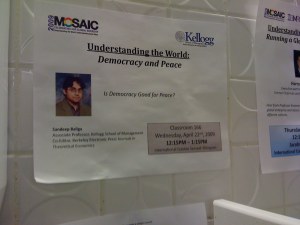 this:
this:
This proves it is over a urinal:
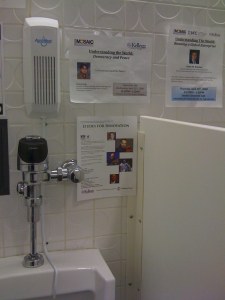
I wonder if this is the wave of the future. You can Tivo through the commercials on TV. You’re pretty trapped when you’re peeing whether you are a man or a woman. Someone is going to come up with paid ads to put in these places, you mark my words.
Anyway, at Kellogg, this form of advertising is mainly used for lectures and parties. As urinals provide such a convenient location I was wondering if and how my talk was being advertised in the women’s restrooms. Having left my dress and wig at home, I recruited a surprised female helper. She guarded the door while I went into one restroom. As I suspected, my talk as not advertised near the wash basins. My helper told me to look in the stall. She was right – there was a p0ster but it was this one:

I was advertised in another restroom though. I chickened out and my female helper (she wants to be anonymous but her name begins with P), went in and saw some posters.
With this sample of advertising, I believed that norming for Kellogg student intake, there would be more men than women at my talk. Also, P said she thought there were fewer women’s restrooms than men’s. P said I should take a photo at the talk too, too verify my hypothesis. I was too nervous and I forgot. My memory is that my simple theory was right.
The federal government owns preferred stock in many of the banks it has bailed out. According to the NYT, it is thinking about converting this preferred stock to common stock. The article also claims that this reduces the need for a further capital infusion and hence the need to go back to a feisty Congress for more money.
How could that be? Isn’t the re-labeling of stocks going to leave banks with exactly the same amount of capital and not change anything? This is just rearranging chairs on the Titanic.
The key sentence is the article is:
The administration said in January that it would alter its arrangement with Citigroup by converting up to $25 billion of preferred stock, which is like a loan, to common stock, which represents equity.
Preferred stock used to recapitalize banks does not come with voting rights but does come with a compulsory dividend. It is 5% now and rises to 9% after five years. In that sense, the preferred stock are more like debt that equity. There is a risk that a bank defaults on this in the same way it could default to other debt holders. Converting it to common stock implies the government gets voting rights but gives up the dividend. This reduces the payments the bank has to make on a regular basis and hence makes it more liquid. This appears to be the main idea. It is good for the banks as their debt obligations are reduced. It makes it more likely they survive.
What about taxpayers? They are taking on more risk as their stake is more junior than before. There are two countervailing effects. First, maybe the probability of bankruptcy goes down as a result of this so the risk goes down. Second, the initial decision to acquire preferred stock may have been politically expedient in which case it did not maximize shareholder/taxpayer value. There is the perception of a big political cost of being seen to nationalize banks. The initial plan reflected this political constraint. This plan is a move to pay this cost to avoid the new political constraint, the cost of going to Congress. So, maybe the Congress constraint is helping Obama to move to the economic optimum from the constrained political optimum as one political constraint cancels out the other.
Family conversation at restaurant:
Wife: …her husband is a political scientist at U of C.
Son (7 years old): What is a political scientist?
Wife: Your father can answer that question better.
Me: Well, scientists who are physicists study physics. Chemists study chemistry and political scientists study politics.
Son: Oh, so they’re not really scientists.
Wife and I fall about laughing.
Me to son: Why do you say that? What do they do?
Son: They study votes and stuff like pollsters. That’s not science.
Out of the mouths of children…..
(True story, I swear. Have yet to have a long conversation about economists.)
The Soviet Union has collapsed. Karl Marx is read mainly in Comparative Literature Departments. You may think class war is no more.
You’d be wrong.
The Taliban are the new Bolsheviks, the new Lenins. Marx wanted communist revolutionaries to exploit class war. Persuade and provoke the proletariat to overthrow capitalists living off the surplus of labor. It is a strategy desgined for a capitalist society. Rural Pakistan has not reached that level of development and is largely a feudal society. The Taliban have simply taken Marxist strategy and applied it to this more primitive society. They are pitting the rural population against their landlords. The landlords are fleeing, their lives in peril. Their land is redistributed to their workers by the Taliban. In return, the Taliban impose Islamic Law and get a share of any profits. Not the outcome Marx envisaged. Power to the Taliban not Power to the People.
What does the future hold? The Taliban have taken control of Swat using this strategy. They might extend it into Punjab Province. And who kows where it goes from there. Pakistan, a nuclear state, is frightening. It’s hard to know what to do. Land reform for the peasants seem to be the least aggressive option. This would make them less amenable to joining the Taliban. Helping the Pakitani army fight the insurgents is a more aggressive policy. This could easily backfire amd draw more support for the insurgents.
The Navy Seals should be training to take over nuclear bunkers as well as shoot Somali pirates.
There’s a serious answer to this question. Something to do with inheritance tax, going on leave abroad…but you’re not going to get that answer here!
When I first moved to the U.S, I arrived in Boston. Californians told me native Bostonians had a weird accent. I could hear a small difference but not large enough to really notice. Now, I think the accent is weird and exotic. It sounds British! I guess I’m a foreigner everywhere. Maybe it’s time to become a citizen?
Less elegant than its counterpart in Cambridge, the branch of the Elephant Walk in Boston did not disappoint. There was a Dilbert-worthy business hard sell going on at an adjacent table. We split water on our table. Despite all that, we enjoyed the excellent food. What’s in those wonderful deep fried spring rolls? My Mee Siem noodles were fantastic. We all had them so I can’t recommend any other dishes! Just go if you’re in the neighborhood.
In Evanston, the location of your residence determines which school your kids attend. In Boston and Cambridge, there is a lottery system that determines where your kids end up. You list schools in order of preference. If your first choice is oversubscribed, you get to try for your second choice. But, at this point, people who listed your second choice as first are ahead of you. This gives you the incentive to lie and perhaps put your true second choice as your first. Because of these problems, Boston has changed its system to one that is resistant to such gaming (Al Roth, his students and co-authors have been at the forefront of this research and its application).
There is one other issue. An obvious response to this lottery is just to get out. Go to a suburb with better public schools where you are not subject to the random outcome of this strategic casino game. The price you pay is extra property tax. Or you might like living in cosmopolitan Boston or university-rich Cambridge. Welcome to suburbia, former bohemian. What impact does this have in the city you left behind? I guess richer people leave. Or people who do not get their first choice, presumably the best school in everyone’s ranking. The more concerned parents are about education, the greater will be their outflow.
I guess it actually requires a model to work out the equilibrium impact on the quality of students left in each locale. It would be surprising if it resulted in higher quality students in Casino School Districts.
It’s Sunday morning. You are reading the Week in Review section of the New York Times and realize piracy still exists in the twenty-first century. Who would have thought it? The Travel Section leaves you a bit wistful as you realize how many interesting places in the world you’ll never visit. Now you pack like a small army because you have two young children. You wish you had done the Inca Trail in 1987 when you went to Peru. That might have invited a kidnapping at the hands of the Sendero Luminoso, but maybe that’s better than grad school?
You hear the sound of Lego and see your kids building the John Hancock Building out of Lego. You smile, thinking, “The Inca Trail can never compare to the joy I just felt seeing the kids playing together so happily.” You turn to the crossword puzzle. Your reverie comes to a screaming end as a fight breaks out behind you. Who got one of diagonal bits that criss-cross the Hancock a bit wonky? You will never know but each kid blames the other.
What to do?
The situation reminds you of the famous Moral Hazard in Teams paper by Bengt Holmstrom. Someone clearly did not exert the cooperative effort level. But you cannot tell who it was as there is no kid-specific signal, just the aggregate signal of the building falling over and the fight. First, you think that you should be fair and punish a child if and only if the weight of evidence is high. You realize you’re screwed as you never have that level of evidence. You could ask the children what happened and cross-check what one did against the other. In fact, this would give an opportunity to apply your own research and you’re excited about that. It dawns on you that the 8 year old can always out-lie the 4 year old. And the volume of the four year old’s cries is measured on the Richter scale. Your research obviously did not take account of these practical matters.
Incentive theory gives the obvious answer: punish them both. This works very well if there is nothing random that can cause the building to fall over. Then, each child knows they get punished if they start fighting so no-one fights as long as the punishment is big enough. If a fight can start randomly – and we parents know this can happen – sometimes you’ll punish them even though nothing truly bad happened. This is unfair and inefficient but what can you do? This second-best solution is still better than no incentives at all.
Briefly, you think about the theory of repeated games which claims to get cooperation even when the game is quite noisy and there is lots of private information about who did what to whom. You remember that Jeff has made important contributions to this theory. You use your common sense and decide that using his research might take the application of game theory to family life a little bit too far. You get up, confiscate the Lego and send the kids to their room to get out of their pajamas and put clothes on. The ultimate punishment. The lovely mother of your lovely children has solved the crossword puzzle by the time you’re done. Bugger.
1001. One to change the lightbulb; the other 1000 to hold everything else constant.
(hat tip: tomas sjostrom)
Mario Batali’s Simple Italian Cooking is not that simple. It’s usually way more time-consuming than he suggests. This turned out to be true of the Crespelles al Formaggio. They were delicious nonetheless and we will make them again. They went very well with this salad (we skipped the pomegranate!) and remnants of yesterday’s Pinot Noir.
Normally, my palette is not good enough to distinguish between the regular Pinot Noir and the Méthode à L’Ancienne (MA). But the 2006 MA vintage is so good that pretty much anyone can tell them apart! There’s lots of cherry, a slight acidity at the end and then the cherry comes back again. I couldn’t taste the bacon or strawberry the description mentions. Maybe I will after a few years in the bottle. It’s worth the extra ten bucks to get the MA over the regular. Navarro is one of my favorite vineyards for whites too. Check it out.
My post about poker was more about game THEORY than game PRACTICE, much to the disappointment of readers! Luckily for us, I have a great, interested student in my class Patrick Nyffeler. His brother, Andre, is an “avid, online poker player”. Andre was kind enough to send me the following information below via Patrick. Thanks Andre!
In the blog he alludes to the fact that there is a game theory optimal (GTO) strategy and an exploitive strategy. There’s a good article on it that’s on one of the instructional sites I used to subscribe to. Luckily, I found a copy of it,
http://forumserver.twoplustwo.com/94/stoxpoker-com/understanding-game-theory-holdem-245479/
Some quick thoughts on each:
GTO
There’s been a team of guys who for the last fifteen years have been working on solving GTO play for heads up limit holdem.
They’re getting really good now, as they won the last “man vs. machine” showdown which was against some elite HU LHE guys.
There is some fear bots could ruin online poker. The idea is that they wouldn’t have to be good enough to beat even good players at middle levels, just good enough to have a tiny edge at the smallest games. They would run 24/7 and take a ton of money out of the poker economy that normally would filter up to the higher limits. Luckily, the big sites (with the help of the pro online players) are good at identifying these bots quickly. Also, the current AIs for NLHE are terrible and it will be a long time before something close to GTO is achieved (although who knows, that could be within five or ten years)
There’s lots of talk about GTO and many solved “minigames” such as that in Mathematics of Poker by Bill Chen (the guy with two bracelets who works at Susquehanna). These give you a good intuition for different aspects of the game as well as a starting point of how to play before you know much about your opponents strategy.
Exploitive
This is what good poker players use 99% of the time. There’s no way a top poker player is using their watch to randomize his bluffing. He is using previous history with the opponent, game flow, and psychology to make/not make his bluff and outplay his opponent. Nobody plays near GTO in games like NLHE so to maximize profit, you adopt an exploitive approach.
If you have some interest/time, here’s two of the best general theory of poker articles I’ve read in the last five years.
Good Poker by Bryce Paradis
http://www.bluffmagazine.com/magazine/What%2Dis%2D%27Good%2DPoker%27%2DBryce%2DParadis-934.htm
G-Bucks by Phil Galfond (this is one kind of dense)
http://sports.espn.go.com/espn/poker/columns/story?columnist=bluff_magazine&id=2817110
The most fundamental theory of economics is general equilibrium. Markets clear via the forces of demand and supply. Demand and supply in one market (e.g. cars) is affected by demand and supply in another (e.g. gas).
The forces of demand and supply can easily spillover into non-standard markets, especially in a recession. As evidence, see this interesting Wall Street Journal article about Indian bachelors in the U.S. having a hard time finding brides from back home. The problem is that parents are worried about the long term prospects of the potential husbands, facing unemployment at any time in cutthroat America. The demand for US-based grooms has gone down. The supply of grooms seems to be stable, at least that is what I infer from the WSJ article. This means the “price” of marriage must go down. The price of marriage is the dowry or more broadly the net transfer made to the groom.
First, the search services are charging more to Indian bachelors n the US. This means the net transfer to grooms has gone down. Second, resources should flow to the country where there are profits to be made. And it seems Indian bachelors are moving back to the home country to take advantage of the better bridal economy.
The article does not say anything about dowries: the money, house, fridges, big-screen TV, Wii….transferred to the husband. Dowries should get smaller or perhaps (finally!), there will be transfer from the husband to the wife’s parents. That would be a wonderful new phenomenon. But, since the supply of brides for Indian bachelors based in India has gone up, the dowries should be getting larger there. Darn it, change is never easy, as Barack Obama has found. (The only countervailing effect is that the supply of Indian bachelors in India has increased as some move back from US to India. Hence, the effect on the dowry is ambiguous.)
Empirical economists always benefit from change. The wordwide recession should generate exogenous change in many markets allowing estimation of elasticity of demand and supply. In the Indian bachelor market, as the demand curve for grooms moves, the elasticity of supply of grooms can be estimated (if there is good data!). How sensitive are grooms to the size of the dowry? If demand is elastic, very much so and money is paramount in marriage. If it is inelastic, can we interpret this as saying grooms are looking for brides for love not money? There’s a publication called the Economics of Jane Austen for someone willing to do the work. This the kind of thing Steve Levitt is so good at. But since he is moving to the Obama administration maybe some other bright young thing will write the paper.
I always start my Competitive Strategy class by comparing economic games with real games, like poker. At the last minute, I found this great story in the New Yorker about a champion poker player, Chris Ferguson. Ferguson is a game theorist/computer scientist who took thirteen years to finish his PhD degree! In the end, it all worked out. The story reports that he has made about $7 million playing poker and at least that much through his website Fulltiltware.com.
How did Ferguson learn to play poker? There are two ways: experience at the poker table or using theory. Ferguson used theory, sitting at home, practicing and playing out different moves and counter moves in his head. He thinks both approaches lead to the same conclusion but his is less “arduous.” Using theory, he came up with his “optimal strategy” which involves playing hands to answer the question “How do I lose the least?”
What does Ferguson’s strategy have to do with game theory? That’s the topic of this post.
Poker is zero sum game: players wins and losses add up to zero. The most developed part of the theory of zero sum games is for the case of two players and most of our intuition about poker comes from this theory. The most famous result in this theory is the minimax theorem due to von Neumann and Morgenstern. I will attempt to explain the result though not the proof!
Ferguson’s optimal strategy seeks to maximize his minimum payoff – How do I lose the least? This is called a maximin strategy. Such a strategy is not optimal in typical games. But the minimax theorem says: No, in zero sum games the maximim strategy is a best-response to the other player’s strategy!
In fact, it tell you even more: the maximin payoff is the same as the minimax payoff. A minimax strategy maximizes payoffs under the assumption that other players are out to get you. So, it is like a typical optimal strategy that says “How do I maximize my payoffs?” rather than “How do I lose the least?” In two player zero-sum games, the two are the same so Ferguson has found the optimal strategy. Moreover, a minimax strategy has a cool property: If other players do not play optimally, you make even more. You are already maximizing your payoff under the assumption they are out to screw you. If they get confused and do not screw you, you must make even more than your minimax payoff.
Unfortunately, an optimal strategy does not mean you win all the time! Suppose two player who know the optimal strategy face each other. What expected value can they guarantee themselves using optimal strategies? As poker is a symmetric game, each player must be able to guarantee the same value v. But as values have to add to zero, as this is a zero sum game, we know we must have 2v=0. This can only hold if v=0.
If Ferguson played rational players all the time, he would make zero. Since he has made $7m, he must be meeting dumb players a lot. His optimal strategy since it has the minimax property works well against dumb players. Even better, if he can “read” dumb players he can play a best-response their dumbness!
This is why there is a second intuitive school of poker. This school is based on looking at people facial expressions and body movements. In looking at their betting to see if there are some weird regularities that help you predict their hand. That’s the whole issue: if you can deduce their hand, your strategy is simple – fold if you have a worse hand and bet if you have a better hand. Poker is all about bluffing and sandbagging to hide your hand. (This is a property of many “games” like some war games where to get an advantage you should keep your strategy secret. Saddam’s bluffing about WMDs has aspects of this.)
I wish I could end this with some mind-blowing practical takeaways but I can’t. The main thing I know from game theory is that people bluff and sandbag much less than theory says is optimal. Binmore’s Playing for Real book has a nice chapter on Nash and von Neumann’s poker models. Check it out if you want to know more. The second thing is that knowing how to read people is a key part of all this. I’m terrible at that. Maybe we will meet across the poker table one day and you’ll be able to take all my money.
Why did we decide to do this blog? I’m not really sure. A creative outlet? A way to throw out random ideas? A vague hope that something fun might come out of it? A replacement for endless websurfing?
Well, the “vague hope” rationale has already worked out. Jeff and I had a wonderful time at our appearance on the Interview Show at the Hideout. There are a lot of dimensions to why we enjoyed it and I’m sure we’ll both blog about it. The thing I want to talk about now is the club itself and its owners. It is a little west of the big Home Depot on North Av. There is weird industrial stuff all around and a large filling station for trucks. And slap bang in the middle of all of it is a little house which has been turned into this club. I thought it would be full of truckers and instead it is weirdly middle class. I had a Bell’s Oberon, definitely in the microbrew category. I could have been ironically postmodern and had a Hamm’s but I did not spot it in time. I love the crappy end of American beer!
Jeff and I are too old to know about clubs but the Hideout gets rave reviews among the cognoscenti. The owners, Tim and Katie Tuten, are very interesting. You might expect some ex rockstar to own it. Maybe, Tim and Katie have this history in their deep, dark past. Now, they have regular day jobs – Tim works in the Chicago Public Schools and Katie for a charity. They’re also a little older than you might expect. (I hope they do not mind me saying this! ) They more than make up for it by having the extroversion and energy of twentysomethings. Tim did a little stand-up before Mark Bazer came on. They also have incredible taste in music – that night’s act Anni Rossi was transporting. Tim worked for Arne Duncan in Chicago and will join him in DC doing special events. As we left, Katie ran to the door and said all economist number-crunchers were welcome, except those from the University of Chicago. I’m sure if she met Phil Reny, Roger Myerson etc she would welcome them too.
And I’d never have met them if it weren’t for this blog! I also got to hang out with Jeff on his own, a rare thing as we’re so busy nowadays. I enjoyed his humor while he dealt with my depression with grace.
I should think about some clever econ thing to blog about and see if it leads anywhere.
Sandro Brusco offers two additions to the Geithner plan to reduce the asymmetric information between owners of toxic assets and potential buyers. The basic idea is for banks to make their claim of the value of assets credible by suffering losses themselves should they over-value them. It’s a nice use of incentive theory.
My favorite region: the Rhone. But this wine was clearly aimed towards an American audience. Loads of fruit (cherry?) and too much alcohol (15%). But I could not taste oak at least. And the French just know what to do even when they look to sell abroad. It was three dimensional. Grass and hay on the nose and it went through three phases on the palette: fruit, barnyard and then acidity. They must have thrown in a smelly sock and a dead mouse in the barrel. It was really nice though I felt hung over this morning Would buy it again and drink less. Around $25-30.
I vote for Michelle. After Barack, Michelle for President? People can keep their Obama for President Signs
The god of Competitive Strategy courses at B Schools is Michael Porter with his book Competitive Strategy. The god of terrorist strategy is Abu Bakr Naji with his treatise The Management of Savagery (MoS) Actually, Naji seems to be an amalgam of many strategic thinkers within Al Qaeda while there is only one Porter.
The Management of Savagery (MoS) is quite a read. It is an eyeopener for people who might think that terrorists are simply “crazy”. They have crazy and grandiose objectives – the overthrow of America. But they think about how to achieve their aims quite “rationally”. They make an analogy with the collapse of the Soviet Union, which they take credit for. They believe they caused it to fall by overstretching in Afghanistan. They seek to replicate it with America. The main idea is to trigger an extreme aggressive response from the U.S. and not the reverse, i.e. make America back off. American aggression will create a war that brings moderates to the side of extremists and America’s defeat the end of American hegemony:
Force America to abandon its war against Islam by proxy and force it to attack directly so that the noble ones among the masses….will see that their fear of deposing the regimes because America is their protector is misplaced and that when they depose the regimes, they are capable of opposing America if it interferes.
Abu Bakr Naji, The Management of Savagery ( p. 24)
It may be quite rational for us to respond to aggression with aggression but this creates an equilibrium which is damaging for America (notice that terrorists are well-read!):
It is just as the American author Paul Kennedy says: “If America ex-pands the use of its military power and strategically extends more than necessary, this will lead to its downfall.”(Naji, p. 18).
“[N]ote that the economic weakness resulting from the burdens of war or from aiming blows of vexation (al-nik¯aya) directly toward the economy is the most important element of cultural annihilation since it threatens the opulence and (worldly) pleasures which those societies thirst for. Then com-petition for these things begins after they grow scarce due to the weakness of the economy. Likewise, social iniquities rise to the surface on account of the economic stagnation, which ignites political opposition and disunity among the (various) sectors of society in the central country.”(Naji, p. 20).
There is a theory of terror and a strategy or terror. And, unfortunately, it does seem to all hang together.
The fundamental tension between technical skills and creativity in economic theory?
Actually, no. This is my half-remembered quote from a judge in the new “reality show” on the Food Network. Four chefs have to cook an appetizer, a main course and a dessert using ingredients that are presented to them. For example, these might be anchovies, jam and a lemon. They open up the hamper with the ingredients and then have half an hour to cook something with them and anything else they find in the pantry. In each round, one contestant is “chopped” by the three judges.
On last night’s show, there was a chef from a Gordon Ramsey restaurant at the London hotel in NYC. His food looked great, displayed great knife skills but was safe and unadventurous. Hence, the quote above from the judge. The other guy who was left standing by the end was tattooed from head to toe. He dropped meat on the floor in one round and then cooked it without washing it. And then he made a chestnut cream saboyon quesadilla for dessert. It was too mushy looking and there was too much quesadilla. The other guy made something generic that I can’t remember right now.
Of course, the technical guy won. But no-one slept with him, I guess, and the tattooed guy probably got laid. Who really won?

I found this place because it won an award on a Chicago food chat site. And the first time I went there I met a colleague from the Econ Dept who must have seen the same blog. Small world.
Anyway, when you go to most Indian restaurants, the stuff they serve – the radioactively orange chicken tikka etc – is North Indian. And for some reason it’s usually cooked by Nepalese chefs. ( There’s got to a story there about some Maoist chef exodus but I don’t know it.) It can be good but you miss the other regional cuisine your mother makes…at least, my mother.
Uru-Swati serves South Indian food (as well as some other generic things). So you get good dosas and idlis, things Indians normally have for breakfast but could easily be a nice light lunch. (Well, maybe it’s not light because the dosa will be cooked in ghee! Idlis, a kind of steamed dumpling, are good for you.)
But better than all of this – they serve Indian street snacks. Bhel Puri, Sev Puri, Chole Bhatura… If you’re tempted by these on an Indian street, you’ll soon regret it as your system gets cleaned out if you know what I mean! You can eat them safely at this restaurant and imagine Goa outside the window rather than the ten degree Chicago weather. The parathas are also excellent. Try the muli paratha which come stuffed with a kind of shredded radish, served with dal and pickle.
UPDATE: Check out this NYT story about just this kind of food
Luigi Zingales was kind enough to reply to my jokey post about him below. He directed me to an op-ed of his, with Oliver Hart. They present an extremely cleaver idea of how to use Credit Default Swaps to prevent large financial institutions (LFIs) from taking on too much risk and not having enough money on hand to pay their debts.
The idea is something like the following. Suppose a Credit Default Swap CDS pays off if Citibank, say, fails. Different traders of the Citibank CDS has different information about the chance that Citibank may fail. The price of the Citibank CDS aggregates that information. The price will be high if the chance of failure are high. Hence, a regulator can monitor the Citibank CDS price and step in to force the LFI to cover it loans or be taken over. For details, see their op-ed.
I guess the only issue is that CDSs got a bad name because they were chopped up, traded and re-traded till the final object was so complex and mixed-up that no-one could evaluate its risk. I suppose this is avoided in the Hart-Zingales plan as a CDS would have a verifiable name to correspond to the institution that it insures.
Continuing to make bold moves in the first 100 days of his administration, Obama will announce this week two blockbuster appointments to senior positions at the Department of Treasury.
Freakonomist
Sure to raise eyebrows will be the appointment of University of Chicago economist Steve Levitt to Tim Geithner’s team. Rarely venturing into the realm of policy, the author of Freakonomics is better known –and often derided– for research focusing more on cute trivialities like cheating by Sumo wrestlers.
Ironically, his foray into Sumo-economics appears to be exactly why he is getting the call. As readers of Freakonomics know, Levitt made headlines when he used the same statistical analysis to expose widespread cheating by teachers in the Chicago Public Schools. How does this help the Department of Treasury you ask? Stress Tests. The big headline of Geithner’s first announcement as Treasury Secretary was the promise to screen out banks doomed to fail. Strangely, Treasury has since been mum on the results from the stress tests. Now we know the reason: it turns out all the banks are getting passing marks and the suspicious Treasury Secretary is calling on Levitt to bring his Sumo-scrutiny to bear on the banks.
Colleagues at the University of Chicago economics department are cheering the move. “I could not think of a better choice than Steve Levitt to move to Washington and help the Obama team” says Nobel Laureate James Heckman, adding that he expects the job to occupy Levitt for two full Obama administration terms. “We will miss him, but he has an important job to do.”
When we finally reached Levitt, he was at McDonalds headquarters at Oak Brook, IL. Some of their franchises have been cheating by hiding Big Mac revenues that they have to share with McDonalds. Levitt has found a way to benchmark performance that can reveal suspiciously underperforming locations. “This is what economists call ‘moral hazard,’ ” Levitt said over a carton of Chicken McNuggets. “Look, economics is not rocket science. Think of the US Government as like McDonalds, a bank and a toxic asset are just like a franchisee and a Big Mac. Once you see it that way, its simple.”
Former Bushie
Joe Lieberman supported John McCain during the election, made a speech at the Republican Convention and said Obama was not ready for the Presidency. And yet Obama later forgave him because he knew Lieberman’s vote was going to be crucial in the Senate.
Now, Obama has shown the same pragmatic streak in inviting Greg Mankiw to join his administration. Mankiw was the head of Bush II’s Council of Economic Advisors. He has so far played a role on the sidelines, an informal referee of the contest between Obama and his right-wing critics. Mankiw is often skeptical of Obama’s plans but at the same time he does not fully endorse their antithesis. This ambiguity has suited Mankiw well, as he has been courted by both sides of the political spectrum. Finally, he has chosen his prom date and decided to join the Obama administration. He will serve alongside his old Harvard colleague Larry Summers as Co-Director of the National Economic Council.
Why did Obama choose Mankiw for this post?
Mankiw said, “Well, in all modesty, I must point out that I proposed something like the Geithner plan – of course, I call it the Mankiw plan (!) – last October. There are some differences in the details but the principles are the same. I’m looking forward to improving the plan and being involved in its implementation. Whenever you are asked to serve your country, I think you should do it, even if there are ideological differences with some of the people involved.”
The additional intellectual heft of having Mankiw on board will certainly help in the coming months. Mankiw is also quite familiar with the rump of the Republican party that is still left standing in Congress. He is one of the rare individuals who has a good relationship with both John Boehner and Mitch McConnell. McConnell and Mankiw were bridge partners and they have the camaraderie and preternatural ability to wordlessly communicate that comes from expertize at that genteel but vicious game. But Mankiw can also be a populist and is a great expositor of complex ideas, a fact that Obama hopes will help in persuading at least some House Republicans to occasionally vote for some of his economic plans.
There is another factor at play. True to predictions, Larry Summers has proved hard to control within the West Wing. Orzag and Geithner have not been able to do it. In any case, they are fantastically busy trying to implement Obama’s healthcare policies and manage the financial crisis. Furman and Goolsbee , who were both students in Cambridge, are in awe of their former teacher and find it hard to contradict him. Summers and Mankiw respect each other, or at least Mankiw respects Summers! Obama has watched Biden and Clinton argue over Afghanistan policy. As a lawyer, Obama has always favored the “team of rivals” approach and wants to replicate it in economic policy.
Only one thing stands in the way. Mankiw has amassed a huge fortune by selling economics textbooks all over the world. He is incorporated in Switzerland as a Verein for tax purposes. A verein is an association of independent businesses and each international textook is an independent “firm” within the Mankiw Verein. This has several tax advantages and seems to be all quite legal. But with the current furor over AIG bonuses the administration wants to tread carefully.
Jeff and Sandeep
Bought it on sale. Totally regret it. It tastes unstructured, flavors are not integrated and there’s huge coconut aftertaste – OAK!
I casually switched on the T.V. to watch the news. I wasn in time for a fight: Luigi was beating up on some unlucky lady from an investment firm on Chicago Tonight. Luigi of course likes the idea that G.M. be taken over by Fiat. We’re not typing on Olivetti computers. We have Neopolitan pizza here in Chicago and everyone makes pasta at home. But we will all be driving Cinquacentos.
But seriously, it was nice to see a Finance Professor say that Wall Street is too close to the administration and Goldman Sachs’ interests are not America’s interests.
 Cheap Talk