
You are currently browsing Sandeep Baliga’s articles.
Linda Tesar, mild-mannered Chair of Michigan Economics Department by day, movie set owner by night:
As you walk down the long brick walkway toward the prominent front porch of Joe and Linda Tesar‘s home, built in 1910, it is easy to spot in the front garden the gallon jug container filled with a red substance and labeled “blood.” This is not the type of item you would normally see on this Burns Park block a full two months before Halloween. But then, the Tesars’ home is far from ordinary: For the past three-and-a-half weeks, it’s been a primary filming location for “Scream 4.”

Grant Achatz is trying an innovative pricing system at his new restaurant Next. There is a set menu and instead of taking reservations and bringing a check at the end of the meal, Next is selling tickets. The ticket sales save on labor costs of employees taking reservations, distributing checks and running credit cards at the end of the meal. The restaurant sells tickets through its own website so it does not share revenue with opentable. The price of the ticket varies by day and time. This is classic profit-maximizing price-discrimination. At times where demand is high, charge a high price; when demand is low charge a low price and keep the restaurant busy when all the lights are on and chefs are in the kitchen. So far, so good.
All the excitement is coming from the explosion in the resale market for Next tickets. Resale is allowed by the restaurant. They seem to think that it is impossible to stop so why not make it above board and monitor it carefully so there is no sale of fake tickets? Also, if someone manages to get a ticket for a particular time or day and then finds they cannot make it, they have the opportunity to sell the tickets. It seems tickets for two with a face value of $170 are selling for $1000. If Achatz and his partner Kokonas thought they were going to give impecunious Alinea fans a better deal, they were mistaken, at least at the opening of Next. Plus all the revenue generated by resale is being handed over to people who were lucky enough to get into the start of the queue. These might be true Achatz fans now but at the next round they will morph into the kind of ticket scalpers we see at Cubs games. Achatz should redesign the ticket pricing to capture some of the revenue from the resale market. At the very least he can take home more money; at best he can make the restaurant bigger and increase capacity till ticket prices fall to reasonable levels.
There a solution that gets Achatz and Kokonas more revenue: an auction. The Cheap Talk team is clearly the obvious crew to consult on the auction. Roger Myerson won a Nobel Prize for his work on auctions, Jeff has dabbled and so have I. I know I’d be willing to work for a table for two at either Next or Alinea and I bet Jeff would too. Roger, I can’t speak for, but in my experience he is always willing to try new things and experiment. So, how about it? We are just up the road and can pop down anytime.
Iran is trying to acquire nuclear weapons. What impact does U.S. intervention in Libya have on Iran’s incentives to go nuclear? Obama said that Gaddafi had lost the support of the citizens of Libya and hence should step down. Deciding not to intervene after this statement might signal weakness and encourage nuclear proliferation by Iran. This is an argument that has some support in the administration:
The mullahs in Tehran, noted Thomas E. Donilon, the national security adviser, were watching Mr. Obama’s every move in the Arab world. They would interpret a failure to back up his declaration that Col. Muammar el-Qaddafi had “lost the legitimacy to lead” as a sign of weakness — and perhaps as a signal that Mr. Obama was equally unwilling to back up his vow never to allow Iran to gain the ability to build a nuclear weapon.
But equally,
“You could argue it either way,” said one official who was involved in the Libya debate and spoke on the condition of anonymity. “Maybe it would encourage them to do what they have failed to do for years: come to the negotiating table. But you could also argue that it would play to the hard-liners, who say the only real protection against America and Israel is getting a bomb, and getting it fast.”
We have to incorporate several other examples to deduce Iran’s interpretation os U.S. strategy. Libya agreed to give up is nascent WMD program after the invasion of Iraq in return for a normalization of relations with the U.S. Although Colonel Gaddafi was not able to pitch his tent at the U.N., his son was allowed to visit American firms, military schools, the creme de la creme of its educational institutions and enjoy the best aspects of its culture (the Broadway show “Mama Mia”). At that point we were trying to signal “If you play ball with us, we play ball with you” (e.g. Libya) but “If you have or might have WMDs, we will get you” (e.g. Iraq). In addition, our approach to North Korea signals “If you are actually nuclear, we pretty much leave you alone”. In fact, the North Kora example undercuts any signaling impact of being tough on Libya: Why would the Iranians leadership believe the U.S. would attack them if they have WMDs when North Korea has survived because (not despite) of being nuclear?
So, will all this information at hand, the Iranians can draw a simple graph. On the x-axis, the mullahs can plot the level of WMD development; on the y-axis the can plot the probability of U.S. intervention. For high level of WMD development, the probability of intervention is low (the North Korea example); for medium, the probability of intervention is high (the Iraq example) and for low level of WMDs it is high when circumstances dictate (the Libya example). What is a mullah who values his independence going to deduce with this data? Simple: Proliferate and acquire nuclear weapons.
To reduce incentives to proliferate, some part of the graph (if not all) must be upward sloping. A threat to attack a country with nuclear weapons seems incredible. That part of the graph is then downward sloping. All the U.S. has left to play with to design incentives is the part of the graph at the low to medium level of WMD activity. If this part is flat or downward sloping, it will maximize incentives to acquire WMDs.
Sign up for tickets
Roger Myerson playing “My Way” on his harmonica on his 60th birthday.
An unusual coalition has developed at New York Times op-ed meetings – sworn enemies libertarian Tyler Cowen and socialist Paul Krugman have banded together to oppose the new NYT paywall. Cowen and Krugman could not be further apart philosophically.
An ardent believer in the esoteric “Coase Theorem”, Cowen opposes all government intervention except to enforce property rights.  He believes everything else can be “left to the market” and “rational agents will negotiate their way to the efficient frontier”. Krugman is now a behavioral economics fanatic. To Krugman, rational agents are some hypothetical ideal that is never seen in the “real world”. If people make mistakes, a government or a super-intelligent being – as Krugman believes himself to be – can make decisions on their behalf. Hence, the Nobel Prize winner thinks consumers, firms, banks, investors, in fact pretty much anybody should be pushed not nudged into making good decisions. Indeed, Krugman is writing a new book “Shove” to act as a counterpoint to the milder forms of intervention proposed by the Chicago School of Behavioral Economics.
Naturally, op-ed meetings were quite lively with these two extremists in the same virtual room via Skype. But NYT Editor Bill Keller and owner Arthur Sulzberger are looking back at those meetings with misty eyed nostalgia now Cowen and Krugman have ganged up. Both commentators are hopping mad about the paywall but for quite different reasons.
Libertarian Cowen thinks his column belongs to him and that the NYT has violated his property rights by making money from his columns without compensating him. Also, he and Alex Tabarrok have a highly successful website, Marginal Revolution, which is free. Cowen makes money from the advertising the site carries as well as from speaking gigs his fame generates. His free-up-till-now column for the NYT was another part of this business model.
Krugman has quite different motives. Most importantly, he simply wants his radical message to get out to as wide an audience as possible. A paywall might stop that. Second, Krugman is obsessed with the size of his readership. In the internal impact ratings followed at newspapers, the newspaper equivalent of Google Scholar, Krugman is number one. But the paywall might allow his archenemy George Will at the (free-after-you-register) Washington Post to leap ahead.
So, Cowen and Krugman are planning a Twitter-murder of the NYT paywall. Each will link to NYT articles in Twitter messages and send them to vast legions of loyal followers. These links are free and subvert the entire logic of the paywall. They may overwhelm traffic at the NYT. If Twitter can get rid of a dictator in Egypt, surely it can tear down a paywall.

The TV channel AMC has a huge critical hit, the show “Mad Men”, on its hands. It’s never been clear how much money they make of the show – a critical hit is not necessarily an audience hit. They are trying to make more money by cutting the budget and the length of the show and putting in ads. The show’s creator Matt Weiner is having none of it. Both sides have dug in their heels and there is a war of attrition. Inside reports suggest:
“Weiner may just walk away from the show and the AMC execs are threatening to go ahead with Mad Mean without Weiner”
Neither side has a fully credible threat. Weiner loves his show too much to walk way from it and AMC needs the show as it put the channel on the map.
Both sides need to work on their outside options. Weiner should talk to HBO which is kicking itself for turning down the show years ago. AMC has an option on the show for one more year but then all bets are off. Who knows how ambiguous AMC’s option on Mad Men is. Maybe the show’s name can be changed and the whole thing can move with a new name to HBO.
Negotiating advice is harder to offer to AMC. Do they have great shows right now or in the planning stage they can slot into the Mad Men time slot? They can threaten to do the show without Weiner but if the actors and writer/director leave, is it really going to draw in an audience or the critics?
The now metered and paywall protected NYT reports:
The Obama administration is engaged in a fierce debate over whether to supply weapons to the rebels in Libya, senior officials said on Tuesday, with some fearful that providing arms would deepen American involvement in a civil war and that some fighters may have links to Al Qaeda.
Why?
Even if fighters do not have links to Al Qaeda or Hezbollah, what is there to guarantee that they are or will remain friendly to the Western allies? Gaddafi while historically unfriendly had finally been seduced with Mariah Carey concerts and Coca Cola. Arming the rebels might fulfill a short term objective of regime change but at the cost of creating an armed future enemy. What’s the debate?

The New York Times paywall has gone up. Many people I know are disgusted by the idea of paying for something that they’ve gotten used to getting for free. Does the paywall make economic sense for the NYT?
A newspaper makes money both from paying customers who buy the paper (print or online) and from advertising revenue. There is a tension between the two: If the newspaper charges customers, this reduces readership and hence advertising revenue. It may make sense to give away the newspaper for free, maximize readership and extract profits from advertising. In this scenario, the paywall might be a mistake, driving away readers and hence advertisers.
Online dissemination of news has other ramifications. Many HuffPo “articles” are simply links to the NYT with some salacious or provocative headline pasted on. People clicking through from HuffPo generate yet more readers and hence advertising revenue. This gives the NYT extra incentive to produce interesting news stories go generate more links and profits. But HuffPo also gets more readers and revenue because people know they can go there to get aggregated information from lots of sources. HuffPo does not have to hire John Burns or David Sanger to go to dangerous places and do actual reporting. They are free-riding off the work done by NYT reporters. The NYT does not internalize the positive externality it exerts on HuffPo and other sites. This effect leads to underinvestment in journalism by the NYT.
Should the NYT charge HuffPo to link to its stories? If the extra readership and advertising revenue compensates the NYT for the positive externality it exerts on HuffPo, there is no issue. But if not, a payment from HuffPo to the NYT can increase profits for both firms by encouraging jointly optimal story production. It is hard to tell if anything like this is part of the plan but it seems not?
We are entering a new world and we will see if it all collapses or changes the equilibrium.
This is an easy one: North Korea thinks (1) the US is out to exploit and steal resources from other countries and hence (2) Libya was foolish to giving away its main weapon, its nascent nuclear arsenal, which acted as a deterrent to American ambition. Accordingly,
“The truth that one should have power to defend peace has been confirmed once again,” the [North Korean] spokesperson was quoted as saying, as he accused the U.S. of having removed nuclear arms capabilities from Libya through negotiations as a precursor to invasion.
“The Libyan crisis is teaching the international community a grave lesson,” the spokesperson was quoted as saying, heaping praise on North Korea’s songun, or military-first, policy.
In a perceptive analysis, Professor Ruediger Franks adds two more examples that inform North Korean doctrine. Gorbachev’s attempts to modernize the Soviet Union led to its collapse and the emancipation of its satellite states. Saddam’s agreement to allow a no-fly zone after Gulf War I led inexorably to Gulf War II and his demise. The lesson: Get more nuclear arms and do not accede to any US demands.
Is there a solution that eliminates nuclear proliferation? Such a solution would have to convince North Korea that their real and perceived enemies are no more likely to attack even if they know North Korea does not have a nuclear deterrent. Most importantly, the US would have to eliminate North Korean fear of American aggression. In a hypothetical future where the North Korean regime has given up its nuclear arsenal, suppose the poor, half-starved citizens of North Korea stage a strike and mini-revolt for food and shelter and the regime strikes back with violence. Can it be guaranteed that South Korea does not get involved? Can it be guaranteed that Samantha Power does not urge intervention to President Obama in his second term or Bill Kristol to President Romney in his first? No. So, we are stuck with nuclear proliferation by North Korea. The only question is whether North Korea can feel secure with a small arsenal.
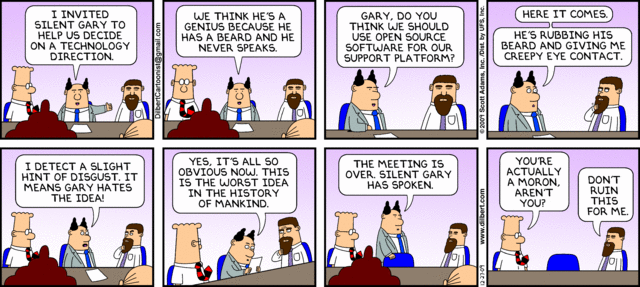
Tomas Sjostrom and I offer one option for reducing proliferation in our JPE paper Strategic Ambiguity and Arms Proliferation. If North Korea can keep the size and maturity of its nuclear arsenal hidden, we can but guess at its size and power. It might be large or quite small – who knows. This means even if the arsenal is actually small, North Korea can still pretend it is big and get some of the deterrent power of a large arsenal without actually having it. The potential to bluff afforded by ambiguity of the size of weapons stockpiles affords strategic power to North Korea. It reduces North Korea’s incentive to proliferate. And this in turn can help the U.S. particularly if they do not really want to attack North Korea but fear nuclear proliferation. Unlike poker and workplace posturing à la Dilbert, nuclear proliferation is not a zero-sum game. Giving an opponent the room to bluff can actually create a feedback loop that helps other players.

Eighty percent of the carrots in the US are produced by Bolthouse and Grimmway Farms. It is a billion dollar business. Moving from one duopoly to another, the new CEO of Boltway, Jeff Dunn, is a former Coke executive. Life is sunny and profitable in a duopoly but every business has its cloudy days in the current recession. The declining sales of baby carrots are blocking out sunshine in the carrot duopoly.
“Baby” carrots are just adult carrots whittled down to baby size. A farmer can plant more seeds per acre and get more yield growing baby carrots. They also sell better so demand is higher. Baby carrots are the “cash cow” of carrots. It turns out they are a “normal good”: demand declines as income declines. Regular carrots on the other hand seem to be an “inferior good”: demand is stable or even increases during a recession. But they are less profitable.
How should the farms reshuffle sales back towards baby carrots? To a Coke executive the idea comes easily: market them like junk food and de-emphasize the health benefits. So,
Display ads, printed up for supermarkets, presented baby carrots as “the original orange doodle,” and billboards suggested never fear carrots and beer. Maybe most provocatively, Bolthouse installed baby-carrot vending machines, wrapped in eat ’em like junk food graphics, at a pair of high schools.
For this and more read a great article in Fast Company.
The AER has been going for a hundred years. (Some scholars who sent in papers at AER’s inception are still going through the “revise and resubmit” process.)
To mark the anniversary, a distinguished panel has picked the Top 20 articles published in the last 100 years. Peter Diamond has three articles on the list and Joseph Stiglitz has two. We can now start the debate of what should be on the list. To fully account for the value added, if an article is proposed, the proposer should also identify which article should be knocked off the current list. To get the ball rolling, I propose Shapiro-Stiglitz to replace the Cobb-Douglas production function. A functional form does not deserve a place on this list, even if the form is canonical. Shapiro-Stiglitz actually have an idea, a theory of involuntary unemployment. More broadly, they provide a simple model of the principal agent model under moral hazard with limited liability, a fundamental model.
But to drop the science and get to the nub of the matter: What is a publication in AER actually worth in terms of salary? Bob Margo estimates the impact of AER articles in his contribution to the anniversary volume. In passing, Bob mentions an article which estimates the salary impact of an AER publication. The author Raymond Sauer finds:
“The full return to a 10-AEQ-page article in the top journal is thus estimated to be a 3.8 percent increase in salary.” (AEQ means the article is adjusted for page size to correspond to AER page length.)
Sauer’s article would not survive the “structural estimation” or “instrumental variation” schools of thought. But he does give us an idea of the payoff to learning the magic taught by the wizards and witches at these schools.
Grading still hangs over me but teaching is done. So, I finally had time to read Kiyotaki Moore. It’s been on my pile of papers to read for many, many years. But it rose to the top because, first, my PhD teaching allowed me to finally get to Myerson’s bargaining chapter in his textbook and Abreu-Gul’s bargaining with commitment model and, second, because Eric Maskin recommends it as one of his key papers for understanding the financial crisis. So, some papers in my queue were cleared out and Kiyotaki-Moore leaped over several others.
I see why the paper has over 2000 cites on Google Scholar.
The main propagation mechanism in the model relies on the idea that credit-constrained borrowers borrow against collateral. The greater the value of collateral “land” , the greater the amount they can borrow. So, if for some reason next period’s price of land is high, the greater is the amount the borrower can borrow against his land this period. Suppose there is an unexpected positive shock to the productivity of land. This increases the value of land and hence its price. This capital gain increases borrowing. An increase in the value of land increases economic activity. It also increases demand for land and hence the price of land. This can choke off some demand for land. The more elastic the supply of land, the smaller is the latter dampening effect. So there can be a significant multiplier to a positive shock to technology.
(Why are borrowers constrained in their borrowing by the value of their land and rather than the NPV of their projects? Kiyotaki-Moore rely on a model of debt of Hart and Moore to justify this constraint. While Hart-Moore is also in my pile, I did not finally have time to read it. I did note they have an extremely long Appendix to justify the connection between collateral and borrowing! The main idea in Hart Moore is that an entrepreneur can always walk away from a project and hold it up. As his human capital is vital for the project’s success, he will be wooed back in renegotiation. The Appendix must argue that he captures all the surplus above the liquidation value of the land. Hence, the lender will only be willing to lend up to value of collateral to avoid hold up.)
But how do we get credit cycles? As the price of land rises, the entrepreneurs acquire more land. This increases the price of land. They also accumulate debt. The debt constrains their ability to borrow and eventually demand for land declines and its price falls. A cycle. Notice that this cycle is not generated by shocks to technology or preferences but arises endogenously as land and debt holdings vary over time! I gotta think about this part more….

Ever since I read a great review of 2008 Oregon Pinot Noirs in the NYT, I’ve been on the lookout in local wine stores. I can’t find many from the NYT list. So I tried the Torii Mor on a whim It’s just over $20 and excellent value. Classic cherry fruit but with plenty of acid and a dry finish. Well balanced. On this evidence, I’m going to try any 2008 Oregon Pinot Noir I can find in this price range.

The forward looking agent forecasts trends in consumer demand, spots market opportunities and readies his organization for a great leap forward. But any decision is plagued with unforeseen contingencies. By necessity, any agent must also be backward looking, putting our fires as they appear. This sucks attention from looking forward and the organization may atrophy and lose its edge.
These two extremes manifest themselves in different ways at different points in an organization’s history. A firm that is just starting out will be forward looking by definition. There is no history, no fires to put out. Either the young firm dies – its products are unpopular – or it succeeds. That’s when the trouble starts. Success also breeds emergencies and crises large and small. Now attention is diverted. A young organization that reaches middle age it may not survive into old age. If optimization of extant decisions is the main activity, there is no time left to prepare for the next wave of technology, consumer demand…etc.
If the organization reaches old age, it is because it has learned to deal with unforeseen contingencies. It has set up frameworks, codes of practice and procedures that can simply be activated when a fire appears. This creates room for forward looking strategy analysis.
To summarize, a young organization is more forward-looking than a middle-aged organization. An old organization may also be more innovative than a middle-aged organization. We do not have a way to rank young and old organization with this bare-bones theory. There are, of course, many other theories. The “replacement effect” is one obvious alternative.
Non-state actors with extreme agendas try to influence state actors. This class overviews a potpourri of models that explore why a player might join a non state organization, the logic of non state actor strategy and the costs and benefits of torture.
Iannaccone has a classic paper on religious sects and their purpose and strategy. It has been applied to terrorism by Eli Berman. Such organizations provide public goods (healthcare, childcare etc) which are non-rival and excludable. They are club goods. And individual who joins such an organization is tempted to free-ride and and use his labor on privately productive secular activities. A religious sect might then prohibit secular activities and will require sect members to wear some kind of uniform to make monitoring easier. Also, a sect would like to admit members who have bad outside options to minimize the free-rider problem. Requiring a sacrifice, a costly signal, can help to identify the ideal member.
There are many theories for the logic of non state actor strategy. The simplest is that terrorists seek to impose large costs on some “occupier” and drive them out. Another is the opposite: terrorists seek to inflame a perceived enemy (a secondary audience). This in turn influences a primary audience whose support is necessary to achieve the non state actor’s ends. This is in effect a three player game where the extremist inflames a primary audience by changing the behavior of a secondary audience. This is only worth doing if the primary audience is suggestible. It might for example signal that the chances for peace are good if only extremism could be ignored.
Finally, what if a potential terrorist is in custody and may have valuable information that can save lives? He might break under torture. A cost-benefit analysis, a favorite of moral philosophers, recommends torture if the value of lives saved is large even though torture is morally reprehensible. But the same cost-benefit calculation subverts the process of torture. If the suspect starts talking, the value of his remaining information outweighs the costs of torture. If he is silent and probably innocent, it recommends stopping. But this undercuts the rationale for torture: the terrorist should stay silent as this is his best hope of escape. But then the value of torture is minimal as information is unlikely to be conceded.
Here are the slides.
Exploding food, frog blancmange, one of the oldest pubs in England (note posh accents), Harry Potter’s drink of choice etc. Creativity run amok with some technical skill – ideal combination for cooking or research. Gordon Ramsay eat your heart out…
Why might democracies be less warlike than other regime types?
Two early and related ideas:
Thomas Paine ([3] p. 169): “What inducement has the farmer, while following the plough, to lay aside his peaceful pursuit, and go to war with the farmer of another country?”
Immanuel Kant ([1], p. 122): “if the consent of the subjects is required to determine whether there shall be war or not, nothing is more natural than that they should weigh the matter well, before undertaking such a bad business.”
This idea has influenced policymakers of different political persuasions. Is there a rational choice/strategic theory for the democratic peace? This lecture discusses various alternatives.
First, we study the fear motive for war. The median voter might be a coordination type who wants his country’s leader to be dovish against a dovish opponent but aggressive against an aggressive opponent. This captures the Kant/Paine idea but also Schelling’s idea that aggression might arise out of fear. These incentives imply that democracies are more responsive to aggression that other regime types. A second possibility is that a leader can survive with the support of the “mob” (which has the same preferences as the median voter) or with the support of an elite that favors war. The leader loses power if he is weak in the face of aggression (no one supports him) but survives if he is aggressive even when an opponent is not (the hawkish elite support him). This kind of regime is more aggressive than a dictatorship. Data support these these comparative statics.
Second, we study the greed motive. The leader of country may get a disproportionate share of the spoils of war should his country win but not suffer a large cost if it should lose. He has a bias. If both leaders are biased, it may be impossible to avoid inefficient war even if transfers are possible. But if both leaders are unbiased then transfers can resolve conflict and may even be unnecessary.
Third, bargaining may devolve into a war of attrition. A democratically elected leader suffers greater “audience costs” if he backs down. This makes him a tough bargainer and his opponent correspondingly weak. A player may even deliberately “talk up” his audience costs to become a tough bargainer.
Here are the slides.
In my youth, every black turtleneck wearing undergraduate hoping to get laid carried around Milan Kundera’s “The Unbearable Lightness of Being“, pretending to be mature enough to understand its rather adult themes. To separate himself from the herd, a clever but randy student might also have an artfully ink-stained and annotated copy of Thomas Kuhn’s “The Structure of Scientific Revolutions“. He would pose around in coffee-shops and project a mood of delicate ennui, a mood that could be lifted by an interesting girl who could give some meaning to his life, especially in the bedroom. But only a professional philosopher would have a copy of Kripke’s “Naming and Necessity“.
According to Errol Morris, a filmmaker who made “The Fog of War: Eleven Lessons From the Life of Robert S. McNamara”, the last book, while not a fundamental contribution to foreplay, is a fundamental contribution to the philosophy of science. It is somewhat the antithesis of Kuhn’s theory. So much so that Kuhn forbade Morris, then a philosophy student, from going to Kripke’s lectures. It seems Morris and Kuhn had a difficult relationship.
I asked him, “If paradigms are really incommensurable, how is history of science possible? Wouldn’t we be merely interpreting the past in the light of the present? Wouldn’t the past be inaccessible to us? Wouldn’t it be ‘incommensurable?’ ”
He started moaning. He put his head in his hands and was muttering, “He’s trying to kill me. He’s trying to kill me.”
And then I added, “…except for someone who imagines himself to be God.”
It was at this point that Kuhn threw the ashtray at me.
And missed.
For that and more, see Morris’ essays in the NYT. I am going to change my PhD supervision style now I know the norm.
“When two dynamite trucks meet on a road wide enough for one, who backs up?” asks Schelling in his classic essay on bargaining. There are multiple equilibria. How can the solution be made determinate?
If one side can make a commitment, Schelling points out a easy solution:
“When one wishes to persuade someone that he would not pay more than $16,000 for a house that is really worth $20,000 to him, what can he do to take advantage of the usually superior credibility of the truth over a false assertion? Answer: make it true…..But suppose the buyer could make an irrevocable and enforceable bet with some third party, duly recorded and certified, according to which he would pay for the house no more than $16,000, or forfeit $5,000.”
But what if both sides can make a commitment? He says:
“Each must now recognize this possibility of stalemate, and take into account the likelihood that the other already has, or will have, signed his own commitment.”
And it is possible there is incomplete information, further complicating the issue.
In this class, I discuss two player bargaining models whether players can commit to demands. If a demand is rejected or joint commitments are incompatible, there is a chance of bargaining breakdown or costly delay till an agreement is reached.
First, I begin with complete information. The classic paper is by Rubinstein and it uses discounting to derive a unique equilibrium. Since, we want to study commitment, I instead followed Myerson’s analysis in his textbook. In his model, if a proposer’s demand is accepted, the game ends but if it is rejected, the game ends with probability p. If the game survives till the next period, the responder in the previous round becomes the proposer. The risk of breakdown acts as a discount factor. The risk of breakdown is a measure of commitment: the higher is p, the higher is the commitment to the demand. Myerson shows there is a unique equilibrium which is a function of p.
Second, suppose that with a small probability one player might be an r-insistent type who demands r and rejects any smaller offers. Then, Myerson shows that even if this player is not the r-insistent type, he can guarantee himself r in any equilibrium. If he demands r repeatedly, the opponent will give up rather than fight forever as he might be facing the r-insistent type. The rational player then knows he can get r eventually by pretending to the the r-insistent type. After a few rounds of haggling, his opponent is forced to give this to him. This solution does not depend on p. Hence, by adding a small probability that a player might be an r-insistent type, we have changed the equilibrium dramatically from the complete information model. In some sense, the player with an r-insistent type has a first-mover advantage. The bound on this player’s payoff varies with r so the equilibrium is not robust in the type that was added to the game.
What happens if both players can commit? Abreu and Gul study this issue. They show that essentially all bargaining games devolve into a war of attrition where rational players either pretend to to be r-insistent types at incompatible demands or reveal their rationality and concede, like in the Myerson game. In equilibrium, the probability that players are r-insistent types must reach one simultaneously. Otherwise, if say it reaches 1 for player 1 first, the rational type of player 2 must still be dropping out after he knows player 1 will not concede. But it is better for player 2 to deviate and give in earlier and get surplus rather than waste time. This idea pins down a property of an endpoint to the war of attrition. And other arguments can then be used to derive the unique equilibrium.
It is surprising the equilibrium is unique: bargaining games and games with incomplete information typically have multiple equilibria. The equilibrium is still sensitive to the r-insistent types. I believe this issue is resolved in later papers by Kambe and Abreu and Pearce. But I did not get to them. Here are my slides

A principal employs an agent to collect taxes. The principal cannot observe how hard the agent is working. What is the best way to set up incentives? Suppose the principal asks for a share of the tax revenue. This acts as a tax on the agent’s effort so he will under-invest. The agent also has the incentive to hide tax revenue. Not the best incentive scheme. Perhaps the only practical alternative is to “sell the firm to the agent”: demand a lump-sum fee for the right to become a tax collector. The agent has great incentives to generate tax revenue. The principal extracts the tax collector’s expected profit upfront via the lump sum fee. A classic two-part tariff.
According to Dexter Filkins in the New Yorker, here is how bribery works in Afghanistan:
Bribes feed bribes: if an Afghan aspires to be a district police officer, he must often pay a significant amount, around fifty thousand dollars, to his boss, who is usually the provincial police chief. The policeman earns back the money by shaking down ordinary Afghans… “It’s a vertically integrated criminal enterprise,” one American official told me.

Lagers like Stella Artois are bottom-fermented while classical Belgian beers are top-fermented. Lagers are more transparent and look “cleaner” in a transparent glass. Perhaps because of this, demand shifted to lagers. The share of lager beers in Belgium went from 15% before WW1 to 70% after WWII.
Bottom fermentation requires more equipment to cool the beer during fermentation and maturation. Hence, it gains from greater scale. Greater demand plus cost economies led to the market shifting towards a few large breweries. These set a lower price than smaller breweries and drove them out of business. Add to this the costs of advertising and scale advantages multiply….
For this and and more on Lambics and Abbey beers see Belgian Beers: Where History Meets Globalization
Suppose there are players and each has private information about how tough they are. The two toughness parameters together determine the probability of winning should there be a war. If the parameters are common knowledge, it is possible to avoid war by making a transfer that makes war pointless. By making a transfer, the target has less resources to capture and the challenger has more to lose and an appropriate transfer can create the right balance to avoid war. But if there is incomplete information, a player might start a war.
Is it possible to set up transfers to completely prevent inefficient war? Myerson and Satterthwaite asked this question in a classical model of trade with incomplete information. We can use similar techniques to answer a similar question in a conflict scenario. In other words, we can use the revelation principle and ask whether it is possible to design transfers as a function of reports to guarantee peace in all circumstances. Players’ types – their toughness parameters – directly affect their payoffs only if there is war. Since there is no war in equilibrium, it is impossible to separate out different types and transfers must be constant as a function of reports. The constant payoff each player then receives must be enough to dissuade his toughest type from starting a war. If this is impossible to guarantee for both players’ toughest types simultaneously, there must be war. Here are the slides.
Research by Chris Avery, Andrew Fairbanks and Richard Zeckhauser showed that early admissions (EA) programs give applicants a boost in college admissions. Improved chances of admissions might reflect a better applicant pool and not an advantage built into the early admissions process. But Avery et al controlled for this and still found that EA gives applicants an advantage.
EA applicants are constrained in their choices should they actually be admitted. To attract them, colleges have to offer lower standards for acceptance for early admission than for regular applicants who have more freedom of choice. Done in isolation, EA might benefit a college, as it steals above average students from its competitors. But if one college is employing EA, so must others, to recapture some of those students they lost. When all colleges use EA, the average quality of the student pool in each college may actually decline, because slots are taken up by the lower quality early applicants who crowd out high quality regular applicants. A Prisoners’ Dilemma.
There are other effects. Early applicants get worse deals on financial aid as they cannot play off multiple offers. So, early admission will attract wealthy students. They will also be more clued into the system. There are impacts on diversity.
But one or two colleges cannot change the equilibrium on their own. All have to give it up. Harvard and Princeton tried to drop EA but most other colleges did not. After all, the quality of Yale etc EA applicants goes up as Harvard and Princeton drop their programs. So it all fell apart and now both Princeton and Harvard have reinstated EA. A Harvard Dean says:
“We looked carefully at trends in Harvard admissions these past years and saw that many highly talented students, including some of the best-prepared low-income and underrepresented minority students, were choosing programs with an early-action option, and therefore were missing out on the opportunity to consider Harvard.”
EA can impact all sorts of settings. A player can try to cream skim before competitors notice. And so NU student Kota Saito heads off to Caltech without even going on the job market. I know MEDS has dome something similar in the past. Will other universities start doing this sort of thing too?

When a pet owner decides to give up a pet for adoption or breed more pets, he is callously ignoring the implications for other potential pets. The pet he gives up for adoption crowds out a home for another animal. The pet exerts a negative externality on other potential pets. The decision-maker – i.e. the pet owner – does not take this externality into account and there is overproduction of pets. Excess pets are euthanized.
When a tomato farmer sells more tomatoes, he is callously ignoring the welfare of other tomato farmers. The tomatoes he sells crowd out a home for other tomatoes. But we think the market for tomatoes in principle works quite well.
Why of your fat cat couch potato not like a tomato? In a new publication, Coate and Knight answer this question. In the tomato market, there is a market price for tomatoes. Each tomato producer is small and his output does not affect the price. But there is a market price for pets and neither buyers nor sellers of pets affect the price. So what’s the big difference?
Tomatoes you are bored with or cannot support financially do not have to be euthanized. Stray tomatoes do not wander the city, scavenging rotten meat from trash cans. Pet euthanasia imposes an external cost that the pet owner does not pay. Stray pets must be caught by public services. There is no easy way to charge the pet owner for these costs. If there were, pets would be like tomatoes. But pet owners can avoid euthanasia fees by dumping unwanted pets as strays. Coate and Knight argue that this “moral hazard” problem makes it impossible to effectively deal with the externality created by pet owners. Hence, there is overproduction of pets.
What is to be done? Taxation of pet ownership is one solution. Subsidies for spaying are another. Dog licenses act as a tax. But cat owners face no government imposed barrier to acquisition of a furry friend. There must be serious overproduction of cats. We all know cats generate more allergies than dogs – another negative externality. This is serious
Obama has made an effort to improve healthcare. Hopefully he or whoever replaces him will take up pet – particularly cat – overpopulation in the next term.
There are many dimensions to this question . Let me focus on just one – collective decision-making.
Say there are two well-defined groups, A and B, in the division doing related but different work. Group A cannot judge collective decisions on hiring, investment etc that impinge on Group B and vice-versa. But the members of Group A certainly have opinions on how they should hire, fire and invest in their own group and so does Group B. Suppose the two groups vote together on all decisions within the division even if they mainly concern one group and not the other. There are two polar cases.
The members of each group have near common values and want pretty much the same thing. Then voting by each group on its own decisions aggregates information. The uninformed group should abstain. And if there are collective decisions that must be made at the division level, there is no need to break the group up.
At the other extreme, suppose for instance there is serious disagreement in Group A – there are significant private values. The members of Group B also get weak signals of the best decision for Group A. There is also a seniority ranking over the members of Group A. If the members of Group B continue to abstain on all Group A decisions, then information is still aggregated.
But there is another possibility. Members of Group B want to curry favor with senior members of Group A. These senior members are involved in lots of firm level decisions and it is important to have them on board. Then, another equilibrium can develop. When Group B member think the senior members of Group A are wrong, they abstain. They think their signals are too weak to overrule Group A members. But if they think the senior members of Group A are right, they vote enthusiastically along with them. Career concerns screw up voting in the division. This division should be broken up.
Schelling on dealing with threats:
“[I]f the person to be threatened is already committed, the one who would threaten cannot deter with his threat, he can only make certain the mutually disastrous consequences that he threatens.”
With “person” equal to professor and “the one” equal to student, Schelling adds:
“At Yale the faculty is protected by a rule that denies instructors the power to change a course grade once it has been recorded.”
Does Yale still have this rule? The threatener can apply a threat at a higher university level and not directly at the professor. Ideally, the threatener’s parents – the ones who sign the checks – can apply the threat. Then the rule will be changed and you can turn your attention back to the professor.
I am in Miami (or more precisely Coral Gables) to teach in Kellogg’s Miami Executive Program. Instead of flagging a cab and heading over to Gloria Estefan’s beach restaurant for lunch, I am glued to the internet checking the NYT website every few minutes to see what’s going on in Egypt.
Like all dictators who manipulate elections to stay in power, Mubarak invoked the Constitution to justify delaying and limiting the transfer of power. It seems laughable to invoke a constitution that has been ignored for decades to use it as an excuse for justifying anything. But I guess it is important.
As far as I can tell from my Hyatt vantagepoint, Mubarak has stepped down and has headed to his home in Sharm el-Sheik. He has handed over power to the army and his Vice President. Yesterday, Mubarak did pretty much the same thing but stayed as President and devolved powers up to the limits allowed by the Constitution. There was a danger than when the protestors calmed down, he would return to power. But it seems he can to something very similar from Sharm al-Sheikh, returning to power once the protests have subsided.
There is a key difference: In the former case, he can invoke his constitutional authority to return to power and in the latter, his return would be extra-constitutional as he would have stepped down. Even though the Constitution is cheap talk, it is a coördination device for the army. The leader the guns support will return to power. They are less likely to support Mubarak after he has formally stepped down. So, all the constitutional garb was relevant after all. It remains to be seen how the army will behave over the next few days. I will not be going to Gloria’s restaurant at all on this trip I suspect.

A player who seeks to be aggressive against an opponent prefers to catch him by surprise and passive and not well-prepared. The chance that an opponent may attack by surprise makes a player cautious and well prepared and not passive. Hence, uncertainty about each player’s intentions can create a vicious cycle where everyone turns aggressive. This was the topic of last week’s class.
Next we study if communication can provide a route out of conflict. But the same incentives that generate conflict generate incentives for deception: whether a player intends to be aggressive or passive, he wants his opponent to be passive. Hence, he might always send the message that maximizes the probability that his opponent is passive but then cheap-talk is not effective and does not affect the equilibrium. An argument along these lines was made by Aumann in a Stag Hunt game.
We show that while deception occurs in equilibrium, it is still possible to transmit enough information to create less conflict. While players may always seek to minimize the probability their opponent is aggressive, they may also value information about his action so they can coordinate against it. If the trade-off between these two benefits is type-dependent in a conflict game with incomplete information, separating equilibria are possible and so is coordination on peace.
The ideas above relate to conflict and escalation, where it is known that aggression begets aggression. What if aggression may beget deterrence not escalation? For example, revealing weapons may create deterrence but trigger escalation. Revealing you have no weapons may reduce escalation but eliminate deterrence. In this situation it can be optimal to employ strategic ambiguity: neither reveal weapons if you have them, nor reveal you do not have them if you do not. Strategic ambiguity allows a player to employ “deterrence by ambiguity” as he may be armed behind the veil of ambiguity. He has less incentive to acquire arms as he can pretend to have arms even when he does not behind the veil of ambiguity. This reduction in arms proliferation can help all players not just the player employing ambiguity strategically.
Here are the slides.
 You are reorganizing your firm. There are many legacy employees the old CEO was too weak to fire. They are inefficient and incompetent but their connection to the old CEO – an insider – kept their jobs safe. You were hired from the outside and feel no particular affection for the old guard. There is one employee Mr X who is high up. He is terrible at his job but has survived by using his charm and by buttering up the customers. Sometimes he went too far. You hear rumors of “liasons” between your staff and the customers. Also, there were inappropriate exchanges of gifts. While nothing was strictly illegal, if news gets out, your firm will look bad and business will suffer.
You want to sack Mr X. Your problem is that he knows too much: if you fire him, he threatens to go to the press and tell them everything he knows. This would be a catastrophe. One thing can save you: what is bad for you is also bad for him. Mr X played no small part in the sleazy business he threatens to reveal. He’ll have a hard time getting a new job if he spills the beans. Even if he gets a new job, stabbing is old boss in the back will make his new boss worry if he can trust Mr X. It seems you are safe.
What can Mr X do to make his threat credible? This is an classic problem in game theory and perhaps I have something new to say. But it cannot be better than what Schelling and Ellsberg said many years ago. For example, see the Theory and Practice of Blackmail by Daniel Ellsberg. Ellsberg identifies four strategies for the blackmailer: (1) commitment, (2) contracts with third parties, (3) uncertainty about payoffs and (4) cultivating a reputation for irrationality.
Mr X might give his evidence over to a lawyer and instruct him to release it should Mr X ever be fired. He might write a contract with a third party stipulating that he will pay a large fine to the third party if Mr X is fired and does not release the evidence. These solutions seem far fetched to Mr X. He has no wealth to hand over as a fine and anyway contracts can be renegotiated (e.g. The third party knows that he will not get paid in equilibrium. So Mr X and the third party could agree to write a new contract after Mr X is fired. The agree to small payment to the third party even if Mr X does not reveal the evidence.)
So, Mr X is left with the last two options which are quite related. He has to look either as if he enjoys a fight for its own sake or that he does not but is crazy enough to take actions against his own self-interest. The topic of many subsequent papers in game theory.
Ellsberg’s paper is the text of a lecture he gave to a general interest audience. It is an easy and fun read. Ellsberg offers a very clear definition of rationality as used in economics. The paper is notable for an aesthetic in game theory that it espouses: Game theory offers qualitative intuition and is not inherently quantitative. And it is an art not a science.
 Cheap Talk