
You are currently browsing Sandeep Baliga’s articles.

Last month… San Diego’s Stone Brewing Co., whose rare Vertical Epic beers are sometimes listed on eBay for more than $1,000 per bottle, began selling the first beer in its new Quingenti Millilitre series via a lottery system, and Stone has announced that people who try to resell it will be banned from future drawings. “We have involuntarily been a part of the eBay aftermarket for many years,” says Greg Koch, Stone’s co-founder and chief executive. “This is the first time we’ve come out, laid it on the table and said very point-blank, ‘Please, do not resell.’”…
Stone’s use of a lottery is intended to keep its beer accessible and relatively inexpensive. The brewery hopes to reward devotees rather than opportunists, and although it is selling the beer for $25 per bottle, that price reflects the cost of production instead of what the market will bear.
If resale can be controlled by ejection from future purchases, the lottery might work. But if not, Stone is going to give money away to resellers and no devotees will get it for cheap. Luckily for me, Stone Levitation is in elastic supply.
I am attending an antitrust conference hosted by the Searle Center at Northwestern University. In my attempt to Americanize, I am drawn to any paper involving sport. And if British sport is thrown in for comparison, resistance is impossible.
Haddock, Jacobi and Sag offer an analysis of American NFL football stadiums versus English soccer stadiums. Their thesis is simple: the NFL controls entry of new teams in the league and teams can move from one city to another. So, if the New Jersey government does not cough up $1 billion for the New Meadowlands, teams can threaten to move and the NFL can refuse to allocate another team to the state. For example:
When the Houston Oilers threatened to move to Jacksonville, Florida in 1987 Harris County, Texas, responded with $67 million in improvements to the funded by property tax increases, doubling the county’s hotel tax, and underwriting bonds to be paid over the next 30 years. Within six years the Oilers began lobbying for a new stadium with club seating. Rather than opposing the Oilers rent seeking, NFL Commissioner Paul Tagliabue warned Houston that “If the Oilers’ situation doesn’t work down there, I don’t see any circumstances in which we’re going to guarantee a team, especially when one team’s already found it unsatisfactory.” The message was clear, if Houston lost the Oilers because it refused to accede to the team’s demands, it was unlikely to receive a prompt replacement. At the end of the 1996 season the Oilers left Houston for Nashville where city officials had promised to contribute $144 million toward a new stadium.
In England, entry is easy. If a team attempts to hold up a city, it can create its own new team. This reduces the bargaining power of the team.
Jerry Hausman, the discussant, found much to disagree with. Hausman claimed many British teams were simply no-hopers. Very few teams are actually competitive. Arsenal is not one of them and hence no-one would fund a stadium for them. In the NFL, many teams are competitive. Hence, they can extract rents from the local community. He thought politics was an the center of problem: Why did Massachusetts fund a new high school in Newton rather than soend money in poorer areas? He displayed a surprising amount of knowledge about English soccer and claimed to have worked for the Chicago Bulls (I didn’t catch what he did for them). He speaks fast so I may have missed some details.
David Pogue has also been thinking/fuming about the Netflix price change which effectively increases prices from $10 to $16 for streaming plus one-DVD-at-a-time. He ends with:
[W]hat makes me unhappiest is how calculated all of this feels. In July, a spokesman told me that Netflix had already taken the subscriber defection into account in its financial forecasts.
And sure enough. When I tweeted that Netflix had lost one million of its 25 million customers, @npe9 nailed it when he wrote:“It damages their brand and images, but 24 million customers paying $16 is still better than 25 million @ $10. Increases revenue by >50%.”
This issue is perplexing many of us who teach in business schools – are we going to have to change our classes as one of the firms in many of our key examples goes bankrupt?
We are not sure we have a good answer to our question so we will satisfy ourselves with a brain dump.
First, it may very well be true that, as CEO Reed Hastings is saying, Netflix does not want to end up like Borders or AOL in the garbage can of history when the next new technology comes along. After all, Blockbuster has never really recovered from missteps when Netflix DVDs arrived on the scene.
Therefore, Netflix wants to be ahead of the curve when DVD technology dies and everyone watches streaming movies. Here is one way to do this: keep the total price of 1 DVD at a time +streaming at $10 but price streaming alone at $6 and 1 DVD alone at $8. What they did instead, to maintain margins we assume, is raise prices by 60% so I DVD at a time + streaming is now $16. Of course this going to cause some serious fall in demand and also create a media frenzy.
There is a broader point: we gave one example of how Netflix might shuffle prices to create switching but we do not have the internal data on revenue and costs so the optimal pricing might be different. But whatever it is, the optimal pricing requires the DVD and streaming prices to be coordinated. If you split these two services into different (competing?) companies, you might create a price war and not only undermines your whole strategy but destroys your profits….
Even if completely separating the two businesses is the only way Netflix feels it can incentivize its streaming business to move ahead properly, there is absolutely no reason the company should expect consumers to care about its internal strategy issues – the strange angle taken by Hastings’ blog postings and emails to customers. It seems to us that it is the large price hike, far more than any other aspect, which has upset customers.
As a final comment, even if Netflix gets everything right operationally in its streaming business, it is hard to see how they plan to maintain margins and demand given that their suppliers (the content producers and owners) have a great deal of bargaining power and have every incentive to treat Netflix as only one outlet among many competing ones for their product. Other companies in the content delivery business, such as cable & satellite operators, face similar issues, but have the advantage of higher barriers to entry in terms of local franchise rights and physical infrastructure that gives them greater scope to raise prices……Our guess is that we will have more posts as more information arrives.
Sandeep Baliga and Peter Klibanoff
Many homeowners are taking advantage of low interest rates to refinance their mortgage. One group is conspicuously absent: low income homeowners with a history of shaky credit. Refinancing would help them and the economy at large but the costs of refinancing plus the reluctance of lenders to lend has compromised the availability of credit to this group. What is the solution? There are three proposals that are in the public domain.
1. Inflation: This has been proposed by Ken Rogoff. He would use inflation to reduce the value of debt and get borrowing moving again. The difficulty is that the FED has carefully nurtured a reputation as an inflation fighter for the last couple of decades. Once it loses that reputation can it recover in time for an inflationary period? This issue makes he Rogoff solution unpopular with many central bankers.
2. Loan Modification: Posner and Zingales propose a loan modification program. The details are complex but require some Congressional input to change bankruptcy law or pass new legislation. This is politically impossible in the current political climate so whatever the merits of the plan, it does not seem feasible.
3. Refinance: Boyce, Hubbard and Mayer propose to ease lending rules and offer loans at 4% to eligible homeowners whose loans are guaranteed by Fannie and Freddie. How much if this plan is implementable by the President without Congressional approval? That is the question. On first blush, this plan seems the most politically feasible to me.
The end of summer heralds the annual ritual of the suburban block party. The street has to be blocked off, notices have to be put up so no-one parks on the street, food has to be ordered or cooked etc. The burden falls on the people with kids because “The block party’s for the kids” we all say. Obviously, there is a huge free-rider problem – we can all enjoy the benefits of the block party without spending time on setting things up. If you don’t hang out with your neighbors much, “repeated game” effects are minor. Hence, morality and peer pressure must step in to provide incentives.
For example, suppose you sign up to put up notices warning people not to park on the street on the day of the block party. You write up some flyers and put them under car windscreen wipers. You print off notices and staple them to trees. You think you’ve done a pretty good job. The next day you wander round putting in new flyers 
 under car wipers and check on the notices. Mysteriously, someone has taken it upon themselves to put up their own notices. These are taped to the trees not stapled. Is that really superior? You are not sure but you see the implicit rebuke in the intervention. Homo economicus would revel in the intervention – he could slack off even more knowing someone will do his job for him. But homo normalicus feels a tad pissed off and even a bit guilty, even though no guilt is truly warranted. Next year, normalicus will go back to picking up the fried chicken from Jewel-Osco. But if economicus/evilicus pops out, he will do the same job worse out of rationality or spite.
Suppose a firm can enter one of several markets. Other things equal, the fewer competitors there are, the greater is the incentive to enter as profits are decreasing in the number of competitors. So, smart managers should enter markets with fewer competitors. The deregulation of local telecommunications services in 1996 led to entry by competitive local exchange carriers (CLECs). These varied in the experience and education of senior managers and hence allow a descriptive and analytic analysis of entry decisions. Goldfarb and Xiao perform this analysis and find
Our descriptive analysis, which  characterizes the entry decisions of facilities based CLECs in 234 midsize US markets with populations between 100,000 and 1,000,000 as of
the 2000 Census, reveals that experienced CEOs, CEOs with an economics or business
education, and CEOs who attended the most selective undergraduate institutions tended to enter
markets with fewer competitors.

They also estimate a behavioral model of entry to try to identify strategic sophistication as defined by the Cognitive Hierarchy model of Camerer, Crawford etc.  They find that the firms with strategically sophisticated managers are more likely to survive and be profitable.  There are many things that one might ague with - e.g. Doesn't better (economics/business) education help you to motivate workers better, cut costs etc?  Why is strategic sophistication identified only with competition avoidance?  Many questions come to mind but this is still an interesting paper.
In the thirteenth century, Italians and Dutch traders went to Champagne not to drink champagne but to trade. They had to travel there and back and worry about theft. There was always the chance that some dispute would arise at the trade fairs. Courts arose to enforce contracts. Did they arise spontaneously in Coasian fashion, created by contracting parties to facilitate trade? Or was their government intervention? The first view is advocated by Milgrom, North and Weingast in a lovely and influential paper. MNW invoke some “stylized facts” about the institution of the “Law Merchant”, They claim the law merchant was a kind of store of the history of past exchanges. The law merchant could substitute for the incomplete knowledge of trading parties themselves and had good incentives to be honest himself to retain his income as a law merchant. The paper is mainly theoretical and has a nice prisoner’s dilemma model with traders changing partners every period.
A new paper by Edwards and Ogilvie challenges the stylized facts that motivate MNW. They claim:
The policies of the counts of Champagne played a major role in the rise of the fairs. The counts had an interest in ensuring the success of the fairs, which brought in very
significant revenues. These revenues in turn enabled the counts to consolidate their political position by rewarding allies and attracting powerful vassals….The first institutional service provided by the counts of Champagne consisted of mechanisms for ensuring security of the persons and property rights of traders. The counts undertook early, focused and comprehensive action to ensure the safety of merchants travelling to and from the fairs..
A second institutional service provided by the rulers of Champagne was contract enforcement. The counts of Champagne operated a four-tiered system of public lawcourts which judged lawsuits and officially witnessed contracts with a view to subsequent enforcement…
A final reason for the success of the Champagne fair-cycle was that it offered an almost continuous market for merchandise and financial services throughout the year, like a great trading city, but without the most severe disadvantage of medieval cities – special privileges for locals that discriminated against foreign merchants
The paper is an interesting read and there are lots of rich details about the Champagne fairs themselves.
“We were worried it was going to be a gripe site,” said the chief executive, Stephen Kaufer. “Who the heck would bother to write a review except to complain?” Instead, the average of the 50 million reviews is 3.7 stars out of five, bordering on exceptional but typical of review sites.
In fact, we can reverse the logic: “Who the heck would bother to write except to praise?”
Imagine you are asked to write a letter of recommendation for someone up for tenure. First, the university asks you if you are willing to write the letter. You mentally measure the amount of time it is going to take to read the papers. Add to that the time to write a clear and comprehensive letter. Are you going o do all that just to say something bad? Probably not. But if you are going to write something nice that gives the candidate a job for life, that might give you the satisfied buzz to counterbalance the cost of writing a letter. So, letters of recommendation will be biased towards the positive.
There is still some information: Bad candidates will get fewer letters than good candidates. Buts is this carefully noted? Is the number of letter writers who refused to write letters even recorded?
Perhaps the main countervailing force is envy. Why does X deserve tenure at highly ranked University A while I the letter writer am at humble University B? It is impossible not to write a letter for University A. If the candidate is bad, you are forthcoming. If the candidate is good, you are begrudging. But the quality of the letter is monotone in the quality of the candidate and information is aggregated. Only the very best universities are the object of envy. The rest have to decode the positive bias in their tenure procedures just like Tripadvisor users.

There are four major providers of national cellphone service in the U.S – Verizon, AT&T, Sprint and T-Mobile. Two of them are proposing to merge. What impact will the merger have on consumers? Senator Herbert Kohl (of Kohl’s stores fame) says:
“According to Consumer Reports, ‘T-Mobile plans typically cost $15 to $50 per month less than comparable plans from AT&T.” Removal of such a maverick price competitor from such a highly concentrated market – a competitor that disciplines price increases from all three other national cell phone competitors, not only At&T – raises a substantial likelihood that prices will rise following this merger.”
Someone can take the opposite view to ATT-TM LT to DOJ and FCC but at least it is coherently argued.
From security analysts Raelynn Hillhouse and her blog The Spy Who Billed Me:
Sources in the intelligence community tell me that after years of trying and one bureaucratically insane near-miss in Yemen,the US government killed OBL because a Pakistani intelligence officer came forward to collect the approximately $25 million reward from the State Department’s Rewards for Justice program.
The informant was a walk-in.
The ISI officer came forward to claim the substantial reward and to broker US citizenship for his family. My sources tell me that the informant claimed that the Saudis were paying off the Pakistani military and intelligence (ISI) to essentially shelter and keep bin Laden under house arrest in Abbottabad, a city with such a high concentration of military that I’m told there’s no equivalent in the US.
The CIA and friends then set about proving that OBL was indeed there. And they did.
Next they approached the chiefs of the Pakistani military and the ISI. The US was going to come in with or without them. The CIA offered them a deal they couldn’t refuse: they would double what the Saudis were paying them to keep bin Laden if they cooperated with the US. Or they could refuse the deal and live with the consequences: the Saudis would stop paying and there would be the international embarassment…
The ISI and Pakistani military were cooperating with the US on the raid.
This is turning into a Tom Clancy novel
Related to my earlier post, where I suggested there as advantage to each chamber from delaying debt limit proposal as long as possible, Pelosi says:
[I]f we had days, instead of backed up to hours, we could have said ‘you don’t have the votes, let’s go back in and how do we move this way in order to cut some of those cuts and have a better bill and get the votes.’ So I think we could’ve done better. I think they were successful at just prolonging it to the last minute so that we didn’t have that option and it was default or no default.
The Guardian has gotten hold the U.K. interrogation policy:
In deciding whether to give permission [for overseas interrogation], senior MI5 and MI6 management “will balance the risk of mistreatment and the risk that the officer’s actions could be judged to be unlawful against the need for the proposed action”.
At this point, “the operational imperative for the proposed action, such as if the action involves passing or obtaining life-saving intelligence” would be weighed against “the level of mistreatment anticipated and how likely those consequences are”.

When the debt limit increase finally passed, the law included the creation of a 12 person committee, the SuperCongress, which will negotiate the next round of spending cuts and tax increases. If they fail to agree, automatic spending cuts go into effect. These spending cuts include elements that are painful to both parties and this punishment is meant to help the committee members compromise. Also, the automatic spending cuts that kick in if there is no compromise are not as painful for the economy as a failure to increase the debt limit. This seems to be the idea. I have a couple of points.
First, the Democrats partly caved this time around because they feared the Tea Party wing of the Republican House members were “crazy types” who were willing to destroy ratings of American Treasury bonds to get dramatic spending cuts. Next time around, the threat of disagreement has to police the Tea Partiers. Do they really care about defense? If they care about small government and less foreign intervention, they may actually want defense spending cuts. To get these guys to compromise, the disagreement point should have included libertarian-unfriendly policies. Federally mandated rules that everyone should brush their teeth twice a day, extra additives in drinking water, gun control laws and perhaps a constitutional amendment to eliminate the right to bear arms. Stuff like that should have been in the disagreement point.
Second, the parties face a choice of whom to put onto the SuperCongress. Each party will have six members, three drawn from each chamber. The strategic problem is fairly familiar as it resembles Schelling’s discussion of delegated bargaining. Each party has the incentive to appoint extreme members with tough bargaining stances so the other side will be more likely to give in. Paul Ryan is an obvious choices for the Republicans. Dick Durbin is an obvious choice for the Democrats. If both parties pursue this strategy, there will be deadlock and the disagreement point will come out of the SuperCongress (another example of Prisoner’s Dilemma everywhere).
This analysis is normative – it does not account for strategic errors. And there have been plenty of those. During the health care negotiations we had Max Baucus fruitlessly pursuing his Republican friends trying to get them to sign on. Olympia Snowe got a lot of one-one-one face time with the President. As Krugman points out (see also Jon Stewart a couple of nights ago!), the debt limit extension could have been folded into the extension of the Bush tax cuts last December but the President believed John Boehner at his word. So, my guess is that while Nancy Pelosi and the Republicans will follow the rational choice predictions because they are quite clearheaded, Harry Reid will try to forge a bipartisan compromise. Max Baucus is on (and Kent Conrad would have been if he were not retiring). Ben Nelson is a maybe. Why not go take the extra step Harry and nominate Susan Collins or Olympia Snowe to show that you mean well? With that kind of strategy, the Bush tax cuts may get extended again as part of the SuperCongress compromise and remarkably the Democrats might be forced to implement a compromise that is worse for them than the disagreement point.
Auctions on eBay have a deadline and aggressive bidding occurs just before the auctions ends. This is called “sniping” (see this excellent paper for a discussion along with the study of many other interesting issues). One reason offered for this behavior is that bids might not come in as the auction ends so if your low bid gets in and my high bid does not, you win anyway (I seem to remember a paper by Al Roth along these lines). A similar effect arises in the debt limit negotiations.
Assume for now the deadline is August 2 – if the debt limit is not raised by then all hell breaks loose. If the House has a proposal on the table later today, this gives the Senate the change to reject it and table their own proposal. But if the House gets their proposal in on August 1, there is too little time left for the Senate to respond with their own bill. If they reject the House proposal, all hell breaks loose. And if the President vetoes the bill, all hell breaks loose. So, there is distinct advantage to the House from delaying the vote. Symmetrically, there is similar advantage to the Senate from delaying the vote. But if both delay the vote, there is also a huge risk that neither proposal makes it through either chamber because both Reid and Boehner are having hard time drumming up enough votes. So, as both parties delay the vote, there is a huge chance of hell breaking loose….
What if the August 2 deadline is not hard? Then, I think I need a model to sort things out but my intuition is that there is bigger incentive to accept an early agreement (after August 1)- if you reject it, there is chance your counter proposal does not make it through as all hell breaks loose because the government runs out of money. But if early agreements might be accepted, there is a bigger incentive to move early and get your bid in…..
Our former Dean, Dipak Jain, now Dean of Insead, suggests:
American schools are often “super-proud” of student bodies in which one-third are international, says Dr. Jain, who was dean at the Kellogg School of Management at Northwestern University until 2009. In classes at Insead, he says merrily, “it looks like the United Nations.”…..Where M.B.A. students at Insead study businesses and business practices from around the world, American curriculums tend to be “very U.S.-centric,” he says, with case studies focused on domestic corporations. A more global outlook might in fact run counter to the fundamental appeal of American schools, he suggests. “The attraction for the U.S. is, people go there to work with the Americans,” he says. “So for U.S. schools, if they become completely international they would lose their competitive advantage.”
There is a difference between teaching international cases and having an international student body. While international students might want to learn about American business at an American business school, that does not mean they do not want to come here to get a degree (I hope!). Going global means staying local.
The gym which I hardly go to sends me frequent emails which may finally push me to cancel my membership. Here is one of the more interesting emails I got:
“We replace about 3,000 towels per month, and while roughly 10% of these are taken out of circulation by us because they are no longer suitable for use, the remaining 90% leave the building and don’t come back. 3,000 new towels a month, especially with the rapidly rising cost of cotton, adds up quickly to an amount of money that we should be spending on things like equipment upgrades and the provision of scholarships to our youth. Here are the steps we plan to take:
- Starting August 8th, two towels per visit will be available to any member who wants them at the Front Desk. This will be the only place where towels are available. The Y will reduce its buying to 1,500 towels a month. Our card scans at the Front Desk tell us this is enough to give everyone working out here two towels per visit.
- Buying will be capped at that 1,500 per month figure, so if towels are not returned we could run out and members working out later in the month would not be able to get towels. Returning your towels before leaving the Y will ensure that this does not happen.”
At first blush, it seems elementary economic theory predicts this plan will fail. The gym is using collective punishment to give incentives. If I take the towel home by mistake (they are too grotty to steal!), the chance of being pivotal in the towel service cancellation decision is small. So, while I’ll take a little bit more care to leave the towel, it’s not going to affect my incentives significantly. Everyone will think the same way and later on the month we will all be bringing our own towels to the gym.
Once we all stop going at the end of the month, as taking your own towel adds yet another impediment to gym attendance, the gym will get the dream member who does not turn up but pays the dues. Is this their dastardly plan after all?
Here is a possible solution: Everyone gets two towels when they turn in their gym ID at the front desk. They get the ID back if they return two towels when they leave. Otherwise they pay a fine. This does unfortunately create an incentive to steal a towel from someone else if you happen to lose your towel. But I think it’s still worth trying.
Crisis management by firms advises that the firm take blame and apologize for any wrongdoing, create empathy from the consumer, solve any fundamental problem and rebuild reputation and perhaps even achieve competitive advantage. Johnson and Johnson’s strategy when it dealt with arsenic in Tylenol bottles is the “gold standard” of this approach. ( I used to teach this material.) NewsCorp advised by Edelman went some way down this path. Rupert had the most humble day ever and James frequently apologized for the hacking of Milly Dowler’s phone. They shut down the News of the World and “cut out the cancer”. But then tensions emerged between the incentives of the Murdochs and even NewsCorp and the classic crisis management strategy.
First, there were denials that the Murdochs knew anything about the hacking – admitting knowledge would imply there were still cancerous cells left in the NewsCorp organism and these should have also be chopped out. The Murdochs do not want to be chopped out and hence cannot admit to any wrongdoing. Also, if Rupert Murdoch leaves, will NewsCorp survive without the mastermind who created the mega-company? So, blame cannot be taken by Rupert and by blood-relation James. But someone did something wrong even if the Murdochs did not.
This leads to the second problem. The Murdochs have to blame someone for the problems that arose. So far, they have blamed a law firm with which they deposited potentially incriminating emails. A NewsCorp lawyer Tom Crone left and with the closing of NoTW there are may disgruntled staff. The latter have been promised re-employment but it is not clear if this has materialized. Finally, during testimony it emerged that NewsCorp was still paying legal fees for the private investigator at the center of the scandal and they have been forced to withdraw that support – it’s hard to get empathy from consumers if you paying the legals costs of the guy who hacked into Milly Dowler’s phone!
These two forces together mean if there is any collusion between these various players it is close to breaking down. I guess the story will get a second wind despite the beginning of the Parliamentary summer hols. I am not even bringing in the Coulson-Cameron angle which acts as a force multiplier for the story.
Researchers at RAND got hold of data on Al Qaeda in Iraq’s expenditures by sector. They also have data on attacks by sector. They claim:
[W]e find that for every $2,732 transmitted by the Anbar administrative emir to a particular sector, an additional attack occurred in that sector….We compute the $2,732 figure as follows. Each spending coefficient
shows how much a $1,000 change in spending in a given week would change the number of attacks. Using the coefficients in Table 5.3, increasing expenditures by $1,000 in a week would increase the number of attacks by 0.1 in the same week, by 0.08 one week later, by 0.08 two weeks later, by 0.04 three weeks later, and by 0.06 four weeks later, for a total of almost 0.4 additional attacks. To convert this to the additional expenditure needed for one complete attack, we divide $1,000 by 0.366 (the exact fractional increase in attacks) to get $2,732.
They add:
The amount $2,700 is equivalent to almost three times Anbari per capita 2007 household income (in 2006 dollars) and 40 percent of total average household income, a relatively large sum.
I assume the data cannot be shared. Otherwise, if the empirical analysis is sufficiently rigorous, the research is publishable in a peer-reviewed journal. These typically require data to be made publicly available so the analysis can be verified.
The behavioral psychology here is very easy to understand. No bank wants to admit that it wrote idiotic loans, and write down its own assets from par. Meanwhile, it’s much easier to write up an acquired asset, if the amount you reduce the loan is less than the discount you bought the loan for in the first place.
Economically speaking, however, what the banks are doing here does not make sense. Either writing down option-ARM loans makes sense, from a P&L perspective, or it doesn’t. If it does, then the banks should do so on all their toxic loans, not just the ones they bought at a discount. And if it doesn’t, then they shouldn’t be doing so at all.
In fact, accounting rules make bank behavior “rational”:
If a bank has a loan on its books valued at par, and it offers a principal reduction, it must write down the value of the loan. It takes a hit against its capital position, and experiences an event of nonperformance that even the most sympathetic regulators will have no choice but to tabulate. If a bank has purchased a loan at a discount, however, the loan is on the books at historical cost. The bank can offer a principal reduction down to the discounted value without experiencing any loss of book equity.
Of course this is a matter of mere accounting. Whether or not a bank takes a capital hit has no bearing on whether a principal reduction will increase the realizable cash-flow value of the loan.
This moves the problem one layer further back: What is the rationale for these accounting rules? Either a principal reduction should be discouraged via accounting convention whether the loan was purchased or bought or it should be allowed in the right circumstances…
(Hat tip: Mallesh Pai)

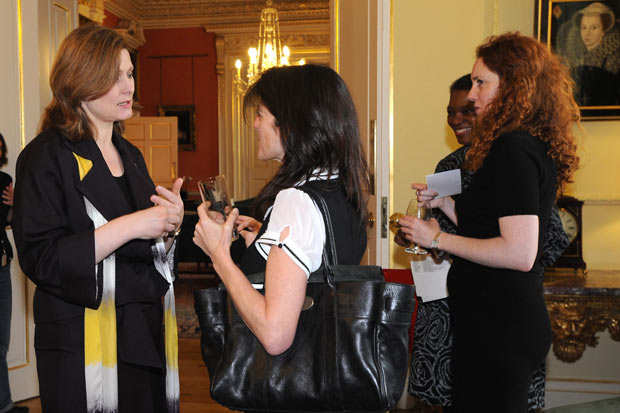
You have friends and enemies. Friends are nice to you and enemies are mean to you. There is always a chance that a friend turns into an enemy and an enemy turns into a friend. An enemy is more likely to turn into a friend the nicer you are to him. A friend is more likely to turn into an enemy the meaner you are to him.
If your enemy is your sworn enemy, hating you whatever you do, there is no point being nice for strategic reasons. But the fact that you want to persuade an enemy to become your friend means you have a greater incentive to be nice. So, Gordon Brown should have gone to Rebekah Brook’s wedding and Sarah Brown should have invited Rebekah over for a pyjama party.
The same logic applies to your friends: be nice to them to persuade them to stay your friends. But don’t be too nice because that may backfire when they become your enemy. This is particularly important in terms of giving them incriminating information they can use against you once they turn on you. If you are prone to disappointment, it applies more broadly. Woodrow Wyatt who helped his friend Rupert Murdoch evade regulation when he bought The Times found this out when Murdoch chose to endorse Blair:

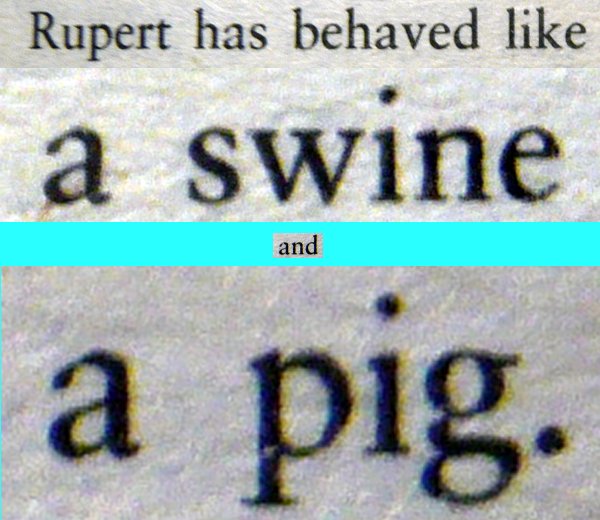
Source: This excellent life of Murdoch in Britain by the BBC’s Alan Curtis
Entrepreneur Jay Goltz opines:
“If there is an aspect of running a small business that doesn’t get enough attention, I think it’s pricing.”
But it is hard and your salespeople can lead you astray:
“From my experience, many business owners do not do an analysis to calculate the effect a price increase might have on their bottom lines — again, for good reason. It is very difficult if not impossible to do. It’s more like guessing, perhaps an educated guess. I cannot tell you how to do it, but I can tell you what not to do. Do not rely on just your salespeople! Most will tell you that the sky will fall if you raise prices. They will tell you that customers are already complaining.”
Is it worth raising prices? The key variables are elasticty of demand and cost f production:
“Here’s the math: if you sell 100 widgets a week at $100 apiece and they cost you $65 apiece, you have a gross profit of $35 a widget or $3,500 a week. But because your fixed expenses have been rising and these are really good widgets, you decide you can charge $102 and still provide a good value to your customer. If you now sell only 95 widgets a week, you will have a gross profit of 95 x $37, or $3,515. But if you manage to sell 98, you will make $3,626. The point is that sales have to fall quite a bit for you not to come out ahead.”
He does not quite come out and say it but implicitly Goltz is comparing marginal revenue and marginal cost. In his examples, MR<MC so it makes sense to reduce output and increase prices.

Getting from the hotel to Heathrow, we faced the hold-up problem, a fitting end to a trip that began with the Grossman-Hart+25 conference in Brussels. Our cab driver was late picking us up and in compensation the cab company offered us a discount. But when we got to the airport, the cab driver refused to give us the discount saying he knew nothing about it and anyway it was not his fault as he’d been called after the previous driver bailed out. He refused to call his company to confirm my deal and refused to take a credit card (the hotel had told us the cab company would take a credit card if we paid a surcharge of five pounds).
Steam coming out of my ears, I traipsed into the airport and got cash out to pay him. This gave me time to think. The cab driver knew I was not a repeat customer but the cab company was contacted by my hotel and they were definitely hoping to keep the relationship with the hotel going into the future. So I called the hotel which called the cab company which called driver and I got my discount.
Deconstructing this later on, it seemed both I and the cab driver reacted irrationally. Conflict annoys me and the sum involved was trivial. The cab driver would definitely have lost his tip even if I had caved in to his demand so he would not have come out ahead by digging in his heels.
Finally, the cab company may not have set up incentives well with its (subcontracted?) employees. Their incentives are short term and differ from the company’s incentives which are long term. A salary or greater vertical integration rather than payment by commission might dominate. But if people are irrational, the design of the incentive scheme may not help. After all, as I said above, the tip should have provided incentives but it did not.
 You went early to the Tower of London hoping to avoid the long line to gawk at the Crown Jewels. Many tour buses were on the same schedule. You went to the Science Museum on a Tuesday to avoid the weekend hordes. What you found were the weekday hordes of uniformed primary school children, pressing all the buttons on the interactive exhibits and leaving a trail of British germs for you to pick up. Anal, misanthropic, germaphobe though you are, of course you forgot the hand sanitizer.
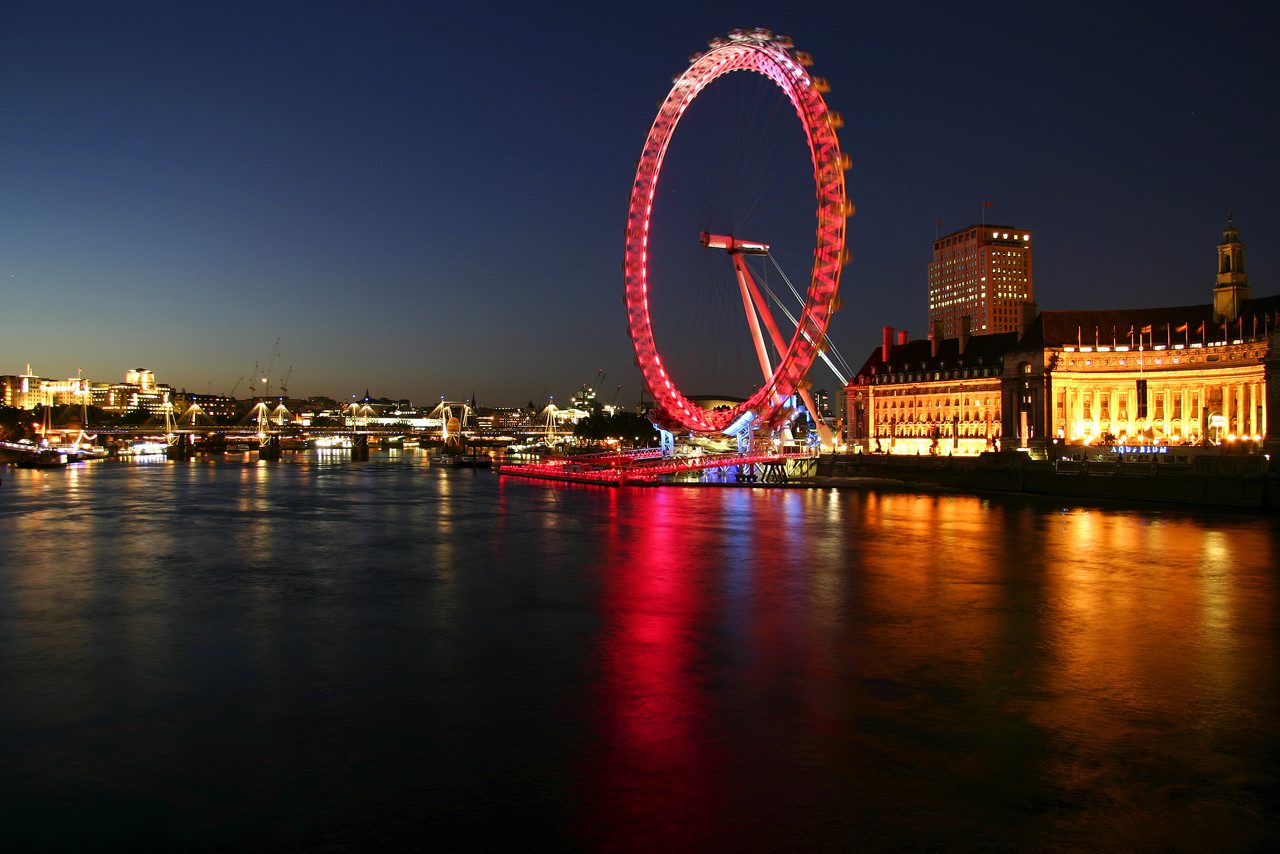
Under family pressure, you decide to go on a ride on the London Eye. The lines are going to be horrible. You go to their website and are pleasantly surprised. They must be private or have a non-London eye firmly trained on profit-maximization because they have come up with a price discrimination scheme exactly for last-minute-planning, people-hating, elitist b’stards like you. You have the option of Flexi Fast Track. You can turn up anytime and swan to the front of the queue!
The Science Museum is free (wow!) and publicly owned so they can’t pull a stunt like this (but why not Science Museum, you really should, you need the money!). The Queen is already so elitist that any further sign that there is a class system would cause a huge backlash. So, there is no two-track procedure for seeing the Crown Jewels. But the London Eye faces no such constraints. You can decide where you lie on the forward-planning/value-of-time dimensions and pick from several options. Why not go the whole hog and get drunk on the London Eye with a Pimm’s experience (with optional extra fee for second glass) or a wine tasting?
You may have one other quibble. Don’t expect to board like United Premier 1K travelers, before all the plebs come on with their crappy baggage. They will let in around ten of you Fast Track princes and ten of us plebs. But the Fast Track line is short because it is so bloody expensive (just like everything else in London!) and you will get on sooner. But you will be sharing a EyePod carriage with some plebs – get used to it. On United, you can recline in your b-class bed secure in the knowledge that the plebs like me in Economy can’t even come into your section to pee. But on the London Eye, you will be breathing the same air as me. Sorry.
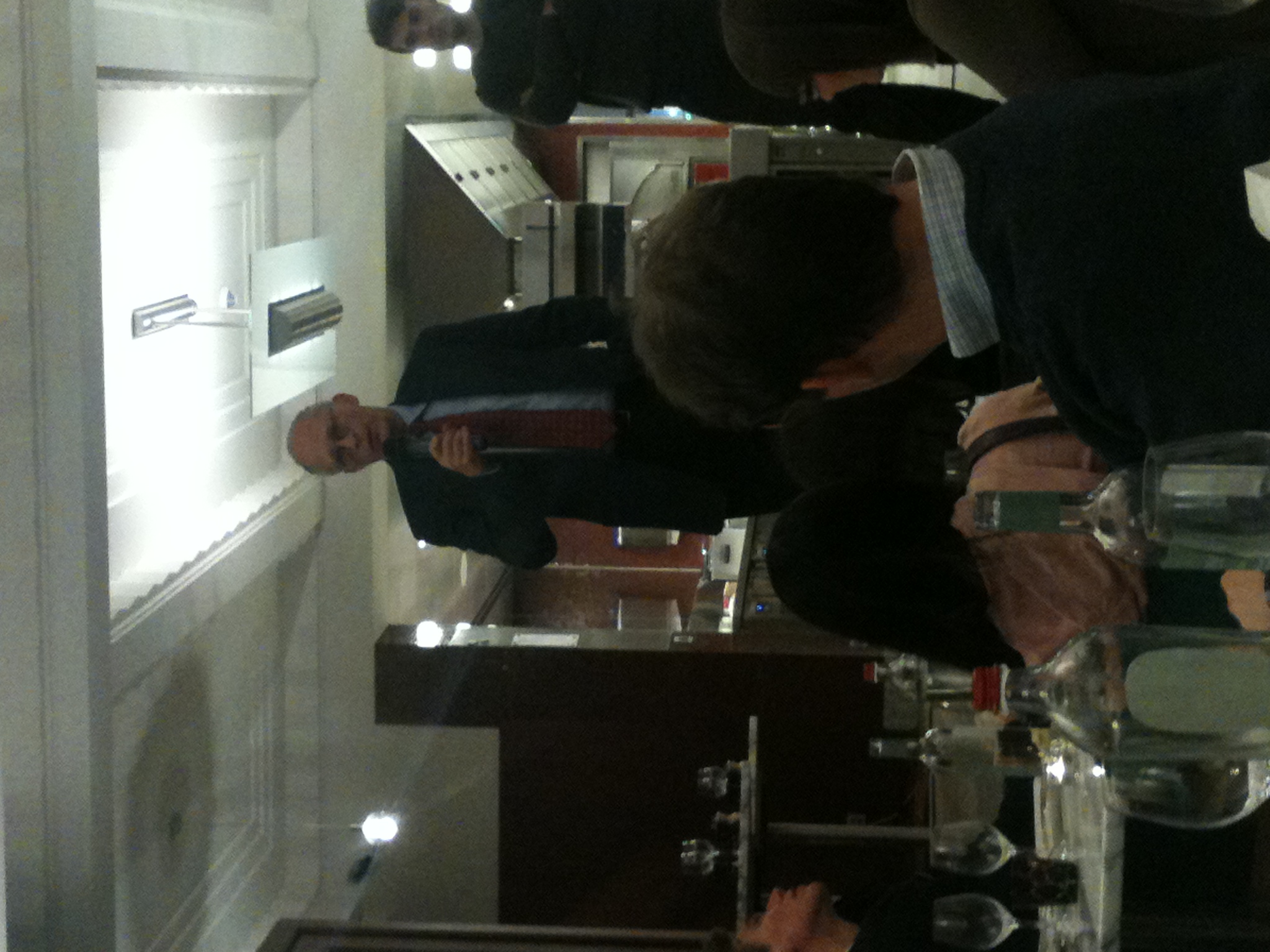
With Oliver’s speech, we got some insights into the inception and inner workings of the Grossman-Hart team. It was formed when both were put into the same session at the Stanford theory conference. Sandy was working on informativeness of rational expectations equilibria and Oliver on general equilibrium with incomplete markets so their combination in one session was not natural. But they hit it off famously, despite political differences. In his speech, Sandy said he was a moderate and Oliver was extremely left-wing and, when it was his turn, Oliver said he was a moderate and Sandy was extremely right-wing.
The Grossman-Hart team met intermittently in the various locations where the two members were located, with Grossman being the more peripatetic of the two. They risked life and limb and went for long walks in the dodgy areas of Philadelphia and Chicago. On one visit, Sandy suggested two topics they might work on, the “theory of the firm” and “supply function equilibria”. Not sure what the latter amounted to, but Oliver suggested that he might have become an auction theorist if he had chosen the latter topic. Fatefully, he decided on the former topic. They went back and forth several times for around ten days, coming up with models and then throwing them out till they finally honed in on the model that made its way into JPE. They actually had a second model based on incomplete information but they decided to delete it from the final version (it was published in a book).
All this information comes from Oliver’s dinner speech. He went on to say that Sandy has affected his thinking in many other ways. He had tended to separate his economics from his political beliefs. Once when Grossman was visiting London to work with Hart, there was a strike of some sort. Oliver instinctively supported the strikers but, in debate with Sandy, Oliver eventually changed his mind. He began integrating his politics and his economics. (Parenthetically, this suggests that both of them see theory not just as a mental-master-of-your-own-domain exercise.) Oliver ended though by defiantly returning to his own moderate or left-wing tendencies, depending on your point of view. He said that while the National Heath Service is not first-best or even the fourth best, it is definitely better than the US version which is tenth best. He added that Sandy had enjoyed the dental care given by the NHS on a Cambridge visit when he had a toothache.
Grossman offered some final remarks. He had come up with the question “what is firm” in response to arguments made by ATT to avoid vertical disintegration. They argued that if a non-ATTphone were plugged into the ATT network it might cause its complete collapse. Hence, they argued that non-ATT phones should not be allowed for use on the ATT network. Grossman thought this argument was crazy and started wondering about the proper definition of the firm. He ended by discussing his toothache. While a root canal was considerably cheaper in England, Grossman complained that the area administered to by English dentists was still sore. QED?

(A Fuzzy iPhone Picture of Sandy Grossman)
One reason I came to the Grossman Hart + 25 conference was to catch a glimpse of Sandy Grossman and see what he had to say about his research. Grossman resigned from Wharton and has been running his own hedge fund for the last 25 years. I have never met him and my generation and younger know him only from his fearsome reputation. I did not get to speak to him so I cannot testify to his testiness. But some sense of his breadth came across.
He offered his current view on ownership and control which was typically idiosyncratic. He pointed out that human beings cannot will themselves to stop breathing. A safety mechanism overrides the conscious, deliberate decision hence an individual who has “decision-rights” over his body does not have “control rights”. And what holds at the level of the individual holds a fortiori at the level of the firm – the owner of an asset does not have necessarily have control rights. Apparently, in his spare time, Grossman reads about the working of the brain and also theoretical physics.
There is an infamous story about Grossman remodeling his house. Having worked on incomplete contracts, Grossman was extra careful to write a contract so there was no wiggle room for the contractor to hold him up. Inevitably, they fell into dispute. The judge said that with the contract that is normally signed he would have sided with homeowner in this kind of dispute. But since a non-standard and rather complex contract was written, the contingency under dispute must have been considered and dismissed. Hence, the judge found in favor of the builder. In other words, Grossman’s attempt to write a complete contract backfired and hurt him in the contract dispute.
When asked about his story, Grossman said “he had never heard it”. Via a Clintonesque use of wording, Grossman gave an incomplete answer and avoided the main thrust of the question …
It is the twenty-fifth anniversary of the publication of Sanford Grossman and Oliver Hart’s “The costs and benefits of ownership, :a theory of vertical and lateral integration” in the Journal of Political Economy. John Moore did a spectacular job introducing the conference. He picked up the paper and said it was so bright that he had to put on sunglasses to look at it (he brought along sunglasses as a prop). He made many other jokes (“We are gathered here today to celebrate…” ) many of which unfortunately I now forget. The conference appears to be taped and perhaps some videos will be available online in the near future. One other point: John checked the Google Scholar scores of the original Grossman-Hart paper and the later Hart-Moore paper – the “property rights theory of the firm” is called the GHM theory. Gross-Hart has approximately 5600 citations and Hart-Moore approximately 3500. Hence, in aggregate, Oliver Hart has 9100 citations (in this area alone!). To acknowledge the different level of contributions and renormalizing by a common factor, John suggested the theory be renamed the G8H15M5 property rights theory of the firm. While cumbersome, the name does convey some information.
David Lake gave an interesting talk about the history of US policy on state-building.
State Building 1.0: Installing puppets. The underlying philosophy was Realpolitik. This phase was exemplified by US support from Rafael Trujillo, “El Jefe”, dictator in the Dominican Republic.
State Building 2.0: Creating a legitimate government. The underlying philosophy is liberal. It implies creating a functioning democracy with limited powers and a free-market economy. This was attempted in Iraq and Afghanistan
Sate Building 3.0: Counterinsurgency. This puts emphasis on providing security and public goods to the general population to get their support. There is less emphasis on democracy and market reforms.
The audience found 3.0 controvertial – is there really a change in emphasis or is it really 2.0? I personally found it persuasive and would add State Building 4.0: Intervention might decouple the provision of security from the creation of democracy altogether and instead install a puppet. Some might say this is version 1.0 and perhaps this is right. In any case, it certainly trends back towards version 1.0. This is where the Afghan policy seems to be heading. A puppet is important because there need to be American bases in Afghanistan to use for drone attacks against terrorists based in Pakistan.
 Cheap Talk