
You are currently browsing the monthly archive for November 2011.
Creative output seems to come in bursts. You have periods of high productivity spaced by periods where you get relatively few good ideas. During the flurries everything seems to come easy and you have more ideas than you can work on at once. During the lulls you wonder if you are still the same person.
What if the pattern can be explained without assuming that your creative energy fluctuates at all? Suppose that ideas of various qualities arrive according to some distribution that is constant over time, but what changes about you is simply the standard you hold them to. Sometimes you are very self-critical and the marginal ideas that come to you don’t seem worth pursuing, so you don’t pursue them. You go through a lull.
Other times you are confident that you can develop your ideas and you do.
In graduate school I read the masterful Introduction to Joel Mokyr’s edited volume on the British Industrial Revolution. But I did not make the Steve Jobs connection. Malcolm Gladwell did:
One of the great puzzles of the industrial revolution is why it began in England. Why not France, or Germany? Many reasons have been offered. Britain had plentiful supplies of coal, for instance. It had a good patent system in place. It had relatively high labor costs, which encouraged the search for labor-saving innovations. In an article published earlier this year, however, the economists Ralf Meisenzahl and Joel Mokyr focus on a different explanation: the role of Britain’s human-capital advantage—in particular, on a group they call “tweakers.” They believe that Britain dominated the industrial revolution because it had a far larger population of skilled engineers and artisans than its competitors: resourceful and creative men who took the signature inventions of the industrial age and tweaked them—refined and perfected them, and made them work.
In 1779, Samuel Crompton, a retiring genius from Lancashire, invented the spinning mule, which made possible the mechanization of cotton manufacture. Yet England’s real advantage was that it had….. Richard Roberts, also of Manchester, a master of precision machine tooling—and the tweaker’s tweaker. He created the “automatic” spinning mule: an exacting, high-speed, reliable rethinking of Crompton’s original creation. Such men, the economists argue, provided the “micro inventions necessary to make macro inventions highly productive and remunerative.”
Was Steve Jobs a Samuel Crompton or was he a Richard Roberts? In the eulogies that followed Jobs’s death, last month, he was repeatedly referred to as a large-scale visionary and inventor. But Isaacson’s biography suggests that he was much more of a tweaker. He borrowed the characteristic features of the Macintosh—the mouse and the icons on the screen—from the engineers at Xerox PARC, after his famous visit there, in 1979. The first portable digital music players came out in 1996. Apple introduced the iPod, in 2001, because Jobs looked at the existing music players on the market and concluded that they “truly sucked.” Smart phones started coming out in the nineteen-nineties. Jobs introduced the iPhone in 2007, more than a decade later, because, Isaacson writes, “he had noticed something odd about the cell phones on the market: They all stank, just like portable music players used to.” The idea for the iPad came from an engineer at Microsoft, who was married to a friend of the Jobs family, and who invited Jobs to his fiftieth-birthday party.
Here is the paper Gladwell mentions. Ralf Meisenzahl and Joel Mokyr conclude:
Are there any policy lessons from this for our age? The one obvious conclusion one can draw from this is that a few thousand individuals may have played a crucial role in the technological transformation of the British economy and carried the Industrial Revolution. The average level of human capital in Britain, as measured by mean literacy rates, school attendance, and even the number of people attending institutes of higher education are often regarded as surprising low for an industrial leader. But the useful knowledge that may have mattered was obviously transmitted primarily through apprentice-master relations, and among those, what counted most were the characteristics of the top few percentiles of highly skilled and dexterous mechanics and instrument-makers, mill-wrights, hardware makers, and similar artisans. This may be a more general characteristic of the impact of human capital on technological creativity: we should focus neither on the mean properties of the
population at large nor on the experiences of the “superstars” but on the group in between. Those who had the dexterity and competence to tweak, adapt, combine, improve, and debug existing ideas, build them according to specifications, but with the knowledge to add in what the blueprints left out were critical to the story. The policy implications of this insight are far from obvious, but clearly if the source of technological success was a small percentage of the labor force, this is something that an educational policy would have to take into account.
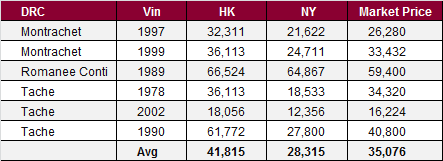 Prices are in british pounds/case of high end Burgundy. Why aren’t the producers shifting stock to Hong Kong? Also, it costs about $40 to ship a case from New York City to Hong Kong so buyers can easily resell or transport their purchase abroad. There must be some tax implication but surely it can’t justify this spread.
If you are trying to come up with a slogan for an ad campaign you have to decide how picky you are going to be with the grammar. For example suppose that there is a grammatical and a more colloquial way to write your slogan. Which do you go with?
Your audience has grammar snobs and regular people. Whichever way you write your slogan it’s going to look natural to one group and un-natural to the other. And the group that stumbles over the syntax is going to be at least somewhat distracted from the message. You have this problem whether you decide to bend toward the grammar snobs or the regular people.
But one thing tips the balance in favor of the ungrammatical slogan. In advertising, you are looking for anything that gets your audience to stop and spin some brain cycles in the presence of your ad. You will smuggle in your brand alongside. You get this benefit only with the ungrammatical. The grammar snobs, annoyed with your slogan are programmed to turn it over, diagram it and correct it. In effect you will cause them to construct variations of your ad campaign inside their own heads.
This is a good thing. Never mind that they will curse you for your trespasses. There’s no such thing as bad publicity. Indeed you hope for their curses. Nothing could be better than having them shout from the rooftops all the ways that your slogan, the one that urges everyone to buy your product, should be rewritten in order to make it more palatable.
Here’s a previous post on krafty konstructions.

The standoff between Herman Cain and his accusers offers us some interesting strategy to contemplate. The accusers are muzzled by a non-disclosure agreement they signed as a part of their settlement with the National Restaurant Association, where they worked alongside Mr. Cain. But lets walk down the tree to the node where the NDA has to be enforced.
One of the accusers has gone public with the allegation. To enforce the NDA is to admit that the NDA exists, which in turn is an admission that there was a settlement, which for all practical purposes is an admission that the allegations are true. Now, back here at the beginning of the game tree, should the accusers consider this a credible threat?
Perhaps. Because the allegations will be devastating whether or not Mr. Cain confirms the settlement. By then he would have little to lose, and at that stage the presumed penalties mandated by the NDA plus plain old retribution would be motivation enough.
(Let’s admire but ultimately ignore as unrealistic the gambit of not enforcing the NDA as a way of “proving” that there is no NDA because there was never any settlement with these accusers.)
However, it appears that the settlement is actually a contract between the NRA and the accusers. If that is the case then the decision to enforce it may not be Mr. Cain’s. Does the NRA have any credible motivation to do so?
Maybe not, but in some ways this arrangement may strengthen Mr. Cain’s position. Imagine that the accuser’s lawyer holds a press conference and publicly asks “Mr. Cain, my client is subject to a Non-Disclosure agreement arising from a sexual harrassment settlement in which you were the harasser. You deny this. Since the accusations are false you should be perfectly willing to release them from the NDA. Please prove to the American people that you are telling the truth by waiving it.”
Mr. Cain wiggles out of this one by publicly saying “Yes, I have nothing to hide. The NDA should be waived” and then by privately urging the NRA to do no such thing. The NRA can of course deny that there was any agreement and indeed the agreement probably requires them that because it presumably prohibits all parties from talking about it.
Measuring social influence is notoriously difficult in observational data. If I like Tin Hat Trio and so do my friends is it because I influenced them or we just have similar tastes, as friends often do. A controlled experiment is called for. It’s hard to figure out how to do that. How can an experimenter cause a subject to like something new and then study the effect on his friends?
Online social networks open up new possibilities. And here is the first experiment I came across that uses Facebook to study social influence, by Johan Egebark and Mathias Ekstrom. If one of your friends “likes” an item on Facebook, will it make you like it too?
Making use of five Swedish users’ actual accounts, we create 44 updates in total during a seven month period.1 For every new update, we randomly assign our user’s friends into either a treatment or a control group; hence, while both groups are exposed to identical status updates, treated individuals see the update after someone (controlled by us) has Liked it whereas individuals in the control group see it without anyone doing so. We separate between three different treatment conditions: (i) one unknown user Likes the update, (ii) three unknown users Like the update and (iii) one peer Likes the update. Our motivation for altering treatments is that it enables us to study whether the number of previous opinions as well as social proximity matters.2 The result from this exercise is striking: whereas the first treatment condition left subjects unaffected, both the second and the third more than doubled the probability of Liking an update, and these effects are statistically significant.
I just caught the first episode, “Heat and Meat”, of the new season of Next Iron Chef. There were two parts to the competition. In the first part, chefs worked in pairs cooking a pig (the meat) over an open fire (the heat) in the wilderness. In the second part, the two chefs in the losing team had to face each other in a sudden death cookoff. If you get to choose your teammate, one obvious strategy is to pick the best chef standing. This maximizes your chance of winning outright and hence avoiding the elimination round. In fact, chef-contestant Spike got to pick the teams and did exactly this by picking Marcus Samuelsson whom he took to be the best chef. (I missed the start of the episode so I do not know how Spike got chosen to be in this powerful position).
Things did not work out as Spike hoped. Marcus and Spike ended up at the bottom of the pile. Spike then lost to Marcus in “battle scallop”.
What did Spike do wrong? Obviously, picking the best chef as your partner carries a big risk – if you end up in the elimination round, you will likely lose. Better to hedge by choosing a worse chef. This increases the chance you get into the elimination round but also decreases the chance you do not make it out of the round. Spike should have picked Alex Guarnaschelli. She is a good cook but she gets tense and nervous. A good partner for round 1 and also a weak competitor in round 2. Perfect.
“I got caught up with the hoopla and the filming of the TV show that when I probably should have ended my relationship, I didn’t know how to and didn’t want to disappoint a lot of people,” the post said.
I was working on a paper, writing the introduction to a new section that deals with an extension of the basic model. It’s a relevant extension because it fits many real-world applications. So naturally I started to list the many real-world applications.
“This applies to X, Y, and….” hmmm… what’s the Z? Nothing coming to mind.
But I can’t just stop with X and Y. Two examples are not enough. If I only list two examples then the reader will know that I could only think of two examples and my pretense that this extension applies to many real-world applications will be dead on arrival.
I really only need one more. Because if I write “This applies to X, Y, Z, etc.” then the Z plus the “etc.” proves that there is in fact a whole blimpload of examples that I could have listed and I just gave the first three that came to mind, then threw in the etc. to save space.
If you have ever written anything at all you know this feeling. Three equals infinity but two is just barely two.
This is largely an equilbrium phenomenon. A convention emerged according to which those who have an abundance of examples are required to prove it simply by listing three. Therefore those who have listed only two examples truly must have only two.
Three isn’t the only threshold that would work as an equilibrium. There are many possibilities such as two, four, five etc. (ha!) Whatever threshold N we settle on, authors will spend the effort to find N examples (if they can) and anything short of that will show that they cannot.
But despite the multiplicity I bet that the threshold of three did not emerge arbitrarily. Here is an experiment that illustrates what I am thinking.
Subjects are given a category and 1 minute, say. You ask them to come up with as many examples from that category they can think of in 1 minute. After the 1 minute is up and you count how many examples they came up with you then give them another 15 minutes to come up with as many as they can.
With these data we would do the following. Plot on the horizontal axis the number x of items they listed in the first minute and on the vertical axis the number E(y|x) equal to the empirical average number y of items they came up with in total conditional on having come up with x items in the first minute.
I predict that you will see an anomalous jump upwards between E(y|2) and E(y|3).
This experiment does not take into account the incentive effects that come from the threshold. The incentives are simply to come up with as many examples as possible. That is intentional. The point is that this raw statistical relation (if it holds up) is the seed for the equilibrium selection. That is, when authors are not being strategic, then three-or-more equals many more than two. Given that, the strategic response is to shoot for exactly three. The equilibrium result is that three equals infinity.
It gives me a forum to tell the world that when you see me texting during your talk, I am not actually texting but rather I am emailing myself a thought that was inspired by your talk that I might write about on my blog later on.
 Cheap Talk