
You are currently browsing the monthly archive for January 2011.
(Regular readers of this blog will know that I consider that a good thing.)
It is rare that I even understand a seminar in econometric theory let alone come away being able to explain it in words but this one was exceptionally clear.
A perennial applied topic is to try to measure the returns to education. If someone attends an extra year of school how does that affect, say, their lifetime earnings? Absent a controlled experiment, the question is plagued with identification problems. You can’t just measure the earnings of someone with N years of education and compare that with the earnings of someone with N-1 years because those people will be different along other, unobservable, dimensions. For example, if intrinsically smarter students go to school longer and earn more, then that difference will be at least partially attributable to intrinsic smartness, independent of the extra year of school.
Even a controlled experiment has confounding factors. Say you divide the population randomly into two groups and lower the cost of schooling for one group. Then you see the difference in education levels and lifetime earnings among these groups. These data are hard to interpret because different people in the treated group will respond differently to the cost reduction, probably again depending on their unobserved characteristics. Those who chose to get an extra year of education are not a random sample from the treated group.
Torgovitzky shows that under a natural assumption you can nevertheless identify the returns to additional schooling for students of all possible innate ability levels, even if those are unobservable. The assumption is that the ranking of students by educational attainment is unaffected by the treatment. That is, if students of ability level A get more education than students of ability level B when education is costly, they would also get more education than B when education is less costly. (Of course their absolute level of education will be affected.)
The logic is surprisingly simple. Under this assumption, when you look at students in the Qth percentile of education attainment in the treated and control groups, you know they have the same distribution of unobserved ability. So whatever their difference in earnings is fully explained by their difference in education attainment. (Remember that the Qth percentile measures the relative position in the distributions. The Qth percentile of the treated groups education distribution is a higher raw number of years of schooling.)
Not only that, but after some magic (see figure 1 in the paper), the entire function mapping (quantiles of) ability level and education to earnings can be identified from data.

Thanks to everyone who suggested restaurants. I went to three:
- Rootdown Denver. The clear favorite. Loud, trendy, waitstaff heavily tattooed. Small plates for under $10 each. I had beet gnocchi, carrot and thai red curry soup, some other stuff. All great. I was lucky to find a seat at the bar otherwise I would have waited a long time. So definitely you need reservations. The best part of my dinner was that I finally found a bar that serves a mythical cocktail: The Aviation. I have been looking for this for a decade. It was fantastic. Thanks for the pointer Dan!
- Osteria Marco. Fine but typical Italian. I had pizza. I’ve had worse. They served by the glass a blend of Dolcetto, Barbera, and Nebbiolo from Langhe. That was something new for me, and I liked it.
- Tastes Wine Bar. A little depressing because I was the only person there. But the food was somewhat adventurous and good. The wine was fine, but not the kind of varied selection I would have expected from a place that calls itself a wine bar. The menu listed a sauvignon blanc from the Loire and when I ordered it to start with, I was told that they were out and tonight they were substituting a Sauv Blanc from Colorado!! I did taste it. Once.
Its a shame I didnt make it to the Fluid coffee bar that Jacob Grier suggested. I was going to stop there on Sunday before going to the airport but Denver got hit with a snow storm and so I got on standby and headed to the airport early to make sure I got out of there before the flights were cancelled.

An article in the WSJ describes an escalating conflict between American Airlines and intermediaries selling tickets to consumers:
In a retaliatory move against American Airlines, Sabre Holdings Corp., a middleman for many carriers’ seats, said it is raising the fees it charges American to distribute its fare information and sell its seats through thousands of travel agents….The jab follows efforts by American, the third-largest U.S. airline by traffic, to sell more of its tickets directly to consumers, a strategy designed to cut costs and give the airline more opportunities to court customers.
Getting rid of middlemen can increase surplus and efficiency. Getting rid of realtors or car salesmen eliminates the surplus they capture and hence increases the surplus left for buyer and sellers for houses and increases trade. This is the famous “double marginalization” problem as both the realtor/carsalesman and the seller charge a margin and eliminating the middleman eliminates one margin and one negative externality and increases trade. And who cries for the middleman if he loses out?
But the airline story has a different dimension: Expedia, Orbitz etc. allow easy comparison shopping. With consumers comparing prices, in a fragmented airline market, one firm or the other will undercut its competitors to make sales. This kind of thing will ensure prices are close to costs. But now, consumers will have to go to the AA website to see the prices and will find it harder to comparison shop. With positive search costs, prices can rise. The Diamond paradox is an extreme example of this. So, I guess I agree with Expedia:
Expedia lashed out at American last weekend for trying to replace the distribution model with the direct-connect network that American has developed in recent years to hook up directly with travel agencies. It called American’s push “anti-consumer” and “anti-choice,” arguing costs would jump for travel agents and there would be less pricing transparency for consumers.
If this is right, consumers will lose in the war between Expedia and AA if other airlines follow suit and ditch the intermediaries.

I am making a prediction. For reasons discussed in this previous post, its important that I announce the prediction but keep it a secret until the uncertainty is resolved. Following the suggestion of a commenter, I wrote my prediction in a text file and ran it through the SHA1 secure hash algorithm (using the web tool here.) Here is the hash:
a35fc654c7a68404bcb94b3b6a1d162223ff69e5
Briefly, this is a digital signature that is (for practical purposes) uniquely associated with the text. But the algorithm is “one-way:” unless you have a powerful computer you will not be able to invert the mapping and discover my prediction from the hash.
When the uncertainty is resolved (it will happen in the not-too-distant future) I will post the prediction here. You can then take it and generate the SHA1 hash and verify that it is the one above. That will prove that the prediction I show you is in fact the one that I have made today.
While we are waiting to find out, you can try to predict what my prediction is. (No, my prediction is not about what you will predict I predicted.)
Update on Jan 10 (one day later:) Having forgotten one important detail, I have updated the prediction and the new hash is:
f502acfb48395d6ab223ca30803f98b9bd6fd6ce
When I reveal the prediction, sometime before the Summer Solstice, I will reveal both text files and you will see the (innocuous) reason for the update.
As suggested in the comments, since I am able to modify the text of this blogpost, I should post the hash somewhere that it cannot be modified. Since Twitter puts a timestamp on every tweet and tweets cannot be edited ex post, I tweeted the two hashes. Here and here.
Illinois governor Pat Quinn is considering whether to sign into law a tax bill that includes a new tax on online retailers, the so-called Amazon Tax. Until now, online transactions are not taxed in states where the retailer has no physical presence (with a few exceptions.) The new measure would end this in Illinois, treating Amazon as an Illinois retailer so long as one of its online affiliates is based in the state. (Every state has thousands of online affiliates.)
Amazon is responding by playing chicken. From Presh Talwalker:
So Amazon is fighting back at Illinois with a threat. Amazon has emailed its commissioned affiliates the following message:
We regret to inform you that the Illinois state legislature has passed anunconstitutional tax collection scheme that, if signed by Governor Quinn, would leave Amazon.com little choice but to end its relationships with Illinois-based Associates. [emphasis mine]
The following logic seems to explain the motive. If Amazon ends its affiliate relationships in Illinois, then it would have no physical presence in the state, and hence it would get around the bill.
The email levies harsh criticism at Illinois and is meant to garner sympathy. In reality, the move is calculated and strategic.
Amazon is threatening all affiliates on purpose – even though it doesn’t have to. Here is an interesting tidbit the Chicago Tribune reported:
The bill applies only to affiliates that have at least $10,000 a year in revenue. But if large retailers, such as Amazon, cut off all affiliates in Illinois, it would end commission streams to small Web sites, such as bloggers, who might sell Amazon goods at their sites. Amazon could not be reached for comment.
Amazon is playing a classic retaliatory strategy. If Illinois wants to pass this law, then it will do everything to hurt the state and even otherwise innocent and small-time bloggers, who might decide its time to complain to Gov. Pat Quinn.
There’s more in Presh’s article here. (Amazon seems to understand reputation building because it carried through with its threat in Colorado when that state passed a similar measure.)
My view is that the threat is credible even ignoring reputation-building. The lost revenue from sales tax would dwarf the losses from cutting off affiliates.
25 of them. Ranging from “Creepy Animal Experiments” to “It Could Destroy The World” (i.e. LHC). The usual suspects are there, but this one is new to me (from “Mind Control”)
MK-ULTRA
MK-ULTRA was a code name for a series of CIA mind-control research experiments, heavily steeped in chemical interrogations and LSD dosing. In operation Midnight Climax, they hired prostitutes to dose clients with LSD to see its effects on unwilling participants.
Here’s wikipedia on MKULTRA, and on Operation Midnight Climax.
(Barretina bluster: Arthur Robson who quips “Economics has the power to bore rather than to scare, at least.”)
Ohio counties solicited bids for road salt from Cargill and Morton Salt. The two companies divided up the counties and hiked up prices:
James Canepa, a deputy inspector general for the state Department of Transportation, said the pricing practice ”crystallized” in 2008 when Morton and Cargill were the only suppliers that presented bids for salt in Ohio’s 88 counties.
In no instance did the companies present bids against each other, Canepa said. At the same time, prices spiked, shortages were reported and salt companies enjoyed record profits, he said.
”Not once in 88 counties did they bid head-to-head,” Canepa said. ”And the counties that they bid were the same ones that they won previously. Those are their incumbencies. Those are their, quote, customers. So, 2008 really crystallized the carve-up of counties.”
But no explicit communication took place and a Cargill spokesman:
pointed to a statement in the first page of the report that says ”we failed to find evidence that the two companies communicated on salt bids.”
”We never did or would talk to competitors about bids,” he said.
(Hat tip Matt)
Jeff and thousands of others head to Denver for the job market meetings. Our flyouts in MEDS begin next week. I am going to dinner with our first candidate on Sunday night. I already know him and he already has an offer from UofC. He can relax, enjoy giving his paper and meeting everyone on all his flyouts. He hopefully can also enjoy dinner on Sunday without any feeling of nervousness. Those not in this lucky position will be more worried about their visits. My brain addled by 10 hours of teaching so far this week, I will focus on the most trivial aspect of the visit – the job market dinner. I discussed this in a previous post from the perspective of faculty so let me switch focus and put myself in the shoes of the candidate.
Most obviously, people will still be checking you out as a future colleague at dinner. Will you be fun to hang out with? Are you a potential co-author etc etc…? So, unfortunately, you’ll still be “performing.”
Less crucially, there are the wine and dessert questions. Should you have a glass or wine and should you order dessert? Are you exposing yourself as an alcoholic by having a drink? Are you exposing yourself as an out-of-control sugar-holic by having dessert? Let me put your mind to rest on these two questions.
Some if not all the people going to dinner with you will also want to have a glass of wine. This is especially true of macroeconomists who will want to have many, many drinks and then go to a bar after dinner. So, by all means say you would like a drink if you want one and say no if you do not. Others will drink anyway even if you refuse so just report your true preferences.
The dessert question is a bit more subtle. If you do not order dessert, neither will anyone else. Perhaps you are really tired and want to go to your hotel and go to sleep. They will want to be polite and not delay you. (The macro-economists will drop you off and go to the bar without you.) But, some of the people at dinner will want to have dessert. The senior faculty do not get out to good restaurants too much anymore and are focused on childcare most evenings. Of course they want dessert! So here, you must misrepresent your true preferences – order dessert and let everyone else go crazy and order the crème brûlée and the chocolate cake. They will thank you for it and think of you kindly when they vote on offers. If you are not hungry, order a sorbet. If you can’t eat it, let it melt and pour it surreptitiously into the flower arrangement in the middle of the dining table – there will be such an arrangement at the fine dining destination they will take you to.
In a paper published in the Journal of Quantitative Analysis in Sports; Larsen, Price, and Wolfers demonstrate a profitable betting strategy based on the slight statistical advantage of teams whose racial composition matches that of the referees.
We find that in games where the majority of the officials are white, betting on the team expected to have more minutes played by white players always leads to more than a 50% chance of beating the spread. The probability of beating the spread increases as the racial gap between the two teams widens such that, in games with three white referees, a team whose fraction of minutes played by white players is more than 30 percentage points greater than their opponent will beat the spread 57% of the time.
The methodology of the paper leaves some lingering doubt however because the analysis is retrospective and only some of the tested strategies wind up being profitable. A more convincing way to do a study like this is to first make a public announcement that you are doing a test and, using the method discussed in the comments here, secretly document what the test is. Then implement the betting strategy and announce the results, revealing the secret announcement.
I arrive there this evening, hungry.
Navy Captain Owen Honors was relieved of his command of The USS Enterprise. This is the guy behind the viral videos that made the news this week.
I want to blog about the news coverage of the firing. For example, this Yahoo! News article has the headline “Navy Firing Over Videos Raises Questions Of Timing.” Here is the opening paragraph:
The Navy brusquely fired the captain of the USSEnterprise on Tuesday, more than three years after he made lewd videos to boost morale for his crew, timing that put the military under pressure to explain why it acted only after the videos became public.
Two observations:
- Sadly, it does make perfect sense to respond to his firing now by complaining that he wasn’t fired earlier. (And to complain less if he wasn’t fired at all.) The firing now reveals that his behavior crosses some line that the Navy has private information about. Now that we know he crossed that line we have good reason to ask why he wasn’t punished earlier.
- Obviously that fact implies that it is especially difficult for the Navy to fire him now, even if they think he deserves to be fired.
The more general lesson is that there is tragically too little reward for changing your mind due to social forces that are perfectly rational and robust. The argument that a mind-changer is someone who recognizes his own mistakes and is mature enough to reverse course cannot win over the label that he is a “waffler” or other pejorative. And the force is especially strong when it comes to picking a leader.

It’s looney to celebrate New Years, New Millenia, etc. Every day counts equally in the march of time. Just by arbitrary historical accident one of those days is called the first day of the year.
But it occurred to me when I wrote the post about the rise in stock prices last month that there is social value from coordinating our focus on arbitrary milestone days. If someone presents statistics to you about the behavior of some variable over the course of a year, which would be more meaningful?
- Stocks rose x% from July 9 2010 to July 9 2011.
- Stocks rose x% from Jan 1 2010 to Jan 1 2011.
Subjectively, it is more likely that the dates for the first range were cherrypicked by the statistician to generate the conclusion. Restricting attention to dates that have significance “outside the model” makes the exhibit more credible.
Of this (via MR):
It’s an auction conducted at the airport terminal. In this auction you are a seller and you are bidding to sell your ticket back to the airline.
Optimists look at this and contemplate the efficiency gains: this is a mechanism for appropriately allocating scarce space on the plane. Pessimists detect a nasty incentive: now that the lowest bidder can be bought off the plane the airline has a stronger incentive to overbook.
The pessimists are right precisely because the optimists are right too.
Consider standard airline pricing with no overbooking. You buy a ticket in advance for a flight next month. Lots of uncertain details are resolved between now and then which determine your actual willingness to pay to fly on the departure date. One month in advance you can only form an expectation of this and that expected value is your willingness to pay for a seat in advance.
This is inefficient. Because, after the realization of uncertainty it could be that your value for flying is lower than somebody else who didn’t buy a ticket. Efficiency dictates that you should sell your ticket to him on the day of the flight.
One way to implement this is to hold an auction on the day of departure. Put aside the issue that flyers want advance booking for planning reasons. Even without that incentive, just-in-time auctions solve the inefficiency problem with conventional pricing but airlines would never use them.
The reason is that an auction leaves bidders with consumer surplus (or in the parlance of information economics, information rents.) As a simple example, suppose there is a single seat avaiable on the flight and two bidders are bidding for it. An optimal auction is (revenue-equivalent to) a second-price auction so that the winning bidder’s price is equal to the willingness to pay of the second-highest bidder. That is lower than the winner’s willingness to pay and the difference is his consumer’s surplus.
The airline would like to achieve the efficient allocation without leaving you this consumer’s surplus. That is impossible in a spot-auction because the airline can never know exactly how much you are willing to pay and charge you that.
But a hybrid pricing mechanism can implement the efficient allocation and capture all the surplus it generates. And this hybrid pricing mechanism entails overbooking followed by a departure-day auction to sell back excess tickets.
The basic idea is standard information economics. The reason you get your information rents in the spot auction is that you have an informational advantage: only you know your realized willingness to pay. To remove that informational advantage the airline can charge you an entrance fee to participate in the auction before your willingness to pay is realized, i.e. a month in advance as in conventional pricing.
Here is how the scheme works in the simple example. There is one seat available. Instead of selling that single seat to a single passenger, the airline sells two tickets. Then, on the day of departure an auction is held to sell back one ticket to the airline. The person who “wins” this auction and makes the sale will be the person with the lowest realized value for flying. The other person keeps their ticket and flies. On auction day, the winner gets some surplus: the price he will receive is the willingness to pay of the other guy which is by definition higher than his own. (Delta is apparently using a first-price auction, but by revenue equivalence the surplus is the same.)
But in order to get the opportunity to compete in this auction you have to buy a ticket a month in advance. And at that time you don’t know whether you are going to win the auction or fly. The best you can do is calculate your expected surplus from participating in that auction and you are willing to pay the airline that much to buy a ticket. Your ticket is really your entrance pass to the auction. And the price of that ticket will be set to extract all of your expected surplus.
Note that the only way that the airline can achieve these efficiency gains and the accompanying increase in profits is by overbooking at the stage of ticketing. So the pessimists are right.
(You can write down a literal model of all of the above. The conclusion that all of your surplus is extracted would follow if travelers were ex ante symmetric: they all have the same expected willingness to pay at the time of ticketing. But the general conclusion doesn’t require this: all of the efficiency gains from adding a departure-day sellback auction will be expropriated by the airline. That follows from a beautiful paper by Eso and Szentes. To the extent that fliers retain some consumer surplus it is due to ex ante differences in expected willingness to pay. The two fliers with the highest expected surplus will buy tickets at a price equal to the third-highest expected surplus. This consumer surplus is already present in conventional pricing.)
You did take my advice didn’t you? If you did, then because of the January effect, you bought the S&P500 at 1180.55 on November 30 and sold it on the first trading day of the new year, yesterday, at a price of 1271.87 and made a 7.5% return in a single month.
“Bob, the professor business is even sleazier than the jewelry business. At least in the jewelry business we were honest about being fake. Plus, when I go to conferences, I’ve never seen such pretentiousness. These are the most precious people I’ve ever met.”
“Come on, Clancy. Did you really think people were going to be any better in a university?”
“Um, kind of.” Of course I did. “And it’s not that they’re not better. They’re worse.”
“Well, you may have a point there.” (Bob was always very tough on the profession of being a professor.) “Focus on the students and your writing. The rest of it is b.s.” (That was a favorite expression of Bob’s, as it is of a former colleague of his at Princeton, Harry Frankfurt.)
“With the students, I still feel like I’m selling.” (I was very worried about this.)
“You are selling. That’s part of what it is to be a good teacher.” (Bob was in the university’s Academy of Distinguished Teachers and had won every teaching award in the book. He also made several series of tapes for the Teaching Company.) “To be a good teacher, you have to be part stand-up comic, part door-to-door salesman, part expert, part counselor. Do what feels natural. Be yourself. Are your students liking it? Is it working for you?”
The story of a guy who dropped out, trained himself as a liar in the jewelry business, and then went back to academia. (Montera missive: kottke.org)
Index funds track indices such as the S&P 500 and match the market not try to beat the market. They are cheap to manage – I guess all you need is a computer program and you don’t need to pay expensive managers. An individual investor who does not have inside information will lose relative to the market and an index fund provides the best way to guarantee at market returns.
So, people buying index funds should have that kind of philosophy. This philosophy also means that you cannot beat the market on day-to-day or hourly transactions – any news you are responding to will also be incorporated in the index fund value and all you will do is incur the transaction cost of buying or selling. So, people who buy index funds should buy and hold. Unless they have a self-control problem. Then, they will respond to price movements despite knowing they cannot make money on average.
Investors who face self-control problems face more difficulties if they buy an index fund in the form of an ETF and not a regular mutual fund. The former are continuously traded and the latter only allow you to buy and sell at the end of the business day. Hence, the latter allow you to commit not to indulge your self-control problem.
First, ETFs are cheaper than the corresponding mutual fund so the first puzzle is why mutual funds are not driven out my ETFs. This is one answer: there is demand for mutual funds from people with self-control problems and in fact they are willing to pay to commit. There is a value to commitment.
Second, investors who think they cannot beat the market but believe they have self-control should buy ETFs. If their belief in their self-control is naïve, they will trade anyway and get worse returns than investors who bought mutual funds. Via the NYT:
“An analysis of the numbers by Kevin P. Laughlin of the Bogle Financial Markets Research Center, found that in the five years through October, what investors earned from their holdings in E.T.F.’s trailed the returns of the funds themselves by 3 percentage points, annualized. By comparison, the earnings of investors in traditional mutual funds lagged their funds’ returns by 1.1 percentage points. These lags happened because investors were buying and selling at the wrong times.”
There is a value to commitment but there is also a value to self-knowledge: recognizing your self-control helps you to know that you should commit and if you commit, you will lose less money.
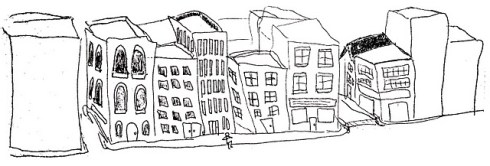
I don’t mean breaking and entering. It’s New Years Eve — 2PM on New Years Eve — and after heading out for a quick lunch I return to find The Jacobs Center locked for the weekend. There is a separate electronic key to the building and I have one somewhere but I never need it so I don’t carry it around with me. So I have to stand in the cold and wait for somebody to enter or exit the building and let me in.
There are two entrances so the question is which one to stand by and wait. I wait for a while at the main entrance and then decide to try my luck at the next one on the other side of the building, about a 2 minute walk. Of course on the way I am imagining that someone must be leaving from the first entrance just as it passed out of sight. When I get to the other entrance I find that there’s just as little activity there as at the first one. After a while I give up again and go back to the first.
I have a sinking feeling as I am walking back that I am violating some basic rationality postulate to have dropped the first alternative only to switch back to it again. But it’s not hard to rationalize switching, even indefinite switching with a simple model of uncertain arrival rates.
At each entrance there is a random arrival process, say Poisson, which produces a comer or goer with some given flow rate. It’s random so even if the arrivals are frequent on average its still possible that there is a long wait just because of bad luck. Because it’s an unusual day I don’t know for sure what the arrival rates are at the two entrances so the best I can do is form a subjective distribution.
As time passes I learn only about the door I am watching and what I am learning is that the arrival rate is slower than I thought. Every moment that passes and I am still out in the cold the current door’s expected arrival rate is continuously dropping. There comes a point in time when it drops low enough that I want to switch to the other door. The expected arrival rate at the other door hasn’t changed becuase I haven’t learned anything about it. I give up and walk to the other door once the estimated rate at the current door drops far enough below that it is worth 2 minutes of walking (and no chance of getting in during that time.) In fact, this may happen before the current door’s expected arrival rate drops below that of the other door. (Due to option value. See below.)
Once at the other door I start to learn about it and I stop learning about the first door. Again, as time passes its estimated arrival rate drops while that of the first door remains constant. There is again another threshold after which I return to the first. Etc. Until I finally give up and throw a brick through the Kellogg student lounge window.
Observation: Consider the threshold at which I switch from door 1 to door 2. That is based on a comparison of the value of staying put versus the value of switching. The value of switching has built into it the option value of being able to switch back. You can see the role of this option value by considering a truncated problem where once I switch doors I am unable to switch back. Relative to that problem, the option of switching back makes me switch more frequently. Because without the option to switch back, I want to hold on to the current option until I am certain that it’s a loser before giving it up for good.
 Cheap Talk