China is threatening to cut off imports of American chicken, but poultry experts have at least one reason to suspect it may be an empty threat: Many Chinese consumers would miss the scrumptious chicken feet they get from this country.

“We have these jumbo, juicy paws the Chinese really love,” said Paul W. Aho, a poultry economist and consultant, “so I don’t think they are going to cut us off.”

The story is in the New York Times.

Tyler Cowen blegs for ideas on the economics of randomized trials. There is a simple and robust insight economic theory has to offer the design of randomized trials: controlling incentives in order to reduce ambiguity in the measurement of effectiveness.

Suppose you are testing a new drug that must be taken on a daily basis. A typical problem is that some patients stop taking the drug but for various reasons do not inform the experimenters. The problem is not the attrition per se because if the attrition rate were known, this could be used to identify the take-up rate and thereby the effectiveness of the drug.

The problem is that without knowing the attrition rate in advance there is no way to independently identify it: the uncertainty about the attrition rate becomes entangled with the uncertainty about the drug’s effectiveness. The experimenters could assume some baseline attrition rate, but when the effectiveness results come out on the high side, there is always the possibility that this is just because the attrition rate for this particular experiment was lower than usual.

The simple way to solve this problem is to use selective trials rather than randomized trials: require patients in the study to pay a price to remain in the study and continue to receive the drug. If the price is high enough, only those patients who actually intend to take the drug will pay the price. Thus the attrition rate can be directly observed by noting which patients continued to pay for the drug. This removes the entanglement and allows statistical identification of the effectiveness of the drug.

This is one of a number of new ideas in a new paper by Sylvain Chassang, Gerard Padro i Miquel and Erik Snowberg.

Followup: Sylvain Chassang points me to two experimental papers that explore/implement similar ideas:

http://www.dartmouth.edu/~jzinman/Papers/OU_dec08.pdf

http://faculty.chicagobooth.edu/jesse.shapiro/research/commit081408.pdf

I hate checking in bags at the start of a flight and waiting for them at the other end.  So, I always travel with a carry-on bag.  If there is no space left, there is a chance that you have to gate-check your bag.   But I can only recall once instance where that has happened.  It’s likely to be a more frequent event as I discovered on Sunday.  Why?

United is now charging for checking in bags but carry-ons are still free.   This increases the incentive to bring a carry-on where you might have checked-in a bag before.  Moreover, if you are forced to gate-check your bag, you do not get charged.  So, there is an additional incentive to carry-on a bag.  So the optimal strategy will imply more passengers moving to “carry-on” from “check-in bag”.  The two forces together meant that all the carry-on storage space was full by the time many people boarded my flight on Sunday and they were forced to gate-check their carry-ons.

This could end up being annoying for United if there is lots of gate-checking going on, delaying flights and  distracting flight attendants.  What should they do?  Four options:

(a) Stop charging for checked in bags.  Not an option United will choose as they need cash

(b) Start charging for gate checking carry-ons.  This gives United the incentive to claim there is no room for carry-ons even when there is.  Even if they are honest, no-one will belive it.  This will to  United broke my Carry-on as a follow up to United Breaks Guitars.  Not a good option for United.

(c)  Start charging for carry-ons.  Seems like the most attractive option for United.  Except no competitor is doing it.  United has become more extreme than American with check-in bags: AA does not charge for the first checked bag.  Is United going to be the first airline to take the next step and charge for carry-ons or..

(d) Stick with the status quo.

Some research suggests that a child’s ability to delay gratification is a good predictor of achievement later in life.  The research is based on some famous experiments in which children were left in a room alone with sweets and told that if they resisted until the experimenters returned, they would be rewarded with even more sweets.  Via EatMeDaily here is a really cute video by Steve V of the marshmallow test.

If a drug trial reveals that patients receiving the drug did not get any healthier than those who took a placebo, is this a failure?  It depends what the alternative treatment is.  Implicitly its a failure if we believe that doctors will prescribe a placebo rather than the drug.  Of course they don’t do that (often) but we can think of the placebo as representing the next-best alternative treatment.

But the right question is not whether the drug does better than the next-best alternative, but instead whether the drug plus the alternatives does better than just the alternatives.  It could happen that the drug by itself does no better than placebo because the placebo effect is strong, but the drug offers an independent effect that is just as strong.

If so, then the right way to do placebo trials is to give one group a placebo and another group the placebo plus the drug being tested.  The problem here is that the placebo group would know they are getting placebo which presumably diminishes its effect.  So instead we use four groups:  drug only, placebo only, drug plus placebo, two placebos.

Maybe this is done already.

Followup: Thanks to some great commenters I thought a little more about this.  Here is another way to see the problem.  Conceivably there may be a complementarity between the placebo effect (whatever causes it) and the physiological effect of the drug.  The more you believe the drug will be effective the more effective it is.  Standard placebo controls limit how much of this complementarity can be studied.

In particular, let p be the probability you think you are taking an effective drug.  Your treatment can be summarized by your belief p and whether or not you get the drug.  Standard placebo controls compare the treatment (p=0.5, yes) vs. (p=0.5, no).  But what we really want to know is the comparison of (p=1, yes) and the next-best alternative.  If there is a complementarity between the placebo effect and the physiological effect then (p=1, yes) is better than (p=0.5, yes).

In previous lectures we looked at the design of mechanisms to allocate public and private goods in “small markets.”  In both cases we saw that incentive compatibility is a basic friction preventing efficiency.  But in the case of private goods we saw how that friction vanishes in larger markets.  In this lecture we show that the opposite occurs for public goods.  The inefficiency only gets worse as the size of the population served by a public good grows larger.  We are capturing the foundations of the free-rider problem.  This is another set of notes that I am particularly proud of becuase here is a completely elementary and graphical proof of a dominant-strategy version of the Mailath-Postlewaite theorem.

The conclusion we draw from this lecture is that the idea of “competition” that restored efficiency in markets for private goods cannot be harnessed for public goods and therefore some non-voluntary institution is necessary to provide these.  This gives an opportunity to have an informal discussion of the kinds of public goods that are provided by governments and the way in which government provision circumvents the constraints in the mechanism design problem (coercive taxation.)  The possibility of providing public goods by such means comes at the expense of losing the ability to aggregate information about the efficient level of the public good.

Here are the slides.

Want to work for Al Qaeda?  The pay is terrible, your future is bleak and Al Qaeda has not managed a big attack for many years so you’ll be working for a declining terrorist entity.

Not much glamour in that job description and the Guardian reports that Al Qaeda is having a hard time finding recruits:

Amid a mood of cautious optimism, some experts talk of a “tipping point” in the fight against al-Qaida. Others argue that only Bin Laden’s death will bring significant change. But most agree that the failure to carry out spectacular mass attacks in the west since the 2005 London bombings has weakened the group’s “brand appeal” and power to recruit.

And there’s a backlash against Bin Laden and al-Zawahiri by other Islamic leaders who are offended because they have been vilified by Bin Laden or regret attacks on Muslims perpetrated by Al Qaeda (links here).

  1. What books would you bring if you were going to be stuck on a tropical island?  Did I mention you were going to have to wear a flourescent orange jumpsuit and have water poured into your nose every day?
  2. Farewell Spotted Dick.
  3. Amish romances are hot.
  4. When great tits are involved, you snooze you lose.

The reason is to enable them to import cheaper cars from Japan which have the steering wheel on the right.  So far the switch has not caused any accidents but public transportation has taken a hit.

All but about 18 of the Pacific island nation’s buses are banned from driving because their doors now open onto the middle of the road.

via mental floss.

“We have shown that by applying tools from neuroscience to the public-goods problem, we can get solutions that are significantly better than those that can be obtained without brain data,” says Antonio Rangel, associate professor of economics at Caltech and the paper’s principal investigator.

Here is the paper.  You should read it.  It is forthcoming in Science. Zuchetto Zip goes to Economists’ View.

The public goods aspect of the problem is not important for understanding the main result here, so here is a simplified way to think about it.  You are secretly told a number (in the public goods game this number is your willingness to pay) and you are asked to report your number.  You have a monetary incentive to lie and report a number that is lower than the one you were told. But now you are placed in a brain scanner and told that the brain scanner will collect information that will be fed into an algorithm that will try to guess your number.  And if your report is different from the guess, you will be penalized.

The result is that subjects told the truth about their number.  This is a big deal but it is important to know exactly what the contribution is here.

  1. The researchers have not found a way to read your mind and find out your number.  Indeed, even under the highly controlled experimental conditions where the algorithm knows that your number is one of two possible numbers and after doing 50 treatments per subject and running regressions to improve the algorithm, the prediction made by the algorithm is scarcely better than a random guess.  (See table S3)
  2. In that sense “brain data” is not playing any real role in getting subjects to tell the truth.  Instead, it is the subjects’ belief that the scanner and algorithm will accurately predict their value which induces them to tell the truth.  Indeed after conducting the experiment the researchers could have thrown away all of their brain data and just randomly given out payments and this would not have changed the result as long as the subjects were expecting the brain data to be used.
  3. The subjects were clearly mistaken about how good the algorithm would be at predicting their values.
  4. Therefore, brain scans as incentive mechanisms will have to wait until neuroscientists really come up with a way of reading numbers from your brain.

I haven’t visited the Wine Library for quite a while.  According to the Times, thousands of other people have.   Those of you who have not, it is worth watching the odd episode for a varietal you’re interested in learning about.  For fun, it is definitely worth watching the Jancis Robinson episode.

Now someone has to do a Beer Library.

There is a carefully researched article appearing in the Huffington Post that says yes.

The Federal Reserve’s Board of Governors employs 220 PhD economists and a host of researchers and support staff, according to a Fed spokeswoman. The 12 regional banks employ scores more. (HuffPost placed calls to them but was unable to get exact numbers.) The Fed also doles out millions of dollars in contracts to economists for consulting assignments, papers, presentations, workshops, and that plum gig known as a “visiting scholarship.” A Fed spokeswoman says that exact figures for the number of economists contracted with weren’t available. But, she says, the Federal Reserve spent $389.2 million in 2008 on “monetary and economic policy,” money spent on analysis, research, data gathering, and studies on market structure; $433 million is budgeted for 2009.

All of the facts in this article are true.  Any academic economist sees first-hand the role the Fed has in supporting research in the area of monetary economics.  And it is easy to see how this article could lead an outsider to its conclusions.

Paul Krugman, in Sunday’s New York Times magazine, did his own autopsy of economics, asking “How Did Economists Get It So Wrong?” Krugman concludes that “[e]conomics, as a field, got in trouble because economists were seduced by the vision of a perfect, frictionless market system.”

So who seduced them?

The Fed did it.

I am not a macroeconomist and apart from an occasional free lunch I have never been the beneficiary of Fed research funding, so I easily could be out of the loop on this conspiracy but for what it is worth I don’t see any evidence of it.  All of the facts are true, but the conclusion follows from them only if you want it to.

I am sure it would be easy to compile a large list of papers funded by Fed research money that are critical of Fed monetary policy.

Its easy to make up just-so stories to explain differences across siblings as being caused by birth-order.  This article casts doubt on the significance of birth order.

But we can ask the question of whether birth order should matter and in what ways.  Should natural selection imply systematic differences between older and younger siblings?  Here is one argument that it should.  Siblings “share genes” and as a consequence siblings have an evolutionary incentive to help each other.  Birth order creates an asymmetry in the ways that different siblings can help each other.  In particular, oldest siblings learn things first.  They are the first to experiment with different survival strategies.  The results of these experiments benefit all of the younger siblings.  (Am I a good hunter?  If so, my siblings are likely to be good hunters too.) Younger siblings have less to offer their older siblings on this dimension.

As a result we should expect older siblings to be more experimental than their younger siblings and more experimental than only children.

Here is evidence that older siblings have more years of education than younger siblings and more years of education than only children.

Estimates are that 7-10% of the population are left-handed. But more than 20% of professional baseball players are left-handed (the figure is closer to 30% for non-pitchers.) On the other hand, among the 32 seeded players at the US Open tennis tournament, only two are lefties (about 6%.) Explain.

Here is some simple market power analysis of Apple’s use of the iPhone as a platform. Think of it as a device you have to buy in order to obtain services from sellers who use the iPhone platform.  The kinds of services you can buy are voice calls (currently from AT&T), music (currently from Apple via iTunes but also via third-parties like Pandora), and applications (from third-party developers via the app store.)

Apple controls the platform, so it can decide whether to provide a service itself (as with iTunes), and if not who provides each service, whether the provider will be exclusive (as with AT&T), and what price to exact from the transaction.  Of course, Apple also sells the handset to you and all of the above factors in to how much you are willing to pay for the iPhone.

Here is a basic principle of monopoly power that is central to these decisions. Whether Apple wants to exclusively provide a service or allow a competitive supply from third-parties depends on which of its customers will benefit from the service.  Suppose the service has similar benefits for all iPhone users.  Then Apple can allow the service to be competitively supplied (as with the App Store) and capture the benefit by raising the price of the iPhone.

On the other hand, if the service will most valuable to those iPhone users who already have a high willingness-to-pay for the phone (the so-called infra-marginal users,) then Apple wants to exclusively provide the service (or contract with an exclusive provider.)  The reason is that the price of the iPhone handset is determined by the marginal user.  In order to raise the price of the phone itself to capture the benefit to high-end users, too many marginal users would be price out of the iPhone and profits would go down.  Instead, Apple captures the value of high-end services (like 3G voice and data) by controlling the supply and pricing the service separately.

The cynical way to interpret this is to say that Apple’s exclusive contract with AT&T is simply a way to extract surplus from high-end users.  The more charitable interpretation is that without this exclusive contract, as a monopolist, Apple would have less incentive to make the phone compatible with high-end services.

100_1138Wow!!   Bread Heaven. Witness the Flower loaf.  As the clever Cheap Talk readers readers may have deduced, I have moved to Boston for the year.  I am focused on tourism and settling in more than intellectual work.  Expect even shallower posts that usual.

So – back to the loaf.  Purchased on Sunday at the Clear Flour Bread Bakery in Brookline.  Consumed within the day, hence justifying further daily visits.

Tennis scoring differs from basketball scoring in two important ways.  First, in tennis, points are grouped into games (and games into sets) and the object is to win games, not points.  If this were the only difference, then it would be analogous to the difference between a popular vote and the electoral college in US Presidential elections.

The other difference is that in basketball the team with the highest score at the (pre-determined) end of the game wins, whereas in tennis winning a game requires a pre-specified number of points and you must win by two.  The important difference here is that in tennis you know which are the decisive points whereas in basketball all points are perfect substitutes.

Then to assess statistically whether tennis’ unique scoring system favors the stronger or weaker player (relative to a cumulative system like basketball) we could do the following. Count the total number of points won by each player in decisive and non-decisive points separately (perhaps dividing the sample first according to who is serving.)  First ask whether the score differential is different for these two scenarios.  One would guess that it is and that the stronger player has a larger advantage in the decisive points. (According to my theory, the reason is that the stronger player can spend less effort on the non-decisive points and still be competitive, thus reserving more effort for the decisive points.) Call this difference-in-differential the decisiveness effect.

Then compare matches pitting two equal-strength players with matches pitting a stronger player against a weaker player.  Ask whether the decisiveness effect is larger when the players are unequally matched.  If so, then that would suggest that grouped scoring accentuates the advantage of the stronger player.

Start by removing the pedals.  Learning to ride a bike involves a chicken-and-egg problem:  you need to learn to pedal in order to learn balance, but before you learn to balance you can’t practice pedaling.  You can break these out by taking off the pedals so that he can straddle the bike easier and learn to balance by “scooting.” (These videos are in hd, to see the hd quality, click on the HD icon.  For some reason I can’t get wordpress to embed the hd version directly.)

Once he has balance, learning to pedal is easy.  Here is his first try (and second try) on the very next day.

Here is a previous installment.  Next week, how to teach a 3 year old to swim.

Smoky, bacon-like and yet not bacon.  Wafer-thin slices, rich in flavor and presumably fat.  Worth its weight in gold and priced accordingly.  Available at Whole Foods in Boston and online.  If a vegetarian survives this temptation, they deserve the highest level of karma.

I don’t know if my pizza standards have gone up or this place has gotten worse but I was unimpressed.  The crust was too crisp and hard.  The toppings were too rich so the flavours were muddy.  I actually prefer the Upper Crust in Brookline even though it’s chaotic and loud.

Or skill?  It matters because many anti-gambling laws have exceptions for games of skill.  From an article in the LA Times:

Other recent skirmishes include a South Carolina case in which five men were arrested in a 2006 raid on a game of Texas Hold ‘Em. They were convicted this year by a municipal court judge who said that he agreed that poker hinged on skill, but that he thought it wasn’t clear whether that was relevant under state law. The men are appealing their convictions.

In Columbia County, Pa., a judge dismissed charges in January against a man accused of running a poker game out of his garage, ruling that he hadn’t committed a crime because when skill predominates, it’s not gambling.

But in a second Pennsylvania case, a Westmoreland County jury last month rejected a man’s contention that the Texas Hold ‘Em tournaments he hosted in local fire halls were legal because they were games of skill.

Can you give an operational definition of a game of skill?  Is tic-tack-toe a game of skill?  (a bit of trivia:  I once bet Matt Rabin I could beat him in 5 games of tic-tack-toe out of 50.  I won the bet.)  Is rock-scissors-paper a game of chance?

Trilby Tilt:  The Volokh Conspiracy.

I grew up in southern California which means that everything I ever needed to know I learned on the 405.  Driving in traffic serves as a useful metaphor for a lot of life and it wasn’t until this morning that I made the connection and started to understand what Simon Johnson has been talking about all this time in blog posts like What Is Finance Really?

The parallels are clear between financial markets and driving in traffic.  Arbitrage is the controlling force.  For example, on the freeways arbitrage equalizes the traveling time across lanes, the commuters version of the efficient markets hypothesis.

You don’t have to have spent much time on the freeways to understand why arbitrage is not always efficient. An individual driver can get where he is going faster by changing lanes, but since there is a fixed capacity on the road this is always at the expense of somebody else.  In equilibrium the total distance traveled by all is the same as if everybody were required to stay in their lanes.  The arbitrage turns out to be a pure social loss due to the increased frequency of accidents.

Addendum: Calculated Exuberance has a nice take.

The firm Palantir, named after the seeing-stone from Lord of the Rings, uses Paypal technology to connect the dots between different terror acts.  The WSJ reports:

“In 2003, Mr. Thiel pitched an idea to Mr. Karp: Could they build software that would uncover terror networks using the approach PayPal had devised to fight Russian cybercriminals?

PayPal’s software could make connections between fraudulent payments that on the surface seemed unrelated. By following such leads, PayPal was able to identify suspect customers and uncover cybercrime networks. The company saw a tenfold decrease in fraud losses after it launched the software, while many competitors struggled to beat back cheaters.”

The resulting graph helps intelligence analysts identify terror networks.  And it seems to be paying off:

“The Pentagon recently used it to track patterns in roadside bomb deployment. Officials say analysts were able to connect two reports and conclude that garage-door openers were being used as remote detonators and soldiers on the ground had a new device to look for.

Analysts at West Point recently used Palantir’s software to map evidence of Syrian suicide-bombing networks buried within nearly 700 al Qaeda documents, including hundreds of personnel records that the military recovered in Iraq. The analysts did an initial sweep of the data without the Palantir tool and assembled a report on foreign fighters in Iraq who were paying Syrian middlemen to send over suicide bombers.

A second analysis with Palantir uncovered more details of the Syrian networks, including profiles of their top coordinators, which led analysts to conclude there wasn’t one Syrian network, but many. Analysts identified key facilitators, how much they charged people who wanted to become suicide bombers, and where many of the fighters came from. Fighters from Saudi Arabia, for example, paid the most — $1,088 — for the opportunity to become suicide bombers.

Such details helped local law enforcement break up some of the rings, said one U.S. official familiar with the work. It also revealed the extent to which al Qaeda was relying on mercenary smuggling networks, rather than true believers, to get suicide bombers into Iraq.”

Pretty impressive.  But the writing is bit confused: Is it really the case that suicide bombers are paying for the right to blow themselves up? Or is it the case that operatives in Iraq are paying Syrian middlemen to send suicide bombers over?

  1. Just don’t pee on your dashboard.
  2. This is your brain on porn.
  3. You are getting very sleepy.

From Not Exactly Rocket Science, here is a writeup on an experiment comparing two systems for enforcing cooperation:  punishments and rewards.  Subjects were organized into groups of four who repeatedly played a simple public goods game.  Each subject in the group could contribute some money to a common pool which would then be multiplied and divided equally among the group members.  It is efficient for the group if all members contribute, but each individual group member would do better by free-riding:  keeping his money and enjoying the benefits of the others’ contributions.

Playing this game repeatedly encourages cooperation:  if one subject is seen to free-ride, the others can respond by contributing less the next time.  Forseeing this, the subjects are induced to keep contributing in order to avoid such a breakdown.  This is all standard.

Now what happens when at the end of each round you give the players the additional option to punish the others by spending $x in order to reduce the other’s income by $3x?  As you would expect this adds to the threat and further enhances cooperation.  But as it turns out, punishments are not as effective as rewards.  An identical setup with the exception that spending $x increases the other’s income by $3x leads to even higher payoffs.

Here’s how to think about the game theory behind this.  We start by considering all options at the players’ disposal and ask what’s the most money they can make as a group if they are nice.  Then we ask an even more important question:  what’s the least they can make if they are nasty.  What matters for cooperation is not so much these amounts separately, but the size of the difference between these.  This difference measures how strong is the threat of a breakdown in cooperation.  If the difference is big enough, it will provide enough incentive to cooperate.

That is, there really is no such thing as a carrot.  Its all about the stick.  What the experimenters are calling a carrot is really just additional scope for cooperation.  When we ask much they can earn by cooperating, taking all options into account, we add this “carrot” into the calculation:  cooperation means contributing to the public good and giving rewards (remember that you pay $x to reward $3x, so the “reward” is just an extra public good added on to the original one.)

Since withdrawing the reward and literally imposing a punishment both reduce the opponent’s payoff by the same amount, the incentive to cooperate is exactly the same in the two treatments.  We should therefore expect that the level of contribution to the public good (net of the reward/punishment addendum) should be the same and the extra payoffs from the reward treatment comes simply from the fact that the rewards are added on.

Aha.  The left panel shows contributions to the public good net of rewards/punishments.  Blue is the reward treatment, red is the punishment treatment.  The right panel shows total payoffs.

With a lot about the making of Where the Wild Things Are which opens Oct 16:

Right away, Jonze told me, he could see that the heads were absurdly heavy. Only one of the actors appeared able to walk in a straight line. A few of them called out from within their costumes that they felt like they were going to tip over. Jonze and Landay had no choice but to tell the Henson people to tear apart the 50-pound heads and remove the remote-controlled mechanical eyeballs.

And other stuff.

It was the only skate video, certainly, to depict a carload of skateboarders consuming what appeared to be vast quantities of Bacardi rum before plunging into a canyon.(To get the shot, Jonze placed a brick on the gas pedal.)

A very entertaining read.

The direction of health care reform in Congress is in the hands of the Gang of Six senators on the Senate Finance Committee.  Two of the Republican members, Grassley and Enzi, seem to be in the gang because they are friends on the Head of the Committee, Democrat Max Baucus, and not because they are centrists.  The conventional wisdom is that these two are not going to sign on to anything that might be a win for Obama because the Republican caucus is breathing down their necks just in case they have any inclination to let centrism trump party.  This leaves Olympia Snowe as the only Republican in the gang who might be pliable.

An interesting article by Ezra Klein in the Washington Post offers a paradox.  According to the article, Snowe is on the left of two of the Democrats in the Gang of Six.  The Democrats need sixty votes to avoid a filibuster.  This implies in a first order analysis that the pivotal vote is not Snowe but a more conservative Democrat like Kent Conrad.  This would imply a conservative leaning bill.

But now it gets interesting and I am going to offer my own simple analysis which differs slightly from Klein’s.

Conservative Democrats do not have to prove/signal how conservative they are if a Republican votes for health care reform.  So, actually Snowe is the pivotal voter and if she votes for reform, her preferences will determine the shape of the final program as Conrad can safely vote for something a bit more leftwing.

Suppose she decides not to vote for reform as she is also under pressure from the Republican caucus.  Then the conservative Democrats do have to signal they are not liberals by moving to the right.  This implies the pivotal (Democratic) voter has shifted to the right if a Republican fails to join the coalition voting for reform.  A Republican’s departure leads to a more right-wing bill. This is the paradox.

Snowe can do her own analysis and realize what her vote means for healthcare reform – a more right-wing bill not a more left-wing bill.

More broadly, signaling to constituents matters (for re-election) to policymakers as well as their own preferences.  The two forces together can lead to subtle policy choices by the winning coalition.  Not sure if there is some formal poli sci work on this or not.

When zero marginal cost is too steep:

Champagne producers agreed to pick 32% fewer grapes this year, leaving billions of grapes to rot on the ground, in a move to counter fizzling bubbly sales around the world amid the economic downturn.

Here is the story. (link fixed.)

The full subtitle is “A Sober (But Hopeful) Appraisal” and its an article just published in the American Economic Journal:  Microeconomics by Douglas Bernheim.  The link is here (sorry its gated, I can’t find a free version.)  Bernheim is the ideal author for such a critical review because he has one toe in but nine toes out of the emerging field of neuroeconomics.  For the uninitiated, neuroeconomics is a rapidly growing but somewhat controversial subfield which aims to use brain science to enrich and inform traditional economic methodology.

The paper is quite comprehensive and worth a read.  Also, check out the accompanying commentary by Gul-Pesendorfer, Rustichini, and Sobel. I may blog some more on it later, but today I want to say something about using neural data for normative economics.  That’s a jargony way to say that some neuroeconomists see the potential for a way to use brain data to measure happiness (or whatever form of well-being economic policy is supposed to be creating.)  If we can measure happiness, we can design better policies to achieve it.

Bernheim comes close to the critique I will spell out but goes in another direction when he discusses the identification problem of mapping neural observations to subjective well-being.  I think there is a problem that cuts even deeper.

Suppose we can make perfect measurements of neural states and we want to say which states indicate that the subject is happy.  How would we do that?  Since neural states don’t come ready-made with labels, we need some independent measurement of well-being to correlate with.  That is, we have to ask the subject.  Let’s assume we make sufficiently many observations coupled with “are you happy now?” questions to identify exactly the happy states.  What will we have accomplished then?

We will simply have catalogued and translated subjective welfare statements.  And using this catalogue adds nothing new.  Indeed if we later measure the subject’s neural state and after consulting the catalogue determine that he is happy, we will have done nothing more than recall that the last time he was in this state he told us he was happy.  We could have saved the effort and just asked him again.

More generally, any way of relating neural data to well-being presupposes a pre-existing means of measuring well-being.  Constructing a catalogue of correlations between these would only be useful if subsequently it were less costly to use neural measurements than the pre-existing method.  It’s hard to imagine what could be more costly than phsyically reading the state of your brain.

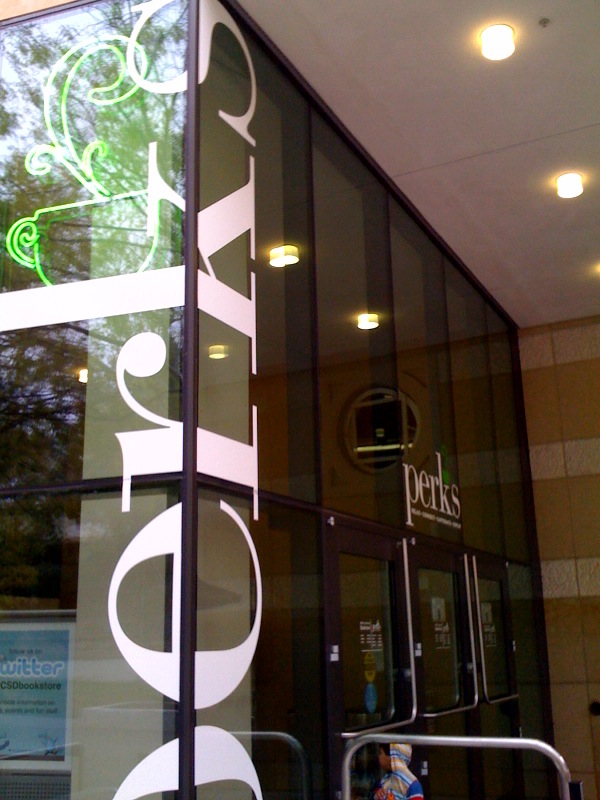
One of the best campus coffee shops I know is on the UCSD campus where I had the great fortune to spend a month this summer (much more on that coming soon.)  The place is called Perks.  Its not the coolest place to hang out.  It shares space with the campus bookstore, the lighting is industrial, and the furniture is not conducive to lingering.  But I don’t know of any other campus cafe so focused on the quality of the coffee.

perks

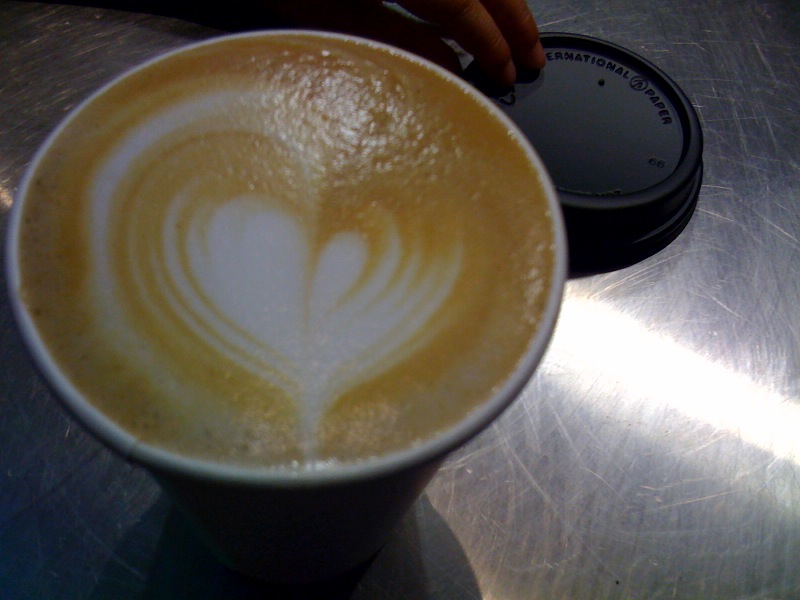
The assistant manager’s name is Jason and he is a serious barista.  It is apparent that he has also trained most of the regular staff.  Their espresso roast is on the light side, a departure from the tendency toward over-roasting from Starbuck’s and Peets.  They make drinks one at a time: the baristas are not multi-taskers.  Listen to the sound as they steam milk.  You don’t hear the usual bubbles-through-a-straw sound that must untrained baristas learn as the quick and easy way to make glue foam.  And you see and taste the results.

cap