
You are currently browsing the category archive for the ‘Uncategorized’ category.
What happens when you put someone in a dense forest, tell them to walk for an hour in a straight line and track them with GPS? They do this (top left.)

Their walking patterns were similar those of blindfolded walkers (right) and very different from those walking in a desert (bottom.) The results suggest that a good reference point (the sun in the case of the desert) helps. And the lack of a consistent turning direction rules out the hypothesis (believe it or not) that the tendency to walk in circles is due to asymmetrical leg lengths.
Read the article from Not Exactly Rocket Science.
Addendum: I bet that if they were swimming instead of walking you would see consistent circles.
- Performance degrading drugs. Also, how to make love and not war.
- A book on wine to retail for $1 million. (Comes with wine.)
- Inkonomics.
I teach a class at Kellogg on “Strategic Crisis Management”. It deals with crises that are triggered by a conflict between moral values and profit-maximization. A student from a class I taught earlier this year, Jason Gilroy, told me about the song United Breaks Guitars by Dave Carroll:
Five million hits later, United is making amends. If you search YouTube you’ll find further videos by Dave and various responses.
We have all heard about problems of overfishing and how quotas and incentive mechanisms have been effective in slowing the depletion of stocks of endangered fish. But while over-utilization of a common resource can be addressed with such measures, it is trickier to implement schemes that incentivize investment toward actively replenishing depleted fisheries. The problem is that any actor bears all of the investment cost but, given the common pool, enjoys only a small fraction of the benefits.
Enter Giant Robotic Roaming Fish Farms. These are essentially mobile fences in the sea that have the potential of bringing the benefits of coastal fish farming to the open waters solving a number of traditional problems.
Traditional fish farms typically consist of cages submerged in shallow, calm waters near shore, where they are protected from the weather and easily accessible for feeding and maintenance.
But raising fish in such close quarters can contribute to the spread of disease among the animals, and wastes may foul the waters. Cages must be moved to keep the waters clean and the fish healthy.
Deepwater cages offer cleaner, more freely circulating ocean water and natural food, which can yield tastier fish.
Fences create property rights and property rights solve incentive problems. As an illustration, here is a remarkable paper demonstrating the rapid advances in agricultural development in the American plains that coincided with the invention of barbed wire.
Suppose I want to send you an email and be sure that it will not be caught in your spam filter. What signal can I use to prove to you that my message is not spam? It must satisfy (at least) two requirements.
- It should be cheaper/easier for legitimate senders to use than for spammers.
- It should be cheap overall in absolute terms.
The first is necessary if the signal is going to effectively separate the spam from the ham. The second is necessary if the signal is going to be cheap enough for people to actually use it.
It is easy to think of systems that meet the first requirement but very hard to think of one that also satisfies the second. Now researchers at Yahoo! have an intriguing new idea that has received a great deal of attention, CentMail. According to this article, Yahoo! is planning to roll it out soon.
The sender pays a penny to have a trusted server to affix an electronic “stamp” to the message. Given that spammers could not afford to pay even one cent per message given the massive volume of spam, the receiver can safely accept any stamped message without running it through his spam filter.
Now here is the key idea. The penny is paid to charity. How could this matter? Because most people already make sizable donations to charity every year, they can simply route these donations through CentMail making the stamps effectively free. Thus, condition 2 is satisfied.
The first question that comes to mind is the titular one. (Settle down Beavis.) Remember, we still have to worry about condition 1 and whatever magic we use to make it cheap for legitimate email better not have the same effect on spam. But just like you, any spammer who makes donations to charity will be able to send a volume of spam for free. Apparently the assumption is that spam=evil and evildoers do not also contribute to charity. And we must also assume that Centmail doesn’t encourage entry into the spamming business by those marginal spammers for whom the gift to charity is enough to assuage their previous misgivings.
But these seem like reasonable assumptions. The more tricky issue is whether the 1 penny will actually deter spammers. It is certainly true that at current volume levels, the marginal piece of spam is not worth 1 penny. But for sure there is still a very large quantity of spam that is worth significantly more than 1 penny. For proof, just take a look in your snailbox. Even at bulk rates the cost of junk-mail advertising is several pennies per piece. With Centmail your Inbox would have at least as much stamped spam as the amount of junk mail in your snailbox.
This leads to the crucial questions. Any system of screening by monetary payments should be viewed with the following model in mind. First, ask how many pieces of spam you would expect to receive per day at the specified price. Next, ask how many spam you are willing to receive before you turn on your spam filter again. If the first number is larger than the second, then the system is not going to substitute for spam filtering and this undermines the reason to opt-in in the first place. For Centmail and me these numbers are 50 and 1.
Now continued spam filtering won’t necessarily destroy the system’s effectiveness. The stamp can be used in conjunction with standard filtering rules to reduce the chance your ham gets classified as spam. Then the question will be whether this reduction is enough to induce senders to adopt the setup costs of opting in.
Finally there is no reason theoretically that the total volume of spam would be reduced. Providing spammers with a second, higher class of service might only add to their demand.
My favorite reality show Top Chef is back and this time it’s in Vegas. Sin City is not known for any special cuisine so the producers have opted to stir in the town’s most famous ingredient – gambling. In each episode one chef is eliminated and we get to watch them fight and flirt till one is left standing many, many weeks from now. So it’s a pretty big deal if you get a pass to the next round. Because of the Vegas setting, one chef won this great prize by drawing a “gold chip”. In the previous shows, you had to cook your way into this advantage in the “quickfire” round. This round still remains but, at least in the first show, there is now the second random route into the next round.
What effect will this have?
As randomization is not a function of the ability of the contestants but winning the quickfire is, the average quality of the chefs in future rounds will go down compared to the previous series. That’s the statistics angle. The game theory angle is the impact on incentives. The good chefs are going to find it easier than before as only the worst chef is eliminated. If a lower quality chef makes it via randomization, the others can slack off in the next round and conserve their energy and best dishes for the future. The cooking will get worse. The producers should drop the randomization trick if they want to see the best possible cooking.
Some of the trade-offs, both mathematical and psychological are discussed in this article from The Numbers Guy. My favorite idea:
• Dilip Soman: “I have a radical solution. Once a shopper is ready to check out, she wheels her cart into an area where she gets a number, and is directed to a lounge. Staff members scan and generate ‘invoices’ and once ready, the numbers are called out into the lounge area so that the customer can pay. The one thing that I don’t know is whether customers will feel some anxiety about not being in front of their groceries when they are being scanned, but if they don’t, I think this will be the most efficient solution!”
When animals move, forage or generally go about their lives, they provide inadvertent cues that can signal information to other individuals. If that creates a conflict of interest, natural selection will favour individuals that can suppress or tweak that information, be it through stealth, camouflage, jamming or flat-out lies. As in the robot experiment, these processes could help to explain the huge variety of deceptive strategies in the natural world.
The article at Not Exactly Rocket Science, describes an experiment in which robots competed for food at a hidden location and controlled a visible signal that could be used to reveal their location. The robots adapted their signaling strategy by a process that simulates natural selection. Eventually, the robots learned not to pay attention to others’ signals and the signals become essentially uninformative.
Paul Kedrosky is intrigued by a claim about golf strategy
While eating lunch and idly scanning subtitles of today’s broadcast of golf’s PGA Championship, I saw an analyst make an interesting claim. He said that the best putters in professional golf make more three putts (taking three putts to get the ball in the cup) than does the average professional golfer. Why? Because, he argued, the best putters hit the ball more firmly and confidently, with the result that if they miss their ball often ends up further past the hole. That causes them to 3-putt more often than do “lag” putters who are just trying to get the ball into the hole with no nastiness.
The hypothesis is that the better putters take more risks. That is, there is a trade-off between average return (few putts on average) and risk (chance of a big loss: three putts.)
His is a data-driven blog and he confronts the claim with a plot suggesting the opposite: better putters have fewer three-puts. However, there are reasons to quibble with the data (starting a long distance from the green, it would be nearly impossible to hole out with a single putt. In these cases good putters will two-putt, average putters will three-putt. The hypothesis is really about putting from around 10 feet and so the data needs to control for distance, as suggested to me by Mallesh Pai. Alternatively, instead of looking at cross-sectional data we could get data on a single player and compare his risk-taking behavior on easier greens, where he is effectively a better putter, versus more difficult greens.)
And anyway, who needs data when the theory is relatively straightforward. Any individual golfer has a risk-return tradeoff. He can putt firmly and try to increase the chance of holing out in one, at the cost of an increase in the chance of a three-putt if he misses and goes far past the hole. The golfer chooses the riskiness of his putts to optimize that tradeoff. Now, we can formalize what it means to be a better putter: for an equal increase in risk of a three-putt he gets a larger increase in the probability of a one-putt. Then we can analyze how this shift in the PPF (putt-possibility-frontier) affects his risk-taking.
Textbook Econ-1 micro tells us that there are two effects that go in opposite directions. First, the substitution effect tells us that because a better putter faces a lower relative price (in terms of increased risk) from going for a lower score, he will take advantage of this by taking more risk and consequently succumbing to more three-putts. (This assumes diminishing Marginal Rate of Substitution, a natural assumption here.) But, there is an income effect as well. His better putting skills enable him to both lower his risk and lower his average number of putts, and he will take advantage of this as well. (We are assuming here that lower risk and lower score are both normal goods.) The income effect points in the direction of fewer three-putts.
So the theoretical conclusions are ambiguous in general, but there is one case in which the original claim is clearly borne out. Consider putts from about 8 feet out. Competent golfers can, if they choose, play safely and virtually ensure they will hole out with two putts. Competent, but not excellent golfers, have a PPF whose slope is greater than 1: to increase the probability of a 1-putt, they must increase by even more the probability of a three-putt. Any movement along such a PPF away from the sure-thing two-putt not only increases risk, but also increases the expected number of putts. Its unambiguosly a bad move. So competent, but not excellent golfers will be at a corner solution on 8 foot putts, always two-putting.
On the other hand, better golfers have a flatter PPF and can, at least marginally, reduce their average number of putts by taking on risk. Some of these better golfers, in some situations, will choose to do this, and run the risk of three-putting.
Thanks to Mallesh Pai for the pointer.
The thing with having a blog is that it affects the way you see everything. You can’t just let go and enjoy a movie, T.V. etc without the odd idea for a post popping into the back of your mind….So, last night I settled down to watch the first episode of “Mad Men” and I thought I concentrated fully and followed the plot. But now all I remember is that the new evil British guy (the Principal) appointed two people, Pete and Ken (the Agents) , “Head of Accounts” after sacking the sole previous incumbent.
This the classic incentive scheme recommended by the tournaments literature in contract theory. The main idea is that you get both Pete and Ken to work hard because if one underperforms relative to the other, he gets punished by lower wages, sacking etc. Of course this transfers risk onto the agents and Pete particularly looked discomfited by the arrangement even though he got a promotion. In fact, a classic paper by Bengt Holmstrom (which I already blogged about), recommends that this relative performance evaluation only be done if one agent’s output gives information about the other’s effort, otherwise you are just imposing risk without any incentive benefits. So, if Pete and Ken were doing totally different jobs, the incentive scheme does not make any sense. But since they are both working in Accounts if one, say Pete, does well and the other, Ken, does badly it signals that Ken might not have worked as hard as Pete. If both do badly, it signals that the economy is bad and no-one shirked etc…So, it fits the theory.
One problem with relative performance evaluation is that Pete and Ken have an incentive to collude (Dilip Mookherjee pointed this out in his research). Ken realizes this and suggests it to Pete but Pete turns him down. Maybe there’s a Prisoner’s Dilemma aspect to the collusion game or Pete was too emotional to get it.
Thought you were secure in a tenured job? I guess if your whole department is eliminated, so are you: The University of Southern Mississippi is getting rid of its economics department in its entirety:
The elimination of economics, along with five tenured and four tenure-track faculty positions, is part of a plan to reduce spending by $11 to $12 million, universitywide, within a year. While university officials stress the plan isn’t yet final, they are slated to decide by September 1 whether to go forward with the proposed cuts, according to a news release. Tenured and tenure-track faculty are legally required to a year’s notice prior to termination, and economics faculty say they’ve already received such notice.
It seems they are not producing enough graduates.
(HT: Tomas Sjostrom)
The link I posted previously was somewhat outdated as it mentioned only that furloughs were under consideration. As a part of the recent budget agreement, the UC furlough is now a done deal. Here are some more recent stories.
I have heard that, system-wide, professors will take an 8% cut in pay. The word “furlough” usually means something like a temporary layoff. Here it means that workers will have shorter hours and commensurately lower pay. For example, UC non-faculty staff will have a few days off each month.
What are the marginal hours where Professors will be furloughed? Saturdays. That is, no classes will be cut, all administrative duties remain intact, pay is cut 8%. Presumably this means that my colleagues in UC system will be doing 8% more surfing the web when they are not in the classroom.
At Legoland, admission is discounted for two-year-olds. But a child must be at least three for most of the fun attractions.
At the ticket window the parents are asked how old the child is. But at the ride entrance the attendants ask the children directly.
The parents lie. The children tell the truth.
Cheney is spilling the beans on “soft” Bush:
Cheney’s imprint on law and policy, achieved during the first term at the peak of his influence, had faded considerably by the time he and Bush left office. Bush halted the waterboarding of accused terrorists, closed secret CIA prisons, sought congressional blessing for domestic surveillance, and reached out diplomatically to Iran and North Korea, which Cheney believed to be ripe for “regime change.”
And
It was clear that Cheney’s doctrine was cast-iron strength at all times — never apologize, never explain — and Bush moved toward the conciliatory.
Via kottke.org, an article in New Scientist on the mathematics of gambling. One bit concerns arbitrage in online sports wagering.
Let’s say, for example, you want to bet on one of the highlights of the British sporting calendar, the annual university boat race between old rivals Oxford and Cambridge. One bookie is offering 3 to 1 on Cambridge to win and 1 to 4 on Oxford. But a second bookie disagrees and has Cambridge evens (1 to 1) and Oxford at 1 to 2.
Each bookie has looked after his own back, ensuring that it is impossible for you to bet on both Oxford and Cambridge with him and make a profit regardless of the result. However, if you spread your bets between the two bookies, it is possible to guarantee success (see diagram, for details). Having done the calculations, you place £37.50 on Cambridge with bookie 1 and £100 on Oxford with bookie 2. Whatever the result you make a profit of £12.50.
I can verify that arbitrage opportunites abound. In my research with Toomas Hinnosaar on sorophilia, we investigated an explanation involving betting. In the process we discovered that the many online bookmakers often quote very different betting lines for basketball games.
How could bookmakers open themselves up to arbitrage and still stay in business? Here is one possible story. First note that, as mentioned in the quote above, no one bookmaker is subject to a sure losing bet. The arbitrage involves placing bets at two different bookies.
Now imagine you are one of two bookmakers setting the point spread on a Clippers-Lakers game and your rival bookie has just set a spread of Lakers by 5 points. Suppose you think that is too low and that a better guess at the spread is Lakers by 8 points. What spread do you set?
Lakers by 6. You create an arbitrage opportunity. Gamblers can place two bets and create a sure thing: with you they take the Clippers and the points. With your rival they bet on the Lakers to cover. You will win as long as the Lakers win by at least 7 points, which is favorable odds for you (remember you think that Lakers by 8 is the right line.) Your rival loses as long as the the Lakers win by at least 6 points, which is unfavorable odds for your rival. You come away with (what you believe to be) a winning bet and you stick your rival with a losing bet.
Now this begs the question of why your rival stuck his neck out and posted his line early. The reason is that he gets something in return: he gets all the business from gamblers wishing to place bets early. Put differently, when you decided to wait you were trading off the loss of some business during the time his line is active and yours is not versus the gain from exploiting him if he sets (what appears to you to be) a bad line.
Since both of you have the option of playing either the “post early” or “wait and see” strategy, in equilibrium you must both be indifferent so the costs and benefits exactly offset.
Of course, with online bookmaking the time intervals we are talking about (the time only one line is active before you respond, and the time it takes him to adjust to your response, closing the gap) will be small, so the arbitrage opportunities will be fleeting. (As acknowledged in the New Scientist article.)
Blame it on the binding constraint.
Let me explain. Has it ever struck you how peculiar it is that the price of so much writing these days is zero? No, I don’t mean that it is suprising that blogs don’t charge a price. There is so much supply that competition drives the price down to zero.
What I mean is, why are so many blogs priced at exactly zero. It would be a complete fluke for the optimal price of all of the blogs in the world to be at exactly the same number, zero.
And indeed the optimal price is not zero, in fact the optimal price is negative. Bloggers have such a strong incentive to have their writings read that they would really like to pay their readers. But for various reasons they can’t and so the best they can do is set the price as low as possible. That is, as it often happens, the explanation for the unlikely bunching of prices at the same point is that we are all banging up against a binding constraint.
(Why can’t we set negative prices? First of all, we cannot verify that you actually read the article. Instead we would have people clicking on links, pretending to read, and collecting money. And even if we could verify that you read the article, most bloggers wouldn’t want to pay just anybody to read. A blogger is usually interested in a certain type of audience. A non-negative price helps to screen for readers who are really interested in the blog, usually a signal that the reader is the type that the blogger is after.)
Now, typically when incentives are blunted by a binding constraint, they find expression via other means, distortionary means. And a binding price of zero is no different. Since a blogger cannot lower his price to attract more readers, he looks for another instrument, in this case the quality of the writing.
Absent any constraint, the optimum would be normal-quality writing, negative price. (“Normal quality” of course is blogger-specific.) When the constraint prevents price from going negative, the response is to rely more heavily on the quality variable to attract more readers. Thus quality is increased above its unconstrained optimal point.
So, the next time you are about to complain that the blogs you read are too interesting (at the margin), remember this, grin and bear it.
The NY Times has an article about a new wave of independent films and their marketing.
When “The Age of Stupid,” a climate change movie, “opens” across the United States in September, it will play on some 400 screens in a one-night event, with a video performance by Thom Yorke of Radiohead, all paid for by the filmmakers themselves and their backers. In Britain, meanwhile, the film has been showing via an Internet service that lets anyone pay to license a copy, set up a screening and keep the profit.
The article is about the variety of roll-your-own distribution and marketing campaigns employed by filmmakers who lack studio backing. But the lede is buried:
Famous fans like Courtney Love were soon chattering online about the film. And an army of “virtual street teamers” — Internet advocates who flood social networks with admiring comments, sometimes for a fee, sometimes not — were recruited by a Web consultant, Sarah Lewitinn, who usually works the music scene.
Here is wikipedia on street teams. The origin is traced back to the KISS army, a grass-roots fan club that aggressively promoted the band KISS and later “vertically integrated” with the KISS marketing machine where they had access to exclusive promotional merchandise.
Today you can hire a consultant to assemble a street team to promote your band, movie, (hmmm… blog?), … A good consultant will find (or make) fans with a selected personality type, street-cred, and social network and organize them into a guerilla marketing squad armed with swag.
Virtual street teams operate in online social networks. Presumably then, actual people are no longer required. A good consultant can manufacture online identities, position them in a social network, getting Twitter followers and Facebook friends and cultivate the marketing opportunities from there. You can imagine the pitch: “We can mobilize 10,000 follower-tweets per day…”
Here is the web site of ForTheWin.com, the agency of Sara Lewitinn who coordinated the virtual street team for the film Anvil! The Story of Anvil.
For The Win! is an cooperative of club urchins and nightlife denizens charged with the task of defending the best of pop culture from the daily onslaught of the whack. At night we comb the streets in search of the best fashion, art, music, and movies New York City has to offer. By day we make sure we spread the word to the world by any and all means necessary of the internet to it’s biggest platforms without skipping a step or taking anything for granted. Each of our campaigns is as unique as the artist it represents.
Note they also count Slighly Stoopid, Electrocute, and The Pet Shop Boys (!) as clients.
Paula Abdul has left American Idol. Apparently,
“Paula didn’t place as much importance on remaining on the show as some other people did,” said a person close to Ms. Abdul who, like several people interviewed for this article who were involved in the negotiations, spoke on the condition of anonymity to preserve relationships on both sides. “She thinks there are a lot of opportunities out there for her, and she will be fine without that show.” NYT
That is, Paula’s assessment of her value, i.e. her outside option, was greater than American Idol’s assessment of her value for their show. This is a reasonable possibility. After all American Idol (AI) has Simon Cowell and then the marginal contribution of Abdul might be lower in AI than her value to a show like “Dancing with the Stars” where there are no recognizable personalities. In this scenario, there are no gains to trade for Abdul and American Idol and so they have to part.
But there is another possibility. Abdul and American Idol have private information, Abdul about her outside option and AI producers about her value for their show. The producers have an incentive to shade their value to minimize the salary they have to pay Abdul. Abdul has an incentive to exaggerate her value to AI. Even if she might be an American Idle she should pretend she is very busy and has lots of options. Joint bluffing can lead to no-trade even when there might be real gains to trade if everyone’s information is public not private. In a famous theorem, Myerson and Satterthwaite proved that for this to happen there has to be chance that there really are no gains to trade. I made the argument in the previous paragraph that this scenario is a possibility. But this scenario then affects bluffing behavior even when there are true underlying gains to trade. So, Paula may be leaving AI even though her value is higher there than at Dancing with the Stars. Tragedy.
Where’s the silver lining? Well, I think there’s one for me. I have an English accent. I can pout like Posh Spice, Paula’s replacement on AI. And I’m pretty sure people think I’m a bit of a overcritical d**khead. In other words, I am an ideal combination of Simon Cowell and Posh Spice. I have huge potential. In fact, the phone is ringing. Maybe it’s Hollywood on the line……
Mindhacks has the scoop:
…in summary it seems that the brain simulates of the outcomes of actions based on your intentions to move because the actual sensory information from the body takes so long to arrive that we’d be dangerously slow if we relied only on this.This slower information is used for periodic updates to keep everything grounded in reality, but it looks like most of our action is run off the simulation.
We can also use the simulation to distinguish between movements we cause ourselves and movements caused by other things, on the basis that if we are causing the movement, the prediction is going to be much more accurate.
If the prediction is accurate, the brain reduces the intensity of the sensations arising from the movement – for good safety reasons, perhaps – we want to be more aware of contact from other things than touches from ourselves.
Twitter came into its own in the recent demonstrations in Iran, coordinating protest and reporting on it. Its everyday uses are more prosaic and even vain but here is another I can applaud: coordinating a countrywide (or even global) wine-tasting. The Slate wine critic will be tasting the following wines on Aug 26 6.30 (Eastern U.S. time) and encourages others to follow and post on Twitter:
Domaine des Aubisières Vouvray Silex 2007, $16.95
Les Héritiers du Comte Lafon Macon 2007, $21.95
Domaines Ott Côte de Provence Rosé les Domaniers 2008, $18.95
Jean-Paul Brun/Domaine des Terres Dorées Beaujolais l’Ancien 2008, $15.95
Betts & Scholl Grenache O.G. 2006, $24.95
Ruinart NV Blanc de Blancs, $64.95
(FYI: Three are at Binnys for Chicago locals.)
A new study has found that third of students graduate with no debt at all. To state the pretty obvious: this does not imply that the cost of education is not a barrier to entry to college. Many students who might benefit from education may simply be staying out of college as they know they would have to take on a huge amount of debt. At an extreme, if only the wealthy went to college there would be no debt problem at all.
There is strategy involved in giving and interpreting compliments. Let’s say you hear someone play a difficult –but not too difficult– piece on the piano, and she plays it well. Is it a compliment if you tell her she played it beautifully?
That depends. You would not be impressed by the not-so-difficult piece if you knew that she was an outstanding pianist. So if you tell her you are impressed, then you are telling her that you don’t think she is an outstanding pianist. And if she is, or aspires to be, an outstanding pianist, then your attempted compliment is in fact an insult.
This means that, in most cases, the best way to compliment the highly accomplished is not to offer any compliment at all. This conveys that all of her fine accomplishments are exactly what you expected of her. But, do wait for when she really outdoes herself and then tell her so. You don’t want her to think that you are someone who just never gives compliments. Once that is taken care of, she will know how to properly interpret your usual silence.
In the world of blogs, when you comment on an article on another blog, it is usually a nice compliment to provide a link to the original post. This is a compliment because it tells your readers that the other blog is worth visiting and reading. But you may have noticed that discussions of the really well-known blogs don’t come with links. For example, when I comment on an article posted at a blog like Marginal Revolution, I usually write merely “via MR, …” with no link.
That’s the best way to compliment a blog that is, or aspires to be, really well-known. It proves that you know that your readers already know the blog in question, know how to get there, and indeed have probably already read and pondered the article being discussed.
Think of the big events that came out of nowhere and were so dramatic they captured our attention for days. 9/11, the space shuttle, the Kennedy assassination, Pearl Harbor. If you were there you remember exactly where you were.
All of these were bad news.
Now try to think of a comparable good news event. I can’t. The closest is the Moon landing and the first Moon walk. But it doesn’t fit because it was not a surprise. I can’t think of any unexpected joyful event on the order of the magnitude of these tragedies. On the other hand, it’s easy to imagine such an event. For example, if today it were announced that a cure for cancer has been discovered, then that would qualify. And equally significant turns have come to pass, but they always arrive gradually and we see them coming.
What explains this asymmetry?
1. Incentives. If you are planning something that will shake the Earth, then your incentives to give advance warning depend on whether you are planning something good or bad. Terrorism/assassination: keep it secret. Polio vaccine, public.
2. Morbid curiosity. There is no real asymmetry in the magnitude of good and bad events. We just naturally are drawn to the bad ones and so these are more memorable.
3. What’s good is idiosyncratic, we can all agree what is bad.
I think there is something to the first two but 1 can’t explain natural (ie not ingentionally man-made) disasters/miracles and 2 is too close to assuming the conclusion. I think 3 is just a restatement of the puzzle because the really good things are good for all.
I favor this one, suggested by my brother-in-law.
4 . Excessive optimism. There is no real asymmetry. But the good events appear less dramatic than the bad ones because we generally expect good things to happen. The bad events are a shock to our sense of entitlement.
Two related observations that I can’t help but attribute to #4. First, the asymmetry of movements in the stock market. The big swings that come out of the blue are crashes. The upward movements are part of the trend.
Second, Apollo 13. Like many of the most memorable good news events this was good news because it resolved some pending bad news. (When the stock market sees big upward swings they usually come shortly after the initial drop.) When our confidence has been shaken, we are in a position to be surprised by good news.
I thank Toni, Tom, and James for the conversation.
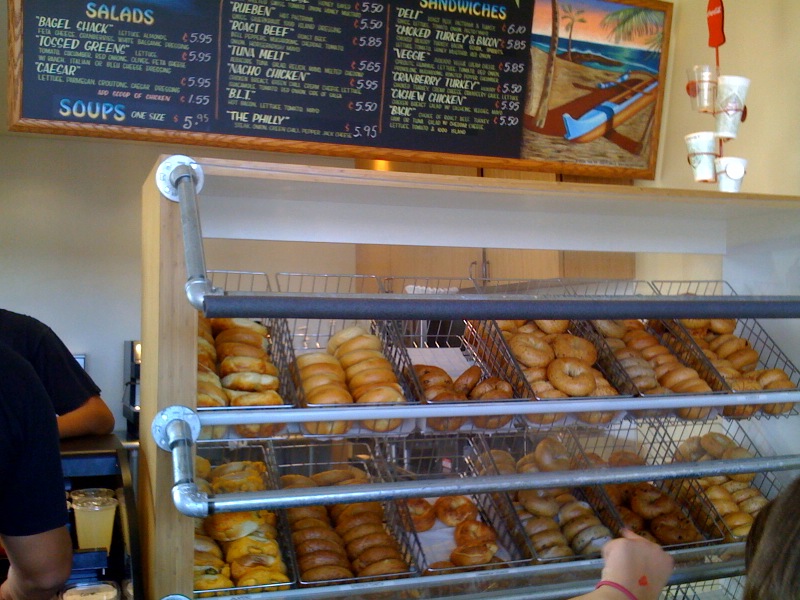
The Bagel Shack. There are two locations, the original in San Clemente and a second one in Mission Viejo off of El Toro. The bagels are big, toothsome, and fresh (due to their fast turnover.) I would go so far as to say that these are the best bagels I have ever had West of the Hudson River (and East of The Dead Sea.) I like that the bagels are shelved so that you can grab your own and quickly pay for them if you are not having them toasted or with cream cheese. Go for the jalapeño bagels.
Make the NPR Weekend Edition on-air puzzle with Will Shortz more fun. Cover your ears when he describes the format of the puzzle. Then, listen to the series of puzzles and try to guess the format quickly enough and see how many of the puzzles you can get right after that.
Via MR, this article describes the obstacles to a market for private unemployment insurance. Why is it not possible to buy an insurance policy that would guarantee your paycheck (or some fraction of it) in the event of unemployment? The article cites a number of standard sources of insurance market failure but most of these apply also to private health insurance, and other markets and yet those markets function. So there is a puzzle here.
The main friction is adverse selection. Individuals have private information about (and control over!) their own likelihood of becoming unemployed. The policy will be purchased by those who expect that they will become unemployed. This makes the pool of insured especially risky, forcing the insurer to raise premiums in order to avoid losses. But then the higher premiums causes a selection of even more risky applicants, etc. This can lead to complete market breakdown.
In the case of unemployment insurance there is a potential solution to this problem which borrows from the idea of instrumental variables in statistics. (Fans of Freakonomics will recognize this as one of the main tools in the arsenal of Steve Levitt and many empirical economists.) The idea behind instrumental variables is that it sidesteps a sample selection problem in statistical analysis by conditioning on a variable which is correlated with the one you care about but avoids some additional correlations that you want to isolate away.
The same idea can be used to circumvent an adverse selection problem. Instead of writing a contract contingent on your employment outcome, the contract can be contingent on the aggregate unemployment rate. You pay a premium, and you receive an adjustment payment (or stream of payments) when the aggregate unemployment rate in your locale increases above some threshold.
Since the movements in the aggregate unemployment rate are correlated with your own outcome, this is valuable insurance for you. But, and this is the key benefit, you have no private information about movements in the aggregate unemployment rate. So there is no adverse selection problem.
The potential difficulty with this is that there will be a lot of correlation in movements in unemployment across locations, and this removes some of the risk-sharing economies typical of insurance. (With fire insurance, each individual’s outcome is uncorrelated with everyone else, so an insurer of many households faces essentially no risk.)
Challenge: re-design speed bumps. They should still induce drivers to slow down, but without making them drive over a bump. How do you do it? Answer after the jump.
Read the rest of this entry »
In the last lecture we demonstrated that there was no way to efficiently provide public goods, whether via a market or any other institution. Now we turn to private goods.
We start with a very simple example: bilateral trade. A seller holds an object that is valued by a potential buyer. We want to know how to bring about efficient trade: the seller sells the object to the buyer if, and only if, the buyer’s willingness to pay exceeds the seller’s.
We first analyze the problem using the Vickrey-Clarke-Groves Mechanism. We see that the VCG mechanism, while efficient, is not feasible because it would require a payment scheme which results in a deficit: the buyer pays less than the seller should receive.
Then, following the lines of the public goods problem from the previous lecture we show that in fact there is no mechanism for efficient trade. This is the dominant strategy version of the Myerson-Satterthwaite theorem. In fact, we show that the best mechanism among all dominant-strategy incentive compatible and budget balanced mechanisms (i.e. the second-best mechanism) takes a very simple form. There is a price fixed in advance and the buyer and seller simply announce whether they are willing to trade at that price.
We see the first emergence of something like a market as the solution to the optimal design of a trading institution. We also see that markets are not automatically efficient even when there are no externalities, and goods are private. There is a basic friction due to information and incentives that constrains the market.
Next we consider the effects of competition. Our instincts tell us that if there are more buyers and more sellers, the inefficiency will be reduced. By a series of arguments I show the first sense in which this is true. There exists a mechanism which effectively makes sellers compete with one another to sell and buyers compete with one another to buy. And this mechanism improves upon the fixed price mechanism because it enables the traders themselves to determine the most efficient price. I call this the price discovery mechanism (it is really just a double auction.)
Finally, in one of the best moments of the class, what was previously some random plots of values and costs on the screen coalescees into supply and demand curves and we see how this price discovery mechanism is just another way of seeing a competitive market. This is the second look at how markets emerge from an analytical framework that did not presuppose the existence of markets at the beginning.
Here are the notes.

