You are currently browsing jeff’s articles.
De Waal’s own experiments suggest that capuchin monkeys are sensitive to fairness. If another monkey gets a tasty grape, they will not cooperate with an experimenter who offers a piece of cucumber (Nature, vol 425, p 297). A similar aversion has been spotted in dogs (New Scientist, 13 December 2008, p 12), and even rabbits seem affected by inequality, leading de Waal to believe that an ability to detect and react to injustice is common to all social animals. “Getting taken advantage of by others is a major concern in any cooperative system,” he says.
This article mostly just regurtitates some tired and fragile “evolutionary” explanations for fairness and revenge, but there are a few interesting tidbits, like some experiments with monkeys and this joke:
A genie appears to a man and says: “You can have anything you want. The only catch is that I’ll give your neighbour double.” The man says: “Take out one of my eyes.”
Following up on my previous post about the infield fly rule, lets get to the bottom of the zero-sum game that ensues when there is a fly ball in the infield. Let’s suppose the bases are loaded and there are no outs.
The infield fly rule is an artificial rule under which the batter is immediately called out and the runners are free to remain standing on base. Wikipedia recounts the usual rationale:
This rule was introduced in 1895 in response to infielders’ intentionally dropping pop-ups to get multiple outs by forcing out the runners on base, who were pinned near their bases while the ball was in the air.[2] For example, with runners on first and second and fewer than two outs, a pop fly is hit to the third baseman. He intentionally allows the fly ball to drop, picks it up, touches third and then throws to second for a double play. Without the Infield Fly Rule it would be an easy double play because both runners will tag up on their bases expecting the ball to be caught.
I would argue (as do commenters to my previous post) that there is no reason to prevent a double play from this situation, especially because it involves some strategic behavior by the defense and this is to be admired, not forbidden. But aren’t we jumping to conclusions here? Will the runners really just stand there and allow themselves to be doubled-up?
First of all, if there is going to be a double play, the offense can at least ensure that the runners remaining on base will be in scoring position. For example, suppose the runner on second runs to third base and stands there. And the batter runs to first base and stands there. The other runners stay put. Never mind that there will now be two runners standing on first and third base, this is not illegal per se. And in any case, the runner can stop just short of the base poised to step on it safely when the need arises. What can the defense do now?
If the ball is allowed to drop, there will be a force out of the runners on third and first. A double play. But the end result is runners on first and third. Better than runners on first and second which would result if the three runners stayed on their bases. And careful play is required by the defense. If the force is taken first at second base, then this nullifies the force on the remaining runners and the runner on third would be put out only by a run-down, a complicated play that demands execution by the defense. The runner could easily score in this situation.
If on the other hand the ball is caught, then the runer on second will be put out as he is off base. Another double play but again leaving runners on first and third.
So the offense can certainly do better than a simplistic analysis suggests. They could allow the double play but ensure that no matter what the defense does, they will be left with runners on first and third.
But, in fact they can do even better than that. The optimal strategy turns out to be even simpler and avoids the double play altogether. It is based on rule 7.08H: (I am referring to the official rules of Major League Baseball here, especially section 7)
A runner is out when … He passes a preceding runner before such runner is out
According to this rule, the batter can run to first base and stand there. All other base runners stay where they are. Now, a naive analysis suggestst that the fielder can get a triple play by allowing the ball to fall to the ground and using the force play at home, third, and second. But the offense needn’t allow this. The moment the ball touches the ground, the batter can advance toward second base, passing the runner who is standing on first and causing himself, the batter, to be called out. One out, and the only out because according to rule 7.08C, this nullifies the force so that all the baserunners can stay where they are, leaving the bases loaded:
if a following runner is put out on a force play, the force is removed and the runner must be tagged to be put out.
Given this option, the fielder can do no better than catch the ball, leaving the bases loaded. No double play. The same outcome as if the infield fly were called. So the designers of the infield fly rule were game theorists. They figured out what would happen with best play and they just cut to the chase.
But just because best play leads to this outcome doesnt mean that we shouldn’t require the players to play it out. When one team is heavily favored, we don’t call the game for the favorite just because we know that with best play they will win. To quote a famous baseball adage “that’s why they play the game.” The same should be true for infield flies. There’s a lot that both sides could get wrong.
As a final note, let me call your attention to the following, perhaps overlooked but clearly very important rule, rule 7.08I. I don’t think that the strategy I propose runs afoul of this rule, but before using the strategy a team should make certain of this. We cannot make a travesty of our national pastime:
7.08(i) A runner is out when … After he has acquired legal possession of a base, he runs the bases in reverse order for the purpose of confusing the defense or making a travesty of the game. The umpire shall immediately call “Time” and declare the runner out;
The first time I ever flew to Canada, I was flying to Toronto and I forgot to bring my passport. This was pre 9/11 and so the immigration authorities still had a sense of humor. Upon landing they brought me to the basement to interrogate me. Only one question was required and it was ingenious. “What is the infield fly rule?” Only an American would know the answer to this question. (The immigration authorities knew the right trade-off between Type I and Type II errors. A quick survey of my dinner companions tonight revealed that indeed only Americans knew the answer, but not all Americans.)
Suppose there is a runner on first base and the ball is hit in the air where it is catchable by an infielder. As the ball hangs in the air, it sets off a tiny zero sum game-within-the-game to be played by the players on the ground watching it fall to Earth. For if the ball is caught by the infielder, then the runner must be standing on first base, else he will be out after a quick throw to the first baseman, a double play. But, if he does stay standing on first base then the infielder can allow the ball to fall to the ground forcing the runner to advance. Then a quick throw to second base will get the runner out. And again a double play unless the batter has already made it to first.
Apparently this goes against some moral code deeply ingrained in American culture. Is it that the optimal strategy is random? Is it that we don’t want our heroes stranded between bases waiting to see which way they will meet their end? Is it that we don’t want to see the defense gaining advantage by purposefully dropping the ball? Whatever it is, we have ruled it out.
The infield fly rule states that in the above situation, the batter is immediately called out and the runner must stay on first base. No uncertainty, no inscrutability, no randomization. No intrigue. No fun.
But we are game theorists and we can still contemplate what would happen without the infield fly rule. Its actually not so bad for the runner. The runner should stand on first base. Usually by the time the ball descends, the batter will have made it to first base and a double play will be avoided as the infielder can either catch the ball and get the batter out or drop the ball and get the runner out. But not both.
In fact, if the ball is hit very high in the infield (usually the case since an infield fly almost always occurs because of a pop-up) the batter should advance to second base and even to third if he can. That is, run past the base runner, a strategy that otherwise would never be advisable. This forces the infielder to catch the ball as otherwise the best he can do is force out the runner on first, leaving a runner in scoring position.
So in these cases an infield fly does not really introduce any subtle strategy to the game. When the team at-bat plays an optimal strategy, the outcome entails no randomness. The final result is that there will be one out and a runner will remain on first base. And the fielder can always catch the ball to get the out.
However, this is not the only situation where the infield fly rule is in effect. It also applies when there are runners on first and second and also bases loaded. In those situations, if we did away with the infield fly rule the strategy would be a bit more subtle. And interesting! Lets try to figure out what would happen. Post your analysis in the comments.
(conversation with Roberto, Massimo, Itai, Alesandro, Wojciech, Alp, Stefan and Takashi acknowledged)
Next time: eliminating stalemate (another mysterious artificial rule) in Chess.
Update: Ah, a reader points out that the infield fly rule is waived when there is only a runner on first. Good thing my friendly immigration officer didnt know that! (even if he did, he would know that only an American would get the question wrong in that particular way).
In the film A Beautiful Mind about John Nash, there is a scene which purports to dramatize the moment in which Nash developed his idea for Nash equilibrium. He and three mathematician buddies are in a bar (here I might have already jumped to the conclusion that the story is bogus, but I just got back from Princeton and I can confirm that there is a bar there.) There are four brunettes and a blonde and the four mathematicians are scheming about who will go home with the blonde. Nash proposes that the solution to their problem is that none of them go for the blonde.
Let’s go to the video.
Of course this is not a Nash equilibrium (also it is inefficient so it cannot be a dramatization of Nash’s bargaining paper either.) However, this makes it the ideal teaching tool.
- This game has multiple equilibria with different distributional consequences.
- The characters talk before playing so its a good springboard for discussion of how pre-play communication should or should not lead to equilibrium.
- One of the other mathematicians actually reveals that he understands the game better than Nash does when he accuses Nash of trying to send them off course so that Nash can swoop in on the blonde.
- Showing what isn’t a Nash equilibrium is the best way to illustrate what it takes to be a Nash equilibrium.
- It has the requisite sex to make it fun for undergraduates.
When police stopped a 49-year-old businessman, they discovered his blood alcohol level to be well over Norway’s legal limit. Citing the man’s personal wealth of more than $30 million, a court ordered him to pay $109,000 as a drunken-driving penalty — almost his entire annual income. In Norway, fines are based on income and personal wealth.
Listen to the brief NPR item here. A similar system is in place in Finland where according to this older story, there was a fine in 2004 of 170,000 euros, the largest I could find.
From a pure revenue point of view this makes sense although it seems like the fines are rising too quickly with wealth. You would raise more revenue by setting the fine a little lower than my entire annual income and induce me to get caught more often and pay more fines.
From an incentive point of view there might be two rationales. The effect of a fixed penalty gets smaller as my income increases so to generate the same deterrent you want the fine to rise with income. Alternatively, you might wish to make the fine so high so as to deter anyone from ever consider breaking the law but you can only expect to extract such a fine from the very rich. The latter story is suspicious because, based purely on efficient incentives, you do want people to sometimes drive drunk if it is sufficiently important, for example if they need to rush someone to the hospital. And perhaps a better way to deal with the former issue is to just take away driving priveleges for some length of time. That would be a simple way to make the effect of the penalty constant despite varying income.
But shouldnt the fine also vary with the income of all the other drivers in the vicinity? Their income is a measure of the value they contribute to society and so its a good measure of the externality caused by the unsafe driving. If you are putting people with high income at risk then you should be fined appropriately.
Today I heard about the following experiment. Subjects were given a number to memorize. Half of the subjects were given 7 digit numbers and half were given 2 digit numbers. The subjects were asked to walk across a hallway to another room and report the number to the person waiting there. If they reported the correct number they were going to earn some money. On the way, there was a cart with coupons available that could be redeemed for a snack. There were coupons for chocolate cake and coupons for fruit salad. Subjects could take only one or the other before proceeding to the end of the corridor and completing their participation in the experiment.
63% of the subjects memorizing 7 digit numbers picked the chocolate cake.
Only 49% of the subjects memorizing 2 digit numbers picked the chocolate cake.
I can see two possible explanations of this. One is very interesting one is more prosaic. What’s your explanation? I will post mine, and more information tomorrow.
Update: The experiment is in the paper “Heart and Mind in Conflict: The Interplay of Affect and Cognition in Consumer Decision Making” by Shiv and Fedorikhin. Unfortunately I cannot find an ungated version. It is published in the Journal of Consumer Research 1999. I heard about the experiment from a seminar given by David Levine. Here is the paper he presented which is partially motivated by this and other experiments.
Our interpretations are similar. The interesting interpretation is that we have an impulse to pick the chocolate cake and we moderate that impulse with a part of the brain which is also typically engaged in conscious high-level thinking. When it is occuppied by memorizing 7 digit numbers the impulse runs wild.
The less interesting interpretation is that when we dont have the capacity to think about what to choose we just choose whatever catches our attention first or most prominently, independent of how “tempting” it is. One aspect of the study which raises suspicion is the following. In the main treatment, the coupons were on a table where threre was displayed an actual piece of chocolate cake and and a bowl of fruit salad. This treatment gave the results I quoted above. In a separate treatment, there was just a photograph of the two. In that treatment the number of digits being memorized made no difference in the coupon taken.
The authors explain this by saying that the actual cake is more tempting than a picture. That’s plausible, but it would be nice to have something more convincing. Would we get the same result as in the main treatment if instead of chocolate cake and fruit salad we had yogurt and fruit salad?
Watch this BBC video. (via BoingBoing)
I continue to believe that de-facto de-criminalization, and not overt legalization, will be the likely path at least in the short run. De-criminalization as it appears to be working in Canada will create an above-board market that will prevent government-sponsored cartelization which could be no better than the existing drug war.
This primer has a lot of advice about how to give a good presentation (via The Browser). Much of it I agree with. Especially these
- No bullet points
- Don’t use the slides to remind yourself what to say
- Don’t read your slides
- Very few words on each slide
On point 4, I remember Bill Zame once telling me that each slide should have no more than a single thought on it. I have used that advice ever since. The most impressive single slide I have ever seen was in a job market talk given by Luis Rayo where his slide had exactly one symbol on it, right in the middle. (One quibble, the font was too small.)
I disagree strongly however with the suggestion of replacing words with pictures. Getting rid of extraneous words is good, replacing them with extraneous pictures is bad. Unless the picture is a diagram that conveys the ideas better than spoken words can, leave it out. Coincidentally using comical pictures is a common practice in computer science talks, at least those that I have seen. The writer of this manifesto is apparently a computer scientist.
Here is an example of a diagram that conveys ideas better than spoken words can, from my talk on Kludged.

We, of course, live in a scientific age, and modern research pierces hocus-pocus. In the view that is now dominant, even Mozart’s early abilities were not the product of some innate spiritual gift. His early compositions were nothing special. They were pastiches of other people’s work. Mozart was a good musician at an early age, but he would not stand out among today’s top child-performers.
Essays about creativity teach us a lot. Not a whole lot about creativity, mind you, but they teach us a lot about the person writing the essay and also the social and political context. Not that David Brooks is a particularly important person to learn a lot about. Instead, treat this more of as an example of how the way in which we talk about unique people really says something more about the way we see ourselves in relation to unique people. (Similarly, this essay will not teach you much about its main subject matter but it will probably reveal stuff about me.)
People, especially intellectuals, are obsessed with what makes people creative. Mostly what makes other people creative. We are surrounded by amazing people who are always coming up with ideas that seem to come from nowhere. It gets worrisome when every day we hear people say ingenious things that would never have occurred to us in a million years. It is comforting to adopt theories of the origin of creativity that puts us on equal footing with them.
These theories come in two varieties.
- Theories that say that those people who seem to be unique are really just ordinary.
- Theories that say that us ordinary people are in fact unique.
And of course these are two ways of saying the same thing. And that’s why these essays don’t really tell us anything about creativity. But the choice of which way to say it reveals a lot about the person saying it.
You write several novels and transfer copyright to a publisher in exchange for royalty payment. When you die your heirs have a legally granted option to negate the transfer of copyright. This option limits how much your publisher will pay you for the copyright. So you attempt to block your heirs by entering a second contract which pre-emptively regrants the copyright.
Eventually you die and your heirs ask the courts to declare your pre-emptive contract invalid.
You are (or were) John Steinbeck and your case is before the Supreme Court. If I am reading this right the appelate court decision went against the heirs. And remarkably the Songwriter’s Guild of America filed an amicus brief in favor of the heirs. (ascot angle: scotusblog.)
Better to plagiarize more reliable sources:
After Fitzgerald learned that French composer Maurice Jarre had died, he immediately went to Jarre’s Wikipedia page, inserted some fake quotations, and waited to see if they would be picked up by news organizations. His experiment worked better than he ever imagined, as evidenced by this correction from The Guardian:
Fitzgerald’s experiment might sound familiar to espionage buffs. It was a variation on the “barium meal,” a term used by the British intelligence service MI5 to describe a process used to expose a leak or a mole: different versions of similar information would be fed to several sources and then you’d wait to see which version leaked, or ended up in enemy hands. Track it back and, voila, you’ve got the culprit. Tom Clancy called it the “canary test” in his novels—or at least that’s what a Wired.com journalist wrote after reading it on this Wikipedia page. (See how it works?)
NB: most likely this story is completely made up. (That would make it an even better story right?)
A standard introductory graduate textbook on game theory, A Course in Game Theory by Martin Osborne and Ariel Rubinstein is now freely available in PDF format. You can download it here. This is a great step toward the day when there will be top quality freely available textbooks in all subjects and the day when students and faculty will not be held-up. While we are on the subject, here is a list of other free economics books (right-hand column.)
Hunger strikes seem pointless to a game theorist. You threaten to starve yourself. I laugh and wait around until you give up and start eating again. So why are they so common? One answer might be that they are not common at all and its for that reason that the few hunger strikes that occur get so much media attention. But I think they are more common than my caracicture would allow. For example, there are two big hunger strikes in the news right now. Roxana Sebari, the American journalist imprisoned in Iran was on a hunger strike to draw attention to her captivity. Mia Farrow, the American actress, was on a hunger strike to draw attention to the crisis in Darfur.
Both were called off in the last few days. Do hunger strikes every achieve anything?
I can see one way that a hunger strike can be effective for a prisoner held in a foriegn country. The key idea is that the hunger striker may reach a point where she loses the will/ability to feed herself and then the responsibility shifts entirely on the captors to keep the victim alive. This may require moving the prisoner to a hospital or some other emergency action which will draw the attention of the international community and potentially bring pressure to allow medical attention from doctors in the prisoner’s home country.
And looking forward to this possibility, the captors may make concessions early to a hunger-striker as now both parties would benefit from preventing the strike from reaching that stage.
Update: Roxana Sebari will be freed today. I wonder if the hunger strike played any role. She abandoned it a few days ago and this turn of events today appears to be a total surprise.
Here is a new paper on the economics of open-source software by Michael Schwarz and Yuri Takhteyev. They approach the subject from an interesting angle. Most authors are focused on the question of why people contribute to open-source. Instead these authors point out that people contribute to all kinds of public goods all the time and there should be no surprise that people contribute to open-source software. Instead, the question should be why do contributions to open source software turn out to be so much more important than say, giving away free haircuts.
The answer lies in a key advantage open-source has over proprietary software. Imagine you are starting a business and you are considering adopting some proprietary software and this will require you to train your staff to use it and make other complementary investments that are specific to the software. You make yourself vulnerable to hold-up: when new versions of the software are released, the seller’s pricing will take advantage of your commitment to the software. Open source software is guaranteed to be free even after improvements are made so users can safely make complementary investments without fear of holdup.
The theory explains some interesting facts about the software market. For example, did you know that all major desktop programming languages have open source compilers? But there are no open source tools for developing games for consoles such as the X-box.
The paper outlines this theory and describes how it fits with the emergence of open source over the years. The detailed history alone is worth reading.
2005 is a legendary Bordeaux vintage. I have a dozen or so bottles stored away and this is the first I have opened. Chateau Cap de Faugeres is in Cote de Castillon on the right bank. Cote de Castillon doesn’t have the reputation of the big-name regions in Bordeaux but that is why you can get good wines like this for relatively cheap. It has a special significance for us because Jennie and I had the 2003 the first time we were in Paris together. I recently finished the last of my 2003 stash, and that was an excellent investment at $22/bottle.
Based on this bottle I am sold on 2005. On the nose there is massive fruit. Blackberries and black cherries. Some smoke and a little oak. The nose is really explosive. And the color of this wine blew me away. Then the taste. Really rich fruit, big tannins, nicely integrated oak. Excellent structure. Everything you expect from the nose and then some roasted coffee tied in with the tannins on the finish. As expected, the tannins are still pretty rough so I will leave the rest of my 2005’s for at least a few more years, but now I know what I am in for. And I think I will buy a few more.
Update: 24 hours on, the wine is noticeably more refined. The bold black fruit now leans toward the red. The tannins are softer and the acidity comes to the fore. The wine is delicious.

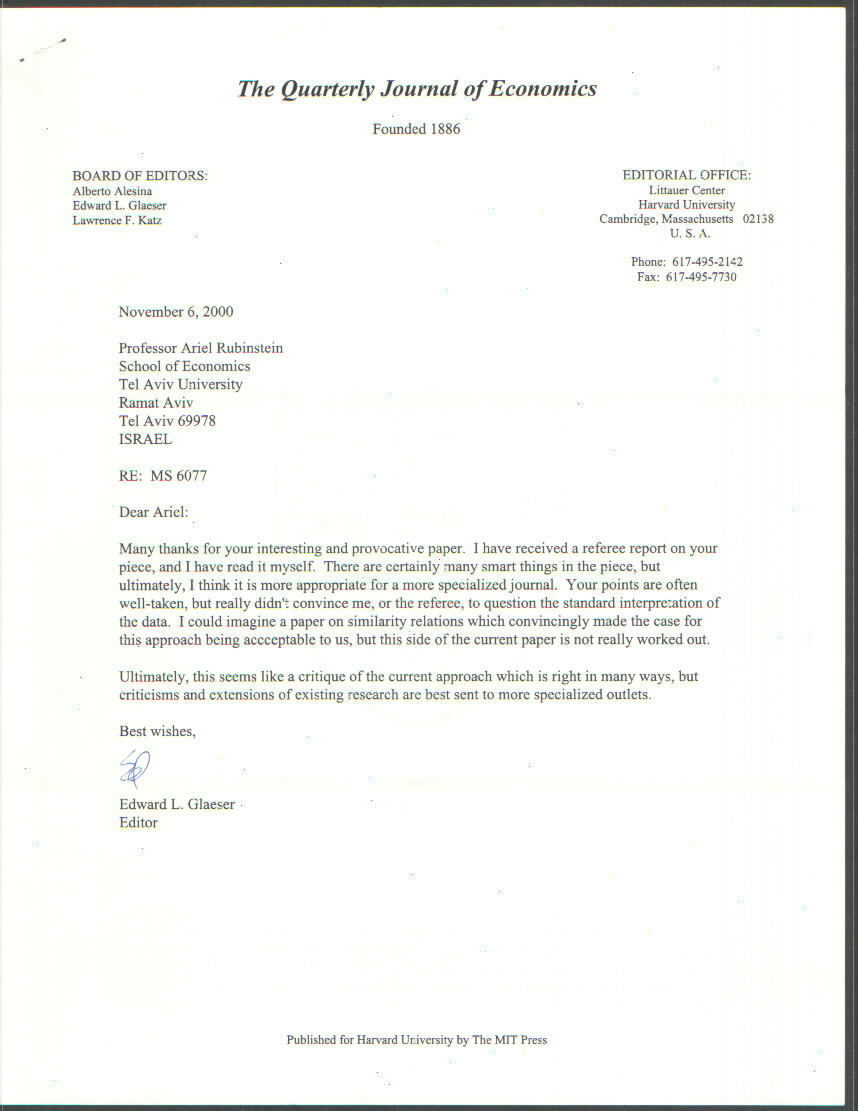
Start your QJE clocks! I just submitted my paper Kludged (rhymes with Qjed) to the Quarterly Journal of Economics. The QJE has a reputation for speedy rejections. For me this is a virtue. Obviously I prefer not to be rejected, (although for some a QJE rejection is a well-earned badge of honor) but conditional on being rejected (always the most likely outcome), the sooner the better.
Addendum: Alas, the paper was rejected 😦 It took about 3 1/2 months and I received 4 thoughtful referee reports. All in all I would say I was treated fairly.
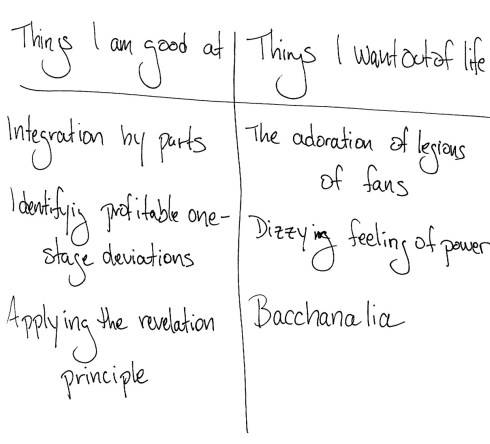
hmmm…. On the night Sandeep and I did our bit for Mark Bazer’s Interview Show at the Hideout in Chicago, Tito Beveridge, proprietor of Tito’s Handmade Vodka was one of the headline guests and he suggested a simple path to profound happiness. Take out a piece of paper and draw a line down the middle. On the left side, write down what you are good at. On the right side, write down what you want out of life.
I tried that, but I am having a hard time figuring out how to get the two ends to meet. Clearly it worked for Tito though, check it out:
Following up on Sandeep’s post about Alex Rodriguez’s alleged pitch-tipping, a game theorist is naturally led to ask a few questions. How is a tipping ring sustainable? If it is sustainable what is the efficient pitch-tipping scheme? Finally, how would we spot it in the data?
A cooperative pitch-tipping arrangement would be difficult, but not impossible to support. Just as with price-fixing and bid-rigging schemes, maintaining the collusive arrangement benefits the insiders as a group, but each individual member has an incentive to cheat on the deal if he can get away with it. Ensuring compliance involves the implicit understanding that cheaters will be excluded from future benefits, or maybe even punished.
What would make this hard to enforce in the case of pitch-tipping is that it would be hard to detail exactly what compliance means and therefore hard to reach any firm understanding of what behavior would and would not be tolerated. For example, if the game is not close but its still early innings is the deal on? What if the star pitcher is on the mound, maybe a friend of one of the colluders? Sometimes the shortstop might not be able to see the sign or he is not privy to an on-the-fly change in signs between the pitcher and catcher. If he tips the wrong pitch by mistake, will he be punished? If not, then he has an excuse to cheat on the deal.
These issues limit the scope of any pitch-tipping ring. There must be clearly identifiable circumstances under which the deal is on. Provided the colluders can reach an understanding of these bright-lines, they can enforce compliance.
There is not much to gain from pitch-tipping when the deal becomes active only in highly imbalanced games. But the most efficient ring will make the most of it. A deal between just two shortstops will benefit each only when their two teams meet. A rare occurrence. Each member of the group benefits if a shortstop from a heretofore unrepresented team is allowed in on the deal. Increasing the value of the deal has the added benefit of making exclusion more costly and so helps enforcement. So the most efficient ring will include the shortstop from every team. Another advantage of including a player from every team in the league is that it would make it harder to detect the pitch-tipping scheme in the data. If instead some team was excluded then it would be possible to see in the data that A-Rod hit worse on average against that team, controlling for other factors.
But it should stop there. There is no benefit to having a second player, say the second-baseman, from the same team on the deal. While the second-baseman would benefit, he would add nothing new to the rest of the ring and would be one more potential cheater that would have to be monitored.
How could a ring be detected in data? One test I already mentioned, but a sophisticated ring would avoid detection in that way. Another test would be to compare the performance of the shortstops with the left-fielders. But there is one smoking gun of any collusive deal: the punishments. As discussed above, when monitoring is not perfect, there will be times when it appears that a ring member has cheated and he will have to be punished. In the data this will show up as a downgrade in that player’s performance in those scenarios where the ring is active. And to distinguish this from a run-of-the-mill slump, one would look for downgrades in performance in the pitch-tipping scenarios (big lead by some team) which are not accompanied by downgrades in performance in the rest of the game (when it is close.)
The data are available.
Suppose that a plane has just landed and a flu pandemic may be emerging. You have the time and resources to check some but not all of the arriving passengers for signs of influenza. A small fraction of the passengers are arriving from Mexico where the pandemic originated and the others have not been to Mexico. How do you allocate your searches?
Efficient screening means that the probability of finding an infected passenger should be equalized across the groups that you screen. And if searches of one group yield a higher infection rate than another then you should allocate your searches to the first group. Since the passengers arriving from Mexico are much more likely to be infected, you will probably use all of your searches on them.
Even though the passengers from Mexico are being searched disproportionally more often than the others, this is not because you are discriminating against them. Your motive is simply to use your limited resources most effectively to stop the spread of the virus.
These ideas should be kept in mind when you read articles like this one (via The Browser) which claim that the disproportionate number of searches of black motorists on the highways indicates that the police are racially biased. The police probably are racists, this would not surprise anybody. But the fact that they stop and search black motorists more often than whites is not evidence of racism, unless it can be shown that the proportion of stopped black motorists who are found to be committing a crime is smaller than the proportion of stopped white motorists.
In fact, this 2001 paper by Knowles, Persico, and Todd test for this using one particualar data set and find no evidence of bias. I don’t know where the literature has gone since then, probably there have been other studies with other findings, but its important to know what the right test is.
Parents today in the US worry too much about letting their kids play outside without supervision. Are they paranoid?
The crime rate today is equal to what it was back in 1970. In the ’70s and ’80s, crime was climbing. It peaked around 1993, and since then it’s been going down.
If you were a child in the ’70s or the ’80s and were allowed to go visit your friend down the block, or ride your bike to the library, or play in the park without your parents accompanying you, your children are no less safe than you were.
But it feels so completely different, and we’re told that it’s completely different, and frankly, when I tell people that it’s the same, nobody believes me. We’re living in really safe times, and it’s hard to believe.
This ignores two crucial details. First, if fewer kids are being left unsupervised then there are fewer crimes to commit so if the number of crimes committed is the same as in the 1970’s then in fact we are living in a more dangerous world. Second, even holding constant the crime rate there is a coordination problem that parents must contend with. If all of your neighbors kids are inside playing their Wii and you let your kid go to the playground then he is the only target so you would be right to pass and go out and get your own Wii. In the 1970’s there were enough of us targets out there already that the marginal kid was safe.
The article is here. Cap clap: kottke.org.
Northwestern researchers base their model of the spread of H1N1 on estimates of the rate at which money flows through the economy.
At the heart of his simulation are two immense sets of data: air traffic and commuter traffic patterns for the entire country, and the yield of a whimsical Web site, Where’s George?
Where’s George? was started more than 10 years ago by Hank Eskin, a programmer who marked each dollar bill he received with a note asking its next owner to enter its serial number and a ZIP code into the Web site, just for the fun of seeing how far and fast bills traveled. By 2006, the site had the histories of 100 million bills.
From Michael Schwarz:
A Russian soldier comes home after years as a POW in Afghanistan. He tells his story: “I was cold, hungry, beaten, tortured and interrogated every day.” Asked if he confessed to anything, the soldier says, “Not a word, they would beat me and beat me but I simply told them again and again I do not know how the AK47 is designed. They got nothing out of me.”
“Very good,” his commanders were pleased. They asked the soldier if he has any words of advice to the new recruits, and the soldier replied, “Yes. You should pay close attention when they teach you the design of AK47.”
The Privacy Act of 1974 does regulate how the government uses information about citizens, and it allows people to find out what the government knows about them and has done with that information. But the act does not apply to data collected by outside companies, such as social networks. This issue has come up in recent years because government agencies increasingly use data brokers like ChoicePoint for various sorts of investigations that are not subject to Privacy Act protection. There have been proposals to broaden the act to account for new technologies, but none has gotten much interest from Congress so far.
This article mostly just repeats paranoia about government using social networking sites, but its still worth reading for the legal context.
WiFi on airlines is coming. On some airlines it is already here. This article talks about a few of the providers and discusses service plans and pricing options.
“Yes, broadband is coming. We’re sitting there asking, ‘Who pays? Is it the airlines or the customers? And what will they pay? What is the right technology? … When does all of this happen?’ We’re in weird economic times,” Moeller said.
Its interesting that in high-end hotels the WiFi is paid for by the guest whereas in the cheap hotels the WiFi is free. So far this pattern is playing out on the airlines too with JetBlue offering free WiFi and others charging hefty fees. Of course it is not truly free so the way to understand this is that on airlines with business travelers it makes sense to charge a high price at the expense of excluding the cheapskates. On the low-cost airlines revenue is maximized by setting a low price that virtually everyone is willing to pay. If everyone is paying the price then it saves on transaction costs by rolling it into the airfare. And it makes us feel good to be told that it is “free.”
Every news story about airline WiFi has the obligitory porn reference.
As for the possibility of passengers offending their seat-mates by surfing for inappropriate content, Blumenstein said nine months of Wi-Fi availability on American yielded no such incidents. Still, airlines including American, Delta and United have requested screening for potentially offensive content, he said.
This is never going to be a problem. There is a key complementary activity and the ban on that activity is easily enforced. Without the complementary activity there will be no demand for porn.
Apropos my previous post on simplifying English, a more dramatic example is simplified Chinese:
A clash between traditional and simplified characters comes down to elitism vs. populism. A recent poll conducted by Sohu.com on whether to reinstate the traditional characters shows that more netizens oppose it. Behind the elitism/populism divide is the opposition between an archaistic nostalgia toward the illusory “purer” traditional Chinese literacy and a pragmatic and forward-looking modern drive. (Both Singapore and Malaysia, with sizable Chinese populations, also adopted simplified characters decades ago.)
Read a debate here.
Suppose that you have evidence of wrongdoing but it is not definitive evidence. You are only 80% sure. Suppose that if you were sure you would feel a certain level of moral outrage. What fraction of that moral outrage should you feel when you are only 80% sure?
Surely it must be less than 100%. The suspect stands before you and you know that he is either guilty or innocent. Whatever level of outrage you feel, you are with 20% probability feeling morally outraged at someone who is innocent.
Is it 80%? Is the level of moral outrage proportional to the probability of guilt? This would lead to the absurd conclusion that, because we know somebody shot JFK, and we don’t know for sure who it is, and everybody around you is guilty with some probability, you feel a certain level of moral outrage toward everybody you meet.
Fortunately, there is a theory of crime and punishment that does not suffer from these paradoxes. Punishment for suspicion of a crime is designed to create incentives for good behavior and this implies a precise relationship between the level of suspicion and the level of punishment. And the relationship usually clashes with that of moral outrage.
For example, you can be certain that a crime was not committed and still insist on punishing. For example, the best way to deter doping in sports might be to set such drastic penalties that nobody will ever use performance-enhancing drugs. To enforce this we must use drug tests. And when a drug test comes up positive, we know it was a false positive because we know that the penalty is so high that nobody would be doping. But we must punish anyway because this is our deterrent.
The opposite is possible as well. You can be quite certain that a crime was committed and let the suspect go free with no penalty. For example, suppose there are two kinds of evidence suggestive of a crime. There might be circumstantial evidence and there might be an eye-witness. It may be an optimal deterrent to punish only in the event of an eye-witness and never when there is only circumstantial evidence, even very strong circumstantial evidence. This would minimize type II errors (convicting the innocent in the event of circumstantial evidence) and would still be a sufficient deterrent if the penalty in the event of an eye-witness could be set high enough.
Ok, so we can escape the paradoxes of moral outrage. Now that we have that settled, what I am trying to figure out is how these ideas extend so that I can escape the paradoxes of statistical voyeurism.
This morning something interesting was demonstrated on the NPR puzzle with Will Shortz. Each week a puzzle is given and listeners are given a week to email their answers. Among those with the correct answer a listener is selected at random to solve a series of puzzle lives on the air the next week.
Last week’s qualifying puzzle was unusually difficult. There was an exceptionally small number of correct answers. The best puzzle solvers right? The listener selected from this group played on the air this morning. The on-air puzzle was a relatively easy format and on a typical week the guest would get nearly all of them right. However, today’s winner got fewer than 1/4 of them. Why?
There are people who are relatively good at getting ideas quickly and there are people whose comparative advantage is in thinking hard for a longer period of time to solve harder puzzles. In chess, there are players who are good at 5 minute “blitz” time controls and those that are good at chess by mail. There is little overlap between these groups. When the qualifying puzzle is easy both types solve the puzzle. When the qualifying puzzle is hard we get a disproportionately large selection of the postalites. This means that the randomly selected listener is less likely to do well at the on-air puzzle which favors blitzers over postalites.
I have been trying to come up with a practical measure of the length of Chicago winters. Here are a few.
- On Oct 4 I swapped out my summer clothes for winter clothes. Tomorrow I will take the summer clothes back out of storage. 7 months of winter.
- On Nov 10 I wore my heavy winter coat for the first time. I downgraded to my wool coat for the first time on March 27. 4.5 months of deep winter.
- Sep 9 was the first day I did not wear flipflops. I wore them for the first time last week. 4.5 months of non-winter.
Hau muC tym dew kids wayst lerning tew spel ingliS? Sudent we 3ther standerdeys 0n a simplifeyd speling sistem or just ubandun speling cunvenCins oltewgether? And hau muC tym is lost lerning to r3d? I caym ucross the Spelling Society wiC advocayts speling r3form and 0lso Wyrdplay wiC arcayvs a number of simplifayd speling sistems raynjing frum the totul3 fonetic tew sistems wiC are intended tew bey incrementul steps toword r3form. This wun I am yewsing is just mayd up bayst 0n luking at a few uf them.
- Dont thinc that deveyces will mayk the pr0blem mewt. Yes my iPhone pr3dicts wut I am reyting but onl3 b3cus I spel the furst few letters curectl3.
- The pr0blem with fonetic sistems is that BritiS and Umericun werds wud be speld diferently.
- I expect that informul speling cunvenCuns wil 3merj sewn withaut a t0p-daun iniSitiv. Instunt mesujing is the furst big r3sun for kids to reyt tew 3C uther. Til nau, kids talct to 3c uther but rot onl3 tew thayr t3Cers. Thay develupt informul spocen layngwij ul0ngseyd the formul layngwij. This is hapening nau with reyting. Just as informul spocen layngwij perm3ayts the formul, this wil hapen with the ritin langwij. 3ven morso b3cus uf the 3fiSens3 gayns.
- This wud b3 a thing uf the past.
(C0nversaySin with Wolfgang and Tomek acn0lijd.)
 Cheap Talk