
You are currently browsing jeff’s articles.
For those of you coming to Chicago this weekend, here is Elie Tamer’s Chicago restaurant map . Elie is your kind of foodie: very good taste, unswayed by hype. And he has been to every restaurant in the greater Chicago area, so he knows what’s good. The center of mass is slightly North of the conference cetner but there are many options close by. I asked him for some recent recommendations and he wrote to me:
all good places, but less my style:
in that area there. recently been to: Ria and balsan (in the elysian hotel… really nice and $$$), girl and the goat, publican, purple pig… all good but very flashy….for out of towners, mexican here is amazing and they can try xoco(lunch sandwich)/frontera/topo there next to the AEA on clark and salpicon in old town,and mercat a la planxa (spanish inspired on south michigan) also if people are interested in steak, there are a ton there (gibsons on rush (you might run into the kardashians here it is so hip) and gene and georgettis on franklin are two examples) and of course avec is always good -really good.
I would echo his Mexican recommendations. They mostly tilt toward the high end, but you can’t go wrong. Another addition is Big Star Tacos, which Emir Kamenica recently turned me on to. Topolobampo is the best of course but good luck getting a reservation. There is the bar/cafe attached called Frontera Grill which does not take reservations but my urgent insider advice is not to go there. Especially not Saturday night around 8.
Update: Xoco/Frontera/Topo all closed through Jan 9.

Someone you know is making a scene on a plane. They don’t see you. Yet. As of now they think they are making a scene only in front of total strangers who they will never see again. It might be awkward if they knew you were a witness. Should you avert your eyes in hopes they won’t see you seeing them?
If they are really making a scene it is highly unlikely that you didn’t notice. So if eventually he does see you and sees that you are looking the other way he is still going to know that you saw him. So in fact it’s not really possible to pretend.
Moreover if he sees that you were trying to pretend then he will infer that you think that he was behaving inappropriately and that is why you averted your eyes. Given that he’s going to know you saw him you’d rather him think that you think that he was in fact in the right. Then there will be no awkwardness afterward.
However, there is the flip side to consider. If you do make eye contact there will be higher order knowledge that you saw him. How he feels about that depends on whether he thinks his behavior is inappropriate. If he does then he’s going to assume you do too. Once you realize you can’t avoid leaving the impression that you knew he was behaving inappropriately, and the unavoidable mutual knowledge of that fact, the best you can do is avoid the higher-order knowledge by looking the other way.
So it all boils down to a simple rule of thumb: If you think that he knows he is behaving inappropriately then you should look away. You are going to create discomfort either way, but less if you minimize the higher-orders of knowledge. But if you think that he thinks that in fact he has good reason to be making a scene then, even if you know better and see that he is actually way out of line, you must make eye contact to avoid him inferring that you are being judgmental.
Unless you can’t fake it. But whatever you do, don’t blog about it.
From a science fiction writer, who should know.
So, yeah: In a film with impossibly large spiders, talking trees, rings freighted with corrupting evil, Uruks birthed from mud (not to mention legions of ghost warriors and battle elephants larger than tanks), are we really going to complain about insufficiently dense lava? Because if you’re going to demand that be accurate in a physical sense, I want to know why you’re giving the rest of that stuff a pass. If you’re going to complain that the snowman flies, you should also be able to explain why it’s okay to have it eat hot soup.
Read on for the Flying Snowman theory.
Suppose our minds have a hot state and a cool state. In the cool state we are rational and make calculated tradeoffs between immediate rewards and payoffs that require investment of time and effort. But when the hot state takes over we abandon deliberation and just react on instinct.
The hot state is there because there are circumstances where the stakes are too high and our calculations too slow or imperfect. You are being attacked, the food in front of you smells funky, that bridge looks unstable. No matter how confident your cool head might be, the hot state grabs the wheel and forces you to do the safe thing.
Suppose all of that is true. What does that mean when a situation looks borderline and you see that instincts haven’t taken over? Your cool, calculating head rationally infers that this must be a safer situation than it would otherwise appear. And you are therefore inclined to take more risks.
But then the hot state better step in on those borderline situations to stop you from taking those excessive risks. Except that now the borderline has moved a little bit toward the safe end. Now when the hot state doesn’t take over it means its even more safe, etc.
And of course there is the mirror image of this problem where the hot state takes over to make sure you take an urgent risk. A potential mate is in front of you but the encounter has questionable implications for the future. Physical attraction receives a multiplier. If it is not overwhelming then all of the warning signs are magnified.
From Inside Higher Ed:
In 2011, the association listed 2,836 positions, down only 6 jobs from 2010. The 2011 figures represent a 21 percent increase from the 2009 total, when the impact of the U.S. financial downturn was most evident on hiring in economics. A report by the association suggested that the total this year probably represents an increase in openings even over the 2,881 jobs reported in 2008 because many of those searches were called off after the economy nosedived in the fall of that year.
Via Lones Smith.
Chris Ziegler, retweeted by Tyler Cowen
imagine sitting down at a desk while 250 people line up and tell you, one by one, that kim jong-il has died. that’s twitter.
To which I reply: imagine logging into Twitter and 250 people line up to tell you that Kim Jon-Il has died, and they can do it using as many characters as they want, and believe me these guys can use a lot of characters, and not only that but after they are done telling you, they are standing there in front of you and you have to have conversation with them and then find some polite way to say get out of here, i need to get some work done. That’s working in an office.
Imagine you discover a lost manuscript. You read it and it has a profound effect on you. You want as many people as possible to discover it and be affected as you were.
Publishers tell you that there is no market for re-discovered literature. But a big publisher is required for the book to have the scale of distribution it deserves.
After a while you see the solution. This is a lost manuscript and nobody would know if you were to put your own name on it, market it as something brand new and get all the buzz that would come from the reviews and best seller lists.
Would you do it? Would you condemn someone who did?
When you shop for a gift, your recipient observes only what you bought, and not what alternatives you considered.
Why would price matter more to givers than receivers? Dr. Flynn and his Stanford colleague, Gabrielle Adams, attribute it to the “egocentric bias” of givers who focus on their own experience in shopping. When they economize by giving a book, they compare it with the bracelet that they passed up.
But the recipients have a different frame of reference. They don’t know anything about the bracelet, so they’re not using it for comparison. The salient alternative in their minds may be the possibility of no gift at all, in which case the book looks wonderfully thoughtful.
Click through for an excellent article on giving, touching on the potlatch, the gift registry, and re-gifting.
A device that blurs photos of you in compromising situations.
In an ad promoting the brand and the new “utility,” provocatively dressed women dance with abandon in a club while the surrounding men (who look distinctly married in some cases) stand at attention, ready to pounce. Meanwhile a screencrawl informs the viewer that in 2011, technological advances and social networks can now turn a night out into… hell. Next, an interloper with a camera snaps a series of pictures illuminating the negative consequences of being caught on film in such a setting. As luck would have it, though, the patrons of this club are protected by Photoblocker, and the resulting snapshots are flooded with white light.
Click the link for the details, including a promotional video.
How did British PM David Cameron steel himself for the historic all-nighter last week in Brussels?
Cameron, it is said, used his tried-and-tested “full-bladder technique” to achieve maximum focus and clarity of thought throughout the gruelling nine-hour session in Brussels. During the formal dinner and subsequent horse-trading into the early hours, the prime minister remained intentionally “desperate for a pee”.
Showing a healthy disdain for ivory-tower types who claim the opposite:
Australian and American researchers examined the “effect of acute increase in urge to void on cognitive function in healthy adults”. After making eight “healthy young adults” drink two litres of water over two hours, the researchers asked them to complete a series of tasks to test their cognitive performance. They concluded from the results that an “extreme urge to void [urinate] is associated with impaired cognition”.
(Regular readers of this blog will know that I consider that a good thing.)
John Lazarev at Stanford GSB has a nice little theory paper (not his job market paper which is not little and not theory, but also nice.) It’s a model of market competition which consists of two stages. In stage one the firms simultaneously and non-cooperatively choose subsets of prices. The interpretation is that the firm is restricting itself to later choose only prices from the restricted set. After seeing the restriction sets each firm has chosen the firms then simultaneously choose prices from their respective sets.
This is a stylized model of the way “competition” works between airlines:
Almost every major US airline has independent pricing and yield (revenue) management departments. That operates as follows. The pricing department sets prices for each seating class (e.g. up to 6 non-refundable economy class fares) starting many days from the actual flight. These prices are subsequently updated very rarely. The revenue management department treats the prices as given but decides three times a day which of the fare classes to make available for purchase and which to keep closed. According to industry insiders, these departments do not actively interact with each other. Thus, there exist two stages of decision making. Effectively, the pricing department commits to a subset of prices, while the revenue management department chooses a price from this subset.
Its also a great question for a future prelim. Construct an equilibrium (subgame-perfect please) in which the firms effectively collude and earn monopoly profits.
Simple. (I will assume symmetric linear cost homogeneous product price-competition because it makes the argument simple and also quite stark: standard Bertrand pricing leads to cutthroat competitition and zero profits.) In the first stage each firm restricts to only two prices: the monopoly price and marginal cost pricing. If nobody deviates from this then all firms set the monopoly price. If anybody deviates from this by either excluding the monopoly price or including an intermediate price then all firms set the lowest price in their chosen set. All other deviations are ignored.
Its easy to check that this is a subgame perfect equilibrium and all firms earn monopoly profits. Lazarev does the same for a more general model of differentiated products price competition.
During my recent unexpected visit to New York I tried to make the best of things and hit up a legendary pizza place in Brooklyn, di Fara Pizza. It’s a real hike from midtown Manhattan but I had an afternoon to kill. I was hoping it was going to brighten up an otherwise gloomy day, but guess what?

Damn you Health Inspectors!
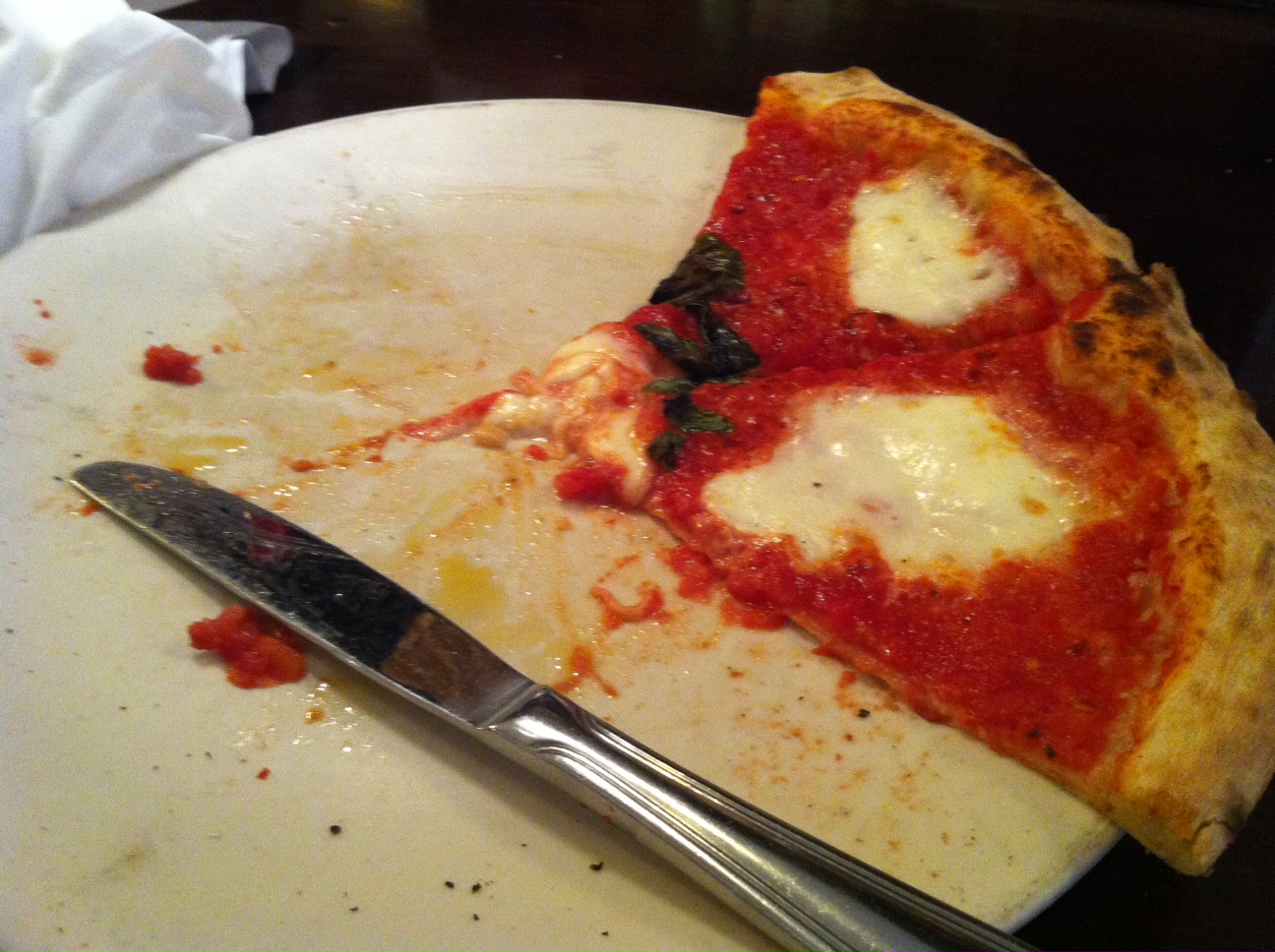
So to make it up to myself I headed back to Manhattan for my go-to Napolitano Pizza, La Pizza Fresca in the Flatiron district. A second tragedy. The pizza guy there was a master, and now he has gone. I didn’t find this out until the pizza was before me but it was obvious immediately. Same oven, same ingredients, different pizza guy; amazing the difference between superior pizza and just average. Here’s your picture of the not-, and won’t-be-empty plate:
In the past few weeks Romney has dropped from 70% to under 50% and Gingrich has rocketed to 40% on the prediction markets. And in this time Obama for President has barely budged from its 50% perch. As someone pointed out on Twitter (I forget who, sorry) this is hard to understand.
For example if you think that in this time there has been no change in the conditional probabilities that either Gingrich or Romney beats Obama in the general election, then these numbers imply that the market thinks that those conditional probabilities are the same. Conversely, If you think that Gingrich has risen because his perceived odds of beating Obama have risen over the same period, then it must be that Romney’s have dropped in precisely the proportion to keep the total probability of a GOP president constant.
It’s hard to think of any public information that could have these perfectly offsetting effects. Here’s the only theory I could come up with that is consistent with the data. No matter who the Republican candidate is, he has a 50% chance of beating Obama. This is just a Downsian prediction. The GOP machine will move whoever it is to a median point in the policy space. But, and here’s the model, this doesn’t imply that the GOP is indifferent between Gingrich and Romney.
While any candidate, no matter what his baggage, can be repositioned to the Downsian sweet spot, the cost of that repositioning depends on the candidate, the opposition, and the political climate. The swing from Romney to Gingrich reflects new information about these that alters the relative cost of marketing the two candidates. Gingrich has for some reason gotten relatively cheaper.
I didn’t say it was a good theory.
Update: Rajiv Sethi reminded me that the tweet was from Richard Thaler. (And see Rajiv’s comment below.)
The Palestinians cannot get membership in the UN because the United States would use its veto. But they have other options. A month ago they were voted in by a wide margin to the United Nations Educational, Scientific and Cultural Organization, UNESCO. This compelled the United States to cease funding to UNESCO because of an American law that prohibits contributing to any organization that recognizes the Palestinian Liberation Organization which the US considers to be a terrorist arm.
The US has no veto power to prevent entry to UNESCO or 14 other special UN agencies. Quoting Gwynne Dyer:
If the Palestinians apply for membership in each of these organisations over the next year or so, they will probably get the same 88 percent majority when it comes to a vote on membership. None of the countries that defied the United States and voted Palestine into UNESCO is going to humiliate itself by changing its vote at other UN agencies. And each time, Washington will be forced by law to cease its contributions to that agency.
The United States would not actually lose its membership by stopping its financial support – at least not for a good long while – but it would lose all practical influence on these agencies, which do a great deal of the work of running the world. It would be a diplomatic disaster for Washington…
I thank Sean Brockelbank for the pointer.

You and your partner have to decide on a new venture. Maybe you and your sweetie are deciding on a movie, you and your co-author are deciding on which new idea to develop, or you and your colleague are deciding which new Assistant Professor to hire.
Deliberation consists of proposals and reactions. When you pitch your idea you naturally become attached to it. Its your idea, your creation. Your feelings are going to be hurt if your partner doesn’t like it.
Maybe you really are a dispassionate common interest maximizer, but there’s no way for your partner to know that for sure. You try to say “give me your honest opinion, I promise I have thick skin, you won’t hurt my feelings.” But you would say that even if it’s a little white lie.
The important thing is that no matter how sensitive you actually are, your partner believes that there is a chance your feelings will be hurt if she shoots down your idea. And she might even worry that you would respond by feeling resentful towards her. All of this makes her reluctant to give her honest opinion about your idea. The net result is that some inferior projects might get adopted because concern for hurt feelings gets in the way of honest information exchange.
Unless you design the mechanism to work around that friction. The basic problem is that when you pitch your idea it becomes common knowledge that you are attached to it. From that moment forward it is common knowledge that any opinion expressed about the idea has the chance of causing hurt feelings.
So a better mechanism would change the timing to remove that feature. You and your partner first announce to one another which options are unacceptable to you. Now all of the rejections have been made before knowing which ones you are attached to. Only then do you choose your proposal from the acceptable set.
If your favorite idea has been rejected then for sure you are disappointed. But your feelings are not hurt because it is common knowledge that her rejection is completely independent of your attachment. And for exactly that reason she is perfectly comfortable being honest about which options are unacceptable.
This is going to work better for movies, and new Assistant Professors than it is for research ideas. Because we know in advance the universe of all movies and job market candidates.
Research ideas and other creative ventures are different because there is no way to enumerate all of the possibilities beforehand and reject the unacceptable ones. Indeed the real value of a collaborative relationship is that the partners are bringing to the table brand new previously unconceived-of ideas. This makes for a far more delicate relationship.
We can thus classify relationships according to whether they are movie-like or idea-like, and we would expect that the first category are easier to sustain with second-best mechanisms whereas the second require real trust and honesty.
(inspired by a conversation with +Emil Temnyalov and Jorge Lemus)
“Today’s protest was a lesson for everyone,” said Andrei Medvedev in the evening broadcast of Rossia 1. “It turns out that, to express your dissatisfaction with the authorities, it is possible to gather on a square after getting permission from those same authorities. And to keep order, all you really have to do is give a polite admonition.”
Other strangely unusual goings on described here. Ushanka shake: Gary Charness.
The Missouri Gaming Commission is deciding whether to scrap a voluntary lifetime blacklist for problem gamblers and replace it with a five-year suspension. That would allow nearly 11,000 self-banned gamblers back into the state’s 12 riverboat casinos. The self-exclusion list, implemented in 1996, has been a centerpiece of Missouri’s efforts to manage gambling addiction, and has been emulated in at least eight other states—usually without the lifetime ban.
Story from the Wall Street Journal here. I thank Daniel Akst for the pointer.
You can find it here. Currently there are discussions of recent papers by Scholhofer-Wohl, and by McGrattan and Prescott and even some current job market papers like Draca and Bigio.
There is also a Twitter feed.
Forget about Twitter as a medium for organizing protests, it is surprisingly effective as an actual protest forum. Yesterday there was a story on NPR about a flurry of protest tweets that, within just hours, got JCPenney to remove from their racks a controversial t-shirt with the slogan “I’m too pretty to do homework so I have my brother do it for me.” (I am not 100% sure but I think the parents were worried about the message this was sending to boys. Boys can be pretty too and they shouldn’t always be doing so much homework.)
Electronic communications and social networking change the power structure of protests. One subtle reason is that the act of listening to the protest is no longer public and verifiable. The organization that you are protesting against would like to commit not to listen to your protest. If we believe that there is no way to get JCPenney’s ear then no matter how much we care about boys’ self esteem we waste our effort on a futile protest. In the old days, with the exception of protests so vocal that they make the evening news, this commitment was credible. Just don’t give out any public channel through which to express your protest.
Now the channel is already there. But more importantly, the act of listening to the protest is private and not verifiable. It is impossible to commit not to listen to protests on Twitter. JCPenney would like to announce to the world that no matter how much we protest on Twitter they are just not paying attention, so don’t bother. But even if they believed that announcement worked, they would still have an incentive to monitor #JCPenney hashtags on Twitter just in case some protest happened to break out. We all know that so we don’t believe them when they say they aren’t listening.
So social media change the balance of power of protests because they give the protesters the first-mover advantage.
Beginning in February of 2012 Stanford economist Matt Jackson and computer scientist Yoav Shoham will be offering an online course in game theory. 2 hours of video lectures will be posted each week online and there will be a forum to ask questions of the instructors. Here is their introductory video.
The website where you can sign up for the course is here. Northwestern/Kellogg should do stuff like this.
In academia, Americans are a small minority of your colleagues. And so very frequently the conversation turns to the subject of American public schools. Europeans, Asians, even Canadians are deeply suspicious about the quality of education in American public schools. All but a few of them put their kids in private schools.
As for the Americans, while they also favor private schools more than the typical non-academic family, still a majority of them happily enroll their kids in public schools.
And the conversation about schools is remarkable because there is general agreement about the facts but polarized opinions about their consequences. American public schools are less rigorous, less challenging, and less disciplined; they are more focused on socialization, “creativity” and self-esteem. For the Europeans these are the weaknesses and for Americans these are the strengths. (Of course I am exaggerating the polarization but not by a lot.)
Having been involved in countless variations of this debate I have finally figured out why its so entrenched: both sides are right.
Academics are a highly selected set of people. Many accidents have to happen to produce someone with the qualities and preferences leading them here. The type of education you had must have matched perfectly the type of person you are for all of that to come together. And since people come in different types, they require different styles of education to succeed.
This explains a lot when you look backwards through that process. An American who survived the American public school system and wound up in academia is almost surely someone for whom that system works well. And a European who succeeded did so precisely because he didn’t go to schools like that. This is not saying that Europeans wouldn’t benefit from wishy-washy American schools, just that all of the Eurpoeans who would have didn’t get that and so they didn’t turn out as successful as the Europeans whose schools matched their type.
And so European parents look at American schools and rightly see that those schools would have been a disaster for them. They extrapolate to their kids and conclude, rightly or wrongly, that their kids should avoid American public schools. American parents, just as rightly, see the opposite.
(Trivia: I am a product of public schools. Here are some of my better-known classmates. See if you can guess which one I got in a fight with in junior high.)
(Regular readers of this blog will know I consider that a good thing.)
Market mechanisms of all sorts are plagued in practice by the problem of unraveling. For example, well before completing law school, law students sign contracts to assume positions at established law firms. Unraveling occurs when this early contracting motive causes market participants to compete by exiting the market earlier and earlier to the detriment of market efficiency. An excellent summary of the problem and a slew of examples can be found in a paper by Roth and Xing.
One of the problems is that the formal market institutions were not designed to combat unraveling. The adoption of stable matching mechanisms is often proposed as a solution. A famous example is the National Medical Resident Matching program which matches residents to hospitals, a stable matching mechanism that is widely believed to have significantly curtailed unraveling in that market.
Nevertheless unraveling is a robust phenomenon and Songzi Du, in a joint paper with Yair Livne, from Stanford GSB has a very simple theoretical explanation. Indeed, he shows that unraveling incentives are strong even in markets with a stable matching mechanism. Moreover large market size seems only to make the problem worse.
Consider an employer and employee who are both highly ranked and suppose that they meet each other well before the matching process begins so that neither has learned anything about the quality of the rest of the market. Let’s analyze their incentives to sign a contract now and exit the market before the formal matching process takes place.
The employee reasons that the mechanism is either going to give him a better match or its going to give the employer a better match. If he, the employee, gets a better match it is not likely to be that much better since the current employer is already highly ranked. On the other hand, if the employer finds a better match then the employee is going to have to take his chances with the rest of the market. Since the current employer is highly ranked, it is likely that whatever new employer he is matched with will be significantly worse.
On average going to the matching mechanism is a bad gamble. And since the employer is in the exact same situation, they both prefer to exit than to take that gamble.
Du and Livne use this idea to quantify how large a problem unraveling is likely to be. They takes the realistic position that participants are going to learn about the quality of close competitors prior to contracting. This gives them a rough sense of the possible matches they will get from the mechanism. The previous intution translates naturally to this setting. If the two potential early contractors are near the high end of this group, they will want to match early. Du and Livne show that for any given similarly ranked pair, this will happen about 1/4 of the time, and this is true even when the market is very large.
Finally, once it is established that unraveling is the norm and not the exception, he uses a dynamic model to give a sense of what kind of equilibrium an unraveled market settles into. And the news here is not good either. No matter how you try to make the match work, by assigning some to match early and some to wait, there will always be some pairs that want to deviate from that plan. That is, there is no equilibrium.
Here is one choice passage.
Economists essentially have a sophisticated lack of understanding of economics, especially macroeconomics. I know it sounds ridiculous. But the reason why I tell people they should study economics is not so they’ll know something at the end—because I don’t think we know much—but because we’re good at thinking. Economics teaches you to think things through. What you see a lot of times in economics is disdain for other’s lack of thinking. You have to think about the ramifications of policies in the short run, the medium run, and the long run. Economists think they’re good at doing that, but they’re good at doing that in the sense that they can write down a model that will help them think about it—not in terms of empirically knowing what the answers are. And we have gotten so enamored of thinking things through that the fact that we don’t know anything needs to bother us more. So, yes, it’s true that the average guy on the street doesn’t understand economics, and it’s also true that we don’t understand economics. We just have a more sophisticated lack of understanding than the guy on the street.
Read the whole thing here.
I was talking to someone about matching mechanisms and the fact that strategy-proof incentives are often incompatible with efficiency. The question came up as to why we insist upon strategy-proofness, i.e. dominant strategy incentives as a constraint. If there is a trade-off between incentives and efficiency shouldn’t that tradeoff be in the objective function? We could then talk about how much we are willing to compromise on incentives in order to get some marginal improvement in efficiency.
For example, we might think that agents are willing to tell the truth about their preferences as long as manipulating the mechanism doesn’t improve their utility by a large amount. Then we should formalize a tradeoff between the epsilon slack in incentives and the welfare of the mechanism. The usual method of maximizing welfare subject to an incentive constraint is flawed because it prevents us from thinking about the problem in this way.
That sounded sensible until I thought about it just a little bit longer. If you are a social planner you have some welfare function, let’s say V. You want to choose a mechanism so that the resulting outcome maximizes V. And you have a theory about how agents will play any mechanism you choose. Let’s say that for any mechanism M, O(M) describes the outcome or possible outcomes according to your theory. This can be very general: O(M) could be the set of outcomes that will occur when agents are epsilon-truth-tellers, it could be some probability distribution over outcomes reflecting that you acknowledge that your theory is not very precise. And if you have the idea that incentives are flexible, O can capture that: for mechanisms M that have very strong incentive properties, O(M) will be a small set, or a degenerate probability distribution, whereas for mechanisms M that compromise a bit on incentives O(M) will be a larger set or a more diffuse probability distribution. And if you believe in a tradeoff between welfare and incentives, your V applied to O(M) can encode that by quantifying the loss associated with larger sets O(M) compared to smaller sets O(M).
But whatever your theory is you can represent it by some O(.) function. Then the simplest formulation of your problem is: choose M to maximize V(O(M)). And then we can equivalently express that problem in our standard way: choose an outcome (or set of outcomes, or probability distribution over outcomes ) O to maximize V(O) subject to the constraint that there exists some mechanism M for which O = O(M). That constraint is called the incentive constraint.
Incentives appear as a constraint, not in the objective. Once you have decided on your theory O, it makes no sense to talk about compromising on incentives and there is no meaningful tradeoff between incentives and welfare. While we might, as a purely theoretical exercise, comment on the necessity of such a tradeoff, no social planner would ever care to plot a “frontier” of mechanisms whose slope quantifies a rate of substitution between incentives and welfare.
- There is a conservation principle for laughter. If I say something funny and sit stone-faced, you will laugh. If I laugh, you probably won’t. People in a room can be ranked by their laughter valence. Any given joke gets a certain quantity of laughs and these come from those with the lowest valence. Sandeep’s valence is minus infinity. This ignores social laughter where I laugh not because the joke is funny but just because everyone else is laughing.
- Women should be attracted to older men because survival to old age indicates good genes. The effect is weaker in the other direction (men being attracted to older women) because the opportunity cost of another mate is zero for men. This explains why men “age gracefully.”
- Skilled interrogators presumably are trained to understand and leverage the curse of knowledge: the fact that you know something makes it very difficult to imitate the frame of mind you would have if you did not know it.
- The things gay men do to make themselves attractive to other men also makes them attractive to women. Not so for lesbians vis a vis men. I am not sure I have a good theory for this one.
At elviscostello.com
The live recording finds the Imposters in rare form, while the accompanying motion picture blueprints the wilder possibilities of the show, as it made its acclaimed progress across the United States throughout the year.
Unfortunately, we at http://www.elviscostello.com find ourselves unable to recommend this lovely item to you as the price appears to be either a misprint or a satire.
All our attempts to have this number revised have been fruitless but rather than detain you with tedious arguments about morality, panache and book-keeping – when there are really bigger fish to filet these days – we are taking the following unusual step.
If you should really want to buy something special for your loved one at this time of seasonal giving, we can whole-heartedly recommend, “Ambassador Of Jazz” – a cute little imitation suitcase, covered in travel stickers and embossed with the name “Satchmo” but more importantly containing TEN re-mastered albums by one of the most beautiful and loving revolutionaries who ever lived – Louis Armstrong.
The box should be available for under one hundred and fifty American dollars and includes a number of other tricks and treats. Frankly, the music is vastly superior.
If on the other hand you should still want to hear and view the component parts of the above mentioned elaborate hoax, then those items will be available separately at a more affordable price in the New Year, assuming that you have not already obtained them by more unconventional means.
By now those means are in fact the conventional ones, but we get the point. Slouch slouch nimpupani.
“Corporations are evil” and we know this because they are always doing malicious things that are only later exposed. This often involves exploiting the complexity of transactions and the inability or unwillingness of consumers to wade through the thicket by surreptitiously ripping people off. For example, unauthorized charges inserted into phone bills, in a practice known as “cramming”, cost Americans $2 billion dollars a year, according to this article.
When something like this is discovered, the automatic reaction is to assume that the malice was intentional. They were sticking those charges in there to squeeze money out of consumers. And its basic economics that if they can secretly insert charges and make money they will. On the other hand, such a theory would appear to require you to accept they hypothesis that “corporations are evil” or at least they are cold-hearted profit maximizers.
But you can believe that corporations are not intentionally malicious and still assume that whenever there is a cold-hearted way to steal money they will do it. Because many malicious practices are not actively designed, rather they creep in and they are passively allowed to persist.
For example, those charges could have been legitimate under an outdated policy and when the policy was changed they forgot to remove them. Or some bumbling technician could have accidentally inserted them. Modern transactions are so complicated that random “mutations” are going to appear without any malicious intent and indeed without anyone noticing. This is a far more likely explanation than someone purposefully sticking them in there, especially if you doubt that “corporations are evil.”
Indeed, to have a conscious policy of ripping off unsuspecting customers requires instructing somebody to do that, and leaving a paper trail. Even a truly evil corporation understands that this is the wrong way to do it. The right way to do it is to structure the organization in a way that facilitates malice creep.
You don’t have to instruct anybody to allow mutant ripoffs to appear. They appear on their own, no paper trail required. All you need to do is to give weak incentives to the officers you have charged with making sure that you are not ripping anybody off. Nobody in your organization will have any knowledge of all the ways you are cheating your clients, not even you. By design.
There is an art to the design of an organization that cultivates malice creep. Because at the same time you have to stop “virtue creep” in its tracks. You don’t want unintended credits to randomly get inserted into the phone bill. What you need is a one-sided monitoring program. You wait around for lots of mutations to appear, you know that some are virtuous and some are malicious. Now getting rid of the virtuous ones and keep the malicious ones is easily done, just announce that its time to do some “cost-cutting.” Form an ad hoc task force to go through and find ways to restructure billing in ways that save the company money. They’ll just look at the credits and ignore the charges.
In terms of the long-run bottom line, Darwinism and Lamarckism are almost indistinguishable, but Occam’s razor favors Darwin. I would argue by the same principles that most of the malicious practices of organizations emerge by cultivated accident rather than by design.
 Cheap Talk