
You are currently browsing Sandeep Baliga’s articles.
How should a behavioral finance proponent buy wine? One basic point of research in behavioral finance is that there are exploitable arbitrage opportunities in free markets.
Richard Thaler is one of the founding fathers of behavioral finance. He is also a wine aficionado. According to this old article in Wine Spectator, Thaler applies his research to his hobby. Acutely aware of the winner’s curse – overpaying for an object at auction – he makes bids by fax rather than turning up at the live auction. He’s scared of getting carried away by the thrill of winning and overpaying for the wine. The faxed bid can be more thought out and less emotional. He also does not go by ratings as he does not believe anyone can forecast how wine will age, just like Jim Cramer can’t know what the future holds for the stocks. Thaler does not buy wine futures, suggesting they are overpriced like IPOs in financial markets. Nice simple translations to employ by yourself when you buy wine.
The usual economist counterpoint to behavioral finance is that arbitrage opportunities can’t survive in the long run because rational investors would enter and prices would change till arbitrage is impossible. Behavioral finance is predicated on the idea that this is simply not true for some reason. I hope this translates into wine markets too as I am following Thaler’s advice for my own modest collection. Unlike stocks and bonds, even if I’m wrong, at least I can drink the wine and enjoy it. All you can do with your G.M. stock is use it to light a fire.
The financial markets are deregulated, banks are “too big to fail”, interest rates were kept low by Alan Greenspan etc…are these the only issues that caused the financial crisis?
Malcolm Gladwell has a very interesting article suggesting overconfidence played a role in causing the bubble that eventually burst. The main protagonist in the story is Jimmy Cayne, former C.E.O. of Bear Stearns. The man was sometimes confident and perhaps over confident:
The high-water mark for Bear Stearns was 2003. The dollar was falling. A wave of scandals had just swept through the financial industry. The stock market was in a swoon. But Bear Stearns was an exception. In the first quarter of that year, its earnings jumped fifty-five per cent. Its return on equity was the highest on Wall Street. The firm’s mortgage business was booming. Since Bear Stearns’s founding, in 1923, it had always been a kind of also-ran to its more blue-chip counterparts, like Goldman Sachs and Morgan Stanley. But that year Fortune named it the best financial company to work for. “We are hitting on all 99 cylinders,’’ Jimmy Cayne told a reporter for the Times, in the spring of that year, “so you have to ask yourself, What can we do better? And I just can’t decide what that might be.’’ He went on, “Everyone says that when the markets turn around, we will suffer. But let me tell you, we are going to surprise some people this time around. Bear Stearns is a great place to be.’’
Gladwell connects overconfidence to success at some games people play in nature and refers to work by biological anthropologists. This all seems quite interesting and I can see chasing it up for fun. But he then goes on to try to connect Cayne’s overconfidence to his success at bridge – appreantly he is an excellent player and it helped him get his job at Bear Stearns. This is a disconnect. Bridge is a zero-sum game. Behavioral biases such as overconfidence lead people to make mistakes and hence lose out more than people who judge hands correctly. If Cayne is good at bridge, he must judge probabilities accurately rather than exaggerating his odds of success. This then implies that he is less likely to be overconfident than others working in finance who are perhaps bad at bridge and poker as they are overaggressive.
So, while Gladwell may have a point to make, he does not do it convincingly as his main example concerns a protagonist who is less likely to be overconfident as he is good at zero-sum games.
The New York Times has a great pub guide to the Cotswolds. The pub! Why has this concept not been imported wholescale into the States? There is the odd gastropub now in Chicago but they do not capture this ambiance:
There are the spacious stripped wood tables, the milky light coming through the frosted windows and the fire smoldering across the room. And my big plate of fresh fish and chips (for the equivalent of $15) is sumptuous. Amid the low murmur of relaxed conversation you can feel the easy comfort, the happiness, of human beings at rest. And with the old plow tackle hanging from the ceiling, and the flagstone floor, and the bushy hops among the beams, there’s a sense of history’s being a friend, of this means of relaxation’s being sanctioned and endorsed through having been enjoyed for centuries. You sense it’s true that Europeans — even the English — still know how to live.
To reach this sense of peace, there has to be good beer (OK – I will now accept that cold lager might be necessary as well as the room temperature English bitter!), no TVs, a sense of welcome and a slow, slow pace. Going into a neighborhood pub where the regulars treat strangers with suspicion is annoying. Remember the movie An American Werewolf in London? That took things to an extreme, turning the strangers who enter the pub into werewolfs, but you get the picture. Americans are more welcoming than the English so the friendly atmosphere should be easier to pull off here. It’s the leisurely pace that is harder to replicate. But I think someone should try.
I have visited and stayed (!) at one of the pubs, the Falkland Arms in Great Tew. It was long ago (March 1999?) and it seems the management has changed. The beer is different and the food seems better. The rooms have also been renovated. That last fact is very important. I remember the shower had the lack of pressure that is typical of England. In addition, it vacillated randomly between being boiling hot and icy cold. My wife, who is hardy, got flu soon afterwards. Hopefully, the showers have been updated from the nineteenth century to at least the twentieth. Next time I visit Oxford, I’m looking forward to heading to the Falkland Arms and enjoying the slow pace of pub life.
I apologize to Palin fans – this is actually a post about Lance Armstrong. This Slate article makes a point about Armstrong that has struck me too:
Five months into Armstrong’s comeback, his athletic career has taken a positive turn: He’s just a fraction of a second off the lead in the Tour de France. His bizarre, histrionic behavior while off the bike, though, leaves one to wonder whether this guy is cut out for public life. Lance actually shares a few traits with Sarah Palin. They both react to any criticism with extreme defensiveness. They demonize their enemies while at the same time cultivating nonstop melodramas that keep them in the news. And while they both periodically issue petulant threats to quit, you get the funny feeling that neither one is going away anytime soon.
Before he retired, Armstrong used to come under attack. He responded aggressively and yet in a controlled manner. Perhaps there were media advisors. Twitter seems to have released him for all constraints. I hope twitty Jeff keeps himself under control.
Goldman Sachs and JP Morgan have quickly returned the money they got from the government. The CEO Of JP Morgan sees it as a badge of honor:
Amid the surge, Jamie Dimon, JPMorgan’s chief executive, has cemented his status as one of America’s most powerful and outspoken bankers. He has vocally distanced himself from the government’s financial support, calling the $25 billion in taxpayer money the bank received in December a “scarlet letter” and pushing with Goldman Sachs, Morgan Stanley and others to repay the money swiftly. Those three banks repaid the money last month.
Whether a bank returns the money quickly and even if they never got any of it, the bank gained from the intervention. Why? Because if AIG, to name the key firm, had gone down, the chain of interlinked insurance contracts that it sold would have been worth nothing. This would impact the whole financial system, including Goldman Sachs etc. That’s why credit was coming to a halt as no-one knew the value of the insurance contracts that were supposedly providing a safety net.
So, taxpayers bailing out AIG helped all these banks, even those who did not participate in the government program. (It’s a classic free-rider problem in public good provision.) So, where’s my Goldman bonus since I helped to save the financial system?
My retirement accounts are looking a little better but I’m scared because the Treasury has decided that CIT Group is not “too big to fail”. And my retirement account is too small to save, despite by best efforts.
Let’s hope CIT Group going down is not another Lehman Brothers scenario.
The Starbucks index suggests that, as a rough rule of thumb, to get the Swiss price for something, double the US price i.e. a tall latte in Switzerland is twice the price of one in the US. This rule works for concerts too meaning I paid a huge amount to see the Keith Jarrett Trio in Lucerne.
But it was worth it. The concert hall itself, KKL Lucerne, is amazing. The views of snow-capped mountains from the roof terrace creates just the right buzz for a concert. The huge roof which overhangs the fountain reflects the lake and the boats as they come in or leave at the dock. It’s a great place to have your beer before you head to your expensive seat.
And I’ve always found Keith Jarrett to be more compelling live than on CD. There’s a warmth to his tone live that is missing in the excellent but cold ECM recordings, even of the live performances. They ended with a song I did not recognize. Jarrett played a repetitive and hypnotic four note theme with his left hand while improvising wildly with his right. Peacock kept up a steady rhythm on the bass and De Johnette improvised with beats and sounds that you would never guess could come from a drumset. I would love to identify the song but I can’t find a playlist on the web! Do this article or this one contain the playlist?
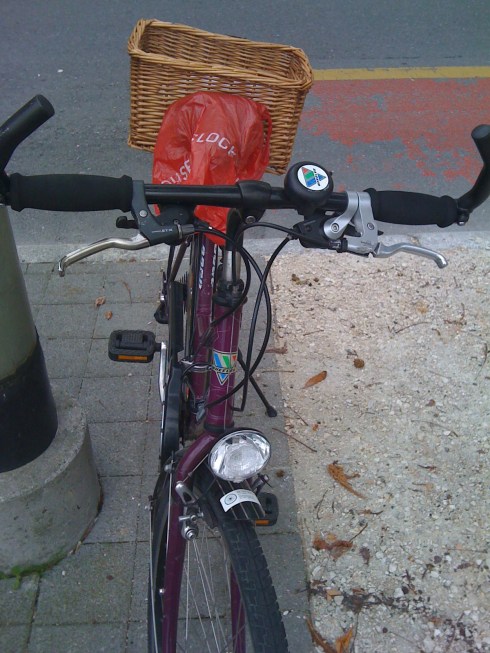
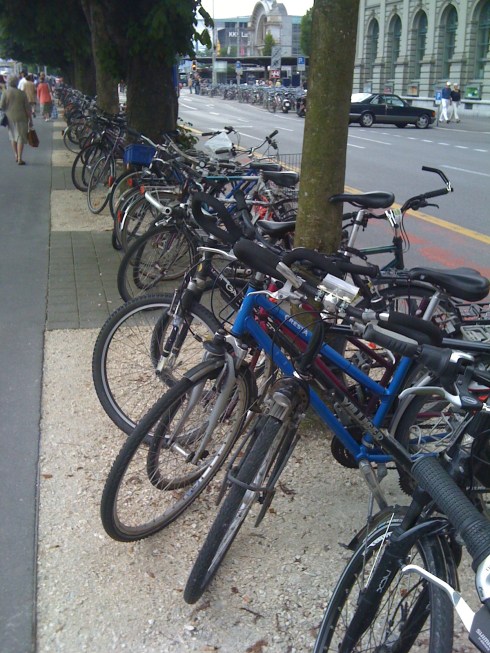 The first photo shows a bike which has a lock but is not tied to a lamppost or bike rack. The second shows a whole row of bikes, some locked as in the first photo, and some totally unlocked. Some of the bikes look old but all are perfectly serviceable.
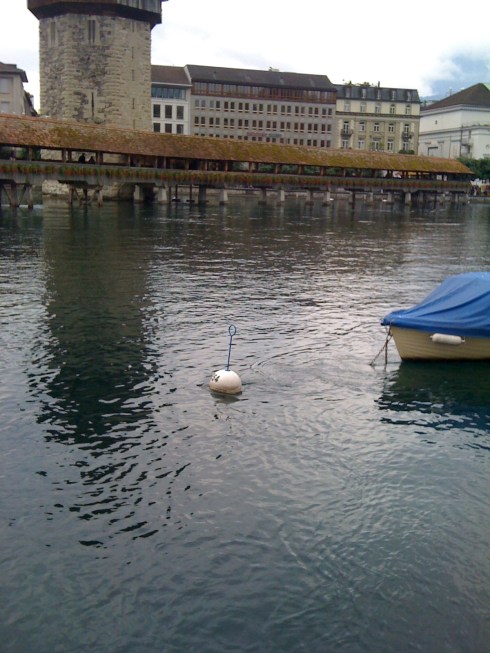 Why go abroad and go to Starbucks? Well, this view from the branch on the river in Lucerne is pretty spectacular. ( This is the Chapel Bridge which runs diagonally across the river. ) But beware: the coffee at Starbucks still sucks and it’s even more expensive in Switzerland than the U.S. While there are no coffeeshops, some of the bars on the river open early, serve coffee and have the same view.
Obama is considering a “public option” in healthcare reform. The idea is that everyone will have the right to sign up with a public non-profit entrant in the health insurance market. This is meant into create more competition in the marketplace and drive down premiums for private health plans. The case for the public option is more subtle than I initially thought.
Here is my argument:
(1) Suppose there is free entry into the healthcare market. Then prices are close to marginal cost for private healthcare organizations so the public option only increases welfare if it has a lower cost. This means in this case the public option has to be more cost effective than the private firms to make the case for entry. There is some lively debate about whether this is actually the case!
But one might say there are entry barriers as a new firm would have to set up a network of doctors, hospitals etc which will be costly and hence prohibit entry. So:
(2) Suppose there are entry barriers and existing firms are playing an oligopolistic equilibrium. This equilibrium might even include implicit collusion at prices well above cost. Even if firms make profits, there will have to ensure that a new entrant cannot enter and make profits. There are two subcases
(a) The costs of the potential entrant put an upper bound on profits that can be made by the incumbents. Then, the public option has to have lower costs than the potential entrant for it to make sense. This cost is higher than that of incumbents but still has to be lower than potential entrants – so there is still has to be some efficiency advantage to the public option.
(b) The costs of the potential entrant do not put an upper bound on the prices charged by incumbents. This is because incumbents are deterring entry by the threat of a price war should entry occur. So quite efficient potential entrants are staying out – they could make profits if entry leads to a non-price-war equilibrium but not otherwise. In this case, the public option can be more inefficient even than the potential entrant, price at its costs and act as an upper bound on the prices that can be charged by incumbents.
Is there any evidence we are in case 2b rather than 2a? Also, the public option effectively acts as a price ceiling on incumbents. A price ceiling can be implemented without the public option. Not sure which intervention is more politically feasible.
An interesting New Yorker article outlines, Operation Ceasefire, an anti-gang violence program in Cincinnati:
“David Kennedy, a professor from John Jay College of Criminal Justice, went to Cincinnati in the fall of 2006 to pitch his program, which is sometimes known as Ceasefire. Ceasefire begins with the fact that a small number of hardened criminals commit a hugely disproportionate number of serious violent crimes. Kennedy explained that, in Cincinnati, the police would identify gang members who were on parole or probation and compel them to attend a meeting. There, the cops would demand that the shootings end, and promise that, if they did not, the punishment would be swift and severe and target the entire gang. The city would also make life coaching and job counseling available to those who wanted out of the thug life.”
It seems the economic logic is this: You might not have the evidence or ability to punish only the few hardened criminals. If you punish the entire gang, they have good incentives to monitor the guy doing the violent crime. On the face of it, it seems as if it is futile to punish the innocent gang members but if they have a monitoring role they become like extra police officers. It’s hard and dangerous to reward them for turning in fellow gang members so carrot incentives are impossible. But stick incentives are not.
I wanted to find my way to the famous pizzerias of Naples. But with two kids and luggage in tow, it was too daunting. If only I’d known about this service I might have done it:
“It seemed like a great idea at the time: hire ex-convicts to escort tourists through seedy Neapolitan streets. Who better to explain to the uninitiated the potential dangers lying in wait?
But after less than a month, the experiment has already run into trouble. The former convicts recently staged a wildcat strike after one worker was taken to police headquarters over a verbal altercation with a traffic officer.
The argument was about a fine issued the day before to a worker with the group, who had crossed the street just a few steps from a crosswalk. “The first jaywalking fine issued in Naples in 200 years,” Corrado Gabriele, the program’s main institutional sponsor, said dryly.”
We should replicate this program in Chicago.
At a mafia trial in 1969:
There were sixty-four defendants, all from the
town of Corleone. The charges related to a mafi a war in Corleone that started in 1958,
and resulting in over fifty murders. There was signifi cant evidence tampering during the
trial, which experienced the rst public intimidation act. In fact, as the jury retired in
July, they and the judge received an anonymous note that read: To the President of the
Court of Assise, and members of the Jury: You have not understood, or rather, you don’t
want to understand, what Corleone means. You are judging honest gentlemen of Corleone,
denounced through caprice by the Carabinieri and Police. We simply want to warn you
that if a single gentleman from Corleone is convicted, you will be blown sky high, you will
be wiped out, you will be butchered and so will every member of your family. We think
we’ve been clear. Nobody must be convicted. Otherwise you will be condemned to death
– you and your families. A Sicilian proverb says: A man warned is a man saved. It’s up
to you. Be wise.” All sixty-four defendants were acquitted. Whilst there was undoubtedly
witness intimidation and evidence tampering, a lot of the evidence was fairly thin.
This is from the paper “Accomplice Witnesses, Organized Crime and Corruption: Theory and Evidence from Italy” by Antonio Acconcia, Giovanni Immordino, Salvatore Piccolo and Patrick Rey. As I told Salvatore in Anacapri, with more data and a bit of work, this will be a cool paper.
Paul Krugman songs continue:
Paul may have the blues but we don’t: Happy 4th of July!
(Hat tip: Our music correspondent, Tomas Sjostrom)
Should we be more scared of North Korea after their recent nuclear tests? Kim Byung-Yeon and Gerard Roland say “No”! They study the impact of major events related to North Korea (e.g. the conduct of the nuclear test in 2006) on South Korean financial markets and conclude:
“We found basically no effects on financial markets of events perceived as increasing the tension on the Korean peninsula. In a nutshell, the financial markets in South Korea are not afraid of Kim Jong-Il.”
They use “event study methodology” which is typically used in finance to study mergers. Prices before and after the merger are used to estimate its impact on value. The key is getting the date of the event right. If you get it too late for example, the price already incorporates the event. For example, if the South Korean markets had already incorporated the “news” of the North Korean test, they would not react significantly to the actual test. Not sure how the authors deal with this issue. In any case, their approach is a highly original attempt to apply economic methods to foreign policy.
When you self-check-in to United Airlines, they make a series of offers where you can upgrade to Economy Plus, get an aisle seat etc.
Why do they do this at the last minute? They are already experts at price discrimination but this usually occurs when you buy a ticket using advanced purchase, cancellation fees etc to separate out different buyers with different willingness to pay. You could do the same with aisle seats and Economy Plus.
Implementing price discrimination at the last minute helps you respond to information, e.g. how full the plane is, which you only have available at that time. Is that the only advantage?
There is a possible disadvantage for the airlines- price discrimination at the time of purchase is transparent to other airlines. They can coordinate on the pricing. But last minute pricing is intransparent. Maybe United even cuts the advance purchase fare, gives only interior seats to get surplus back via an “add-on” price for an aisle seat. This might trigger a price war.
On the other hand “add-ons” are very effective for extracting suplus at hotels (mini-bars etc) and for credit card companies (late fees etc). Is this what airlines are hoping?
As Jeff pointed out in an earlier post, David Levine thinks rational choice theory is remarkably successful and that behavioral economics may be doomed. This message has made it into experiments and the New York Times:
[S]uppose, instead of scanning people’s brains as they’re sipping wine in a laboratory, you tested them in a more realistic situation: a restaurant where they’re spending their own money. That challenge was undertaken at an upscale restaurant in Tel Aviv by two behavioral economists, Ori Heffetz of Cornell and Moses Shayo of the Hebrew University of Jerusalem, who expected to be able to manipulate diners’ choices by changing the prices on the menu.
Unbeknownst to the diners or to their waiters, the economists monitored the choices of people who ordered from the prix fixe menu. The three-course meal cost included a choice of five entrees: shrimp gnocchi, pork shank, red mullet fillet, sausage or stuffed artichoke.
Next to each of these entrees on the menu, in parentheses, was the cost of what it would cost to order that entree from the à la carte menu. These prices didn’t affect the cost of the prix fixe meal, which was the equivalent of $30 no matter what the entree, but the researchers expected just the sight of the prices to make a difference. If the mullet were listed at $20 and the other entrees were $17, more people would presumably be enticed into ordering the seemingly more valuable fish.
But after three months of testing various combinations of prices, the researchers found they couldn’t sway the customers. Putting a higher price on the shrimp or any other entree didn’t make people more likely to order it.
This same stubbornly independent streak was manifest in another food experiment by the same researchers. This time they let people sample two kinds of candies — peanut butter bars and caramels — and varied the sticker prices for each one.
Superficially, the manipulation seemed to work, because people said they would be willing to pay more for a candy if it had a higher sticker price, but that was just in answer to a hypothetical question. When people were given a chance to pick a bag of candy to take home, they pretty much ignored the sticker prices and chose what they liked.
Why weren’t people duped into favoring the high-priced candies and entrees? Why did they follow their own tastes?
“Maybe, sometimes, old-fashioned economics is just about right,” Dr. Shayo says. “Maybe when it comes to food, people do have reasonably stable preferences. Some people like shrimp and some don’t, even if it’s worth a lot of money.”
Interestingly, the results also back up another hobbyhorse of economists: experiments with real payoffs give very different results to those relying on answers to hypothetical questions. As economic decisions involve real payoffs, its the results with real consequences that are a better predictor of what decision-makers will do when faced with real decisions. Economists insist that research papers with experiments use monetary rewards. I always wondered if this really mattered – perhaps it does.
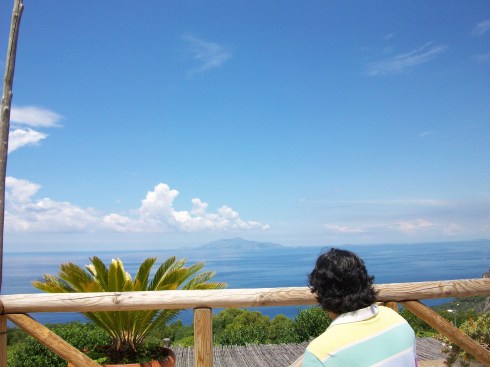 I’ve been on Capri for a week for work. Here are some impressions largely of Anacapri.
Hotel
We stayed at the Casamariantonia. There were four of us so we got a suite. It’s pretty pricey but actually cheaper than the hotels. The hotel is family-owned and they are pretty helpful – the father walked with us part of the way to show directions to a rustic path from Anacapri to the Blue Grotto. The grandmother makes fresh tarts for the breakfast buffet. Our room was nice and had a small kitchen. There’s a grocery store opposite so you can cook if you want to. There’s balcony where you can hang out and good air-conditioning. Two downsides: no swimming pool (they are waiting for a permit) and no WiFi in rooms (you have to go downstairs to the lobby). This is the main reason for my lack of posts!
Restaurants
Our favorite by far was Da Gelsomina (photo was taken there). They have a swimming pool too. There is hefty charge (incl for sunbeds, towels, umbrella as well as entrance) but you get a discount if you eat there and/or stay at Casamariantonia. There is the usual Capri fare, ravioli caprese, insalata caprese, pennette aumm aumm etc, and it’s all done very well. There are also dishes you do not find elsewhere (e.g. gnocchi with gorgonzola and arugula), great fried stuff as an appetizer. They make their own organic wines which are delicious. Down the road from the restaurant there are two spots with amazing views of the lighthouse and the Faroglioni, three dramatic rocks in the ocean. They also have rooms. It’s a bit out of the loop at the top of a hill but they have a free bus service to drop you off and pick you up in downtown Anacapri. Might try it next time.
At 1.4 Euros to the dollar, costs mount up. Pizza is a good standby to tighten the belt. Ristorante Arcate does good pizza. Trattoria Il Solitario does pizza and also some original pastas (e.g. paccheri with lardo and fava beans).
What to do
1. Capri Walk up to Villa Jovis, Emperor Tiberius’s old home. Now in a state of decay. Great views. Walk back into town and eat at Bar Jovis or at Da Gemma, Graham Greene’s favorite restaurant with great views over the mountain and sea. There’s a bunch of chi-chi shops if you are into that kind of thing.
2. Boat trip Splash out for the personal boat ride (around E 50 more than the sardine can version). How else would you ride through the hole in the central Faroglioni?
3. Walk to Grotta Azzurra Take nice old pedestrian walk from Anacapri, not the main road. If you get lost you can find the main road.
4. Hike: There is a great walk along the sea from one pirate watchtower to another (not suitable for young kids).
Things to watch out for: Chair lift up to top of Monte Solaro has individual seats – not good for kids. Grotta Azzurra closes when sea is choppy and there can be a long wait. Go either before tourist hordes arrive from Naples or after they leave. Incidentally, Naples is a bit overwhelming. It feels like Bombay. So be prepared!
I’ve had a couple of excellent bottles of Coltassala in the past. Definitely had to try it again. Came away it a bit disappointed. It was very heavy. Quite bitter. May have drunk it about 10 years too early in my attempt to recreate old memories. Its almost 100% Sangiovese. I’ve never liked Chianti which is also Sangiovese. I think it needs to be blended with another grape.
Whic brings me to ….Balifico which was very delicious. It’s a Cabernet/Sangiovese blend. Very smooth. Lots of fruit, deep red color.
The Chianti from Castello di Volpaia is quite easy to get hold in the States. I have found Coltassala in the past. Hope I can get hold of Balifico somehow.
As you can guess from my earlier post, I totally love Volpaia. Castello di Volpaia has a tasting room and what looks like a restaurant under construction. There are at least two other places to eat, including the wonderful Bottega. Not sure what would keep the Euros rolling in but I would love to move here. It’s a cliche.
A Slate article reports that in surveys the proportion of people who say they voted for Obama over McCain does not match the results of the election. Of course this panders to my inner economist. I’m interested in how much of the difference can be attributed to outright lying versus self-deception. An outright liar knows he is lying while credible self-deception involves some chance you actually believe the story you tell yourself.
It would be cool to have an experiment that distinguished between the two. Maybe it’s already out there?
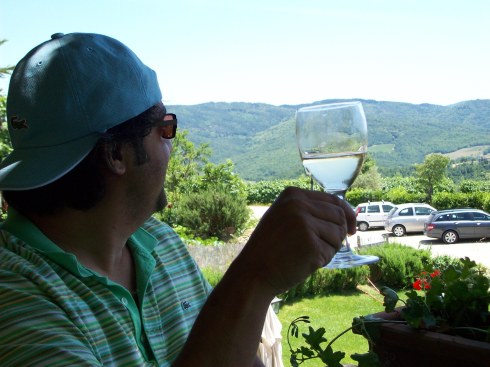 I’m visiting my sister in Tuscany on my way to a conference. She runs a cooking school, Organic Tuscany. The students are all housed in an 18th century villa near Certaldo. We’re staying here too because the villa is huge and has a swimming pool. The students seem to be having a great time. They cook from 10.30-1.30. and then eat what they made for lunch. The incentives are place to pay attention in class! In the afternoon, they go somewhere for an organized trip – today Siena, yesterday San Gimignano. My sister has set this up. I’m very impressed as I could never pull off something like this.
We didn’t want to disturb her this morning during class so we did our own disorganized trip to Volpaia. We went there ten (!) years ago before we had kids. We had a nice, semi-challenging hike to the hill-top where Volpaia sits prettily. I remember it well as my pre-made boring pecorino sandwich looked much less interesting that by wife’s finnochiana. That’s where the salami-exception to my “vegetarianism” began. The beginning of a key hypocrisy is always memorable, however many mild hypocrisies you commit daily.
I indulged the big one again at La Bottega di Volpaia where we shared a salami plate. I followed this with spectacular potato tortelli in a fresh porchini sauce. My wife enjoyed her classic ricotta ravioli in a butter and sage sauce and the kids even ate their spaghetti with pesto.
The drive up there is great too as long as your stomach can withstand the hair-raising near-crashes with Italians speeding in the other direction while hogging the middle of small, windy roads. The lunch was so good and the drive so picturesque that we might risk it again.
Iran’s political system is complex and confusing. But the basic point is that it is a form of dictatorship with Supreme Leader Khamenei in charge. The protests on the street suggest it is weaker than ever before. My research with David Lucca and Tomas Sjöström suggests regimes which are neither democracies nor dictatorships but something in between can be the most aggressive of all.
I used this idea for an opinion piece in the New York Times. Here it is:
A stolen election, and what it reveals about the security of Iran’s ruling elite, means that it is more important than ever to engage with Iran.
So far the signs from the Obama administration are encouraging: “The administration will deal with the situation we have, not what we wish it to be,” one senior official said. Let’s hope the administration understands what that situation is.
President Obama is in a difficult position. He under pressure to speak out more and take a tougher line with Iran, as Senator McCain has. But the main issue is not whether the election was stolen or not, but what it reveals about Ayatollah Khamenei’s hold on power.
If we respond with our own saber-rattling, this is more likely to inflame the situation than ever before.
Under Khamenei’s leadership, the Revolutionary Guard has become more powerful and taken over parts of the economy. The disputed election suggests that Khamanei’s position has become weaker as the public distaste for Ahmadinejad’s policies has grown. If we respond with our own saber-rattling, this is more likely to inflame the situation than ever before. A strong dictator can be passive in the face of aggression and still survive in power. But a weak dictator must respond forcibly to every threat to his rule.
The key question is whether Khamenei will ratchet up aggression to survive in power. One way to consolidate power is to win a war. If the regime’s survival is in question, it may destabilize the region and pursue nuclear weapons in a bid to consolidate internal support. A democratic leader may also try to use aggression to drum up support for re-election.
A careful study of history finds that weak dictatorships like Iran, that lie in between full democracy or strong dictatorships, can be the most warlike of all.
I might add one more point: I would love for the Obama administration to “help the demonstrators” somehow. But making a statement in their support will backfire as it will give an excuse to display demonstrations as American sponsored. Iranian TV can just run footage of Obama making the statement, translate it and interpret it in a biased way and literally beat protesters over the head with it.
Much as I’d like to rationalize alcohol consumption, it seems the studies showing moderate drinking leads to better health have the usual problem according to the New York Times:
No study….. has ever proved a causal relationship between moderate drinking and lower risk of death — only that the two often go together. It may be that moderate drinking is just something healthy people tend to do, not something that makes people healthy.
Health economics might provide a treasure trove for economists well-versed in the techniques of “instrumental variables” typically used to determine causation.
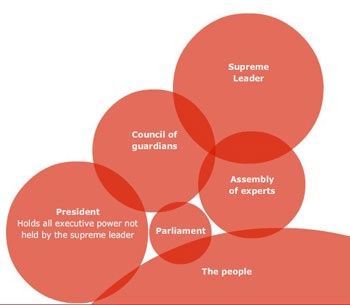
Iran is clearly not a full democracy like the United States – there is a Supreme Leader, currently Ayatollah Khamenei, who controls foreign and nuclear policy and is not subject to general election. There is a President who is (or was?) elected and controls domestic policy. There is a council, the Assembly of Experts, that ostensibly determines who is Supreme Leader. However, they have never acted to remove anyone! Moreover, the Supreme Leader via the Guardian Council can veto candidates who stand for election for President or the Assembly of Experts! Confused? I am. But here are three excellent depictions of the political systems.
– Jeff found this one
– The prettiest but most confusing is from the UK Guardian news paper, above.
Once you work it all out it boils down to one thing – Khamenei is the man in charge and always has been (Ahmadinejad is more colorful and has a bigger press presence but he is just the face of the regime).
What is still not clear is whether the election was stolen removing even the veneer of democracy or whether there is a vocal minority in Tehran that does not support Ahmadinejad but Ahmadinejad actually won.
In the past, Khamenei has managed to live with a reformist President, Ayatollah Khatami, by sabotaging his policies behind the scenes. If he can no longer do that and is behind the stolen election, it means Khamenei is weaker than before. Weak dictators or even democratic leaders with a weak hold on power do crazier things that a strong dictator because they need some support, e.g. from the army, to survive in power. Starting a war is one way to try to generate enough support to survive. (E.g. Galtieri in Argentina). Drumming up popular hatred of an enemy the country must oppose is another related strategy. So if Khamenei is weaker than before, Iran just got more dangerous. This means Obama must not give Khamenei/Ahmadinejad an excuse to increase their hold on power by taking bellicose actions that allow them to weaken internal opposition. For example, making pro-democracy statements can be made to seem like outside interference. This will lead to people “rallying around the flag” and hence lead to less chance of democracy flowering.
Obama does seem to be keeping a low profile so far. Let’s wait and see what happens.

Suspicious graph of Ahmadinejad’s vote share? No, says Nate Silver
An excellent analysis from a former National Security Council member.
Where did I find all these? Huffington Post.
David Pogue does not call it demand elasticity but that is what he’s talking about when he explains why Apple is selling it’s new OS upgrade for $29 rather than the usual $130:
The App Store Effect says this: if you cut a software program’s price in half, you sell far more than twice as many copies.
If he had only said something like this ten weeks ago, I would have had a great example for class!
Apple always claimed its computers were better than PCs. Yet, PCs became ubiquitous and Apple’s share of the computer market is small.
Q: Why did the supposedly inferior product win out?
A: Network effects. PCs became cheap, Microsoft let developers loose on its operating system and so there are more useful applications available for the PC than Apple. Steve Jobs did not want to let developers have control over his product and his product withered away as a result.
Apple has learned its lesson this time around with the iPhone. Apps take the phone to a different level. I can’t survive without my G-Park app that tells me where I parked my car in the vast array of Northwestern carparks. I let my kids play JellyCar to distract them when we’re on a long trip. As Slate puts it, the irony is that the network effects that killed the Apple computer make the iPhone impregnable:
For years, Apple fans claimed that the company made the best PCs in the world, hands down. Nevertheless, it was hard to argue with the fact that Windows PCs simply ran more programs. Now Apple is in the position once occupied by Microsoft. Over the next few years, Palm, Research in Motion, Nokia, Sony, and others are sure to create some transcendent mobile devices. But the hardware hardly matters anymore. How is anyone going to compete with all these amazing apps?
For coffee, Peet’s for me. Better coffee, fewer people (at least in Evanston), and for us in the Midwest, a wistful San Fran ambiance at the height of winter.
Apparently, Zagat‘s readers disagree rating even Dunkin Donuts over Peet’s. Nate Silver at fivethirtyeight solves the mystery: Zagat’s counts an “abstain” vote for Peet’s as a “zero” rating from a 0-3 rating scale. What happens in a binary election where abstainers are eliminated?
I wish Peet’s had the Greek yogurt I get from Starbucks. Then, I would face no dilemma in the morning.
According to the New York Times:
Mr. Obama answered a question about “dealing with the hawks in the current Israeli government,” by suggesting that Israel’s new, conservative prime minister, Benjamin Netanyahu, might have an opportunity to play a more constructive role than a more liberal leader:
I believe that Prime Minister Netanyahu will recognize the strategic need to deal with this issue. And that in some ways he may have an opportunity that a labor or more left leader might not have. There’s the famous example of Richard Nixon going to China. A Democrat couldn’t have gone to China. A liberal couldn’t have gone to China. But a big, anti-communist like Richard Nixon could open that door. Now, it’s conceivable that Prime Minister Netanyahu can play that same role.
This is the essence of Cukierman and Tomassi’s “Why does it take a Nixon to go to China?” American Economic Review, Mar. 1998, pp. 180-197. Suppose a political knows the “state of the world” and the policy that most voters would support. But voters do not have this information. They cannot tell whether a policy is suggested by a politician because it is the ideal policy for the state of the world or because he has a bias for it. Then, a right-wing politician is more likely to implement a extreme left-wing policy. Voters are likely to believe it is the “right” policy as he is voting against his natural bias. He is then rewarded by being re-elected. Hopefully, there is no Watergate on the horizon for Netanyahu.
Greg Mankiw thinks B-School economists are “practical” and “empirical” while Econ Dept economists are free to be abstract and theoretical.
I don’t think this is true for the research done by economists differs across these two types of schools but it is true that the teaching is different. The MEDS Dept at Kellogg where I work is somewhat different from other business schools as it has always been very theory focused. The Econ group at Stanford GSB is similar. Some of the best work in game theory, contract theory and decision theory came out of these departments.
It is the case, as Mankiw says, that teaching has to be practical and useful in a B School. Whether that drives research or not depends on the philosophy of the school. I have never felt any pressure for my research to be practical.
Mankiw writes his post to answer David Brooks’s query about why B School economists are giving him better answers about the current state of the economy. As finance is a B School specialty, it very natural that B schools profs may know more about what a CDS is without having to look it up on Wikipedia! But again, finance economists are not more “practical” or “empirical” than econ dept economists. I bet Doug Diamond and Milt Harris at Chicago GSB have really perceptive things to say about the financial crisis as has Oliver Hart at Harvard Econ. They will use simple, clear models (hopefully!), to explain their ideas about how to fix incentives in the financial sector. And then maybe somone will give a little theory a chance as much as data analysis!
 Cheap Talk
