
You are currently browsing Sandeep Baliga’s articles.
1. Possible future Prime Minister and Chancellor of Exchequer of Britain in earlier days. A Who’s Who for the David Cameron photo.
2. Of course, it’s hard to join the Bullingdon Club. But you can approximate their social and dress codes (y-updated).
See this interesting new approach to MBA teaching. Here is an interesting novel approach by a new school in Moscow and the associated Times story:
New York Times, April 1, B1
MBA students pay high fees, leave the job market for two years and lose income and face the stress of getting a job when they’re done. Why?
The value added from an MBA must be high. Where does it come from? The teaching, the professors, the exams and grades. All that value has to be substantial. But undoubtedly, another huge part of the value comes from meeting other like-minded, smart, beautiful, go-getting people.
But the value of networking can be generated without a bricks-and-mortals B School. At least this is the bet taken by a budding education entrepreneur, Anton Napolitanokich, based in Moscow.
“Leading B Schools in the US and Europe are not going to risk their reputation by going digital,” said Napolitanokich. “And nor are great students in those regions going to give up the brand reputation that a HBS degree gives you to do something risky. But here in Moscow, there is little competition and a more amenable market. The Virtual MBA is the future of business education”
Napolitanokich’s business model is based on social networking websites like Facebook and as well pure, old-fashioned “networking” in nightclubs! “MBA students are in constant wireless contact already. All they need is someone to screen the group they interact with. That’s the key to what the traditional bricks and mortar B Schools do and we will replicate that. Of course we are total unknowns right now. So, we will do an excellent job letting in great students in our first round. We will let them in for free to prime the pump. If it works out, everyone will want to interact with our star students. In the next rounds, we will auction off entry into this select group It is kind of like a nightclub: you let in the good-looking people for free and then wait for everyone else to line up to get in. Of course, we can’t let in everyone – we have to maintain a high quality pool. So, we’ll restrict the number of spots and let the bidding takeoff! If it works, the price will be even higher than a traditional MBA! Go to www.virtualmba.com and apply for admission right away! It’s the future – even Sergey Brin is interested in the idea. He’s from Moscow you know. Brin ses we are the new Amazon and they are the old Barnes and Noble”
But what will the students actually be doing? Napolitanokich envisages that students will play interactive business games. The point of the games is more to get the students to get to know each other, establish networks and friendships. In a business coup, Napolitanokich has partnered with Disney to produce interactive business games. Disney’s Club Penguin website has been a huge hit with the elementary school set. Kids get to choose an avatar in penguin form to play interactive video games and hang out with other avatar penguins in chat rooms. Napolitanokich envisages a similar scenario for the b school games. Preppy J Crew wearing MBA avatars will engage in strategic competition, negotiation and marketing and have time to relax in virtual bars and restaurants. Disney finds the model every promising and hopes to create connecting sites all the way from Club Penguin up the age ladder to Virtual MBA, training budding entrepreneurs in high school.
Of course, only so much can be achieved by networking remotely. Actual face-to-face communication is vital too. Napolitanokich envisages intense live-in weeks where flocks of virtual MBAs fly in to isolated resort locations for intense interactive teaching sessions. So, some professors are inescapable he admits. But they will be a new breed of hyper-profs, flying in and out for short trips, living everywhere and nowhere. Ciphers who facilitate and coordinate student-student interaction but otherwise get out of the way. The still young century welcomes a new model for education.
Hope it does not work out for Anton, otherwise I’m out of a job!
President Obama has used the Congressional recess to appoint Paul Krugman as Vice Chairman of the Federal Reserve system.
Obama spent the first year in office wooing centrists like Olympia Snowe. That strategy slowed down his reform agenda and did not pay off. The President had to rely on old hardball Chicago politics to pass healthcare reform. He has realized his hope of appealing to the center of the political spectrum is futile. And in any case, it’s the diehard party faithful that decide midterm elections. What better way to energize the base than by appointing their hero, the self-styled conscience of liberalism and economics Nobel Prize winner, Paul Krugman, to the Federal Reserve?
Krugman stands no chance of getting the 60 votes required to survive the usual Senate confirmation process. As his appointment has no direct impact on the budget, the arcane procedure known as “reconciliation”, that requires only a simple majority, cannot be used to give him an up and down confirmation vote. Ironically, Krugman will have a huge impact on the budget as he favors expansionary monetary and fiscal policy in recessions. A perpetually gloomy forecaster, Krugman almost always believes a recession is round the corner and for all practical purposes favors large budget deficits all the time. Even if reconciliation could be used, with moderate Democrats against him, it is not clear that Krugman could draw 50 votes. So, a recess appointment was the only possible strategy for Obama.
This is obviously a dangerous move for the President. He is used to hiding his liberal agenda behind the fig-leaf of bipartisanship. With the leaf removed, he feels naked and vulnerable. Obama has gambled that the extreme left must be brought out to retain the Democrats’ hold on Congress. With the Krugman appointment as a flashpoint, Obama risks losing moderates and perversely provoking the extreme right to turn out and vote.
The benefits and risks for Obama are clear but what’s in it for Krugman? He has long wanted to get his hands on the levers of economic policy. But at what cost? He will have to step down from his sinecure as a Times’ columnist. He will have to mothball his textbook, as Ben Bernanke did before him. Most of all, he may regret the demise of the speaking engagements that have helped to bankroll his many houses and apartments in America and beyond. A favorite of the Hollywood glitterati – Ben Affleck is a close friend – Krugman will now have to give up the organic-chicken-and-chardonnay circuit and attend regular Fed meetings in Washington D.C. A dream for a regular economist but perhaps a letdown for a media star like Krugman. Of course as a recess appointee, Krugman can only serve until the next Congress is seated – maybe that is just the right amount of time for him to substitute Ben Bernanke for Ben Affleck in his speed dial.
All in all, an intriguing appointment for all parties concerned.
The more students use technology to do homework, the more they cheat:
In surveys, he asked students if they viewed bringing a cheat sheet to an exam as cheating. Most did. Then he asked the same students whether they would consider it cheating to bring a graphing calculator with equations secretly stored on it. Many said no, that wasn’t cheating.
“I call it ‘technological detachment phenomenon,'” he told me recently. “As long as there’s some technology between me and the action, then I’m not culpable for the action.” By that logic, if someone else posted homework solutions online, what’s wrong with downloading them?
One proposal:
Make it easier for professors to handle such cases, and reform academic judicial systems to make clearer distinctions between smaller violations, like homework copying, and larger ones, like cheating on exams. And assign appropriate punishments for each.
What stops students from cheating? Social norms must play some role. Formalizing a price for allowing a decision maker to violate a norm might invalidate the norm and cause its collapse. This is the idea in an experimental paper by Gneezy and Rustichini “A Fine is a Price”. If the norm collapses, cheating may actually rise if the fine is too small. So the appropriate punishment for small infringement is large – then, even if the norm collapses, the fine alone will deter cheating on homework. Maybe a large fine for small infringements is not credible. How could a professor or a university justify a large fine for a small crime morally or even worse to an angry parent? If that is a problem, the present system, turning a blind eye to small violations, might be the best system after all.
1. Even the graffiti in the UofChicago men’s room is nerdy.
2. Markets propagate fairness as does religion.
3. Polite British potential Chancellors of the Exchequer debate on TV for the first time.
4. Tomorrow night’s dinner?
Last week, I was in line at the front desk of a condo hotel in Naples, Florida at around 9 pm. My electronic key had discharged and I needed a replacement, i.e. I already had a room.
Unlike me, the guy ahead of me was looking to rent a two bedroom but the clerk said they were all full but she could offer him a couple of one bedrooms. She has three left. The guy asked her the rate and she quoted him $269/room. He said that was too much and she asked him how much he was comfortable with paying. My guess is that as it was pretty late, it was unlikely that the rooms would be used that night so the clerk was willing to negotiate. The guy said he was willing to pay at most $200/room. The clerk said she had to ask her manager and disappeared into the back room. She came back with an offer of $239 and the guy said that was too much. The clerk was unwilling to haggle further and the guy left.
All I wanted was a new key. I was itching for the guy to leave so I could go to bed and ended up focusing on the discussion as I was hoping it would end quickly. For an economist, it was pretty fun.
First, who knew you could haggle for hotel room prices this way? A sign of the recession perhaps. Second, the “let me take your offer to my manager”, just hearkens to haggling for cars so there is a nice symmetry with that subculture of bargaining.
Finally, we see how delegation can help in certain situations. Normally, when an agent works for a principal, the principal tries to align incentives so the agent works hard on her behalf. This results in the optimality of bonuses, commissions and the like where the agent shares the profits of hard work. But sometimes it is good to commit to turn down business.
A firm with monopoly power wants to maintain a high price. Once it has made a take or leave it offer to a buyer, if the buyer rejects the offer, the firm has the incentive to cut the price to get business. Knowing this will happen, high value buyers will reject the initial offer and wait for the lower price. The firm’s market power diminishes as a result of its inability to commit not to lower prices. This is a hugely simplified version of the Coase conjecture.
But, if instead of a firm/hotel, a manager/clerk makes the offer, there is potentially a different conclusion. If the clerk does not see a share of the profits generated by the extra sale, the clerk has no incentive to cut the price. This results in some business being turned away but allows the hotel to maintain some market power. I guess something like this happened in the hotel bargaining I observed. (Perhaps the clerk is on commission to make a sale and the manager in the back room makes sure the rooms are not then just given way to get the commission?). If the clerk had the same incentives as the hotel owner, it would be bad for profits as commitment power would evaporate. Mis-aligning incentives makes more sense.
Or there is a small chance that a person observing the conversation reports it on his blog. The hotel’s reputation for maintaining high prices goes up in smoke and future sales are made at low prices. Knowing this, the hotel refuses to accept low offers and keeps its reputation intact.
You are having dinner with your child in a restaurant. He has ordered chicken tenders with fries and you force him to have a small salad before the main course arrives. In a “When Harry met Sally” moment, you ask for the fries to be brought “on the side”, i.e. on another plate.
He has a small amount of the chicken and you give him a few fries as a reward. He then claims that he is full. Is he really?
There are two states of the world, full F and hungry H. The state is known to the agent/child but the principal/parent does not know the state. The agent has private information. How does the principal work out the true state? Offer the agent another french fry. If it is accepted, the true state is H – he is truly hungry and only pretending to be full. If he refuses, it is F and the chips he had earlier filled him up. Of course you have to know your kids to determine which food product separates or screens the two states.
The first few times you try this trick, you can go a bit further. Once he has accepted the fry, you point out he must really be in state H and make him have some more chicken. In the long run, he will work out that accepting the fry leads to more chicken. He will refuse the fry and you’ll never work out if the true state is F or H. Your solution depends on bounded rationality and if learning helps to eliminate it, you are powerless in the long run. Also, if you choose the wrong food group you won’t be able to screen the two states in the first place. In our case, ice cream is always acceptable in all states while more french fries are acceptable if and only if the true state is H.
Tom Friedman is concerned that it might:
“One-party autocracy certainly has its drawbacks. But when it is led by a reasonably enlightened group of people, as China is today, it can also have great advantages. That one party can just impose the politically difficult but critically important policies needed to move a society forward in the 21st century. It is not an accident that China is committed to overtaking us in electric cars, solar power, energy efficiency, batteries, nuclear power and wind power. China’s leaders understand that in a world of exploding populations and rising emerging-market middle classes, demand for clean power and energy efficiency is going to soar. Beijing wants to make sure that it owns that industry and is ordering the policies to do that, including boosting gasoline prices, from the top down.
Our one-party democracy is worse. The fact is, on both the energy/climate legislation and health care legislation, only the Democrats are really playing. With a few notable exceptions, the Republican Party is standing, arms folded and saying “no.” “
A dictator can simply impose policies but in messy American democracy a filibuster-proof consensus has to emerge to get anything done. This is an advantage for central planning, at least if the dictator is benevolent. This is Friedman’s main idea.
But he misses a key point, the cornerstone of laissez-faire market economics: even a benevolent dictator is not omniscient and does not know what to invest in. Demand and cost information is dispersed through the economy and the dictator may invest in the wrong industry. Overproduction of tractors and shoes and underproduction of soap, the cliches of communist central planning. Market prices aggregate information and the invisible hand directs investment into the right activities. Chinese central planning might be as bad as Soviet or for that matter Indian central planning of yesteryear. So messy democracy mixed up with free markets might dominate Chinese communism. This is the flaw in Friedman’s logic.
Still, I think there is an element of truth in his conclusion if not his reasoning. As we shop in any American store, we realize how many goods are made in China. New Communism is not closed economy central planning but open economy central planning. Chinese central planners can learn what sells and what doesn’t sell by observing prices. If green products are in, the reds can easily find out the same way we can. And then can order, subsidize and simply force entry into green products. Messy American politics will have a harder time doing the same thing. American capitalists will not fight on a level playing field with Chinese “capunnists”. American innovators may come up with new products first but if they can be made cheaply in China, they won’t stay American.
So there is a chance that Chinese communism can outperform American capitalism.
(HT: Thanks to dinner companions in Princeton for listening to my random warbling and also for identifying the Friedman thesis that I use to begin this post.)
Ten Tables JP may be my number one restaurant choice for Boston. I love Sportello and Oleana. The food is equally good at all three places. But the ambience at Ten Tables is the best. It actually only has ten tables so you have to book well ahead. (They cheat a bit by having a bar but it looks a lot less cosy than the restaurant.) There’s an open kitchen so you can see the chefs at work.
My wife’s garlic soup was spectacular. My citrus panna cotta was too heavy and creamy but the radicchio salad that came with it was lovely. My ricotta pasta with maitake mushrooms was delicious and my two companions really enjoyed their chicken and steak dishes. We split a chocolate mousse and pistachio semifreddo for dessert. The wines are decently priced and I had a great barbera in my Italian wine flight.
Looking forward to going back. By the way, there is a second Ten Tables in Cambridge. The food is equally good but the service is rude and the dinner crowd is less cool. Make sure you go to the right branch.
On average, dentists are conservative Democrats. This and many other interesting facts from Adam Bonica‘s great pictorial representation of campaign contributions and occupations: 
Updated to reflect ryan’s comment below!
HT: Matt Yglesias
Amazon is trying to beat down the prices of eBooks sold on the Kindle:
Amazon appears to be responding to the Apple threat by waging a publisher-by-publisher battle, trying to keep as many books as possible out of Apple’s hands, while preserving as much flexibility as it can to set its own prices.
Apple meanwhile has signed up five of the six major publishers and is allowing them to set their own prices. Apple is taking 30% of the price for acting as the go-between. If the variable cost of producing an eBook is zero (a pretty good approximation!) then a publisher will set the same price for a book as it would if the Apple “tax” is zero – if costs are zero, the publisher maximizes revenue and the “tax” charged by Apple just cancels out of its calculation. So, Apple iPad book prices will be high and reflect monopoly power.
Amazon is taking a different approach: Sell the books for cheap, maximize volume and hence adoption of the Kindle. Two different approaches so which one is playing the eReader game better?
I’m inclined to go with Apple right now. Publishers want control over pricing and Apple is getting them on board by giving them flexibility. Amazon has been playing hardball with the same publishers:
Amazon shocked the publishing world by removing the “buy” buttons from its site for thousands of printed books from Macmillan, one of the country’s six largest publishers, in a dispute over e-book pricing.
Eventually, Amazon climbed down and let Macmillan set prices.
A consumer not only cares about the price of a book but what the range of books being sold. If Amazon isn’t getting a full selection because publishers are unhappy with its pricing policy, then you might hesitate to get a Kindle. I’m thinking particularly of students in high schools and colleges who have to get books for their classes. Electronic books are going to be cheaper than hard copies anyway, as the variable costs are lower. And it’s way more convenient to carry an eReader than heave around a bunch of textbooks. But if Macmillan textbooks are not on Kindle, you’re going to get the iPad.
So you’re not going to be able to trigger sales of the Kindle by having cheap books if your range of offerings is small. This is the danger posed by Amazon’s strategy.
In a classic article “The Problem of Dirty Hands”, the philosopher Michael Walzer offers the following scenario:
[C]onsider a politician who has seized upon a national crisis-a prolonged colonial war-to reach for power. He and his friends win office pledged to decolonization and peace; they are honestly committed to both, though not without some sense of the advantages of the commitment. In any case, they have no responsibility for the war; they have steadfastly opposed it. Immediately, the politician goes off to the colonial capital to open negotiations with the rebels. But the capital is in the grip of a terrorist campaign, and the first decision the new leader faces is this: he is asked to authorize the torture of a captured rebel leader who knows or probably knows the location of a number of bombs hidden in apartment buildings around the city, set to go off within the next twenty- four hours. He orders the man tortured, convinced that he must do so for the sake of the people who might otherwise die in the explosions- even though he believes that torture is wrong, indeed abominable, not just sometimes, but always.
Walzer concludes the politician is “right” to torture the rebel leader. I want to point out how this leads to a commitment problem for the moral politician. First, it is impossible to keep a promise to stop torturing if the rebel leader releases part of his information. Once he has supplied the information, the Walzer argument can be reapplied. The utility of saving innocent lives outweighs the costs of continuing torture so a utilitarian should continue not cease torture as he promised. Second, the rebel leader says he was not involved in the planning of the attack and does not know the details. You become convinced he is telling the truth. Then, the Walzer argument means the moral politician should stop. The leader knows nothing that will save lives in the next 24 hours and the politician abhors torture so there is no point carrying out the threat of torture.
So, the moral politician faces the two commitment problems Jeff and I have discussed in earlier posts. Walzer concludes that the moral politician should get “dirty hands” and torture the rebel leader. But what happens to this conclusion when the moral politician faces commitment problems? To be continued….
I got it for $30 on sale in a New Hampshire state liquor store. Great year for Bordeaux so I went for it.
It’s drinkable but it’s not worth it. There’s lots of oak, heavy coconut and a one dimensional, fruity taste. Not worth the money. Plenty of good stuff under $20 that’s better. Maybe it’ll get better with age?
Recommendation: Don’t buy unless you see it for less that $20.
Obama has gone “all in” with his healthcare strategy, now delaying a foreign trip to have more time to pressure House Democrats:
The president’s international trip had grown into a source of frustration among many House Democrats, who complained privately to the White House that they were being forced to take a quick vote on health care so Mr. Obama and his family could leave on a trip to Indonesia next week.
The president agreed to delay his departure from March 18 to March 21, an administration official said, in an effort to show flexibility in the final push on health care legislation. The three-day delay effectively sets a new timetable for the House vote on the measure.
He has outlined a healthcare reform plan after a year of saying it was up to Congress to come up with one. Obama has revealed his hand after months of ambiguity. It’s obvious why. The original hope was to have a bipartisan plan. By not laying down an explicit plan, he could have hoped that Republicans and Democrats came up with one together. He was playing to two audiences. One audience has rejected his message. This leaves only the Democrats. Now, he has to nail his colors to the mast to get them to pass healthcare alone using the Byrd Rule that Jeff discusses below.
Ellsberg stopped doing research years ago but someone, somewhere, is citing his classic work on “ambiguity aversion” every day. He dropped out of research to become a policy guy and worked at the Pentagon during the Vietnam War. Ellsberg became a dove as he discovered what was going on behind the scenes and leaked the Pentagon Papers. The movie about him, “The Most Dangerous Man in America”, was nominated for an Oscar in the documentary category. The camera picked him out at one point in the telecast. An interview with him can be found here (the Ellsberg segment starts 25 mins into video).
Karen Tumulty at the Time blog Swampland perceptively writes:
“the easiest choice for endangered Democrats in swing districts is to vote against the bill–but only if it passes. That’s because they need two things to happen to get re-elected this fall. They need to win independent voters (who in most recent polls, such as this one by Ipsos/McClatchy, are deeply divided on the bill). But they also need the Democratic base in their districts to be energized enough to turn out in force–something that is far less likely to happen if Barack Obama’s signature domestic initiative goes down in flames.”
Tumulty compares the scenario to an earlier vote in 1993 on the Clinton economic plan:
“It was the night of August 5, 1993, and Bill Clinton was one vote short of what he needed to get his economic plan through the House–a vote he got, when freshman Marjorie Margolies-Mezvinsky switched hers. The other side of the Chamber seemed to explode. Republicans pulled out their hankies and started waving them at her, chanting: “Bye-bye, Margie.”
Margolies-Mezvinsky learned the hard way that they were right. Her Main Line Philadelphia district was the most Republican-leaning of any represented by a Democrat in Congress. She had sealed her fate:
During her campaign, she had promised not to raise taxes, and the budget proposed a hike in federal taxes, including a gasoline tax. On the day of the vote, she appeared on television and told her constituents that she was against the budget. Minutes before the vote, however, on August 5, 1993, President Clinton called to ask Margolies-Mezvinsky to support the measure. She told him that only if it was the deciding vote—in this case, the 218th yea—would she support the measure. “I wasn’t going to do it at 217. I wasn’t going to do it at 219. Only at 218, or I was voting against it,” she recalled.11 She also extracted a promise from Clinton that if she did have to vote for the budget package, that he would attend a conference in her district dedicated to reducing the budget deficit. He agreed (and later fulfilled the pledge). Nevertheless, Margolies-Mezvinsky told Clinton “I think I’m falling on a political sword on this one.”
Tumulty suggests the underlying game is the Prisoner’s Dilemma. Some of her commenters suggest the game is similar to the free-rider problem in provision of public goods. The free-rider problem is very similar to a Prisoner’s Dilemma so really the commenters are echoing her interpretation though they may not realize it.
I claim the interesting version of the game for Democratic Representatives in conservative districts is Chicken. Two cars race towards each other on a road. Each driver can swerve out of the way or drive straight. If one swerves while the other does not, the former loses and the latter wins. If neither swerves, there is a terrible crash. If both swerve, both lose. A variant on this game is immortalized in the James Dean movie “Rebel without a Cause”.
According to Tumulty, Democratic Representatives in conservative districts want to have their cake and eat it: they need healthcare reform to pass to get Democratic turnout but they want to vote against it to keep independents happy. The strategic incentives are easy to figure out in two scenarios. First, suppose the bill is going down however the Rep votes as it does not have enough votes. Then, this Rep should vote against it – at least they get the independents in their district. Second, suppose the bill is going to pass however the Rep votes – they should vote against via the Tumulty logic.
The third scenario is ambiguous. Suppose a Rep’s vote is pivotal so the reform passes if and only if she votes for it. At the present count with retiring Reps, Pelosi needs 216 votes to pass the Senate bill in the House so a Rep is pivotal if there are 215 votes and her vote is the only way the bill will pass. Margie M-M was in this position in 1993. There are two possibilities in the third scenario. In the first, the Rep wants to vote against the bill even when she is pivotal as she is focused on the independent vote. This means she has a dominant strategy to vote against it the bill.
This case is strategically uninteresting and, as in the Margie case, it is implausible for all the undecideds to have a dominant strategy of this form. So let’s turn to the second possibility – many undecideds Rep wants to vote for the bill if they are pivotal. This generates Chicken. If none of the conservative Democratic Reps vote for it, the bill goes down and its a disaster as Democratic voters do not turn out. This is like cars crashing into each other in Chicken. Your ideal though is if someone else votes for it (i.e swerves) in the pivotal scenario and you can sit on the sidelines and vote against it (drive straight). There is a “free-rider” problem in this game as in the Prisoner’s Dilemma. But there is a coördination element too – if you are the pivotal voter you do want to vote for the bill.
Chicken has asymmetric equilibria where one player always swerves and the other drives straight. This corresponds to the case where the conservative Democrats know which of them will fall on their swords and vote for the bill and the rest of them can then vote against it. This is the best equilibrium for Obama as the Senate Bill definitely passes the House. But there is a symmetric equilibrium where each conservative Rep’s strategy is uncertain. They might vote for it, they might not. There is no implicit or explicit coördination among the voters in this equilibrium. This equilibrium is bad for Obama. Sometimes lots of people vote for the bill and it passes with excess votes. But sometimes it fails.
There is lots of strategy involved in trying to influence which equilibrium is played. And there’s lots of strategy among the Reps themselves to generate coordination. If you can commit not to vote for the bill, Obama and Pelosi are not going to twist your arm and they’ll focus on the lower-hanging fruit. Commitment is hard. You can make speeches in your district saying you’ll never vote for the bill. Margie M-M did this but a call from the President persuaded her to flip anyway. Republicans are going to emphasize the size of the independent vote to convince the undecideds that they have a dominant strategy to vote against the bill. And the President is going to hint he’s not going to help you in your re-election campaign if you vote against the bill. Etc., etc.
So, if the Senate bill is finally voted on, as we creep up to 200 votes or so, we’ll see Chicken played in the House. We’ll see who lays an egg.
1. How can Obama/Senate commit to push reconciliation if the House passes the Senate Bill? Jonathan Chait gets reputation/repeated games:
Why would Obama and the Senate nakedly double cross the House? It would mean never being able to pass a piece of legislation again. The reputations of the double-crossers would be destroyed, both inside Washington and, to a lesser extent, nationally. No remotely rational politician, no matter how evil, would do something like that.
2. Q: Does frequent use of Purell reduce flu? A: Get a flu shot.
3. Tiger’s got wood.
The primary rationale for tenure is academic freedom. A researcher may want to pursue an agenda which is revolutionary or offensive to Deans, students, colleagues, the public at large etc. However, the agenda may be valuable and in the end dramatically add to the stock of knowledge. The paradigmic example is Galileo who was persecuted for his theory that the Sun is at the center of our planetary system and not the Earth. Galileo spent the end of his life under house arrest. Einstein considered Galileo the father of modern science. Tenure would now grant Galileo the freedom to pursue his ideas without threat of persecution.
From the profound to the more prosaic: the economic approach to tenure. For economists, tenure is simply another contract or institution and we may ask, when is tenure the optimal contract? My favorite answer to this question is given by Lorne Carmichael’s “Incentives in Academics: Why Is There Tenure?” Journal of Political Economy (1996).
Suppose a university is a research university that maximizes the total quality of research. Let’s compare it to a basketball team that wants to maximize the number of wins. Universities want to hire top researchers and basketball teams want to hire great players. Universities use tenure as their optimal contract but basketball teams do not. Why the difference?
On the basketball side of things it’s pretty obvious. Statistics can help to reveal the quality of a player and you can use the data to distinguish a good player from a bad player. And this can inform your hiring and retention decisions.
On the research side, things are more complicated. Statistics are harder to come by and interpret. On Amazon, Britney Spears’ “The Singles Collection” is #923 in Music while Glenn Gould’s “A State of Wonder: the Complete Goldberg Variations” is #3417. Even if we go down to subcategories, Britney is #11 in Teen Pop and Glenn is #56 in Classical.
So, is Britney’s stuff better than Bach, as interpreted by Glenn Gould? I love “Oops..I did it Again”, but I am forced to admit that others may find Britney’s work to be facile while there is timeless depth to Bach that Britney can’t match.
I’ve tried to offer an example which is fun, but it is also a bit misleading as the analogy with scientific research is flawed. First, music is for everyone, while scientific research is specialized. Second, there is an experimental method in science so it is not purely subjective. But the main point is there is a subjective component to evaluating research and hence job candidates in science. There is less of this in basketball. Shaq is less elegant than Jordan but he gets the job done nonetheless. The subjective component actually matters a lot in science because of the specialization. Scientists are better placed to determine if an experiment or theory in their field is incorrect, original or important. And they are better placed to make hiring decisions, when even noisy signals of publications and citations are not available.
Subjective evaluation is the starting point of Carmichael’s model of tenure. If you are stuck with subjective evaluation, the people who know a hiring candidate’s quality best are people in the department that is hiring him. If the evaluators are not tenured, they will compete with the new employee in the future. If the evaluators hire who is higher quality than they are themselves, they are more likely to get sacked than the person they hire. In fact, the evaluators have the incentive to hire bad researchers so they are secure in their job. This reduces the quality of research coming out of the university. On the other hand, if the evaluator is tenured, their job is secure and this increases their incentive to be honest about candidate quality and leads to better hiring. If there are objective signals as in sport, there is less need for subjective evaluation and hence no need for tenure.
This is the crux of the idea. It is patronizing for anyone to impose their tastes of Britney vs Bach on others. Everyone’s opinion is equally valid. It is possible to say Scottie Pippin was a worse basketball player than Jordan – the data prove it. Science is somewhere in between. There is both an objective component and a subjective component. We then have to rely on experts. Then, the experts may have to be tenured.
The Times reports that:
Couples who live together before they get married are less likely to stay married, a new study has found….The likelihood that a marriage would last for a decade or more decreased by six percentage points if the couple had cohabited first..
Obvious conclusion: Don’t live together before you get married, if you want to stay married.
But this is another one of those “correlation does not imply causation” posts. Here are two interpretations that do not imply the obvious conclusion.
First, suppose one partner is reluctant to get married and has doubts about the relationship. More information would be helpful to decide whether to stay together or break up. If the couple cohabit, that will give them valuable information. On the other hand, couples who are more confident about their relationship are more likely to get married straight away. Hence, more stable couples are less likely to live together before marriage than less stable couples. Living together per se is not the problem. The real problem is that a deeper source of instability is correlated with cohabitation.
Second – and this theory is implicit in the research – more religious couples are less likely to get divorced and less likely to live together before marriage. Again, selection explains the data and not cohabiting per se.
The empirical results are interesting but you can carry on living in sin without worrying that this is going to lead to the collapse of your marriage. That may happen but it’s because you really hate each other and religion is not providing the glue to keep you together.
1. The great tomato paste rip-off
2. Taliban/Pakistan strategy: Try not to be so sweet as to get eaten and not so bitter as to get spat out.
Via the Times:
Amazon has been pushing publishers to sign a new round of legal agreements that would guarantee that the Kindle price for their content is always the same or lower than the price on other electronic reading devices, such as the iPad or the Sony Reader. The clause, a variation of a legal concept known as “most favored nation,” would guarantee that Amazon’s customers would always get the best price for electronic versions of magazines, newspapers and books.
If publishers accept Amazon’s contract, what impact does it have on prices of books purchased for the iPad or the Sony Reader? In the existing regime, if Apple negotiates low prices for books, it can undercut Kindle prices for the same books. This makes the iPad more attractive vs the Kindle and stimulates sales of the iPad and profits for Apple. In the new regime (i.e. if publishers accept Amazon’s terms), Apple can no longer undercut Kindle book prices as any price cut they negotiate is automatically passed on to Kindle consumers. Apple has less incentive to negotiate low prices with publishers and publishers have more incentive not to give in. An eBook price war is less likely with Amazon’s policy and consumers are going to see less competition on this dimension not more.
Publishers are complaining that Kindle book prices are too low. They are presumably worried that the Amazon deal is bad for them. But I suggest it is actually good if current prices are really too low as they claim. So they should sign it.
Is it good for Amazon? Higher prices for eBooks will slow down adoption of eReaders. But if prices of eBooks increase and their revenue sharing agreement is generous, there may be more revenue from sales of content. So the net effect depends on how much money Amazon will make off hardware versus the slice of revenue they’ll get from sales of content. And it’s not at all clear that this goes the right way for Amazon. If it goes the wrong way, in a bid to sell more Kindles, the obvious strategy is to cut the price of hardware. Then, the publishers will be even happier they signed the contract with Amazon!
This is one possible scenario. With an industry and technology that is changing rapidly, there are many others. Still, did Amazon think through all this? It’s hard for an outsider to gauge. Iran has recently moved nuclear fuel to an overground facility, within easy reach of Israeli bombs. The theories for Iran’s counterintuitive strategic move range from the “wow, they’re so sneaky and strategic” to the “duh, they did what?!”. Interpretations of Amazon’s move fall into same categories.
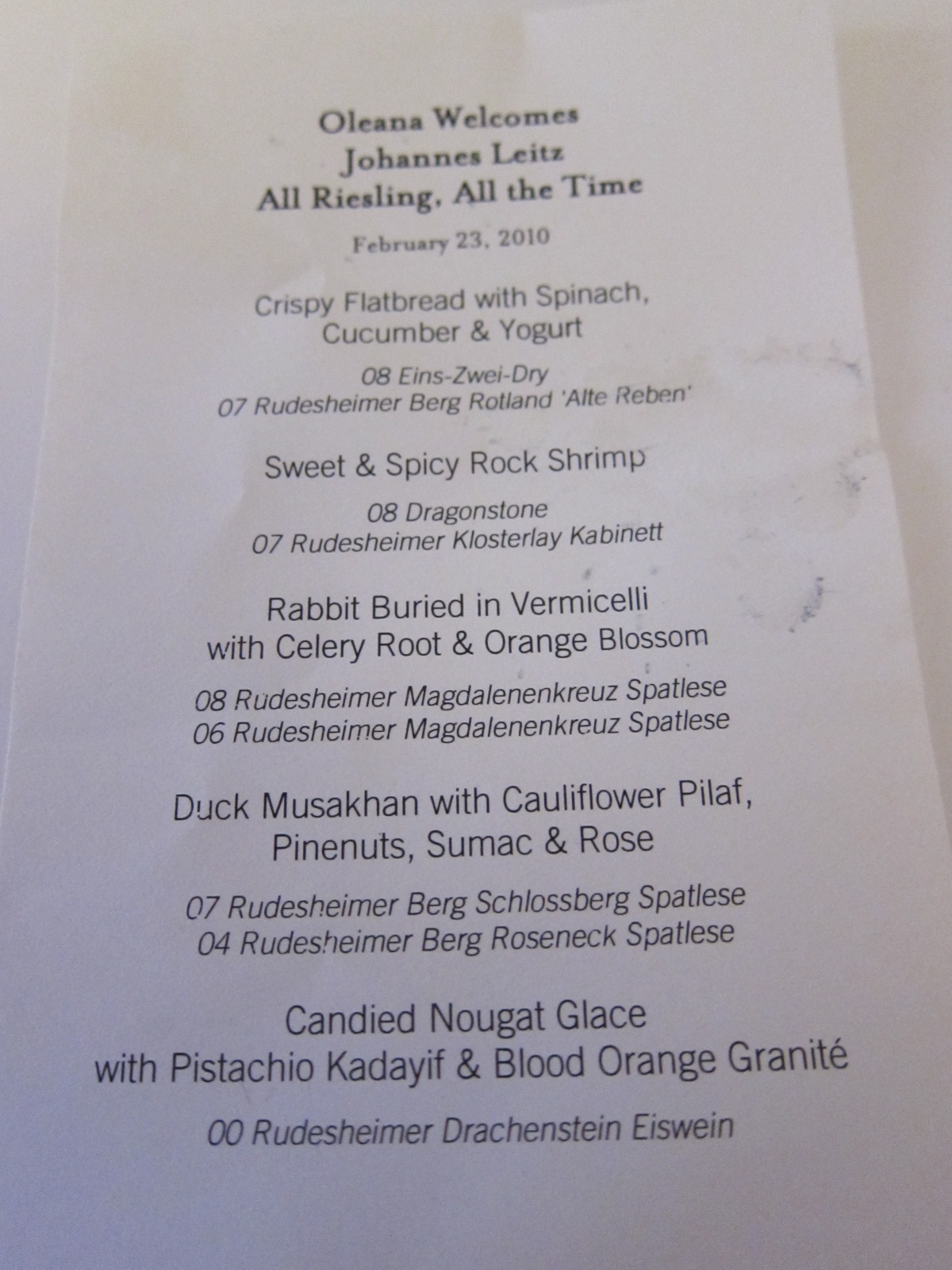
Our favorites were Eins-Zwei-Dry and the 06 Magdalenenkreuz Spatlese. Riesling is a great food wine. The main flavor in the food cancels out the corresponding flavor in the wine so you taste different dimensions with each bite/sip. For instance, I had a Riesling recently with a dish that included a cheesy potato gallette and stewed prunes. The potato brought out the sweetness and the prunes the dryness. Hoping to experiment a bit more with them as there are many categories (Kabinett, Spatlese etc.) which correspond to different densities of the grape (!) and other variables. And the categories correspond to different flavors and sweetness.
I find curling soothing and otherworldly, a sport that Hobbits might play rather than real people. It turns out my new passion is shared by Wall Street traders. Some links:
1. History
2. Basic and Advanced Strategy
3. Want to learn in Boston area? Try the Broomstones Curling Club.
Harold Pollack at the New Republic blog The Treatment has an interesting comparative historical analysis of the current push to include the “public option” in the health bill via reconciliation and a famous vote in 1956 on a House bill to extend federal aid to states to build schools:
The bill would have provided federal aid to the states to build schools. Democrats sponsored the bill, which was popular ten years into the baby boom. For familiar pre-election reasons, Republicans wanted HR7535 to die. They got lucky when Harlem Congressman Adam Clayton Powell dropped a hand grenade into the process by proposed an amendment mandating that grants could only be used by states with schools “open to all children without regard to race in conformity with the requirements of the United States Supreme Court decisions.” Urban liberals could hardly oppose this amendment. Yet its inclusion would doom the final bill by driving away critical southern Democratic votes.
The inclusion of the Powell amendment killed the whole bill. Pollack thinks that the inclusion of the public option would kill the health bill and hence Rockefeller and Obama do not want it included in the reconciliation process. There are many theories for why Powell offered his amendment. He could see that it would cause the collapse of the bill. In the process, it would reveal the hypocrisy of the Democratic leadership of the House and that, to him, was a greater goal than building more schools in the short run. There is no greater goal, like civil rights, at stake in the current health reform so Pollack has a point in suggesting the progressives’ strategy is short-sighted not far-sighted.
Continuing our trade theme, in honor of Krugman’s profile in the New Yorker, an old Krugman song –
My parents are visiting from England. My father arrived with a loose molar which had to be removed. We do not know good dentists in the area and my father does not have American dental insurance. We settled on TUFTS Medical School’s Emergency Dental Center for the extraction. Three and a half hours later we were out of there, leaving one molar and $180 dollars in our wake.
My father thinks he now needs an implant so I quickly checked out options:
1. A New York Times ad offered an implant for $1000 (not including the crown).
2. In the U.K. it costs about the same.
3. Given the high prices in the U.K. and U.S., an attractive option is to go to Hungary. A quick search suggested a price of $700 for an implant. So, you can go to Budapest for a bit of a holiday and get your grotty teeth dealt with at the same time.
Why is Hungary so cheap? One nice thing about trade in dentists services is that it largely must be one way: Hungarians aren’t going to Britain to go to dentists! This makes it different from other products like cars which countries export and import simultaneously. This is hard to explain with traditional trade theory. The traditional theory should be adequate for trade in dental services though. Ricardian trade theory suggests differences in technology drive trade patterns. Is that the explanation? Heckscher-Olin’s theory of trade instead assumes technology is the same across countries and differences in endowments drive trade patterns. Is the endowment of dentists large in Hungary? At this point, I’m stuck.
A great random find. Purchased tax free at a New Hampshire state liqour store. Cabernet based Bordeaux from a great vintage and drunk young. Velvety and rich on the palette. Cherry as well as the ubiquitous blackberry. Pepper and celery at the end. Around $25. I’m going to buy it up if I can find it again.
India has proposed a new round of talks with Pakistan. The last meaningful talks in 2007 led to a thawing of relations and real progress till everything was brought to a grinding halt by the terrorist attacks in Mumbai.
What are the payoffs and incentives for the two countries? David Ignatius ar the Washington Post offers this analysis:
“The India-Pakistan standoff is like one of those game-theory puzzles where both nations would be better off if they could overcome suspicions and cooperate — in this case, by helping the United States to stabilize the tinderbox of Afghanistan. If Indian leaders meet this challenge, they could open a new era in South Asia; if not, they may watch Pakistan and Afghanistan sink deeper into chaos, and pay the price later.”
The quote offers a theory for how India might gain from peace but what about Pakistan? Pakistan cannot be treated as a unitary actor. Some part of the elite and perhaps even the general population may gain from an easing of tension and a permanent peace with India. But the Pakistani military has quite different interests. The military dominate Pakistan politically and economically. Their rationale for resources, power and prestige relies on perpetual war not perpetual peace. Sabotage is a better strategy for them than cooperation with India. The underlying game is not the Prisoner’s Dilemma.
Military payoffs have to be aligned with economic payoffs to encourage cooperation. Economic growth can also generate the surplus to bankroll a bigger army. A poor country needs the threat of war to divert valuable resources into defense. But a rich country does not.
1. Long arm of the Mossad – a brief history and a longer one.
2. The quality of suicide bombers is declining in Afghanistan. Perhaps it is because:
The martyrdom testament videos that are so common in other countries are unknown here. “Such individual recognition,” said the United Nations report, “is largely absent in Afghanistan.” Instead, these suicide bombers are buried secretly at a potter’s field in a wasteland at the foot of a mountain, at Kol-e-Hashmat Khan, a neighborhood of junkyards on the outskirts of Kabul. A policeman on duty there said no one ever visited. Many of the unmarked graves have been dug open by starving dogs, which feast on the remains.
1. How did Obama lose his groove? May require free registration at FT
 Cheap Talk