
You are currently browsing Sandeep Baliga’s articles.
Sean left an interesting comment on my earlier post which got me thinking: If Springsteen does not price discriminate ticket sales, the resale market will do it for him, charging high prices for rationed tickets and getting surplus from high willingness to pay consumers. So, even if Bruce wants to sell tickets for cheap to his fans, the fans get screwed by the scalpers. Then, Bruce should come up with some other way to help his blue collar fans. One way would be to price-discriminate like a profit-maximizer and then give refunds to loyal fans. Maybe, you can use your fan club to give refunds to members who attend your concert or something of that ilk. And fans might even prefer giving money to Bruce than to scalpers: after all they’re probably pirating all his albums and concerts are his main source of revenue!
So, the prevalence of the resale market is puzzling: why don’t bands, plays etc simply price optimally and eliminate the scalpers? I looked for some research on this and found a paper by Pascal Courty, “Some Economics of Ticket Resale“. His theory has two parts: (Part 1) Suppose some people only realize over time whether they are free to attend a concert while other diehard fans know immediately. At the time you set ticket prices, the late bloomers do not yet know their demand. If you price too high the diehard fans will not buy as they can’t afford it. The late-blooming consumers won’t buy as they’re not yet sure they can attend. So, the promoter prices low and diehard fans and scalpers buy tickets. As time goes buy the late bloomers who are free to attend the concert demand tickets and scalpers rip them off. (Part 2) Scalpers are always more flexible than promoters. If promoters attempt to enter the late-blooming market, scalpers can always undercut them.
And there is some empirical work too. Connolly and Krueger in Rockonomics present data on ticket pricing and on Krueger’s experience at a Springsteen concert.
If You Give Love a Bad Name and adore Bon Jovi, you can pay for Coming up Close. Love Hurts: It’ll cost you to $1750 for a front-row seat, a seat that you can literally take home. People may say you’re crazy, but you’re not the only one:
“It’s probably the biggest negotiation in any tour deal,” said Randy Phillips, the chief executive of AEG Live, promoter of the Bon Jovi tour. “On a hot act you can make as much money from 10 percent of the house as the other 90.”
Some fans will say “You Broke My Heart in Seventeen Places“:
“The artists are just gouging their fan base,” said Terrell Lowe, 49, a brewery sales executive and an avid concertgoer in San Francisco. “The majority of people just can’t afford that.”
Bruce Springsteen doesn’t want fans like Lowe to be left Dancing in the Dark so his tour last year had a maximum ticket price of $98. Is Bruce doing right by his blue collar fans by setting this maximum price?
This is a classic question in monopoly pricing, comparing a price which averages over many types of consumers (a “uniform” price) with price-discrimination. Let’s just look at the welfare of the fans and keep Bruce’s profits out of the calculation – his wealth and his preferences over pricing suggest he’s happy as long as the tour makes more than some lower bound. So consider a move from uniform or near uniform pricing to price discrimination. Some people who were paying $98 before and getting good seats won’t be able to get them for that little any more. If they pay more for roughly the same seat or buy cheaper seats as they can’t afford the high prices, they will be worse off.
But there is another effect. The $98 price is paid by high willingness-to-pay (WTP) and medium-willingness-to-pay consumers. If you the price little lower, you may sell more but you’ll lose margin on the high WTP consumers. So, you keep the price high. With price discrimination, you can charge different prices to the two groups, a high price for the high WTP and a medium price for medium WTP. You can cut the price for medium WTP without hurting your margin on the high WTP as they are buying a different class of seat. (Caveat: you have to set up your pricing/seat quality ratios cleverly to minimize switching between classes!) So, some medium WTP consumers will be better off. They are happy getting slightly worse seats for a lower price.
In fact, this argument applies for all consumers classes that are now pooled at the compressed pricing scheme. If you can fine-tune pricing and target it, some consumers will lose but some will gain. The ones who gain will be price-sensitive so it pays to cut prices to get volume. And price-sensitive consumers are more likely to be low income, precisely the consumers the Boss wants to subsidize.
So, Bruce, do some V.I.P. pricing and give me some free tickets for advising you how to help your neediest fans.
On the way from Brookline to Central Square in Cambridge to go to Toscanini’s, we turned on Hampton St to avoid roadwork and found the Myerson Tooth Corporation:
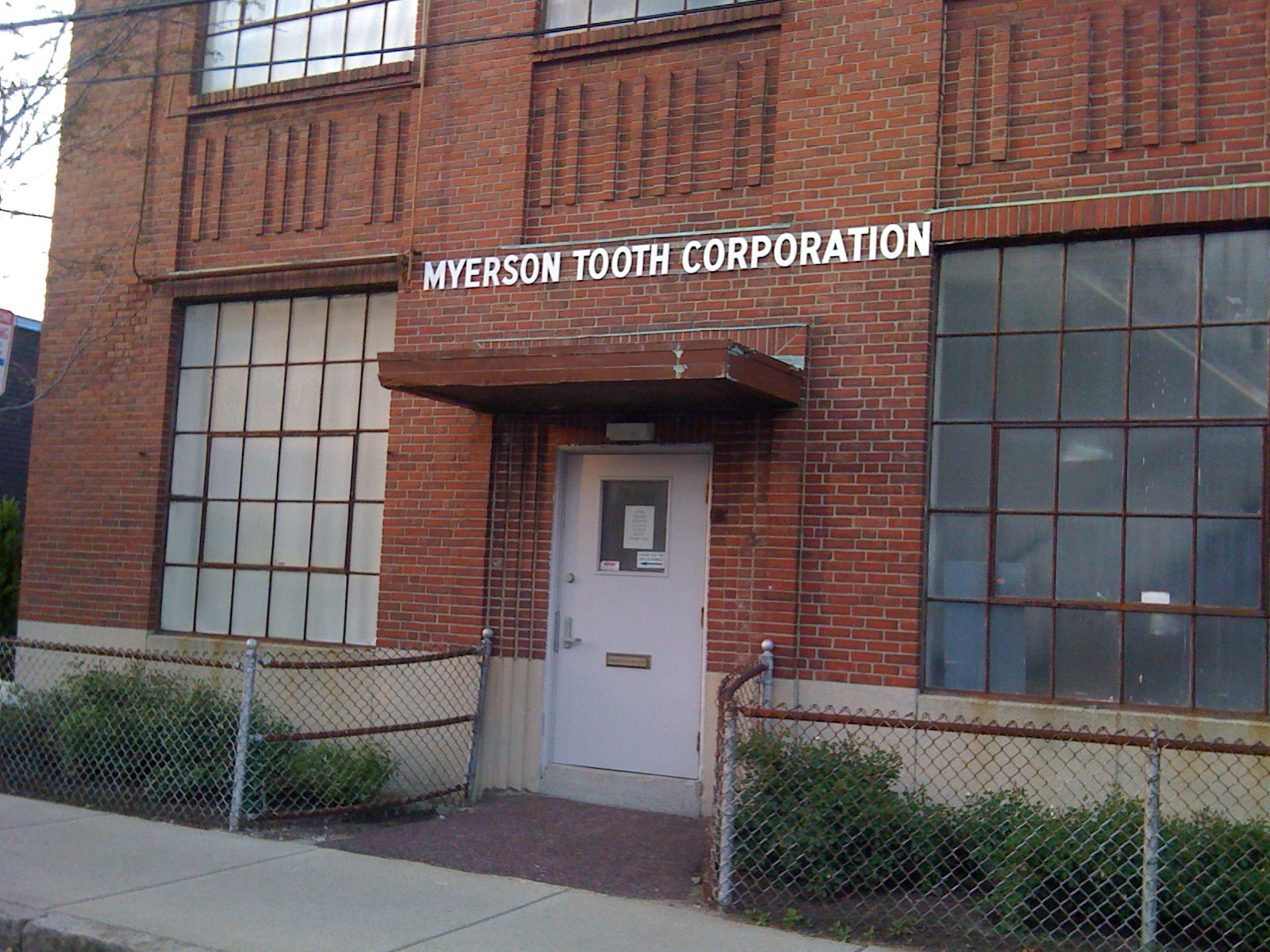
Next door is the Good News Garage owned by Click and Clack of NPR fame.
1. Is David Cameron posher than Nick Clegg? Choice quote:
“David Cameron is Eton-Oxford-country- clubby-cutglass-shooting party sort of posh, whereas Nick Clegg is Westminster-Cambridge- metropolitan-foreign-glottalstop-trustfund sort of posh. Cameron is upper-upper-middle class with a dash of English gentry, but Clegg is middle-upper-middle class with a hint of European aristocracy.”
2. What does the future hold for your lying toddler?
3. What do Buzz Aldrin and Leon Panetta have in common?
4. Brookline-Palestine beer connection.
Your Chair emails the entire Department. She is desperate because no-one has signed up to attend a boring but important weekend event. If you decide you can suffer the complaints of your spouse and children for bailing on them on a Saturday, should you hit “reply” or “reply all” on your response to the Chair?
A preliminary analysis indicates that “reply all” is the best option. First, you signal to the Department what a great public good provider you are, embellishing your image (and self-image?) as the Mahatma Gandhi-esque figure in the Department. People will look up to you and treat you with respect. Second, maybe you can guilt others into attending the event. You have made a sacrifice after all and maybe they will feel compelled to as well. So, all in all, “reply all” is looking pretty good as an optimal strategy.
But wait – you are signaling on multiple dimensions using one signal. “Reply all” signals you have gone through the rather than vulgar and manipulative analysis in the previous paragraph. A truly altruistic person would have signed up already without all the hot air you are blowing out of your email account. So, you’re probably not altruistic. In fact, you might be devious b’stard hoping to get out of serious public good provision in the future by investing one afternoon of work now. If people make this inference, hitting “reply all” is a mistake.
With all this agonizing, research is not getting done and the web is not getting surfed. Just randomize your choice whatever email arrives. Sometimes you’ll look good, sometimes not so good but people will be confused – maybe you are an altruistic after all as altruists do not email strategically. Then, you can cash in your reputation on a serious decision when it really matters not waste it on a trivial one.
(Hat Tip: Loosely based on Stephen Morris’s paper on Political Correctness)
There have been many blog posts about a possible flaw in “Obamacare”. Firms with more than 50 employees incur a fine of $2000/worker if they do not offer their workers healthcare. Their costs of healthcare may be much higher than the penalty and so a preliminary analysis may suggest that they save money by dropping healthcare coverage. John Cassidy does the calculation:
Take a medium-sized firm that employs a hundred people earning $40,000 each—a private security firm based in Atlanta, say—and currently offers them health-care insurance worth $10,000 a year, of which the employees pay $2,500. This employer’s annual health-care costs are $750,000 (a hundred times $7,500). In the reformed system, the firm’s workers, if they didn’t have insurance, would be eligible for generous subsidies to buy private insurance. For example, a married forty-year-old security guard whose wife stayed home to raise two kids could enroll in a non-group plan for less than $1,400 a year, according to the Kaiser Health Reform Subsidy Calculator. (The subsidy from the government would be $8,058.)
In a situation like this, the firm has a strong financial incentive to junk its group coverage and dump its workers onto the taxpayer-subsidized plan. Under the new law, firms with more than fifty workers that don’t offer coverage would have to pay an annual fine of $2,000 for every worker they employ, excepting the first thirty. In this case, the security firm would incur a fine of $140,000 (seventy times two), but it would save $610,000 a year on health-care costs. If you owned this firm, what would you do? Unless you are unusually public spirited, you would take advantage of the free money that the government is giving out. Since your employees would see their own health-care contributions fall by more than $1,100 a year, or almost half, they would be unlikely to complain. And even if they did, you would be saving so much money you afford to buy their agreement with a pay raise of, say, $2,000 a year, and still come out well ahead.
Actually, it is not clear the calculation is correct because there are tax breaks to employers who offer healthcare so the savings may not be as large as Cassidy calculates. A second response is simple: why not just increase the penalties? Cassidy has a ready counter-argument for this suggestion:
Even if the government tried to impose additional sanctions on such firms, I doubt it would work. The dollar sums involved are so large that firms would try to game the system, by, for example, shutting down, reincorporating under a different name, and hiring back their employees without coverage. They might not even need to go to such lengths. Firms that pay modest wages have high rates of turnover. By simply refusing to offer coverage to new employees, they could pretty quickly convert most of their employees into non-covered workers.
I was confused by this point. Does the legislation distinguish between new employees and old employees? If not, I don’t see how this gaming works. If there is a gaming issue, then the legislation will have to be altered to cover all employees, not just present employees.
But finally, competition between firms is a factor that can prevent unraveling. If a firm wants to retain its workers it will have to make up for any shortfall in the quality or price of healthcare in the exchanges by paying its workers more. Otherwise, workers will go elsewhere. The more skilled the labor-force, the more important it is to retain them. In fact, given the absence of enforced provision of healthcare right now, the reason workers are being given healthcare benefits in the first place is because they have the option of working somewhere else. We always emphasize how competition helps consumers but it also helps workers!
Healthcare reform may fail but it’s more likely to do so for some other reason (cost control, impossibility of rationing?) than penalties which can so easily be adjusted.

The second-closest gas station to our current apartment was place of employment for one of the men arrested by the F.B.I. last week.

1. Before the election the LibDems prepared
“for various contingencies using the principles of game theory developed by the Nobel prize-winning mathematician John Nash and regularly employed by the CIA.
This technique, where “mind trees” outlining various scenarios are drawn on whiteboards, was used by Vince Cable for many years when he was chief economist at Shell. Together with Chris Huhne, then a City analyst, they mapped out possible scenarios concerning political stability in Nigeria and the future of Norway’s regulatory framework.”
While their policies are closer to Labour:
“the top of the party is also united in its belief that they must remain “equidistant” from both Labour and the Tories in order to maximise their negotiating hand in the event of a hung Parliament.
They recognise, for instance, that it would be “suicide” for the party if it kept Gordon Brown in Number 10 in the event that the Conservatives emerge as the largest party.”
Since this article was published in the Guardian well before the election, Labour could have “war-gamed” their response. I guess they did not as suggested by –
2. Andrew Adonis of the Labour negotiating team who complains that the LibDems overtures were
“an attempt by the Lib Dem leadership to conduct a dutch auction, inviting Labour to outbid the Tories on a shopping list of demands.”
These stories and the an analysis of what the electoral reform under consideration would have meant for the last election can be found in an excellent NYT blog post.
A fungus is damaging opium poppies in Afghanistan. The price of dry opium has gone up dramatically. This is good for the Taliban in the short run as they have stockpiles of dry opium they can sell off at higher price. But in the medium term the price charged by farmers will go up as there is less crop to go around. As input prices go up, profits go down. Ceteris paribus, Taliban profits will go down in the medium term. Drawn by higher profits, if entry of new farmers into opium production occurs in the long run, we will head back to the status quo. Intermediate micro is kind of fun!
Seeing this logic at work, government intervention is possible: U.S. forces can discourage entry to keep input prices high and Taliban profits low. I’m sure the Law of Unintended Consequences will be at work too. What form it will take, by definition I cannot predict.
Is the marginal incentive to become a terrorist increasing or decreasing in the level of drone strikes? In the former case, terrorist activity is a strategic complement to drone strikes and, in the latter, a strategic substitute. Of course, the relationship may change sign with the level of strikes , e.g. at a medium level of drone strikes, terrorist activity is a complement but at very high levels it is a substitute (as we kill terrorists more quickly than they can be created!).
This issue lies at the heart of the optimal policy of drone strikes. Robert Wright asks whether hawkish policies:
“have, while killing terrorists abroad, created terrorists both abroad and — more disturbingly — at home.
These possibly counterproductive hawkish policies go beyond drone strikes — a fact that is unwittingly underscored by the hawks themselves. They’re the first to highlight the role played by that imam in Yemen, Anwar al-Awlaki, in inspiring Shahzad and other terrorists. But look at the jihadist recruiting narrative al-Awlaki’s peddling. He says America is at war with Islam, and to make this case he recites the greatest hits of hawkish policy: the invasion of Iraq, the troop escalation in Afghanistan, drone strikes in Pakistan, etc.”
Wright adds:
“Unfortunately, President Obama isn’t discarding the Bush-Cheney playbook that has given jihadist recruiters such effective talking points. Quite the contrary: the White House thinks the moral of the Shahzad story may be that we should get more aggressive in Pakistan,possibly putting more boots on the ground. And already Obama has authorized the assassination of al-Awlaki.
Even leaving aside the constitutional questions (al-Awlaki is an American citizen), doesn’t Obama see what a gift the killing of this imam would be to his cause? Just ask the Romans how their anti-Jesus-movement strategy worked out. (And Jesus’s followers didn’t have their leader’s sermons saved in ready-to-go video and audio files; al-Awlaki’s resurrection would be vivid indeed.)”
David Jaeger and Daniele Paserman have done empirical work on this issue in the context of the Israeli-Palestinian conflict. In one paper they find that Israeli fatalities in the last period are a good predictor of Palestinian fatalities the next (strategic complements) but Palestinian fatalities last period are not related significantly to Israeli fatalities the next. It is not clear whether this translates to the Al Qaeda/Taliban context. Surely the data is there somewhere to do the analysis. Is Obama’s policy evidence-based or is he, as Wright suggests, just copying the Bush-Cheney playbook?
The Liberal Democrats have played the Conservatives and the Labour Party off against each other brilliantly. While negotiating openly with the Conservatives, the Liberal Democrats were secretly talking to the Labour Party.
It was always clear that the game resembles an auction with two bidders, the Conservatives and Labour, and one object for sale, the Liberal Democrats. The value that can be extracted by the Liberal Democrats as in classical auction theory depends on the bid of the second-highest bidder. As I suggested in an earlier post, the Labour Party is the weak bidder as it got less votes in the General Election. But Clegg’s masterstroke has been to strengthen the value of Labour by pressuring Brown to step aside, which he did today. This immediately led to a stronger bid by the Conservatives: they are open to allowing a referendum on a change in the voting procedure used to elect Members of Parliament. This is a cause dear to the hearts of the Liberal Democrats who cannot get many seats in parliament otherwise.
Has Labour leap-frogged the Conservatives as the strong bidder? At least pretending this is the case is the next stratagem available to the Liberal Democrats to extract maximum concessions from the Conservatives. The Conservatives will send out their right-wingers to show they won’t offer any more and the Liberal Democrats will send out their left-wingers to signal a better offer is necessary. Some members of Labour may prefer to be in opposition. The next government will have to make huge cuts in spending to rein in the deficit. Better to wait on the sidelines and pick up the pieces in a few years. There are so many layers to this it is hard to keep up!
Neither the Labour Party nor the Conservative Party has won an absolute majority in the British elections. Each can try to rule as a minority government. This means roughly that each policy proposal would be voted on in an ad hoc fashion. If a key vote fails to win majority support, the minority government would fall and there would be another round of jostling for position. An alternative is to form a coalition with another party to form a government with majority support. This would mean the large party in the coalition would have to compromise on its ideal policy positions.
Both Labour and the Conservatives need the Liberal Democrats if they are to go the latter route. The Liberal Democrats suffer under the British electoral system where power is related to seats won in Parliament not total vote won across districts. Hence, they support “proportional representation”. Can the Liberal Democrats play the two parties off against each other to win this prize?
The difficulty for the Liberal Democrats is that the other two parties are in an asymmetric situation. The Conservatives are in better shape for running a minority government than Labour because they won more seats in Parliament. They are willing to offer less than Labour. Labour is willing to offer more but even the total number of seats held by the Liberal Democrats and Labour is not enough to form a majority coalition government. Plus it would involve a deal with a party mired in scandal and win a dark, brooding unpopular leader who refuses to step aside. Neither option looks good.
Hence, the real issue is the next election which may happen in days not years. The Liberal Democrats had great hopes of breaking out of their third party status and replacing the Labour party as the alternative to the Conservatives. It seems that in the end, voters were too worried about putting their faith in an unknown unknown. To break out of this hole, the Liberal Democrats have to look statesmanlike and work in the national interest not party interest. If neither party offers them a solid commitment to electoral reform, the Liberal Democrats should stay out of any coalition and maximize influence and publicity in Parliament. They can support sensible common values policy proposals put forward by the minority government and build themselves up in the eyes of the electorate. Only if they win significantly more seats in the next election will the Liberal Democrats get electoral reform
The owners get peak-load pricing and volume discounts:
Like Disney, however, Mr. Achatz and Mr. Kokonas will sell tickets to their Magic Kingdom. Yes, tickets. (That’s a direct quote from the trailer.)
While the ticket sales portion of the web site hasn’t been worked out yet, anyone wishing to eat at Next will pay for the time slot in advance. Prices will be lower for off-peak hours and will also vary depending on the menu, but will run from $45 to $75 for a five- or six-course meal. (Wine and beverage pairings will begin at $25.) Annual subscriptions — seasons tickets — will also be sold.
They also get cost control:
“We now pay three or four reservationists all day long to basically tell people they can’t come to the restaurant,” Mr. Achatz said. “People call and say, ‘I want a reservation for four for next Saturday,’ and we’re like, ‘No, I’m sorry, it’s been booked for three months.’ Most people don’t realize how much of the cost of a meal is the cost of running a restaurant.” He said Next will strip away this and other hidden costs of dining out: “It allows us to give an experience that is actually great value. The guest will actually benefit. That’s the theory.”
Hertz is making an offer for Dollar-Thrifty. Consolidation of this sort helps all players in the industry by reducing capacity and allowing all firms, including those outside the merger, to raise prices. (I already talked about this in a post about the United-Continental-US Airways merger dance.) There is an incentive then to stay outside the merger and gain from it. There has to be a countervailing force to overcome the positive externality of a merger. In the rental car case, it seems Dollar has access to a leisure-traveller market that Hertz would like to get their hands on. And there is an interesting twist to the merger deal they signed with Dollar. The Avis CEO would like to bid for Dollar (or so he says) and writes to Dollar:
“[W]e are astonished that.. you have compounded these shortcomings by agreeing to aggressive lock-up provisions, such as unlimited recurring matching rights plus an unusually high break-up fee (more than 5.25% of the true transaction value, as described by your own financial advisor), as a deterrent to competing bids that could only serve to increase the value being offered to your shareholders.”
Hertz has built in a nifty-seeming “match the competition” clause into its agreement with Dollar, If other bidders emerge, Hertz gets to match their bids and there is a break-up fee that deters Dollar from accepting another suitor.
There are several strategic effects. If Avis truly wants the Dollar leisure market access, this clause clearly makes it hard for them to acquire it. But it leaves Hertz vulnerable to a spoiling strategy by Avis: Avis can start bidding up the price Hertz pays for Dollar by make high bids for Dollar. Avis won’t win Dollar but will leave Hertz stuck with a big payment.
Spoiling may backfire if its triggers a future price war if Hertz is forced to take a short-run perspective and slash prices to survive . We will see what happens in the next few days.
A water pipe to the Greater Boston area has broken. Two million residents have to boil water before they drink it. We were moving apartments so we were a bit slow off the mark. By the time I got to Walgreens this morning, all the water was sold out. Even the San Pellegrino at Whole Foods was gone. The water shortage has all the features of a classic bank run.
Of course everyone needs more bottled water than they usually buy. Who knows when the pipe will be fixed? So, everyone buys extra water for insurance. But then, this increases an individual’s incentive to buy lots of water yet further as there is greater risk of having no water. This is like a classic bank run: the more others’ withdraw money, the more I withdraw money as there may be nothing left for me to withdraw later. Lo and behold bottled water is all gone within hours, just like all the deposits in bank facing a run.
Luckily, there was no beer run. So, I’m safe.
Interesting conference at BU and view from conference room
Like me, ants like dark houses/nests with small entrances. Facing a choice between a dark nest with a large entrance (option A) and a light nest with a small entrance (option B), an ant colony faces a trade-off. Some go this way to A and some go that way to B. Suppose we add a third decoy nest option D. Option D is as dark as A but has an even larger entrance. It is thus dominated by A but not by B. How will the ant colony’s behavior change when they face the three options together versus just A and B?
Rational choice theory says that the fractions choosing A and B should not change. Option D is dominated and should never chosen and hence is an irrelevant alternative. Its presence or absence should not affect the choice between A and B.
One psychological theory suggests that the proportion choosing A should go up. Option D helps to crystallize the advantages of option A (the smaller entrance). This may increase the perception of the advantages of A over B as well leading to a change in the proportion of ants choosing A over B.
So what actually happens?
A controlled experiment by Edwards and Pratt answers this question. Edwards and Pratt built nests with the properties above and made ant colonies make repeated binary and ternary choices. They randomized the order of choices, where the nests were located etc. And because they were experimenting with ants, they could cruelly force the choice of nest upon the ants by destroying the old nest the ants lived in by removing it’s roof.
They find no significant change in the proportions choosing A vs B when the decoy D is present. Ant colonies are rational and do not violate the axiom of independence of irrelevant alternatives (IIA).
In other work, Pratt shows that ant colonies obey transitivity (i.e. if a colony prefers A to B and B to C, it prefers A to C).
Why are ant colonies more rational than individual humans? The authors offer a cool hypothesis: choice between colonies is typically made by sending independent scouts sent to the different options. No scout visits different locations. The scouts reports are simply compared and the best option is chosen. A human being contemplates all the choices by herself and has a harder time comparing the attributes independently leading to a violation of IIA.
An ant colony is like a well performing and coordinated decentralized firm with employees passing information up the hierarchy and efficient decisions coming down from the center Can we import lessons into designing firms? Alas, I believe not. A human scout evaluating a decision/option will not be as impartial an ant scout. He will exagerrate its qualities, hoping his option “wins”. He hopes to get the credit for finding the implemented option, get promoted, receive stock options and retire young to the Bay Area. In other words, career concerns ruin a simple transfer of ant colony principles to firms. If we eliminate career concerns within the firm, we will induce moral hazard as there is no incentive to exert costly effort to find the best decisions for the firm. Ants in the same colony do not face the same issue as they are genetically related and have “common values”.
Still, a thought-provoking paper and it has many references to other papers that it builds on. I am going to read more of them.
(Hat tip to Christophe Chamley for the reference)
Threeway merger that is. Or more accurately, how does a two firm merger depend on the possibility that one of the firms can merge with a third if their deal falls through?
This is the key issue in the potential United-Continental merger. The deal has stalled because they cannot agree on the price. Things were going well just after Continental learned that United was in merger talks with U.S. Airways. Talks between United and U.S. Airways have collapsed because United started talking to Continental. And as the United-U.S. Airways talks have collapsed, so have the Continental-United talks.
A man who has many girlfriends must find it hard to keep all their names straight. I have a similar issue with this threeway merger post. Back to the economics which I am also having a hard time keeping straight but here goes.
If two firms merge, the third firm standing outside gains:
The merged firms cut capacity and raise prices. This is the main incentive to merge in the first place. In the airline industry with its overcapacity and low profits, consolidation and merger is a key strategy to regain profitability. No wonder these firms flirt with each other periodically. But if the merged firms consolidate, everyone else in the industry gains as prices go up. The firms in merger talks do not take this positive externality into account in their flirtation. They merge less than is ideal from the perspective of industry profitability. They date but don’t commit and the industry stays too large and unprofitable.
This analysis is consistent with the U.S. Airways strategy. In a letter to employees, the C.E.O. says:
Whether we participate in a merger or not, consolidation will create a more efficient domestic industry that can better withstand economic volatility, global competition and the cyclical nature of our industry as a whole. As I have said many times, it is not necessary for us to be direct participants in a merger because the entire industry benefits when consolidation occurs.
But the same logic should apply to Continental: if the other two firms merge, Continental gains. So, why did they go back to the negotiating table when they learned the other two firms were in merger talks? There has to be some negative externality to Continental caused by a United-U.S. Airways merger. Continental and United coördinate heavily even now – they are both in the Star Alliance, their flights link up etc. (I just flew to Newark on some joint Continental-United flight). Antitrust authorities are going to take another look at the Continental-United relationship if the merger with U.S. Airways goes through. A U.S. Airways merger can cause the Continental-United marriage to collapse. So Continental has the incentive to work even harder at the marriage.
But of this was true before, it is still true now: if Continental and United can’t agree on a price, United can always go back to U.S. Airways. This should lend some urgency to the merger talks. To make a United-Continental merger more likely, the U.S. Airways C.E.O. should go back to talks with United. The arrival of the ex-girlfriend can make the new girlfriend nervous and willing to commit.
Round the corner from where we live right now but as we are closer to Anna’s Taqueria we never ventured the extra couple of blocks. When we decided Anna’s offerings were limited and greasy, we did eventually go in to Dorado.
It was great and very reasonable. The cemitas are particularly good. Burger style bread with a black bean paste, chipotle salsa, guacamole and you filling of choice – I’m partial to the spicy mushrooms. All for $6. The yucca chips are great. You can ask for the super-hot sauce if you dare. Other things we like: the steak cemita, the quesadilla and shrimp taco. Get the frequent buyer card as you’ll be going twice a week if you live nearby.
1. Market Design meets the N.F.L. draft.
2. Gaming the credit rating agencies.
I loved Mark Bittman’s no-knead bread recipe. The inventor is New York breadmaker Jim Lahey. Lahey reviews the new Domino’s Pizza.
You are an ambitious, young Presidential-wannabe. This makes you a trifle immodest and you decide to write an autobiography, Volume 1. It’s going to set the stage for your Presidential bid. Some may say you have yet to do anything so said volume may not sell too well, even though you have an exotic cocktail of a family background and were President of Harvard Law Review. They may be right so you are not willing to pay a lump sum fee to employ an agent to sell your manuscript: not only might your book not work out, you would be stuck with a bill from an agent to add to your law school debts.
Luckily for you, pretty much every guy who writes a book is in the same position as you: immodest enough to write a book and yet knowing that it might not sell. So, there is a standard contract that is signed with a book agent: they work for you to get you a contract and if the book actually sells they get 15%. This way you share the risk: if the book fails, at least you do not also lose the amount you paid the agent; in return, if it succeeds, you do not get to keep all the benefits. The 15% contract gives you a form of insurance. Plus, it gives the agent the incentive to work hard, helping to alleviate the moral hazard problem.
Miracle of miracles, the book does actually sell eventually. It lies ignored but you become kind of famous anyway and then people buy it. Now you’re ready for Volume 2. Is the old book agent contract still the best option for you?
Well, Volume 2 is almost certainly going to fly off the shelves. You do not need to share the risk. All you care about is the getting the best price and you don’t need protection in case of failure as it ain’t going to fail. Best just to go with a great negotiator. In fact, a well-connected Washington lawyer might be just the thing. You just pay him upfront and he calls his contacts. And he’s done it before. It’s expensive if your book fails and you don’t get the rest of your advance or even have to give back the chunk they gave you. But Volume 2 is your road to the Presidency, Volume 1 was just laying the foundation. Everyone will read it as you’re intriguing and you’ll get to keep your advance and even get royalties. Now, you can afford to be President as your law school debts are paid and you can even send your kids to a spiffy private school.
Republican leader, Senator Mitch McConnell, opposes the current version of the financial reform bill. He claims that the bill generates “moral hazard” by creating a fund that bails out banks if they fail:
Mr. McConnell has framed the Republican opposition as an attempt to prevent future bailouts, and has specifically criticized a $50 billion fund, to be created with a tax on banks, that would help cover the costs of dealing with failing firms in the future. Mr. McConnell said the mere existence of the fund is an invitation to banks to take on risk that could lead them to fail. The White House does not support the fund, which is being pushed by Congressional Democrats.
Democrats have countered that the fund is intended pay for dismantling such firms and putting them out of business – and that setting up in advance would help ensure that the financial industry, rather than taxpayers, would cover the expense of future failures.
Note that the White House does not support the fund either and recently advised the Congressional Democrats to ditch the provision from the bill. As far as I can tell, the White House view is that the fund is too small and its existence would complicate efforts to raise extra money should it be needed. If McConnell is right, a bigger fund would exasperate the moral hazard problem so the White House’s preferences would make things even worse.
Also, the Democrats’ faith that firms would be dismantled if they fail may turn out to be mistaken. The same executives who get their firm in trouble by taking risky bets are in the best position to disentangle them if they go bad. That’s what happened with A.I.G.
All that leaves just one feature of the current bill to discuss: the fund is to be created by taxing financial firms in good times to help them out in bad times. Depending on how the tax is designed, it can mitigate risk-taking. The tax would have to affect the marginal incentive to make a risky bet and cannot be a lump-sum tax. A successful tax would basically work by decreasing the upside to a trade to compensate for the fact that the firm is insured on the downside by the fund. This brings up the whole question of what the optimal incentive scheme might be. I was puzzling about this but then I realized I was trying to reinvent the wheel. Much attention has already been paid to these issues in the finance literature and our very own Jeff Ely linked to a blog where Eric Maskin gave his five recommendations for great papers to read for guidance about the financial crisis.
To summarize some of the main points: Banks must take equity in the bets they take to reduce moral hazard and this may have to be regulated (Holmstron and Tirole). Depositors and small shareholders do not have good incentives to monitor so the government may have to set capital requirements to substitute for them (Dewatripont and Tirole). Tight monetary policy can be used reduce the profitability of lending, much like a tax. There are lots of other points but they are less relevant for the topic of this post. I have not read a couple of these papers myself (eg Kiyptaki-Moore) but I intend to!
There are lots of other ideas floating out there (Volker rule, breaking up banks, reinstating Glass-Steagal). Which is truly the best is hard to say. But the basic principle is clear: If banks are going to be bailed out as a bank failure would cause systemic risk, they do have the incentive to take on riskier bets (let’s call this the “McConnell effect”). Then, there has to be a countervailing effort to reduce the upside of risky bets (let’s call this the Olympia Snowe/Susan Collins/Scott Brown effect as we know who’s in the driving seat).
This brings me to my final point: While such a policy is designed for the long run, it will create pain in the short run. Banks are pretty reluctant to lend right now (I assume?). They do not need a tax to dis-incentivize them. They may need the reverse. How does financial reform deal with this? Do we delay the implementation of the restrictive legislations? This would create the incentive to invest and lend now rather than delay if profits from future lending are going to be taxed. Probably there is some old finance paper that already discussed this too! But I do not know it.
1. We have no clear strategy to deal with Iran’s nuclear ambitions.
2. The Taliban want peace.
3. Graham Allison gives Obama an “incomplete” on one aspect of his policy on nuclear arms.
4. Osama loves volleyball, de Gaulle and Field Marshall Montgomery.
It’s always nice when you get a comment from someone you recognize but do not know personally. So it was a nice surprise to see that Andrew Gelman left a comment on my earlier post and then wrote his own blog post. Andrew says:
[I]f this “cheap talk” is useless, why it’s done at all! Or, conversely, why it wasn’t done earlier. Baliga’s analysis seems to me to rely on there being some “suckers” somewhere who don’t realize what’s going on.
Perhaps, for example, the leaders of Iran, Russia, etc., aren’t fooled by the cheap talk.–after all, they run countries and have incentives to understand the relevant signaling–but maybe it could sway American voters, who don’t have the time and inclination to gain a deep understanding of power politics. But . . . if it could fool the voters, it could change U.S. policy, and in that sense the stated policy does mean something. Beyond this, there are default effects and status quo effects and costs to violating or altering a stated policy. So I don’t think such public statements are necessarily meaningless, especially considering the many players involved in policymaking in any country.
On the other hand, I know next to nothing about international relations, so I could well be missing something important. I don’t see Baliga’s conclusions as following from basic game theory but maybe there’s something about this particular setting that changes things.
I was a bit terse in my original post and the concept of “cheap talk” is confusing so let me have another stab at an explanation.
Cheap talk is a costless message sent before a game is played. Since it is costless, you might think it never has an impact. That turns out not to be true. But whether and how cheap talk has an impact depends on the game that’s played after the talk.
The simplest and most famous scenario is where the game just involves a decision made by one player, the receiver (this is the famous Crawford-Sobel model). In the background, there is some uncertainty and the receiver would love to fine-tune his decision to the underlying state. If he does not know the state, the receiver makes a decision which works out on average and this is the equilibrium of the game without cheap talk. Now add a player, the sender, who knows the state and whose preferences coincide exactly with the sender’s. Let the sender send a message before the receiver makes his decision. The sender has perfect incentives to tell the truth, so the receiver learns the true state in equilibrium and cheap talk works. That is, the equilibrium set of the game without cheap talk is different than the game with cheap talk. Hence, cheap talk can be effective even if it is costless. It does not require the existence of suckers. And cheap talk is useful as it helps the two players to some to the best decision in each state. (Actually, Jeff has already written about this game.)
But in the nuclear proliferation scenario I claim cheap talk is not useful. I copy my initial response to Andrew:
But there is one key case where cheap talk is useless even in games of incomplete information: when a player i’s preferences over player j’s actions do not depend on player i’s preferences. In the nuclear story, this arises if the player i prefers that player j not acquire nuclear weapons, whether player i is itself rapacious, conciliatory or something in between. Then, player i will always send the message that minimizes the probability that player j arms and cheap talk cannot be informative.
As player i sends the same message whatever his preferences, his message contains no information. Hence, the equilibrium set does not change compared to a nuclear proliferation game with no talk preceding it. Whatever player j’s optimal plan was in the game without cheap talk, it remains optimal with cheap talk. Some message is sent in any case – even saying nothing is a message. There will always be some message, like it or not, once you allow cheap talk before a game. The question is whether it is effective and I claim it is not in my visualization of the nuclear proliferation game.
My analysis is a rational choice analysis, as is analysis in basic game theory. It assumes in particular that Iran is rational. This means they can do backward induction and think through Obama’s strategic incentives to send messages. Then, they can deduce that he always has the incentive to minimize their probability of acquiring weapons whether he intends to be belligerent, conciliatory or not. So, there is no information content in the message as the same message in sent in all cases.
Gelman makes the point that if voters can be fooled, cheap talk may be effective. Also, if Iran is fooled, cheap talk is also effective. This latter possibility is the hypothesis that makes sense of the new nuclear policy in the simplest way – if Iran accepts Obama’s message at face value, it might stop pursuing nuclear weapons. If Obama believes that Iran is naive, he does want to send the message. But, as Andrew suggests, the idea that Iran would be caught out is implausible. If even if Obama believes there is small chance Iran/North Korea is fooled, he may send it anyway – after all I claim the policy has no impact anyway if Iran is rational but if it makes things better with a small probability, why not?
Andrew’s idea that voters might be fooled is plausible and his post built around this idea. (Somewhat confusingly, he suggests I am assuming there are suckers in the model but I think his idea requires them while mine is a rational choice analysis.) But anyway, till we have a good theory of how to fool voters, it is hard to judge how the change in nuclear policy affects nuclear proliferation. If voters think Obama’s policy is a softening of the previous policy and will embolden Iran, as the Cheneys will say, voters may think Obama is weak. Then, Obama may have to signal he is tough by acting tough, not just talking tough. So fooling voters is bad for Obama in the end and he is a sucker too in this scenario. Or we can go the other way and say voters will increase support for Obama as he is a smart foreign policy guy and will reduce nuclear proliferation. Then, the Obama strategy makes sense. We can send the analysis anyway we want by adding players who can be fooled into the story.
But there is an insight to the basic game theory analysis – why might communication not work? It would be good to understand that before moving on to add naive voters, status quo effects and the like.
There was a Memorial Service for Paul Samuelson last weekend. A video of the service and texts of speeches are available and they are quite interesting. Ricardo Caballero’s speech has a lovely passage where he describes a faculty lunch on a snowy day. To a small group of colleagues, Samuelson held forth on a thesis of Alberto Calderon, John Nash’s contemporary at M.I.T. Caballero says:
“This episode left such an impression on me that I decided to take the afternoon off to savor the moment. (And afternoons off are not my thing, as many of you
know…) I drove home in complete awe. The silence that only snow can produce, served to exacerbate the surreal feeling I was experiencing. Much like what one feels when visiting the Basilica di Santa Croce in Florence, where names such as Michelangelo, Galileo, and Machiavelli are buried: Sheer and pure admiration for a great mind.”
Obama’s Nuclear Posture Review has been revealed. The main changes:
(1) We promise not to use nuclear weapons on nations that are in conflict with the U.S. even if they use biological and chemical weapons against us;
(2) Nuclear response is on the table against countries that are nuclear, in violation of the N.P.T., or are trying to acquire nuclear weapons.
This is an attempt to use a carrot and stick strategy to incentivize countries not to pursue nuclear weapons. But is it any different from the old strategy of “ambiguity” where all options are left on the table and nothing is clarified? Elementary game theory suggests the answer is “No”.
First, the Nuclear Posture Review is “Cheap Talk”, the game theoretic interpretation of the name of our blog. We can always ignore the stated policy, go nuclear on nuclear states or non-nuclear on nuclear states – whatever is optimal at the time of decision. Plenty of people within the government and outside it are going to push the optimal policy so it’s going to be hard to resist it. Then, the words of the review are just that – words. Contracts we write for private exchange are enforced by the legal system. For example a carrot and stick contract between an employer and employee, rewarding the employee for high output and punishing him for low output, cannot be violated without legal consequences. But there is no world government to enforce the Nuclear Posture Review so it is Cheap Talk.
If our targets know our preferences, they can forecast our actions whatever we say or do not say, so-called backward induction. So, there is no difference between the ambiguous regime and the clear regime.
What if our targets do not know our preferences? Do they learn anything about our preferences by the posture we have adopted? Perhaps they learn we are “nice guys”? But even bad guys have an incentive to pretend they are nice guys before they get you. Hitler hid his ambitions behind the facade of friendliness while he advanced his agenda. So, whether you are a good guy or bad guy, you are going to send the same message, the message that minimizes the probability that your opponent is aggressive. This is a more sophisticated version of backward induction. So, your target is not going to believe your silver-tongued oratory.
We are left with the conclusion that a game theoretic analysis of the Nuclear Posture Review says it seems little different from the old policy of ambiguity.
My former colleague Oprah Winfrey reportedly resigned once the grading of term papers got too much for her.
Luckily, for busy Oprahs and slightly less busy Baligas and Elys everywhere, capitalism has come up with a solution – outsourcing of grading to India:
Virtual-TA, a service of a company called EduMetry Inc., took over. The goal of the service is to relieve professors and teaching assistants of a traditional and sometimes tiresome task — and even, the company says, to do it better than TA’s can.
The graders working for EduMetry, based in a Virginia suburb of Washington, are concentrated in India, Singapore, and Malaysia, along with some in the United States and elsewhere. They do their work online and communicate with professors via e-mail. The company advertises that its graders hold advanced degrees and can quickly turn around assignments with sophisticated commentary, because they are not juggling their own course work, too.
The company argues that professors freed from grading papers can spend more time teaching and doing research.
Who does the grading and how do they know how to grade? Answer:
Assessors are trained in the use of rubrics, or systematic guidelines for evaluating student work, and before they are hired are given sample student assignments to see “how they perform on those,” says Ravindra Singh Bangari, EduMetry’s vice president of assessment services.
Mr. Bangari, who is based in Bangalore, India, oversees a group of assessors who work from their homes. He says his job is to see that the graders, many of them women with children who are eager to do part-time work, provide results that meet each client’s standards and help students improve.
“Training goes on all the time,” says Mr. Bangari, whose employees work mostly on assignments from business schools. “We are in constant communication with U.S. faculty.”
Such communication, part of a multi-step process, begins early on. Before the work comes rolling in, the assessors receive the rubrics that professors provide, along with syllabi and textbooks. In some instances, the graders will assess a few initial assignments and return them for the professor’s approval.
When will I be replaced by a robot?
 Cheap Talk