
You are currently browsing Sandeep Baliga’s articles.
Stalin stayed in Moscow during WWII to lead resistance against the approaching German armed forces. He was putting his own life at risk. Why do leaders have to take costly actions to persuade followers to follow?
A seminal paper Leading by Example (jstor link) by Ben Hermalin (AER 1998) has an answer based on a classical signaling model. Suppose a leader wants followers to exert costly effort. The ideal level effort depends on some factor known only to the leader. Stalin might have a better idea as to the chances of success against the Germans; or a C.E.O. might have better information about the state of demand. What if the leader simply tells the followers his information? Of course, this is Cheap Talk. If the leader wants the followers to exert high effort whatever the true state of affairs, the followers cannot believe anything the leader says. For example, Stalin might tell his troops to fight hard whether they have a good chance of beating the Germans or not. Communication breaks down and the followers’ effort cannot be a function of the truth.
The picture changes if the leader can himself exert costly effort and lead by example. Then, he might only be willing to work hard if and only if he thinks the chances of his effort paying off are good. Stalin’s decision to stay in Moscow signals that he believes that his life is likely to be safe as the chances for Soviet success are good. If the Germans have the advantage, he does truly risk his life and would prefer to leave Moscow. As the leader’s incentives to send the signal or not depend on the true state of affairs, his “message” is credible. The followers can then fight hard or work hard if and only if the leader leads by example and works hard himself.
“Actions speak louder than words” and Costly Signaling is more informative than Cheap Talk. Hence leaders must lead by example because words cannot be believed while actions can. This is the heart of Hermalin’s idea.
Once you buy into the framework, it is easy to think of variations. Hermalin does not talk explicitly about competition but let’s add that in. If things are going well for the organization in the product market, then the competition does not matter – you have a good product so you can slack off. More importantly the leader slacks off and the followers do too. If the organization is defunct if the crew does not pull the oars hard, the captain has a good incentive to pitch in and row. So, this is similar to the first Hermalin story except the leader works hard when the going is bad and effort is very important and not when the going is good. The followers do the same.
Another variation: Middle managers looking to get promoted have weird incentives. They want to signal how hard-working they are to their superiors. They want to work hard even when the going is bad. So, the followers cannot filter out the true state from the middle manager’s effort. The followers will slack off. The middle manager cannot be a credible leader by example as signaling to his superiors destroys the credibility of the signal to his juniors. This is a good reason to appoint someone who does not want to be senior manager into the middle position. Hence, looking at the leading by example issue alone, academic department should appoint Chairs who do not have any ambition to rise further in the hierarchy. Many other examples can be given…
In search of a rural retreat, ideal for apple picking? A decent close option to Chicago is Heinz Orchard. No mazes, hay rides etc…just apples. The only problem: what do you do with the 40 pounds of apples you end up picking…?!!
I double-checked to make sure it wasn’t April 1 when I saw this story in the Independent:
The Queen asked ministers for a poverty handout to help heat her palaces but was rebuffed because they feared it would be a public relations disaster, documents disclosed under the Freedom of Information Act reveal.
Royal aides were told that the £60m worth of energy-saving grants were aimed at families on low incomes and if the money was given to Buckingham Palace instead of housing associations or hospitals it could lead to “adverse publicity” for the Queen and the Government.
Check out their request.
Mayor Daley will step down as Chicago Mayor after over two decades in office. His campaign coffers are full and his popularity is high and yet Daley the Younger will voluntarily leave office after serving a slightly longer term than Daley the Elder. We can ascribe lofty reasons for his departure but at Cheap Talk we usually focus on the basest of human motives: rational self-interest.
First, if Daley had decided to run again, I’m assuming he would have been re-elected easily with no candidate coming close to him popularity. His voluntary departure signals that there is some hidden problem that’s going to be trouble in the next term. It could be trouble for Daley alone, the private value case, such as an affair, some personal corruption or something of that sort. And there is a prime candidate for this scenario: Daley’s wife has cancer and he may rightly want to concentrate on her welfare. So, the private value case is possible. In the opposite scenario, there is some issue that will affect anyone who becomes Mayor, the common value case. There is an obvious candidate for this scenario too: the City of Chicago is in deep financial trouble and the next Mayor will have to sort that out. Forget the glamourous public projects like Millenium Park, greening the city etc. There will be nitty-gritty fights with unions to renegotiate pension deals, cutbacks, layoffs and protests.
Not only will that be painful but re-election will be hard. Voters will blame the next Mayor for everything that goes wrong whether it’s is his fault or not. The next Mayor will be a one term Mayor.
So, Rahm should spend a few years at some investment bank, making millions in a few short years – just like he did last time around. He can build his political machine and run for Mayor the next time around.
Peter Cramton emailed a bunch of us today asking us to sign a comment he and others are submitting to a House Committee. There are many issues but one is related to an odd pricing rule proposed for buying equipment for Medicare.
Suppose Medicare needs x machines and wants to save money. They can run a simple procurement auction (or some variant) as follows: Suppliers submit bids and the lowest x bids are accepted and all are paid the highest accepted bid. This is similar to a market mechanism that spits out a market clearing price that all suppliers receive. Just like the market mechanism, all but the highest cost supplier get surplus at the market-clearing price. Is there some way to leave the suppliers with less rent and for Medicare to save more money? Unless Medicare knows the costs of production of the suppliers, the answer is basically “No”, under reasonable assumptions. Any mechanism has to leave low cost suppliers with information rent and the minimum rent is left by the market-clearing mechanism.
But it seems that does not stop Medicare from trying! They are proposing a median pricing rule where the lowest x bidders are chosen but are paid the median of the x winning bids. This means the top 50% of bidders are not paid their submitted bids. This leads to many pathologies as the authors point out in their comment. First, the top 50% may simply refuse to supply and withdraw their bids (this is allowed under the present auction rules). Then Medicare will be left with less equipment than it needs. Or the suppliers may make a loss if they are forced to supply for one reason or another. This is not good for the long term financial health of the suppliers. Or they may game and shade their bid etc. etc.
Check out the comment for more detail. Peter is providing a public good and testifies in front of the House Committee on September 27. We’ll see what happens. If the median pricing rule stays in place despite Peter’s best efforts, expect to see (many!) papers working out equilibria of the procurement auction under that rule!
My colleague Josh Rauh who is a pensions expert testified in the front of the Evanston City Council. You can read about his report here. I particularly enjoyed the little jokey exchange at the end:
‘Do we want to take action now and forge a financially responsible course?” If not, he [Josh Rauh] said, the City could just keep going in the present direction, “hoping that someone will bail us out. We could get state and federal bailout money.”
“Are we too big to fail?” asked Mayor Tisdahl.
“The City of Chicago is too big to fail,” responded Dr. Rauh; “the City of Evanston may not be. …
Plenty of government intervention means plenty of data – data that can be creatively exploited to study long-standing questions of political economy such as….
Do politicians vote based on ideology, constituent preferences or to get lots of cash from lobbyists to pay for the re-election campaigns?
“The Political Economy of the U.S. Mortgage Default Crisis” by Atif Mian, Amir Sufi and Francesco Trebbi (forthcoming in AER I believe) uses data on voting in Congress on the American Housing Rescue and Foreclosure Prevention Act AHRFPA and the Emergency Economic Stabilization Act EESA to study politicians’ voting behavior. AHRFPA supported mortgage holders who were financially distressed and EESA supported banks supplying them with liquidity. We can think of them as constituents and special interests. There is data on default rates in a district at the ideological level – you can see the default rate among Democrats and Republicans. There is data on contributions made by the financial industry to a candidate’s campaign war chest.
There is no variation in Democratic votes for AHRFPA so the paper studies Republican votes. The authors find that Republican politicians’ votes for the bill are correlated with the default rate of Republican constituents in their district. Moreover, if the district lies in a Presidential swing state and is more competitive,the response is stronger.
On the EESA, the authors find that campaign contributions by the financial industry are correlated with voting for the bill. Also, retiring politicians less likely to vote for the bill, even if they received campaign contributions from the financial industry in the past. Finally, the more ideological a politician is, the less likely he is to respond to these measures (ideology is measured on some scale that is usually employed in these studies).
Lots of interesting and provocative results. Lots of caveats and subtlety I cannot do justice to in this post. Take a look at the paper.
Sarah Palin puts her toe in the water in Iowa and Robert Gibbs calls her:
“a formidable force in the Republican Party and may well be, in all honesty, the most formidable force in the Republican Party right now.”
On the other hand:
“While popular among conservatives, Palin still has a long way to go with other Americans. A CBS News poll on Thursday said 46 percent of American voters viewed Palin unfavorably, compared with 21 percent who have a favorable opinion of her and 33 percent who are undecided.”
Elton John and Bernie Taupin pose a classic conundrum:
It’s sad, so sad
It’s a sad, sad situation
And it’s getting more and more absurd
It’s sad, so sad
Why can’t we talk it over
Oh it seems to me
That sorry seems to be the hardest word
Elton must have done something in the recent past that requires an apology. He wants his partner to “make you love” him. What has he “got to do to be heard”?
So his entreaties are not being heard. Why? Elton has a credibility problem. He wants love whether or not he is truly sorry. If he gets a positive response from saying “sorry” whether he means it or not, he’ll just say it. It is, of course, cheap talk.
To make Elton’s apology credible, it has got to be hard or costly to say sorry. There has to be some loss of face, some blow to pride from saying sorry. But to make “sorry” truly credible, the cost of saying sorry has to be low if Elton is truly sorry and high if he’s not sorry at all. So, if Elton is having a hard time saying sorry, maybe he’s not really sorry?
More on Mr. Sha.
 I am partial to RJ’s Black Soft Licorice. In moderation, like cocaine (I imagine!), it does no harm. But like cocaine (I imagine!), one is tempted to consume it in excess, a bag at a time.
How can I just eat a reasonable amount? I could joint Licorice Lovers Anonymous (LLA) and complete a ten step program to kick my habit entirely. I am sure there are many fellow sufferers out there, who love RJ’s not too little but too much. Just a few tweets would allow us to coördinate and set up weekly meetings. Seems like overkill. And anyway, I don’t want to kick the habit entirely, just control it.
I see my five-year old wandering around, causing trouble and a simple solution appears magically in my mind. I ask him to hide the licorice. He is very good at hiding things that do not belong to him – remote controls, his brother’s toys, my watch etc. etc. He’ll love to hide the licorice. There are a couple of problems. It is my intention to ask him to bring the licorice back every day so I can have a few pieces. But there is s significant chance that he’ll forget where he hid the bag. So what? Then, we’ll lose the bag and the licorice. But this is not any worse than the LLA solution of cutting out the addiction completely.
There is a second and quite famous problem from incentive theory: Who will monitor the monitor? In other words, perhaps your police-kid will eat the licorice himself. For this problem I have an answer. My five-year old will consume strawberry Twizzlers by the cartful, but black, spicy licorice, I think not. I am proved right. One piece of licorice is chewed but the rest are intact.
Thinking about it, I realize that I have used a variation of an old idea of Oliver Wlliamson’s, “Credible Commitments: Using Hostages to Support Exchange” (jstor gated version). In his analysis, a contracting party A voluntarily hands over an “ugly princess” to party B to give party A the incentive to perform some costly investment. Party B does not value the princess and hands her over once the investment is sunk. In my argument, the ugly princess is the licorice and instead of specific investment, I want to commit to avoid over-consumption of an addictive good.
This pretty much gives you principles under which this mechanism works: Consumption of good that is addictive for party A but has no value for party B can be controlled by allowing party B to control the use of the good. Party A might return the favor for party B (e.g. by rationing computer game time). Only, my party B would never agree to this voluntarily and would see as a violation of civil liberties rather than as a favor. This level of addiction I have no solution for….
An Israeli leftist believes that right-wing Prime Minister Neyanyahu can bring peace:
“The left wants to make peace but cannot, while the right doesn’t want to but, if forced to, can do it.”
Why can a right-winger make peace, while a left-winger cannot? There might be many reasons but the one mentioned in this blog must of course draw from Crawford-Sobel’s Strategic Information Transmission which has become the canonical model of the game-theoretic notion Cheap Talk. The key intuition was identified by Cukierman and Tommasi in their AER paper “Why does it take a Nixon to go to China?” (working paper version).
Suppose an elected politician knows the true chances for peace but also has a bias against peace and for war. The the median voter hears his message and decides whether to re-elect him or appoint a challenger. Given the politician’s bias, he may falsely claim there is a good case for war even if it is not true. It is hard for a politician biased towards war to credibly make the case for war. He risks losing the election. But if he makes the case for peace, it is credible: Why would a hawk prosecute for peace unless the case for peace is overwhelming? So the more a politician proposes a policy that is against his natural bias, the higher is the chance he gets re-elected. If the case for peace is strong, a war-biased politician can either propose war in which case he may not get re-elected and the challenger gets to choose policy. Or he can propose peace, get re-elected and implement the “right” policy. In equilibrium, the latter dominates and Nixon is necessary to go China, Mitterand is necessary for privatization etc…
Is this why Netanyahu believes he can make peace? Maybe he cares about leaving a legacy as a statesman. This would make him a less credible messenger – via the logic above, he is biased towards peace and any dovish message he sends is unreliable. Let’s hope that the stories of his strongly his Zionist father and hawkish wife are all true. And then Hamas should fail to derail the negotiations…And Hezbollah should fail in its efforts… And the other million stars that must align must magically find their place….
Let’s take a bike ride next to the Lake Michigan and see what our impressions are of the neighborhoods we ride through.
We start in south Evanston. We can ride on a path of some sort next to the lake all the way to Lincoln St in north Evanston, about 2-3 miles. We see lovely sandy beaches on our right (i.e to the east) and on our left we see families barbecuing or picnicking. We pass playgrounds, tennis courts and enter the grounds of Northwestern University. We bike around a lovely lagoon. We pause and look back south to take in a fantastic view of downtown Chicago.
Our impressions of Evanston are pretty good so far: nice bike path, nice views, generous provision of public goods. This impression fades a little after Lincoln. We continue north, perhaps heading east on Central and then north again on Ridge St. Or we take a big risk and ride on Sheridan. Potholes whichever way we go. And fast cars if we go on Sheridan. We amend our impression of Evanston: perhaps the local government isn’t as flush with cash as we thought.
Then, we enter Wilmette. We have to bike on the road but there is a lovely bike lane. All smooth and fast. We start thinking we’re pretty fit as we pick up speed. We realize we’re heading downhill so maybe not. We pass a lovely Bahai Temple. We try getting closer to the lake to recreate our wonderful Evanston experience. Big mistake: many parts of the road are cobbled to slow down traffic. Our arms get tired and we feel the beginning of a backache. So, we head back to Sheridan and ride along the road looking at the large houses and wondering how much they cost. By the time we leave Wilmette, we have a mixed impression. Nice bike path but are the cobbles really necessary? Sure they slow down cars but Wilmette ain’t no urban metropolis – there’s no traffic to slow down in the first place. We remember why we decided not to move to Wilmette but are happy they have a nice bike path.
Next, we ride into Kenilworth. The houses are even larger. There’s the odd McMansion but it’s hard to see behind the trees, at the end of a long drive. The bike lane suddenly disappears and we’re left high and dry. At least the road is wide and Kenilworth is small and we enter Winnetka. The road narrows. More potholes than Evanston. Have we crossed a boundary back into a poor neighborhood? We look around. A line of mutant double-cheeseburger-meets-big-macs homes as far as the eye can see. Surely richer than Evanston. We conclude that they are deliberately not maintaining the road to keep interlopers out of their chi-chi town. We’re a little disgusted and anyway we’re risking our life riding on this road.
We cut across to the Green Bay Trail. We realize that riding along the lakefront, seeing all those big houses, has triggered avarice and envy. We’re a little disgusted at having fallen prey to such base emotions. We hunker down and pedal hard, ignoring Glencoe and Highland Park.
Syllabus for his course on Leadership:
- 7th September 2010: “The Importance of Leading Differently – The Changing Operating Environment”
- 14th September 2010: “Case Study: The Changing Military 1972-2010”
- 21st September 2010: “Role of a Leader”
- 27th September 2010 (6-8pm): “Coping With Failure”
- 28th September 2010 (Assignment 1 Due): “Building Teams – What Makes Some Great”
- 5th October 2010: “Driving Change and Operating Differently”
- 12th October 2010: “Navigating Politics”
- 19th October 2010: “Making Difficult Decisions Pt. 1 – How We Decide”
- 26th October 2010 (Assignment 2 Due): “Making Difficult Decisions Pt. 2 – Dealing With Risk”
- 2nd November 2010: “Loyalty, Trust and Relationships”
- 9th November 2010: “Dealing With Cultural Differences”
- 16th November 2010: “Communicating the Story – the Media Environment”
- 30th November 2010 (Assignment 3 Due): “The Leader – the Personal Impact of Responsibility, Notoriety and Other Realities”
- 7th December 2010: “The Future Leader”
Details about the first class:
7th September 2010 – Seminar 1: The Importance of Leading Differently: The Changing Operating Environment
Description: A description of how changes in our operating environment over the 34 years of my service have demanded changes in how organizations operate – and how leaders lead them. For the military, focus often falls too narrowly – on technological advances in weaponry and armor. But like most organizations, truly significant changes in technology, politics, media, and society overall have driven change to almost every aspect of leading. Increasingly, the product of a failure to change – is failure.
Historical Examples:
- Case Study 1: The career of Stanley McChrystal
- Case Study 3: The 2002-2003 decision to invade Iraq
- Case Study 3: The United States Civil War
- Case Study 4: German Grand Strategy of World War 2
Primary Reading
- Filkins, Dexter. Stanley McChrystal’s Long War. The New York Times Magazine.
- 18th October 2009. P. 36.
Supplemental Reading
- FM 6-22 Army Leadership, Chapter 10: Influences on Leadership (Operating Environment, Stress in Combat, Stress in Training, Dealing with the Stress of Change, Tools for Adaptability).
- Coutu, Diane L., “How Resilience Works,” Harvard Business Review on Leading in Turbulent Times. Harvard Business School Press. 2003.
- Gehler, Christopher P. Agile Leaders, Agile Institutions: Educating Adaptive and Innovative Leaders for Today and Tomorrow. Strategy Research Project.
- Carlisle Barracks, PA: U.S. Army War College, 2005. 26pp. http://handle.dtic.mil/100.2/ADA434868
- Wong, Leonard. Developing Adaptive Leaders: The Crucible Experience of Operation Iraqi Free-dom. Carlisle Barracks, PA: U.S. Army War College, Strategic Studies Institute, 2004. 23pp. http://handle.dtic.mil/100.2/ADA424850
- Doyle, Michele Erina and Mark K. Smith, “Classical Leadership: theories of leadership” article (ILE materials)
- Reed, George E., ”Warrior Ethos” (ILE materials)
- Gardener, John. On Leadership. New York: Free Press. 1990., Chapters 1-3.
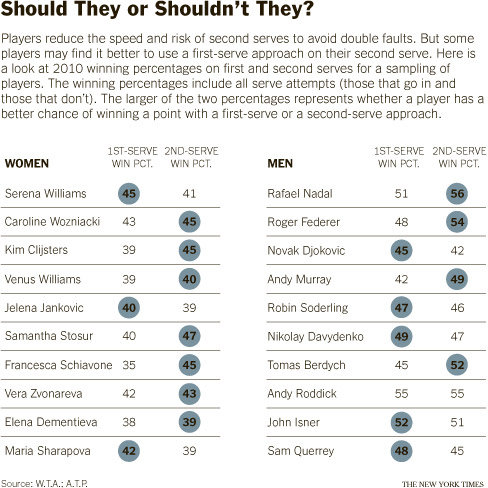
The data suggest that players should serve big on the second serve as well as their first. And distinguished psychologist and Nobel Prize winner Daniel Kahnemann offers an explanation:
“People prefer losing late to losing early,” Daniel Kahneman, a Noble Prize-winning psychologist and professor emeritus at Princeton, wrote in an e-mail.
Some of Kahneman’s best-known research, with Amos Tversky, focused on decision-making and people’s aversion to risk, even when given identical potential outcomes.
“Imagine a game in which you have a 20 percent chance to get to the second stage and an 80 percent chance to win the prize at that stage,” Kahneman wrote. “This is less attractive than a game in which the percentages are reversed.”
But this is not an individual decision-making scenario, it is a game so we have to account for how the receiver will respond to the change in strategy by the server. One model: the receiver has a budget of effort to expend on the two serves. In the slow second serve and fast first serve scenario, he saves some effort for the second serve. Hence, the first-serve win percentage for the server is large. If the server serves hard on both serves, there is less incentive to save effort for the second serve as it is fast anyway. So, transfer effort to the first. For the server, the win percentage will go down on the first serve and up on the second. I guess the server might be worse off as result. No-one is imagining any of this is explicitly calculated by either player but perhaps learning by trial and error, a process that should work well in zero sum games, should find the optimum.
Who knows is this is realistic or formalizable. But the qualitative point is the most important: in a game when one player evaluates a change in strategy based on data, she should carefully think through the response of other players to her change.
I was wandering by the Bottle Shop last week when I popped in on a whim to see if they had the Trimbach Fredric Emile. No luck in that search but I starting talking to Joe, one of the owners. I asked him if he carries wines distributed by Kermit Lynch. Not only did he carry them but Greg, the local Kermit-rep, was in the shop opening some of his wines for Joe and Amy, the other owner of the Bottle Shop. One thing led to another and I found that the Bottle Shop had both the Chateau Aney and Ch. de Bellevue recommended by the NYT wine writer Eric Asimov. I left clutching those two bottles and an invitation to a Saturday tasting at the shop hosted by Greg.
When I went by on Saturday, Greg was pouring a Domaine Henri Perrusset Macon-Villages. It was multi-faceted – classic Chardonnay but with a mineral almost salty finish. We bought several bottles and left converts to the Bottle Shop. They carry lots of wines hard to find elsewhere and the owners are friendly and informed.
The atmosphere of melancholia on the show Mad Men has to broken by brief bursts of bright comedy or an undercurrent of sexual intrigue. In this instance, the show indulged in the use of (at least) three strategic ploys to distract us from the plight of sad, newly divorced Don Draper regretting he boinked his secretary.
Draper’s ad agency SCDP is facing competition from a small entrant, say agency X (I forgot the name). SCDP has lost some accounts and is bidding for a new contract from Honda. Honda has put strict limits on the bid, stipulating that only a storyboard should be presented, not a filmed ad. SCDP cannot afford to produce a filmed ad and nor can agency X. Also, Don believes the Japanese might not appreciate the rules of their auction being broken. He comes up with a bluff: pretend to make a filmed ad and thereby trick agency X into making one. The Japanese will reject them and agency X will be driven close to bankruptcy. The ploy works not because of the clichéd Japanese cultural stereotype embraced by Don but because Honda is using its own strategic ploy: it gets a better deal from its existing agency by threatening to switch to the winner from the auction.
Two players bluffing and lying.
And then another player, Dr. Faye, reveals her bluff. She is not really married and is wearing a wedding ring to ward off unwanted male attention. She tells Don and he wonders why she told him. Faye smiles slightly. We know why she revealed her hand and we wonder why Don doesn’t get read it. Married-Winner-Don of Seasons 1 to 2 and perhaps even Season 3 would have worked it out immediately. But Single-Loser-Don of Season 4 is missing even blindingly obvious signals. I guess codes will be broken in a later show.
I’m on a brief family trip to the Willamette Valley in Oregon. A couple of days ago, the temperatures were in the mid-90s F in the valley and in the 60s on the coast. To escape the heat, we made the obvious decision to visit the coast for the day. After the obligatory trip to the beach, I persuaded the troop to visit the Rogue Brewery and Pub in Newport. Rogue is a well-known producer of supposedly good beers. Somehow I had only sampled the Dead Guy Ale so I was eager to expand my horizons. The visit started well enough. You enter through a tall metal tower which looks like it’s been built from old beer storage vats. You can make howling noises and listen for the echo. A persuasive opening for two complaining children. Then, you walk through the brewery itself before you get to the pub – see the photo. All the goodwill started disappearing when we got to the pub. The waitress couldn’t do justice to the 15 or so beers on tap and assumed we were already familiar with them. She wanted us to make decisions quickly and we had to slow her down. We settled for the samplers ($6 for four tastes) to get some idea of the beers on offer. Some of them were better than others. We enjoyed the Dry Hop Red and Yellow Snow IPA (ha ha). The Wheatbeer was weak, the Brutal IPA was not particularly brutal etc etc. You win some, you lose some so it was all forgivable. But what was unforgivable was the food. The clam chowder was O.K. but the rest was almost inedible. There’s lots of great seafood in Oregon and lots of great produce. With such great raw materials readily available, it’s criminal to put out food that could easily be English school lunch material. I’m definitely not coming here again and it’s put me off the beer.
On the way out, we sang a chorus: “The beer is O.K., the food – No!” People coming in looked amused. Hopefully they were visiting for the brewery tour and not for an early dinner.
Mastercard inControl allows a credit card user to set up a monthly budget so charges are rejected once the user’s expenditures per month reach the budget. Useless for the fully rational consumer and a godsend for the accidentally-profligate and the constantly-tempted shopper.
Citibank is set to introduce this product in the U.S. in partnership with Mastercard, Visa and Amex do not have similar products. The Mastercard network and Citi are in a great position to capture consumers from their competitors. The segment that is creditworthy and lives beyond its means is the most profitable for the credit card companies. It is precisely this segment that will value the inControl feature to limit their consumption. They may be willing to pay for the feature and there is also the possibility that they will spend a lot on their cards so there are plenty of fees to be collected from merchants who accept the cards.
Sounds good for credit card companies. But what’s good for one firm is not good for the industry. If Citi/MC capture consumers from competitors, the competitors will adopt similar practices and adopt the same technology to retain existing user or entice new adopters. Just the sort of competition that is good for consumers and bad for firms.
Perhaps new consumers will get credit cards because of the inControl feature. There must be some consumers who do not even have a credit card as they are have gone overboard using them in the past. If they get one, the additional purchases will generate more merchant fees.
Isn’t that good for the credit card companies? Even that is not clear. More purchases will generate more merchant fees. The fess are set by Mastercard and Visa and accrue mainly to them. The banks may not see much of this additional revenue.
All in all inControl will be good for the networks but bad for banks who will lose the interest fees they generate from outofControl credit card user. The mystery is why MC or Visa did not introduce a similar product earlier. There are good reasons for banks to oppose them….maybe that’s why?
1. What will Israel do if Iran gets close to going nuclear? Interesting article by Jeffrey Goldberg in the Atlantic.
2. What does the future hold for your lying toddler?
3. What do Buzz Aldrin and Leon Panetta have in common?
4. Brookline-Palestine beer connection.
1. Kenneth Arrow on healthcare and climate change.
2. Thomas Schelling on climate change.
Jeff discussed a seminal game theoretic analysis of Cheap Talk in an earlier post: “Strategic Information Transmission” by Crawford and Sobel studies a decision-maker, the Receiver, who listens to a message from an informed advisor, the Sender, before making a decision. The optimal decision for each player depends on the information held by the Sender. If the Sender and Receiver have the same preferences over the best decision, there is an equilibrium where the Sender reports his information truthfully and the Receiver makes the best possible decision.
What if the Sender is biased and wants a different decision, say a bit to the left of the Receiver’s optimal decision? Then the Sender has an incentive to lie and move the Receiver to the left and always telling the truth is no longer an equilibrium. Crawford and Sobel show that this implies that in equilibrium information can only be conveyed in lumpy chunks and the Receiver takes the best expected decision for each chunk. The bigger the bias, the less information can be transmitted in equilibrium and the larger each lump must be.
The Crawford-Sobel model has differences of opinion generated by differences in preferences. But individuals who have the same preferences but different beliefs also have differences of opinion. The Sender and Receiver may agree that if global warming is occurring drastic action should be taken to slow it down. But the Sender may believe it is occurring while the Receiver believes it is not. Differences in beliefs seem to create a similar bias to differences in preferences and hence one might conjecture there is little difference between them. A lovely paper by Che and Kartik shows this is not the case. If the Sender with a belief-based bias acquires information, his belief changes. If signals are informative, his beliefs must move closer to the truth and his bias must go down. If Sender with a preference-based bias acquires information, his bias by definition does not change. So, when there are belief-based differences in opinion, information acquisition changes the bias, indeed it reduces it. This allows the Sender to transmit more information in equilibrium and improve the Receiver’s decision implementation (this is the Crawford-Sobel intuition but in a different model). The Sender values this influence and has good incentives to acquire information. Hiring an advisor with a different belief is valuable for the decision-maker, better than having a Yes-Man. Some pretty cool and fun insights. And it is always nice when the intuition is well explained and it is related to classical work
There is lots of other subtle stuff and I am not doing justice to the paper. You can find the paper Opinions as Incentives on Navin’s webpage.
In a recent episode of Top Chef, the remaining contestants were split into two groups, say A and B. Group A had to vote for the best and worst dishes in Group B and vice-versa. One the two contestants with the worst dishes gets eliminated by the usual judges, i.e.not the contestants.
All the contestants cooked in the same kitchen so they could match each dish to each chef (and, in any case, each chef introduced his own dish). So, each voter knows which chef’s chances of surviving she is affecting by voting for or against his dish. In the next episode, each voter – if they survive till the next round – competes with the remaining chefs. So, other things being equal, the optimal strategy is simple: each voter should vote for the weakest candidate in the other group and against the strongest candidate. There have been enough episodes for everyone to pretty much agree on who the best and worst cooks are in each group. The “rational choice” calculation: you want to maximize the chances of winning so you want to be matched up against the worst chefs in future rounds and get rid of the best chefs if possible.
One caveat is that in future rounds, contestants will be judged by the usual crew of Tom, Padma etc so you might care about your reputation with them. But the evidence from past series strongly suggests that they do not vote against “strategic” contestants. Food is important and, for the producers, drama. Strategic behavior might actually help you survive longer if you create drama.
This “rational choice” prediction had at most a 50% success rate. One group did choose one of the strongest contestants, Kenny, from the other group for the worst dish. And he did claim that he’d been put on the chopping block to eliminate a future threat. But the strongest guy in the other group, Angelo, did not get close to elimination. And maybe Kenny did have the worst dish.
It’s interesting to speculate on why the obvious rational choice prediction is not borne out. Perhaps people are honest or it is very hard to lie about a dish when its obviously good – the verifiable information makes it difficult to dissemble. It’s also hard to be disliked. The contestants all live in the same house. In some episodes they cook together and have to coöperate. Everyone cam remember the hated Marcel from an earlier season! Voting is sequential which exasperates the problem – the first person to vote does not want to come out as an evil strategic player and the later people to vote know they can’t impact the outcome anyway. So, perhaps reputation among the contestants themselves is important.
If they use the same Cold War conceit next season, I would love to have anonymous voting. Behind the veil of ambiguity, people might be more strategic. It would add to the drama – the following week’s episode will be full of intrigue if a good chef gets knifed (figuratively!) in the back.
Limbaugh quotes from a Times article about the paper (gated link) and critiques it:
“Using survey data, it finds that high unemployment rates are associated with less concern for the environment and greater skepticism about global warming.” I don’t think unemployment has nothing to do with it. It has to do with the fact that we have now learned that man-made global warming is a hoax that has been perpetrated by a bunch of leftists, and the guys participating in it at the Hadley Centre for Climate Prediction and Research at the University of East Anglia have been found out. And even though the partisan political operative media has yet to report on this, we have — and more and more people are understanding now what a fraud this whole thing has been, like much of liberalism is. “The Chilling Effect of Recession.”
He adds:
Despite all their efforts over the last 20 to 30 years to make you feel guilty for causing all this destruction, now we have a recession that’s come along and, damn it, you are being so selfish that you’ve given up the notion that you have to save the planet. Now you want a job instead, and these ruling class professors are distressed. By the way, as we have previously noted on this program, Google searches themselves cause global warming. “From national surveys…” This is from the abstract: “From national surveys, we find that an increase in a state’s unemployment rate is associated with a decrease in the probability that residents think global warming is happening and reduced support for the US to target policies intended to mitigate global warming. Finally, in California, we find that an increase in a county’s unemployment rate is associated with a significant decrease in county residents choosing the environment as the most important policy issue.”
So now you, you selfish people, are so concerned about finding a job while you’re unemployed that you are forgetting about global warming. You are forgetting about environmentalism. “From the study’s abstract: ‘[W]e find that an increase in a state’s unemployment rate decreases Google searches for “global warming” and increases searches for “unemployment,” and that the effect differs according to a state’s political ideology.'” So this scientific survey is using Google searches for their data? This is hilarious. This is actually from the study by these two university professors: “We find that an increase in a state’s unemployment rate decreases Google searches for ‘global warming’…” They’re actually judging public interest in global warming by examining Google searches, and they’re ticked off more of you people are entering the search term “unemployment” than you are “global warming.”
Limbaugh grudgingly/sarcastically admits:
I am not making this up. These are learned, high-education, ruling class members — the best and the brightest, the smartest — and they’re out there researching why it is that you don’t care about global warming.
We are all used to such reports, delivered behind the veil of anonymity furnished by peer-reviewed journals. But to have infamy delivered in public and by Rush Limbaugh. Surely, a mark of honor.
Hertz made a merger offer to Dollar, an offer that made it difficult for Dollar to approach another suitor. But Dollar is trying to wriggle out of its chastity belt and flirt with Avis. Each marriage carries the risk that the Feds step in before the relationship is fully consummated. After all the merged firms might have the market power to hike up prices. A preliminary analysis suggests given the current segmentation of the rental market into leisure and premium classes, antitrust issues are less of a threat to merger to Hertz than for Avis:
“The rental car market is segmented into two categories: premium and travel/leisure. Hertz and Avis classify themselves as premium car rental companies renting to travelers on business and those who otherwise are less sensitive to price and more attuned to service and car quality. Both companies also operate in the leisure market. Budget is Avis’s leisure market subsidiary, while Hertz has its Advantage leisure subsidiary. Hertz has offered to divest itself of this subsidiary as part of this transaction and in response to any antitrust objections.
Dollar Thrifty classifies itself as travel/leisure.
At first blush, this would appear to give Hertz a free pass, as the company does not define itself as being in Dollar Thrifty’s market segment and the Advantage subsidiary is quite small.”
But even in this scenario, market power issues arise. In the existing market structure, Dollar sets its prices ignoring the impact they have on Hertz and Avis profits and focussing on just its own profits. In particular, Dollar captures some premium customers from Hertz and Avis if its prices are sufficiently low. This kid of cutthroat competition is the essence of capitalism and is to be lauded.
But of there is a Dollar-Hertz merger say, the competition from the leisure car rental division cannibalizes the profits of the premium car division. There is less of an incentive for Dollar-Hertz to cut prices and leisure rental from the firm will become more expensive. Now, Avis can raise the price of Budget cars. This will allow Dollar-Hertz to raise leisure car prices more and a lovely – for firms! – spiral of rising prices will ensure. And this is without any collusion between the firms- the basic forces of competition are dampened by the merger.
How big is this effect? It’s going to depend on substitution effects between premium and leisure segments. All my colleagues who do empirical I.O. will be gainfully employed and I hope I will be drinking good wine at their houses (yes, they will each have multiple houses).
One of my favorite vineyards. Ridge wine is undervalued because their vineyards are largely in the Santa Cruz Mountains not in ever-trendy Napa. Watch Paul Draper their iconic wine maker with Julia Child:
Cable T.V. is boring, the sky is dark and it’s snowing. What can you do to entertain yourself? One answer:
When Nancy Bonnell, 31, thinks of her baby girl due next month, she recalls the December snow that she and her husband, Brian, endured: “We lived in the apartment and had nothing to do.”So they cooked in their Derwood home, they grew restless and then they — well, you know.
The couple had been trying to have a baby and originally thought it might happen during a post-Christmas vacation to the Cook Islands in the South Pacific. They could nickname her “Cookie Girl,” they thought.
Then Bonnell learned during the second week of January that she was expecting. She deduced that she had conceived sometime during the snowstorm. Time for a new nickname.
“It was more like ‘Snow Angel,’ ” she said.
But:
Yet that theory was quashed in a 1970 paper by Richard Udry, a demographer at the University of North Carolina at Chapel Hill. He found no statistically significant upswing in births associated with the blackout. “It is evidently pleasing to many people,” he concluded, “to fantasize that when people are trapped by some immobilizing event which deprives them of their usual activities, most will turn to copulation.”
Someone should go back and look at the data and see if it was analyzed correctly. Surely a Q.J.E. if you can show convincingly that snow leads to nookie.
1. Wine tasting note generator.
2. Postmodern essay generator.
Suppose in a Department in a university there are two specializations, E and T. The Department has openings coming up over time and must hire to fill the slot when it appears or let it lapse, perhaps with some chance of getting it the following year.
The Department can hire on the “best athlete” criterion: just choose the best candidates, regardless of specialization. Or it could have a “Noah’s Ark” approach and let in one E specialist for each T specialist (perhaps this is done intertemporally if there are less than two slots/year). Both approaches are used in hiring in practice. How does the best approach depend on the environment?
To think this through, let’s suppose the Department uses the best athlete criterion. There are two problems. First, if specialty T has lower standards than specialty E, they will propose more candidates. They may exaggerate their quality if it is hard to assess. Or specialty T may simply want to increase in size – there will be more people to interact with, collaborate with etc. How should specialty E respond? They know that of they stick to their high standards, the Department will be swamped by Ts. So, they lower their bar for hiring, reasoning that their candidate has to be better than the marginal candidate brought in by the Ts, a weaker criterion. In other words, the best athlete hiring system leads to a “race to the bottom”.
Hiring by the Noah’s Ark system prevents this from happening. The two groups might have different standards or want to empire build. But the each group is not threatened by the other as their slots are safe. This comes at a cost – if the fraction of good candidates in each field differs from the slot allocation in the Department, it will miss out on the best possible combination of hires. So, if the corporate culture is good enough and everyone internalizes the social welfare function, it is better to have the best athlete criterion.
A new study by many authors presented at the N.B.E.R. finds:
“Students who had learned much more in kindergarten were more likely to go to college than students with otherwise similar backgrounds. Students who learned more were also less likely to become single parents. As adults, they were more likely to be saving for retirement. Perhaps most striking, they were earning more.
All else equal, they were making about an extra $100 a year at age 27 for every percentile they had moved up the test-score distribution over the course of kindergarten. A student who went from average to the 60th percentile — a typical jump for a 5-year-old with a good teacher — could expect to make about $1,000 more a year at age 27 than a student who remained at the average. Over time, the effect seems to grow, too.”
Correlation is not causation but the study:
“offered a chance to answer these questions because it randomly assigned students to a kindergarten class. As a result, the classes had fairly similar socioeconomic mixes of students and could be expected to perform similarly on the tests given at the end of kindergarten.
Yet they didn’t. Some classes did far better than others. The differences were too big to be explained by randomness. (Similarly, when the researchers looked at entering and exiting test scores in first, second and third grades, they found that some classes made much more progress than others.)
Class size — which was the impetus of Project Star — evidently played some role. Classes with 13 to 17 students did better than classes with 22 to 25. Peers also seem to matter. In classes with a somewhat higher average socioeconomic status, all the students tended to do a little better.
But neither of these factors came close to explaining the variation in class performance. So another cause seemed to be the explanation: teachers.”
 Cheap Talk
