
You are currently browsing the monthly archive for December 2010.
You hear this a lot in Chicago. “We are having a cold snap because there is a low-pressure system over the Midwest and a high-pressure system to the North. This causes windy conditions which brings cold air down from Canada.”
This sounds better than just saying “it’s cold today” but I can’t tell if it really is saying anything more than that. First of all, as I have said before the following two statements are equivalent, at least empirically:
- The air is colder than usual
- The air was blown here from some place colder than here.
So telling me that the air came from Canada isn’t telling me much more than I already knew, it’s cold. But the extra bit here seems tautological at an even deeper level because these two statements:
- The air is blowing from down Canada
- There is high pressure in the North and low pressure here
appear to be literally the same thing. Why else would the air move from position A to position B if it were not due to pressure imbalances?
Is meteorology really just like finance? (“Stocks fell today because of bearish investors”) Or is there a non-circular way of explaining my frozen toes that just doesn’t fit into a 30 second weather report?
(drawing: glooming from http://www.f1me.net)
“Sometimes it seems that they only understand the language of force. We have learned from history that the appeasement of an aggressive adversary can be a disastrous mistake, with our concessions only encouraging further attacks on our communities. To deter them from attacking us, we need armed strength, and our leaders must demonstrate the resolve to use it when necessary.” What should we say to someone who describes the Israeli-Palestinian conflict in these terms?
A game theorist is trained to look at conflict problems from both sides, assuming that people on both sides are rational and intelligent. I have tried to write the above quote as one that many Israelis and Palestinians might consider a fair description of their situation, symmetrically identifying themselves as “we” and the other side as “they”, but the symmetry of this view is probably not common knowledge. In particular, many may not understand the other side’s fear of appeasing an aggressive adversary. Such misunderstanding can undermine hopes for peace.
In the above quote, the response to our armed strength that “we” seek from “them” is, in a word, appeasement. We want them to appease us. But why should they not fear that concessions to us could encourage our greater ambitions, inviting further invasion of their communities? And if the demand for armed vigilance on each side is matched by a fear of appeasement on the other side, how can the two sides ever escape from the long war of attrition?
We must think more carefully about the logic of deterrent strategies. Our strategy to deter potential adversaries must have two parts: a threat that we will fight them if they attack us, and a promise that we will be good restrained neighbors if they accommodate us. The difference between our threat and our promise is what encourages them toward accommodation. For our deterrent strategy to be effective, our potential adversaries must understand and believe both the threat and the promise.
Failing to credibly communicate the threat is naive appeasement. Our potential adversaries must not think that we are the weak type of people, who lack resolve to respond forcefully against aggression. To prove that we are not weak may require costly signals of our resolve, many of which have become too familiar: sending out young men on deadly missions against the other side.
But deterrence can fail also if we do not credibly communicate a promise that differs from the threat. If they believe that we are an aggressive type, who cannot restrain ourselves from invading their communities further at any feasible opportunity, then they will feel driven to seek militant leaders against us, and then we will be locked in conflict with them.
How can we demonstrate to them that we are not such an aggressive type? This is a very serious question, because everyone knows that aggressors may try to mask their intentions with honeyed words of peace. The point is not to convince ourselves of our own moral purity; the goal is to convince our adversaries that they can safely make peace with us.
We can effectively signal our restraint by articulating clear strategic limits that verifiably constrain our actions in the conflict, and by showing real understanding and respect for justice as our adversaries see it. Credibly communicating our promise of restraint to a suspicious adversary can be a long and difficult process, but it is an essential part of effective communication in the language of force.
That is the theory. Today we learned that Israel has resisted intense American pressure to freeze expansions of its settlements in the West Bank. It is hard to see this decision as a signal of restraint. Indeed, it seems just the opposite. In rejecting its strongest ally’s interpretation of the legal limits on its expansion, Israel seems to have given a costly signal of an inability to restrain expansionist forces in its political system. Nobody can enter into a treaty without confidence that the other side will accept a mutually agreed interpretation of its limits under the treaty. As a costly signal that reduces the other side’s willingness to make peace, this decision may be less stark than missiles from Gaza, but it is only a matter of degree.
We dress like students, we dress like housewives
or in a suit and a tie
I changed my hairstyle so many times now
don’t know what I look like!
Life during Wartime, Talking Heads
Mr C. is the new C.E.O. of your firm, Firm C. He was head of operations at one of your competitors Firm A. He was passed over for promotion there and had to exit to get to the C Suite. You wonder about the wisdom of your Board: Why would they choose someone who rejected for the top job by their own company? You subscribe the “Better the Devil you know, than the Devil you don’t” principle. If your firm appoints an internal person to the top job, at least you know their flaws and can adapt to them. This principle also applies at Firm A. So, if they rejected the Devil they know, he must be a really terrible Devil or, to put it in tamer economic terms, a “lemon.”
But you are also aware of the counter argument: Real change can only be achieved by an outsider. Mr C said some smart things in the interview process and so you are happy to give him the benefit of the doubt. You are expecting Mr C. to define a mission for Firm C, a mission that everyone can sign on to. Of course, to persuade everyone to work hard on the vision it has to be a “common value” – something everyone agrees is good – not a “private value” – something only a subgroup agrees is good. In this regard, Mr. C surprises you – he makes a big play that Operations are the most important thing in a successful firm. “Look at H.P. and Amazon,” he says. “They don’t actually make anything, just move stuff around efficiently and/or put in together from parts they buy from other firms. We need innovation in Operations not fundamental innovation in our product line.”
You are shocked. Your firm has R and D Department that has produced amazing, fundamental innovations. Innovative ability is sprinkled liberally throughout your firm in – it is famous for it. It is a core strength of Firm C. Why would anyone want to destroy that and focus on Operations? What should do you do? In times of trouble, you have a bible you turn to – Exit, Voice and Loyalty by Albert Hirshman
Should you give voice to your concerns? The last CEO ignored you and the new CEO might give you more attention so you had thought that you might talk to him. But your first impressions are bad and something you might say might be misinterpreted and lead to the opposite conclusion in the mind of the new CEO. Talking is dangerous anyway. You might be identified as a troublemaker and given lots of terrible work to do. Better to keep quiet and blend in with the crowd.
Is loyalty enough to keep you working hard anyway? Your firm is not a non-profit and, given the CEO plans to quash innovation, it is basically going to produce junk. Why should anyone be loyal to that?
You are drawn inexorably to Hirshman’s last piece of advice: exit. This is hard during the Great Recession – there are few jobs going around. You will be joined by all those who can exit from your sinking ship C so you have to move fast….

To use the justice system most effectively to stop leaks you have to make two decisions.
First, you have to decide what will be a basis for punishment. In the case of a leak you have essentially two signals you could use. You know that classified documents are circulating in public, and you know which parties are publishing the classified documents. The distinctive feature of the crime of leaking is that once the documents have been leaked you already know exactly who will be publishing them: The New York Times and Wikileaks. Regardless of who was the original leaker and how they pulled it off.
That is, the signal that these entities are publishing classified documents is no more informative about the details of the crime than the more basic fact that the documents have been leaked. It provides no additional incentive benefit to use a redundant signal as a basis for punishment.
Next you have to decide who to punish. Part of what matters here is how sensitive that signal is to given actor’s efforts. Now the willingness of Wikileaks and The New York Times to republish sensitive documents certainly provides a motive to leakers and makes leaks more likely. But what also matters is the incentive-bang for your punishment-buck and to deter all possible outlets from mirroring leaks would be extremely costly. (Notwithstanding Joe Lieberman.)
A far more effective strategy is to load incentives on the single agent whose efforts have the largest effect on whether or not a leak occurs: the guy who was supposed to keep them protected in the first place. Because when a leak occurs, in addition to telling you that some unknown and costly to track person spent too much effort trying to steal documents, it tells you that your agent in charge of keeping them secret didn’t spend enough effort doing the job you hired him to do.
You should reserve 100% of your scarce punishment resources where they will do the most good, incentivizing him (or her.)
(Based on a conversation with Sandeep.)
Update: The Australian Government seems to agree. (cossack click: Sandeep)
One way players might play a game is by learning over time till they reach a best response to strategies they have observed in the past. If learning converges, then a natural hypothesis due to Fudenberg and Levine , is that it settles on a self-confirming equilibrium:
Self-Confirming Equilibrium (SCE) is a relaxation of Nash equilibrium: Each player chooses a best response to his beliefs and his beliefs are “correct” on the path of play. But different players may have different beliefs over strategies off the path of play and may believe that players’ actions are correlated. Nash equilibrium (NE) requires that players’ beliefs are also correct off the path of play, that all players have the same beliefs over off the path play and that players’ strategies are independent. As the definition of Nash equilibrium puts extra constraints on beliefs, the set of Nash equilibria of a game cannot be larger than the set of self-confirming equilibria.
There is no reason why learning based on past play should tell us anything about off path play. So SCE is a more natural prediction for the outcome of learning than NE. Finally, we come to college football!
The University of Oregon football team has been pursuing an innovative “off the path” strategy:
“Oregon plays so fast that it is not uncommon for it to snap the ball 7 seconds into the 40-second play clock, long before defenses are accustomed to being set. That is so quick that opponents have no ability to substitute between plays, and fans at home do not have time to run to the fridge.”
Opposing teams on defense are just not used to playing against this strategy and have not developed a best-response. So far they have come up with an import from soccer, the old fake an injury strategy. This has yielded great moments like the YouTube video above.
I am trying to relate this football scenario to SCE. SCE does not incorporate experimentation which is what the Oregon Ducks are trying so this is immediately inconsistent with SCE. But set that aside – even without experimentation, is the status quo of slower snaps and best responses to them an SCE? I think it is and that it is even consistent with NE.
Even in a SCE of the two player sequential move game of football, the offense has to hypothesize what the defense would do if the offense plays fast. Given their conjecture about the defense’s play if the offense plays fast, it is better for the offense to play slow rather than play fast. Their conjecture about the defense’s play to fast snaps does not have to be at a best response for the defense as this node is unreached. And the defense plays a best response to what they observe – slow play by the offense. So both players are at a best response and the offense’s conjecture about the defense play off the path of play can be taken to be “correct” as neither SCE nor NE put restrictions on the defense being at a best response off the path of play.
In other words, in two player games, a SCE is automatically a NE. From diagonalizing Fudenberg and Levine, it seems this that this is true if you rule out correlated strategies (but I am administering an exam as I write this so I cannot concentrate!). If I am right, the football example is consistent with SCE and hence NE. (In three (or more) player games, there can be a substantive difference between SCE and NE as different players can have different conjectures on off path play in SCE but not NE and this can turn out to be important.)
But the football experience is not necessarily a Subgame Perfect Equilibrium. This adds the requirement of sequential rationality to Nash equilibrium: Each player’s strategy at all decision nodes, even those off the path of play, has to be a best response to his beliefs and beliefs have to be correct etc. So, it may be that football teams on offense have been assuming there is some devastating loss to playing fast. First, it is simply hard to play fast and perhaps they thought it was easy to defend fast snaps. But since this was never really tested, no-one really knew it for a fact.
Now the Oregon Ducks are experimenting and their opponents are trying to find a best response. So far they have come up with faking injuries. Eventually they will find a best response. Then and only then will the teams learn whether it is better for the offense to have fast snaps or slow snaps. And then they will play subgame perfect equilibrium: the offense may switch back to slow snaps if the best response to fast snaps if sufficiently devastating.

For 4.6 billion years, the Sun has provided free energy, light, and warmth to Earth, and no one ever realized what a huge moneymaking opportunity is going to waste. Well, at long last, the Sun is finally under new ownership.
Angeles Duran, a woman from the Spanish region of Galicia, is the new proud owner of the Sun. She says she got the idea in September when she read about an American man registering his ownership of the Moon and most of the planets in the Solar System – in other words, all the celestial bodies that don’t actually do anything for us.
Duran, on the other hand, snapped up the solar system’s powerhouse, and all it cost her was a trip down to the local notary public to register her claim. She says that she has every right do this within international law, which only forbids countries from claiming planets or stars, not individuals:
“There was no snag, I backed my claim legally, I am not stupid, I know the law. I did it but anyone else could have done it, it simply occurred to me first.”
She will soon begin charging for use. I advise her to hire a good consultant because pricing The Sun is not your run-of-the-mill profit maximization exercise. First of all, The Sun is a public good. No individual Earthling’s willingness to pay incorporates the total social value created by his purchase. So it’s going to be hard to capitalize on the true market value of your product even if you could get 100% market share.
Even worse, its a non-excludable public good. Which means you have to cope with a massive free-rider problem. As long as one of us pays for it, you turn it on, we all get to use it. So if you just set a price for The Sun, forget about market share, at most your gonna sell to just one of us.
You have to use a more sophisticated mechanism. Essentially you make the people of Earth play a game in which they all pledge individual contributions and you commit not to turn on The Sun unless the total pledge exceeds some minimum level. You are trying to make each individual feel as if his pledge has a chance of being pivotal: if he doesn’t contribute today then The Sun doesn’t rise tomorrow.
A mechanism like that will do better than just hanging a simple price tag on The Sun but don’t expect a windfall even from the best possible mechanism. Mailath and Postlewaite showed, essentially, that the maximum per-capita revenue you can earn from selling The Sun converges to zero as the population increases due to the ever-worsening free-rider problem.
You might want to start looking around for other planets in need of a yellow dwarf and try to generate a little more competition.
(Actual research comment: Mailath and Postlewaite consider efficient public good provision. I am not aware of any characterization of the profit-maximizing mechanism for a fixed population size and zero marginal production cost.)
[drawing: Move Mountains from http://www.f1me.net]
- Neologism of the moment: gate rape.
- When did you decide to be straight?
- Transcription errors in the Yale Anthology of Rap.
- Parkour for lazies.
- Nativity on Google StreetView.
- This just in: special bonus sordid link, courtesy of kottke.org. Painful flashback inducement machine.
Today Qatar was the surprise winner in the bid to host the FIFA World Cup in 2022, beating Japan, The United States, Australia, and Korea. It’s an interesting procedure by which the host is decided consisting of multiple rounds of elimination voting. 22 judges cast ballots in a first round. If no bidder wins a majority of votes then the country with the fewest votes is eliminated and a second round of voting commences. Voting continues in this way for as many rounds as it takes to produce a majority winner. (It’s not clear to me what happens if there is a tie in the final round.)
Every voting system has its own weaknesses, but this one is especially problematic giving strong incentives for strategic voting. Think about how you would vote in an early round when it is unlikely that a majority will be secured. Then, if it matters at all, your vote determines who will be eliminated, not who will win. If you are confident that your preferred site will survive the first round, then you should not vote truthfully. Instead you should to keep bids alive that will easier to beat in later rounds.
Can we look at the voting data and identify strategic voting? As a simple test we could look at revealed preference violations. For example, if Japan survives round one and a voter switches his vote from Japan to another bidder in round two, then we know that he is voting against his preference in either round one or two.
But that bundles together two distinct types of strategic voting, one more benign than the other. For if Japan garners only a few votes in the first round but survives, then a true Japan supporter might strategically abandon Japan as a viable candidate and start voting, honestly, for her second choice. Indeed, that is what seems to have happened after round one. Here are the data.
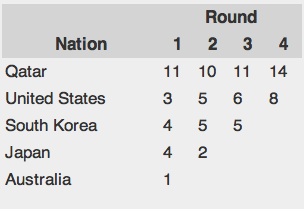
We have only vote totals so we can spot strategic voting only if the switches result in a net loss of votes for a surviving candidate. This happened to Japan but probably for the reasons given above.
The more suspicious switch is the loss of one vote for the round one leader Qatar. One possibility is that a Qatar supporter , seeing Qatar’s survival to round three secured, cast a strategic vote in round two to choose among the other survivors. But the more likely scenario in my opinion is a strategic vote for Qatar in round one by a voter who, upon learning from the round 1 votes that Qatar was in fact a contender, switched back to voting honestly.
Part I of BBC program:
Groovy Action At A Distance
Isaac Washington was so cool
That when he left his stateroom
He would set the door in motion
With the precise velocity
That in the time it would take
For the deceleration
To bring the locking mechanism
To a halt
An infinitessimal measure short
Of fully shut
He has walked
No, drifted,
Just far enough across the deck
At which distance
The radiant force of his
Cool
Was just enough to induce
The final click.

Obama’s favorite strategy is to be middle-of-the-road: don’t side with either Democrats or Republicans and hope both sides support a compromise plan. To do this effectively, it is important not to reveal your true preferences and maintain “strategic ambiguity” as clarity risks alienating one audience or the other. But if it is obvious that one side is not going to support you, you have to show your hand to get the other audience to buy in. Otherwise, no-one will support your policy and it will never pass. I mentioned that Obama already had to do this earlier this year with healthcare reform. Now an interesting article by Matt Bai points out that he faces a similar dilemma over debt reduction.
Mr. Obama has almost invariably sought to position himself halfway between traditionalism and reform, just as his vague notions of “hope” and “change” during the 2008 campaign were meant to appeal simultaneously to both disaffected independent voters and core progressives. And in virtually every case, he has satisfied pretty much no one….Since he isn’t willing to break publicly with liberals, independent and conservative voters tend to see him as a tool of the left. And since he generally won’t do exactly what the left wants him to do, he ends up with very little gratitude from his own party.
This political no-man’s land, however, is about to become uninhabitable. The national debt is near the top of any list of voter concerns at the moment, and when his commission votes Friday on its final recommendations, Mr. Obama will be handed concrete and contrasting options for addressing it.
 Cheap Talk