
You are currently browsing the monthly archive for November 2010.
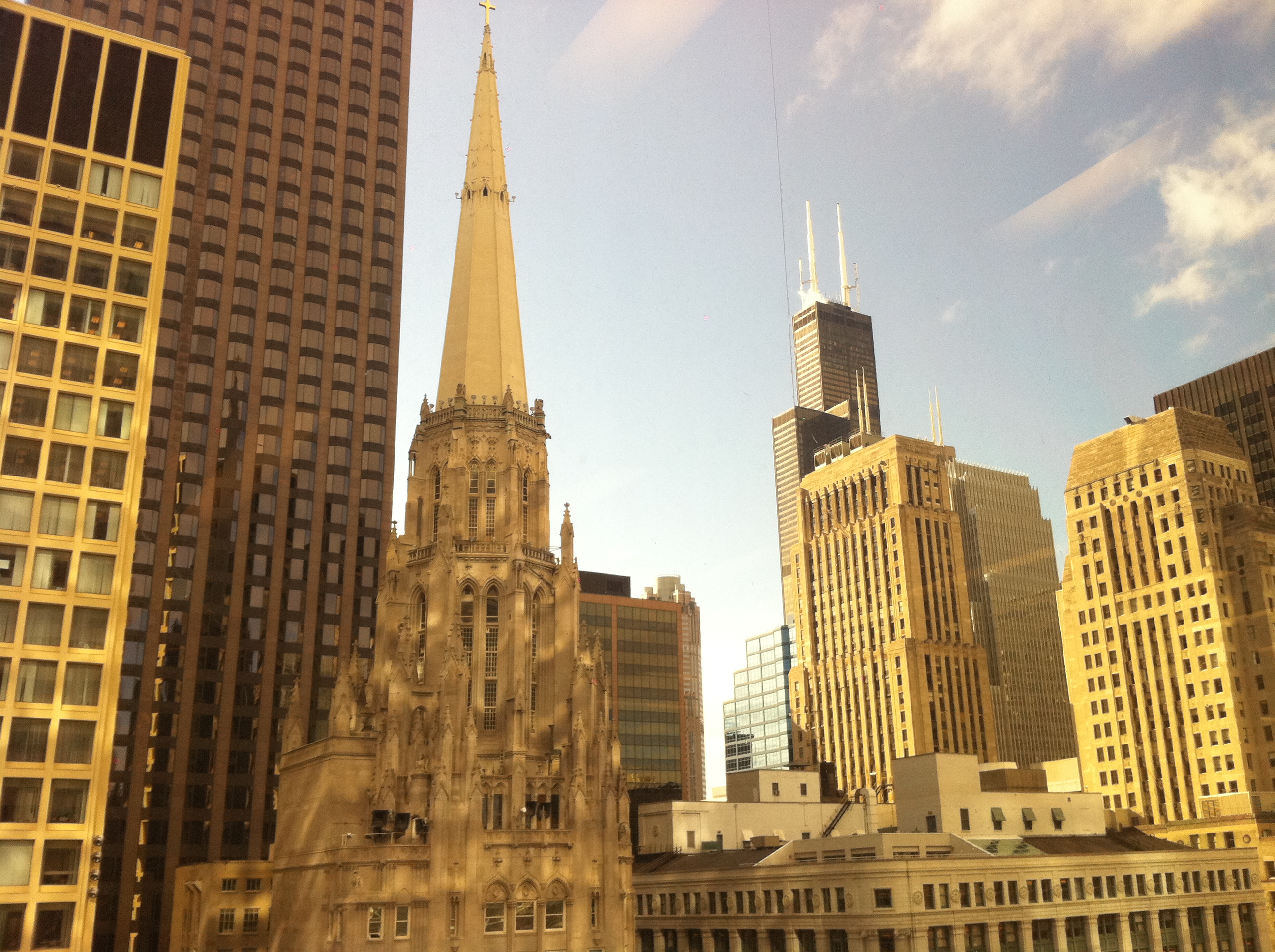
Last Friday I earned $17.20 for a day’s work as a standby juror. Standby jurors wait in a big room until they are put in a panel of 14 and sent into a courtroom for selection. In civil trials, 6 jurors will be selected and seated from the 14. I was rejected from two panels and then sent home.
The jury selection process is a little obscure, but I found this. Here’s the model I glean from it. The panel is numbered 1-14. Lawyers for Plaintiff and Defendant each have 3 “peremptory” challenges which enables them to strike a juror from the panel. The Plaintiff moves first and makes any peremptory challenges. This creates a provisional jury consisting of the 6 highest jurors on the list that have not been eliminated yet. The Defendant can either accept this jury or use a challenge to strike one or more from it sending a new proposed jury, again consisting of the 6 highest jurors not yet struck, back to the Plaintiff. This continues until someone accepts or all challenges are exhausted.
The game can be solved by backward induction. I think something like the following is an optimal strategy. First, when given a proposal of 6 jurors, rank them from least favorable to most. To decide whether to strike the least favorable, ask whether her replacement will be stricken by the opposition (and any further replacements) and if so whether the final replacement will be better or worse than the least favorable now. Of course you could always just strike the 3 least favorable in one go, but you are better off moving sequentially in hopes that the other guy makes a mistake and does it for you.
It gets more complicated when you take into account the challenges for “cause.” These are challenges that require justification on the grounds that the juror is biased. The possibility of challenges for cause explains why the panel has 14 rather than just 12. And challenges for cause are evidently used a lot because on my second panel all but 3 jurors were excused.
In practice the jury selection is at least as much signaling as screening. As if we were playing jury-Jeopardy, the lawyers sent messages phrased in the form of a question. The defendant asked us “Does everybody understand that anyone can file a lawsuit if they pay a fee?” The Plaintiff said “Does everyone understand that an insurance company has all the same rights as an individual?” This is a kind of pre-opening statement.
I wonder whether it was the Plaintiff or Defendant that challenged me. What they knew about me is that I am a Professor of Economics, the father of three kids, and that I drove a car over a mailbox when I was 16. (Both of the cases were insurance claims arising out of an auto accident so they wanted to know.)
When I entered the first courtroom the Judge informed us that this case involved an insurance company. I sized up the lawyers for the two sides. I immediately pegged the Plaintiff as a sleazy ambulance chaser and the Defendant as a slick insurance company henchman whose life’s calling is to deprive the injured their just deserts (and instead send them to the Mojave for ice cream sundaes.) The next thing we were told was that this was in fact a case in which the insurance company was suing a client. So much for reading people by their faces.
The judges struck me as smarter than the attorneys. (This based on talking with them, not just the looks on their faces 🙂 )
30% of my fellow standby jurors were unemployed. 60% were divorced or separated.
Paul Krugman has attacked Senator Evan Bayh‘s suggestion that the Obama administration “overreached by focusing on health care rather than job creation during a severe recession.” Krugman expresses great difficulty in seeing what this statement could mean.
Are people who say that Mr. Obama should have focused on the economy saying that he should have pursued a bigger stimulus package? Are they saying that he should have taken a tougher line with the banks? If not, what are they saying? That he should have walked around with furrowed brow muttering, “I’m focused, I’m focused”?
To answer Paul Krugman’s question, let me suggest that the severity of the current recession could have been reduced if the Obama administration had made financial regulatory reform its top legislative priority in 2009.
When President Obama was inaugurated in January 2009, the American economy was sliding into recession because of a catastrophic loss of confidence in our financial system. In the previous decade, global investors’ confidence in American financial institutions had brought vast capital inflows into the American economy. This confidence had been based on a perception that America’s legal and political system provided safeguards for investors that were second to none in the world. This confidence was shattered in 2008 with the collapse of Lehman Brothers.
A meaningful and effective financial regulatory reform in 2009 could have restored investors’ confidence, reviving investment flows and stemming the loss of jobs. Imagine how different the economic environment might have been on election day in 2010 if President Obama could have announced by September 2009 that, after an intensive review of the financial regulatory system by both Congress and the White House, he was signing into law some carefully designed and well-focused reforms that could restore investors’ and taxpayers’ confidence in American financial institutions.
The focus on health care reform made it impossible to achieve meaningful financial regulatory reform for more than a year after President Obama took office. Health care reform and financial regulatory reform are both extremely complex issues and both have been fiercely resisted by powerful vested interests. Neither reform could be accomplished without strong political leadership at the highest level. The Obama administration could only address one at a time, and only one could be the central focus in the crucial first year when the new President’s political capital was greatest. The Obama administration chose in 2009 to focus on health care reform.
It may be surprising that, when a catastrophic macroeconomic decline is clearly being caused by a loss of confidence in the basic regulatory controls of our financial system, that many leading economists would not see financial regulatory reform as an urgently needed remedy. The reasons may also be found in the history of economic theory, on which I may comment later.
[Thanks to Jeff and Sandeep for letting me guest-blog here.]
We have a new guest-blogger: Roger Myerson.
Roger is a game theorist but his work is known to everyone – theorist or otherwise – who has done graduate work in economics. If an economist from the late nineteenth century, like Edgeworth, or early twentieth century, like Marshall, wakes up and asks, “What’s new in economics since my time?”, I guess one answer is, “Information Economics”.
Is the investment bank trying to sell me a security that it is trying to dump or is it a good investment? Is a bank’s employee screening borrowers carefully before he makes mortgage loans? Does the insurance company have enough reserves to cover its policies if many of them go bad at the same time? All these topical situations are characterized by asymmetric information: One party knows some information or is taking an action that is not observable to a trading partner.
While the classical economists certainly discussed information, they did not think about it systematically. At the very least, we have to get into the nitty-gritty of how an economic agent’s allocation varies with his actions and his information to study the impact of asymmetric information. And perfect competition with its focus on prices and quantities is not a natural paradigm for studying these kind of issues. But if we open the Pandora’s Box of production and exchange to study allocation systems broader than perfect competition, how are we even going to be able to sort through the infinite possibilities that appear? And how are we going to determine the best way to deal with the constraints imposed by asymmetric information?
These questions were answered by the field of mechanism design to which Roger Myerson made major contributions. If an allocation of resources is achievable by any allocation system (or mechanism), then it can be achieved by a “direct revelation game” DRG where agents are given the incentive to report their information honestly, told actions to take and then given the incentives to follow orders. To get an agent to tell you his information, you may have to pay him “information rent”. To get an agent to take an action, you may have to pay him a kind of bonus for performing well, “an efficiency wage”. But these payments are unavoidable – if you have to pay them in a DRG, you have to pay them (or more!) in any other mechanism. All this is quite abstract, but it has practical applications. Roger used these techniques to show that the kind of simple auctions we see in the real world in fact maximize expected profits for the seller in certain circumstances, even though they leave information rents to the winner. These rents must be paid in a DRG and hence if an auction leaves exactly these rents to the buyers, the seller cannot do any better.
For this work and more, he won the Nobel Memorial Prize in Economics in 2007 with Leo Hurwicz and Eric Maskin. Recently, Jeff mentioned that Roger and Mark Satterthwaite should get a second Nobel for the Myerson-Satterthwaite Theorem which identifies environments where it is impossible to achieve efficient allocations because agents have to be paid information rents to reveal their information honestly. This work also uses the framework and DRG I have described above.
Over time, Roger has become more of an “applied theorist”. That is a fuzzy term that means different things to different people. To me, it means that a researcher begins by looking at an issue in the world and writes down a model to understand it and say something interesting about it. Roger now thinks about how to build a system of government from scratch or about the causes of the financial crisis. How do we make sure leaders and their henchmen behave themselves and don’t try to extract more than minimum rents? How can incentives of investment advisors generate credit cycles?
These questions are important and obviously motivated by political and economic events. The first question belongs to “political economy” and hints at Roger’s interests in political science. More broadly, Roger is now interested in all sorts of policy questions, in economics and domestic and foreign policy.
Jeff and I are very happy to have him as a guest blogger. We hope he finds it easy and fun and the blog provides him with a path to get his analyses and opinions into the public domain. We hope he becomes a permanent member of the blog. So, if among the posts about masturbation and Charlie Sheen’s marital problems you find a post about “What should be done in Afghanistan”, you’ll know who wrote it.
Welcome Roger!
I have standby jury duty today. Might make for some good blogging.
- The New York Times torture euphemism generator. My contribution: Logs show binding IC, no IR.
- How WSJ stipple drawings are made. (I came this close to having one but I was edited out of a story on latte art.)
- Nature scores a point versus Nurture.
- Price discrimination based on the browser you use.
- How Chatroulette is making money?
Fresh from their rout of the Democrats, the G.O.P. are promising to repeal President Obama’s healthcare reform. There are lots of things that can be improved in the law but there are also some features that will be popular with voters. To think about the risks of repeal, I find it useful to recall my favorite Rumsfeld quote:
“[A]s we know, there are known knowns; there are things we know we know. We also know there are known unknowns; that is to say we know there are some things we do not know. But there are also unknown unknowns — the ones we don’t know we don’t know.”
In the minds on most voters, the healthcare law in an unknown unknown – most of its provisions have not gone into effect and non-experts (and even experts?) have not read the bill fully. There was never a really serious discussion of the law in the main stream media so citizens just know various buzz words (“death panels”). The huge uncertainty made the law unpopular with voters and it gave Republicans an electoral advantage.
If the Republicans clamor to repeal the law, the Democrats can point to he features of the law that will be popular with voters (no denial of coverage for pre-existing conditions, kids can stay on their parents’ policies till they are twenty six..). The law will go from being an unknown unknown into known unknown/known known territory. There is only upside for Democrats from this change – uncertainty-averse voters can’t have a worse impression of the healthcare reform than they already have. They are judging the unknown unknown in its worst possible light. The risk for Republicans is that if voters find some parts of the law appealing, their assessment actually improves and the Republicans’ electoral advantage diminishes. Better to keep the details hidden.
There is a “middle of the road” strategy – repeal unpopular bits and keep the popular ones. I’m not sure if this is really viable either. It forces a serious discussion of the law. For example, if Republicans try to repeal the requirement to buy insurance coverage, there will be some discussion of the subsidies offered and the costs of getting rid of the provision (some people will not buy insurance and then free-ride on emergency care pushing up costs for everyone else). Even if the discussion is a mess, it can’t be worse than the shallow discussion we sat through last year.
My guess is that the usual promise of tax cuts seems to dominate healthcare repeal as a strategy for Republicans.

- Are people with blue eyes more successful? Many studies of the effects of physical attractiveness have endogeneity problems. But given the randomness of eye color (conditional on parents with recessive genes), siblings make a great control. Someone must have looked at this.
- Procrastination is a best-response to perfectionism. A perfectionist spends too much time on a task, so she should optimally procrastinate so that the deadline disciplines her to work quickly and settle for imperfection.
- When secretly hiding Halloween candy from your kids you face a non-convexity: either hide just a little bit at a time, or go all the way and hide it all. Leaving too little is the worst of both worlds: the stash itself reminds them that they have Halloween candy, then the noticeably small remainder cues them that you are hiding the rest.
- In sports like golf, bowling, and chess players are rated in order to match players of similar skill or handicap the weaker players. Then there are kludgy rules to prevent “sandbagging:” playing poorly in one tournament in order to get an advantage in the next tournament. These systems could surely be improved by formally analyzing the strategy-proof mechanism design problem.
You may have heard that the Michelin guide has been bestowing many stars on Japanese restaurants. So many that Europeans are suspecting ulterior motives.
The generous distribution of stars has prompted a snarky backlash among some Western critics and celebrity chefs, whose collective egos can be larger than acroquembouche. Some have said Michelin is showering stars upon Japan in an attempt to gain favor in a brand-conscious, France-loving country where it wants to sell not only culinary guides, but automobile tires.
Well, the Japanese aren’t so keen either.
Many Japanese chefs, especially in the Kansai region, say they never courted this attention. Even a single Michelin star can be seen as a curse by the Japanese: Their restaurants are for their customers. Why cook for a room full of strangers? Even worse: crass foreigners.
“It is, of course, a great honor to be included in the Michelin guide. But we asked them not to include us,” says Minoru Harada, an affable young Osaka chef. His Sakanadokoro Koetsu, a fish restaurant with a counter and 10 seats, just earned a single star, its first. Loyal customers have sustained the restaurant over the years, he says, adding: “If many new customers come, it is difficult.”
And with the upcoming realease of Michelin’s guide to Tokyo, Japan may soon be the most spangled restaurant nation in the world.
I saw David Myatt present this paper in Oxford this Fall. It made quite a splash with some surprising results about voter turnout rates consistent with “rational choice” theory. Voting theories based on the assumption that voters calculate the costs and benefits have always been thought to imply very low turnout in order to generate sufficiently high probabilities of close elections.
Consider a region with a population of 100,000 where 75% of the inhabitants are eligible to vote. Suppose that a 95% confidence interval for the popularity of the leading candidate stretches from 56% to 61%. If each voter is willing to participate in exchange for a 1-in-2,500 chance of influencing the outcome of the election, then turnout will exceed 50%. Greater turnout for the underdog offsets her disadvantage.
Another celebrity marriage has hit the rocks: Charlie Sheen and Brooke Mueller have filed for divorce. As sad as this is, we economists can tell that Charlie and/or his lawyers are good negotiators. His divorce filing (page 27) requires that:
“In no event and under circumstances shall the child support paid by Charlie for Bob and Max [his kids with Brooke] be less than the child support paid by Charlie to Denise Richards for Sam and Lola…… The sum received by Denise for child support shall be the minimum received by Brooke for Bob and Max.”
This is all dressed with the claim that Denise has higher earning potential than Brooke. But so what? Brooke and her kids are in great shape even if Denise and her kids are in better shape. Envy has to be playing a role. But more cynically, Charlie benefits: If Denise asks for more money, he can refuse saying he’d also have to pay more to Brooke and he simply cannot afford it, given his expensive watch buying habit. Also, Brooke is going to negotiate less hard for more money in the future, hoping Denise does the hard work.
So that brings us to Denise – I am not a legal expert but is it O.K. to mention a contract with Denise in a contract with Brooke without Denise agreeing to it? Denise should really sue to have this clause removed. It definitely hurts her in future negotiations. Denise, if you need an expert witness, I am right here.
Your vote makes a difference only when it is pivotal. Now don’t worry, I am not bringing this up to sort through the tired old arguments about whether you should go to the polls today. You should! That settled, let’s talk about what it implies for how you should vote once you get there.
Because if your vote only makes a difference when it breaks a tie (or makes a tie), then when it comes time to decide how to vote, you might as well assume your vote will be pivotal. And ask yourself how would you vote if your vote was going to make or break a tie.
Be careful. This is not the same as the question “How would you vote if you were the dictator?” Indeed quite often your vote should not be the vote you would cast if yours was the only vote. That’s because when your vote is pivotal you learn something that a dictator doesn’t. You learn that all of the other voters were (almost) perfectly split and and that implies something very specific about the other voters and what they must know about the candidates (or propositions) on the ballot.
Quite often that information is crucial for determining how you want to vote. Let me give you a simple example. Judges are almost always re-elected. Pretty much the only time a judge is voted off the bench is if that judge is completely incompetent. Now you haven’t bothered to read anything about the judges on your ballot. You know nothing about them individually but you know that most judges are doing just fine and should be re-elected.
If you were the dictator (an uninformed dictator!) you would vote yes for every judge. But things turn completely upside-down in an election when you factor in the information you learn from your vote being pivotal. Since all competent judges are easily re-elected, the only way it could have happened that all the other voters are split is that this judge is not competent! Knowing that, and knowing that your vote will decide whether an incompetent judge is re-elected, you should vote no. Against every judge.
Now, the smart readers of this blog have already thought one step ahead and noticed that this logic is self-defeating. Because if everyone figured this out, then everyone is voting against every judge and then every judge is voted down, not just the incompetent ones. Here’s where the theory takes one of two paths, use your judgement.
First you might not believe that the electorate in general is as sophisticated as you are. The vast majority of voters don’t understand the logic of pivotalness and they are naively voting the way they would if they were dictators. In that case, the argument I have laid out works as written and you should vote against every judge.
On the other hand you might believe that a signifcant fraction of voters do understand the strategic subtleties of voting. Then we have an equilibrium to find. For starters we take as given that the judge himself and all of his friends will vote for him. So he has a head start. Now there’s a small group of do-gooders who have read up on this judge and know whether he is competent. They vote as if they are dictators, with good reason now because they are informed. They vote yes if he is competent and no if he is not.
The rest of us know nothing. Until, that is, we take into account what we can infer from being pivotal. And if it were just the informed and the judge’s friends who were voting then what we can infer is that enough of the informed are voting no to counteract the judge’s head start. That is, the judge is incompetent.
In equilibrium none of us uninformed voters vote yes. Because if any of us are voting yes, then effectively the judge has an even bigger head start and that makes it even worse news that the no votes caught up with the head start. But not all of us vote no. Some of us do, but most of us abstain. Enough of us that it remains a valid inference that a pivotal vote means that enough of the informed voted no to make it optimal for us to vote no.
This is the logic of The Swing Voter’s Curse.
I was taught the example below as an undergrad and I think it may originally be due to Pigou (or perhaps, as you will see, it was made up by British Rail):
Suppose travelers can either drive to get from A to B or take the train. The road is free and tolls are technologically infeasible. Using the train requires buying a ticket. In fact, the railways are nationalized and, in a narrow definition of the first-best, they should price at marginal cost (this is a pre-privatization example!). This means too many people will drive, imposing costs on each other and speeding up depreciation of the road. One solution: subsidize train tickets and price them below cost. One departure from optimality – the inability to charge a toll on the road – leads to another – pricing below cost on the train. The theory of the second-best.
Now let’s turn to torture in medieval Continental Europe. The law was administered by professional judges and sentences often involved maiming or death. As the punishment was so severe, the proof had to be overwhelming: Conviction required the testimony of two eyewitnesses to the crime. No circumstantial evidence was allowed. Let us take the two eyewitness rule as a constraint, like the no toll rule for the road.
What can the judge do if there are less than two eyewitnesses but there is circumstantial evidence that the prisoner is guilty? The judge is then allowed to use torture to extract a confession. To prevent false confessions, the prisoner has to give up details only someone who is guilty might know. Dealing with one constraint, the two eyewitness rule, leads to the use of torture, presumably not the best way to introduce circumstantial evidence into judicial proceedings.
There was much room for abuse (leading the prisoner during torture so they know details of the crime etc). Torture was eventually outlawed in judicial proceedings. There are many theories for why. The most prosaic suggests that with incarceration replacing maiming as a tool for punishment, standards for proof could be relaxed. In England, torture was not used as trial was by jury. A jury at that time (or even now?) could take any old fact, circumstantial or not, into account in their deliberations. No need to torture a prisoner when you can convict him on whim anyway!
My source: The Legal History of Torture, John H. Langbein in Torture: A Collection.
 Cheap Talk