
You are currently browsing the monthly archive for July 2010.
This is a very interesting article that has the unfortunate title “Plants Can Think And Remember.” (Unfortunate because the many links to it that I have seen come with snarky comments like “Whatcha gonna do now vegetarians??”)
It reminds me of a great joke: Three scientists are on the committee to decide mankind’s greatest invention. The engineer is arguing for the internal combustion engine, the doctor is arguing for the X-ray machine and Martha Stewart is arguing for the Thermos. “The Thermos, you’ve got to be kidding?” Sez Martha “Well you see it keeps hot things hot and cold things cold.” They look perplexed. “Yeah, big deal.” Martha: “How does it know??”
The article is about some pretty sophisticated ways that plants respond to signals in their environment. That is very cool. Kudos to the Plant Kingdom. But while, there may be something in the underlying research that justifies saying that plants “think”, I rather doubt it, and it is definitely not to be found in this journalistic account. Look:
In their experiment, the scientists showed that light shone on to one leaf caused the whole plant to respond.
“We shone the light only on the bottom of the plant and we observed changes in the upper part,” explained Professor Stanislaw Karpinski from the Warsaw University of Life Sciences in Poland, who led this research.
When I light a match to the coals at the bottom of my charcoal chimney, eventually all of them ignite and turn red even the ones on the top. My charcoal can think.
Then there’s stuff about “memory.” But I already knew that plants had memory. When I give my grass water today, it is green next week. When I don’t give my grass water today, it is brown next week. The grass changes its color next week depending on whether I give it water today. It remembers.
This is Asia:
 More
More 
Here’s an experiment you can do that will teach you something. Get a partner. Think of a famous song and clap out the melody of the song as you sing it in your head. You want your partner to be able to guess the song.
Out of ten tries how often do you think she will guess right? Well she will guess right a lot less than that. This is the illusion of transparency which is very nicely profiled in this post at You Are Not So Smart. We overestimate how easily our outward expressions communicate what is in our heads.
This should be an important element of behavioral game theory because game theory is all about guessing your partner’s intentions. As far as I know, biases in terms of estimates of others’ estimates of my strategy is untapped in behavioral game theory. Its effects should be easily testable by having players make predictions about others’ predictions before the play of a game.
There are games where I want my partner to know my intentions. For example I want my wife to know that I will be picking up coffee beans on the way home, so she doesn’t have to. Of course I can always tell her, but if I overestimate my transparency we might have too little communication and mis-coordinate.
Then there are games where I want to hide my intentions. In Rock-Scissors-Paper it shouldn’t matter. I might think that she knows I am going to play Rock, and so at the last minute I might switch to Scissors, but this doesn’t change my overall distribution of play.
It should matter a lot in a casual game of poker. If my opponent has a transparency illusion he will probably bluff less than he should out of fear that his bluffing is too easy to detect. So if I know about the transparency illusion I should expect my opponent on average to bluff less often.
But, if he is also aware of the transparency illusion and he has learned to correct for it, then this changes his behavior too. Because he knows that I am not sure whether he suffers from the illusion or not, and so by the previous paragraph he expects me to fold in the face of bluff. So he will bluff more often.
Now, knowing this, how often should I call his bets? What is the equilibrium when there is incomplete information about the degree of transparency illusion?
In a long game of course reputation effects come in. I want you to believe that I have a transparency illusion so I might bluff less early on.
Academics appreciate the pure search for knowledge, whether or not it can ever be put to use. This is the pinnacle:
In what appears to be an attempt on Amruthavalli’s part to understand suicide by hanging, the housewife hanged herself from the ceiling of her family home in Madivala on July 7.
What the suicide note says:
‘No one is responsible for my death. For many days I have harboured a wish and have had doubts about how people hang themselves. So just I am trying to get to the bottom of the matter by hanging myself. No one should be held responsible for my death. I love you Bava, I love you dad, mom and my sisters. I love you Saran. Thanks for everything Athama.’
-Amruthavalli
Hood hello: nimbupani.
Are prejudices magnified depending on the language being spoken? An experiment based on a standard Implicit Association Test suggests yes.
In an Implicit Association Test pairs of words appear in sequence on a screen. Subjects are asked to classify the relationship between the words and then the time taken to determine the association is recorded. In this experiment the word pairs consisted of one name, either Jewish or Arab, and one adjective, either complimentary or negative. The task was to identify these categories, i.e. (Jewish, good); (Jewish, bad); (Arab, good); (Arab, bad).
The subjects were Israeli Arabs who were fluent in both Hebrew and Arabic.
For this study, the bilingual Arab Israelis took the implicit association test in both languages Hebrew and Arabic to see if the language they were using affected their biases about the names. The Arab Israeli volunteers found it easier to associate Arab names with “good” trait words and Jewish names with “bad” trait words than Arab names with “bad” trait words and Jewish names with “good” trait words. But this effect was much stronger when the test was given in Arabic; in the Hebrew session, they showed less of a positive bias toward Arab names over Jewish names. “The language we speak can change the way we think about other people,” says Ward. The results are published in Psychological Science, a journal of the Association for Psychological Science.
Nice. But this leaves open the possibility that, since Hebrew is the second language, all response times in the Hebrew treatment were increased simply making it harder to see the bias. I would still prefer a design like this one.
Balaclava bluster: Johnson.
Yesterday on the NPR hourly newscast the lead-in to the barefoot bandit story was this “A man allegedly known as the barefoot bandit…” Perhaps I had too much time on my hands (I had a doctor’s appointment and they always go like this: Step 1) you are 30 minutes too early Step 2) please wait for an additional hour in a room with no AT&T reception Step 3) Stop wasting our time, your blood pressure is 120 over 70, go away and never come back) but this struck me as a strange way to phrase it.
Journalists apparently have a self-imposed rule that suspects should be “alleged” to have done whatever they are suspected of, at least until they are convicted. Presumably this is to avoid prejudging guilt. Now, since this guy was just picked up, the rule applies and he is “allegedly” something. But allegedly what? “Allegedly known as the barefoot bandit.” Is it a crime to be known as the barefoot bandit? And is that what he is accused of?
OK, there were some crimes committed and all of these crimes are thought to have been committed by the same person and that, so far unidentified, person has been given a proxy identity “the barefoot bandit.” Now we are trying to find the barefoot bandit. The linguistic complication is that since “the barefoot bandit” is not a real identity you cannot say that someone “is” the barefoot bandit. Whoever this criminal is, he is “AKA (*also* known as) the barefoot bandit.” We are not literally looking for someone who is called the barefoot bandit, as if that by itself is a crime. We are looking for the person who committed the crimes which have been grouped together by that heading.
So we are looking for the person who (not by his own choice has come to be) “known as the barefoot bandit.” And now we have to somehow fit the “allegedly” in there in order to comply with the journalistic moral code. That’s the problem and the NPR copyeditor seems to have just stuck them together without trying to parse the final product.
Probably he didn’t have the spare time afforded by a futile doctor’s appointment. Or if he did, he had no iPhone reception to make the necessary changes before the newscast went live.
An executive rises through the ranks at a large organization and becomes C.E.O. He makes terrible decisions or is a passive leader, letting the firm slide into obscurity. The firm is publicly traded and poor performance is observable. But the C.E.O. manages to get another great job, leading a “turnaround” at another large organization. He uses the same strategy that performed so badly in the first firm. His second firm also goes down the tube. This story is loosely based on an example I use in one of my M.B.A. classes. And I have another new example. How can it happen?
The first theory is pretty simple. If a project fails, it is hard to know where to lay the blame – the economic climate, the C.E.O., bad luck etc. etc. The the C.E.O. can come up with a story that helps him look like a leader not a loser. Even worse, the people he works with want to get rid of him. Perhaps they say nice things and sell a lemon to someone else. The potential recipients of the lemon should know the perverse incentives in play and avoid the winner’s curse. Perhaps the consult insiders they trust and with whom they will likely have a long future relationship.
But this theory does not accommodate cases where the C.E.O. publicly proposed and pushed a failed strategy at the first firm. Or very obviously did not do his job. Even these characters can pull off a successful exit. The rationale for this phenomenon has two parts: (a) the pool of viable potential leaders is small and (b) very few people have the experience of running a large organization. So, even if they performed poorly, perhaps they can learn from their mistakes and do better the second time around.
This presumes that a known bad performer carries less risk than an unknown performer because the former has experience. I find it hard to believe. A rational choice interpretation would be nice for the conscious purchase of a known experienced lemon who might change over a potential inexperienced mango.

You firmly believe that the sun will rise every morning. Then one day you awake and the sun does not rise. What are you to believe now? You have basically two alternatives. One is to go on believing that the sun will rise every morning by rationalizing today’s exception. There could have been a total eclipse this morning. Perhaps you are dreaming. The other choice is to conclude that you were wrong and the sun does not rise every morning.
The “rational” (i.e. Bayesian) reaction is to weigh your prior belief in the alternatives. Yes, to believe that you are dreaming despite many pinches, or to believe that a solar eclipse lasted all day would be to believe something near to absurdity, but given your almost-certainty that the sun would always rise we are already squarely in the exceptional territory of events with very low subjective probability. What matters is the relative proportion of that low total probability made up of the competing hypotheses: some crazy exception happened, or the sun in fact doesn’t always rise. It would be perfectly understandable, indeed rational if you find the first much more likely than the second. That is, even in the face of this contradictory evidence you hold firm to your belief that the sun rises and infer that something else truly unexpected happened.
Cognitive dissonance is a family of theories in psychology explaining how we grapple with contradictory thoughts. It has many branches, but a prominent one and perhaps the earliest, suggests that we irrationally discard information that is in conflict with our preconceived ideas. It began with a study by Leon Festinger. He was observing a cult who believed that the Earth was going to be destroyed on a certain date. When that date passed and the Earth was not destroyed, some members of the cult interpreted this as proof they were right because it was their faith that saved humanity. This was the leading example of cognitive dissonance.
My preamble about Bayesian inference shows that when we see people who are rigid in their beliefs and we conclude that they are irrationally ignoring information, it is in fact we who are jumping to a conclusion. All we can really say is that we disagree with their prior beliefs and in particular the strength of those beliefs. Somehow though it is much less satisfying to just disagree with someone than to say that they are acting irrationally in the face of clear evidence.
Now, watch this video, especially the part that starts at the 3:00 mark. When this guy experiences his moment of cognitive dissonance, what is the rational resolution?
I am giving my paper with Jeff at the annual conference of the Society of Economic Dynamics in Montreal. And I just found 5 dollars Canadian on the floor in a conference room. At first, I thought it was a practical joke but no-one popped out of a room and snapped a photo. So, I guess it was not a setup. In present company, my experience is consistent with the following joke:
An economics professor and a grad student are walking along the sidewalk, and the grad student spots a twenty dollar bill on the sidewalk. He says, “Hey professor, look, a twenty dollar bill.” The professor says, “Nonsense. If there were a twenty dollar bill on the street, someone would have picked it up already.” They walk past, and a little kid walking behind them pockets the bill.
- Beverage assortment must include thoughtful assortment of meads and bendy straws.
- Sad Keanu.
- Very early Talking Heads playing Psycho Killer.
- 70’s rock stars photographed with their parents. (via Marbury.)
- Marvin Gaye sings The Star Spangled Banner. (This by itself justifies the whole revolutionary war.)
- I just hope it’s me.
- Tired, yeah right, a likely excuse.
- Are civil wars more often North vs South than East vs West? Put differently, based on the boundaries that have survived until today, are countries, on average, wider than they are tall?
- Which will arrive first: the ability to make a digital “mold” of distinctive celebrity voices or the technology allowing celebrities to map the digital signature of their voice in order to claim property rights?
- The hard `r` in Spanish and other languages creates a natural syncopation because the r usually occupies the downbeat, as in “sagrada” or “cortado”
- Syncopation adds a dimension to music because brain tickles as it tries to make sense of two times at once.
- Among European soccer nations, the closer to Africa the fewer black players on the national team.
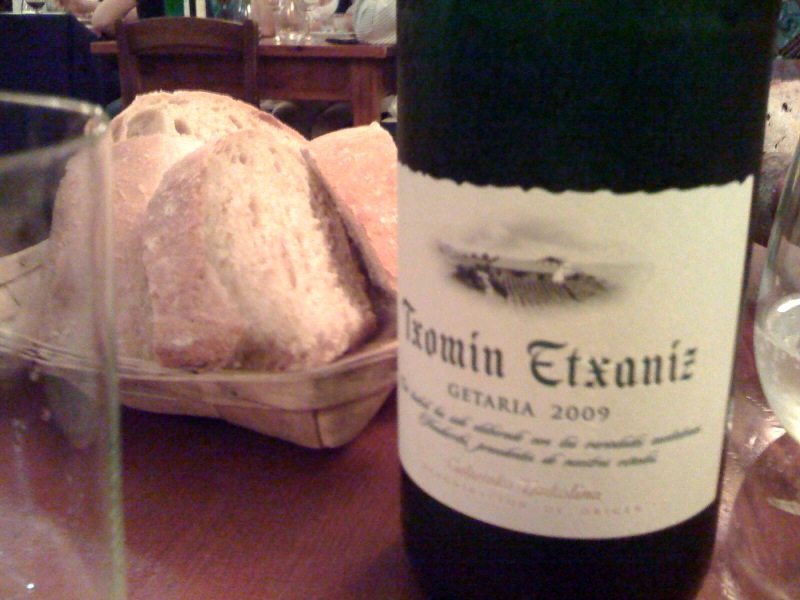
Usually you order a bottle of wine in a restaurant and the waiter/wine guy opens it and pours a little for you to taste. Conventionally, you are not supposed to be deciding whether you made a good choice, just whether or not the wine is corked, i.e. spoiled due to a bottling mishap or bad handling. In practice this itself requires a well-trained nose.
But in some restaurants, the sommelier moves first: he tastes the wine and then tells you whether or not it is good.
Suspicions are not the only reason some people object to this practice. Others feel they are the best judges of whether a wine is flawed or not, and do not appreciate sommeliers appropriating their role.
We should notice though that it goes two ways. There are two instances where the change of timing will matter. First there is the case where the diner thinks the wine is bad but the sommelier does not. Here the change of timing will lead to more people drinking wine that they would have rejected. But that doesn’t mean they are worse off. In fact, diners who are sufficiently convinced will still reject the wine and a sommelier whose primary goal is to keep the clientele happy will oblige. But more often in these cases just knowing that an expert judges the wine to be drinkable will make it drinkable. On top of this psychological effect, the diner is better off because when he is uncertain he is spared the burden of sticking his neck out and suggesting that the wine may be spoiled.
But the reverse instance is by all accounts the more typical: diners drinking corked bottles because they don’t feel confident enough to call in the wine guy. I have heard from a master sommelier that about 10% of all bottles are corked! Here the sommelier-moves-first regime is unambiguoulsy better for the customer because a faithful wine guy will reject the bottle for him.
Unless the incentive problem gets in the way. Because if the sommelier is believed to be an expert acting in good faith, then he never lets you drink a corked bottle. You rationally infer that any bottle he pours for you is not spoiled, and you accept it even if you don’t think it tastes so good. But this leads to the Shady Sommelier Syndrome: As long as he has the tiniest regard for the bottom line, he will shade his strategy at least a little bit, giving you bottles that he judges to be possibly, or maybe certainly just a little bit, corked. You of course know this and now you are back to the old regime where, even after he moves first, you are still a little suspicious of the wine and now its your move. And your bottle is already one sommelier-sip lighter.
You are a poor pleb working in a large organization. Your career has reached a stage where you are asked to join one of two divisions, division A or division B. You can’t avoid the choice even if you prefer the status quo – it would be bad for your career. Each division is controlled by a boss. Boss A is sneaky and self-serving. perhaps he is “rational” in the parlance of economics. Even better, perhaps his strategy is quite transparent to you after a brief chat with him so you can predict his every move. He is the Devil you know. Boss B might be rational or might be somewhat altruistic and have your best interests at heart. He is the Devil you don’t know. Neither boss is going anywhere soon and you have no realistic chance of further advancement. You will be interacting frequently with the boss of the division you choose.
Which division should you join?
You face a trade-off it seems. If you join division A, it is easier for you to play a best-response to boss A’s strategy – you can pretty much work out what it is. If you join division B, it is harder but the fact that you don’t know can help your strategic interaction.
For example, suppose you are playing a game where “cooperation” is not an equilibrium if it is common knowledge that both players are rational – the classical story is the Prisoner’s Dilemma. Then, the incomplete information might help you to cooperate. If you do not cooperate, you reveal you are rational and the game collapses into joint defection. If you cooperate, you might be able to sustain cooperation well into the future (this is the famous work of Kreps, Milgrom, Roberts and Wilson).
On the other hand, if you are playing a pure coordination game, this logic is less useful. All you care about is the action the other player is going to take and you want to play a best response to it. So, the division you should join depends on the structure of the later boss-pleb game.
Perhaps it is possible to frame this question in such a way that the existing reputation and game theory literature tells us if and when incomplete information should be welcomed by the pleb so you should play with the Devil you don’t know and when it is bad, so you should play with the Devil you know?
You have probably heard about the science that shows how incompetent people are overconfident. Here is a nice article which cuts through some of the hype and then presents a variety of ways to debunk the finding as a statistical illusion. (Which comes as a relief to me, but perhaps a little late.) Let me give you an even easier way, one that is related to the “regression toward the mean” idea given in the article. First, here is the finding summarized in a graph.
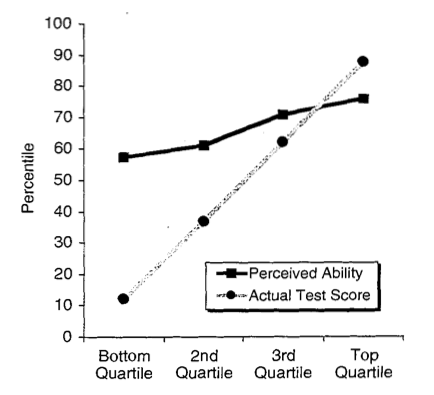
Suppose you have competent and incompetent people in equal proportions. They will take a test which will give them a score ranging from 0 to 4. The competent people score a 3 on average and they know this. The incompetent people score 1 on average and they know this. Due to idiosyncratic features of the test, the weather, etc. each subject’s actual score is random and it will range from one less to one more than their average.
You ask everyone to predict their outcome. The incompetent people predict a score of 1 and the competent people predict a score of 3. These are the best predictions. Then they take the test. The actual scores range from 0 to 4. Everyone who scored 0 predicted a score of 1, everyone who scored 4 predicted a score of 3, and the average prediction of those who scored 2 is about 2.
Trilby tribute: Marginal Revolution.
Some organizations have clearly defined goals and many of the tactics to meet their goals come readily to mind. An economics department wants to produce the best research possible and the best grad students possible. They try to hire great professors, train students well and place them in good universities. If the organization is resource constrained, there will be conflict. A good leader for this kind of organization needs strong arbitration and mediation skills but not vision. A neutral player is the ideal leader. A leader with strong preferences one way or the other will alienate some members and escalate conflict. Only if the organization needs to radically alter course will vision be required. For example, if an economics department wants to leap up in the rankings or is in danger of decline, a visionary needs to take control.
But in most organizations and at most points in time, things are not so easy. A firm wants to maximize profits but how should it do so? For example, Microsoft has done very well for itself but how many it avoid being left behind as Apple and Google capture the imagination of new consumers? And Microsoft needed a vision when it started and when it grew. In some organizations, there is a fundamental uncertainty about what an organization should be doing and where it should be going. Almost everyone may accept that the status quo is not sustainable and that a leader with a vision for the organization should take control. In this scenario, there are common values among the members of the organization and for better or worse it will move in some direction established by the vision of the leader. If everyone does not agree, then the organization will stay at the status quo. It may slowly or even rapidly depreciate. Only a random shock can salvage it.

If you play tennis then you know the coordination problem. Fumbling in your pocket to grab a ball and your rallying partner doing the same and then the kabuki dance of who’s gonna pocket the ball and who’s going to hit first? Sometimes you coordinate, but seemingly just as often the balls are simultaneously repocketed or they cross each other at the net after you both hit.
Rallying with an odd number of balls gives you a simple coordination device. You will always start with an unequal number of balls, and it will always be common knowledge how many each has even if the balls are in your pockets.
I used to think that the person holding 2 or more should hit first. That’s a bad convention because after the first rally you are back to a position of symmetry. (And a convention based on who started with two will fail the common knowledge test due to imperfect memory, especially when the rally was a long one.)
Instead, the person holding 1 ball should hit first. Then the subgame following that first rally is trivially solved because there is only one feasible convention.
By the way, this observation is a key lemma in any solution to Tyler Cowen’s tennis ball problem.
Of course this works with any odd number of balls. But five is worse. It becomes too hard to keep track of so many balls and eventually you will lose common knowledge of the total number of balls in rotation.
With many neighbors willing to help with childcare, my wife and I managed to escape for a quick meal on our own. We went to Anteprima, within easy striking distance of Evanston. At a dinner at Rialto in Boston, I’d guessed that we’d eat better and cheaper at Anteprima and our experience proved me right. The chef has the market-driven sensibility that is all the rage. I was in luck because someone must have brought squash blossoms to the market that week. So, I had lovely fried zucchini flowers stuffed with ricotta-herb mix. My wife had the Tuscan crostini and enjoyed it as well. We both settled for the spaghetti with tomato, chilis and crispy breadcrumbs – easily made at home unlike the stuffed squash blossoms! We didn’t regret it as it was executed perfectly.
In New York City, people might expect this kind of meal from their local Italian joint. After Boston, it seemed extraordinary to us.
For dessert, we ended up getting overpriced gelato at Pasticceria Natalina. The owner makes quite exceptional pastries but the pricing is crazy. No-one else was there and I wonder if this unique place is going to last too much longer. Someone should tell them about the trade-off between margin and volume and perhaps also how to calculate margin correctly in the first place – don’t incorporate fixed and sunk costs into your pricing decision! It makes you think that elementary economics is actually useful for business owners.
How often do you and your friends agree?
According to recent work by Winter Mason, Duncan Watts, and myself [Sharad Goel], you probably don’t know them as well as you think. In particular, we found that when friends disagree on a political issue, they are unaware of that disagreement about 60% of the time. Even close friends who discuss politics are typically unaware of their differences in opinions.
You probably can guess my reaction. (Or at least you think you can.) Since I am always right, and my friends are right more often than they are wrong, I am right to assume that they agree with me more often than not.
It turns out that my distant friends are right just about as often as my close friends:
people consistently overestimate the likelihood that their friends agree with them on political issues. Notably, even though close friends (so-called strong ties[1]) are in reality more likely to agree with one another than distant friends, people do not appropriately adjust their perceptions. In other words, though we think close and distant friends are about equally likely to agree with us on political issues, in reality we are much more likely to agree with close friends.
I am very interested in this kind of survey work because I think that people do overestimate how similar they are to the rest of the world and I think it has important consequences. But perhaps for different reasons than these authors are emphasizing.
At the margin people are too reluctant to express themselves because they assume that what they have to say is obvious. But in fact the obvious thing is exactly what you want to say. Because the more obvious the thought the more likely it is uniquely yours and the more valuable it is to others.
Apple’s latest response to the iPhone 4 antenna issue:
Upon investigation, we were stunned to find that the formula we use to calculate how many bars of signal strength to display is totally wrong. Our formula, in many instances, mistakenly displays 2 more bars than it should for a given signal strength. For example, we sometimes display 4 bars when we should be displaying as few as 2 bars. Users observing a drop of several bars when they grip their iPhone in a certain way are most likely in an area with very weak signal strength, but they don’t know it because we are erroneously displaying 4 or 5 bars. Their big drop in bars is because their high bars were never real in the first place.
Apple will soon be releasing a software update that will fix the problem by lowering the number of bars displayed on your phone. In related news, in response to my students’ grade groveling I have re-examined the midterm and noticed that everyone’s score was 5 points higher than it should have been. The curve has been re-calculated.
It gets harder and harder to avoid learning the outcome of a sporting event before you are able to get home and watch it on your DVR. You have to stop surfing news web sites, stay away from Twitter, and be careful which blogs you read. Even then there is no guarantee. Last year I stopped to get a sandwich on the way home to watch a classic Roddick-Federer Wimbledon final (16-14 in the fifth set!) and some soccer-moms mercilessly tossed off a spoiler as an intermezzo between complaints about their nannys.
No matter how hard you try to avoid them, the really spectacular outcomes are going to find you. The thing is, once you notice that you realize that even the lack of a spoiler is a spoiler. If the news doesn’t get to you, then at the margin that makes it more likely that the outcome was not a surprise.
Right now I am watching Serena Williams vs Yet-Another-Anonymous-Eastern-European and YAAEE is up a break in the first set. But I am still almost certain that Serena Williams will win because if she didn’t I probably would have found out about it already.
This is not necessarily a bad thing. Unless the home team is playing, a big part of the interest in sports is the resolution of uncertainty. We value surprise. Moving my prior further in the direction of certainty has at least one benefit: In the event of an upset I am even more surprised. This has to be taken into account when I decide the optimal amount of effort to spend trying to avoid spoilers. It means that I should spend a little less effort than I would if I was ignoring this compensating effect.
It also tells me something about how to spend that effort. I once had a match spoiled by the Huffington Post. I never expected to see sports news there, but ex post I should have known that if HP is going to report anything about tennis it is going to be when there was an upset. You won’t see “Federer wins again” there.
Finally, if you really want to keep your prior and you recognize the effects above, then there is one way to generate a countervailing effect. Have your wife watch first and commit to a random disclosure policy. Whenever the favorite won, then with probability p she informs you and with probability 1-p she reveals nothing.
 Cheap Talk