
You are currently browsing the category archive for the ‘art of office politics’ category.
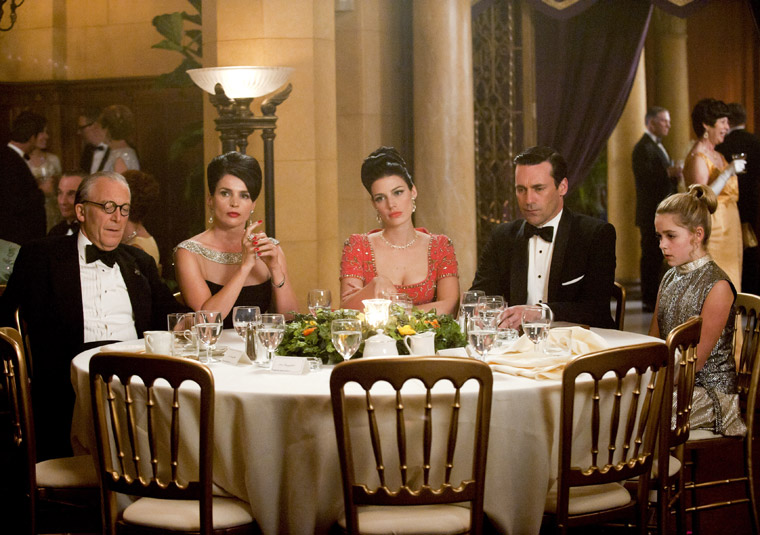
Derrick Rose is out for the season and a weekend that started badly might have ended sadly with another super dark episode of Mad Men. Instead, we got a few comedic rays of sunshine to break through the gloom – Pete tricking Megan’s pretentious father, Peggy’s mother’s surprise that Abe’s favorite dish is ham etc. Those of us looking to enliven our courses with the odd example here or there had to wait till the end.
Don is busy trying to drum up new business at his award dinner. He got the award for an anti-cancer ad he took out in the newspaper after losing the Lucky Strike cigarette account. But a colleague’s father rains on Don’s parade. He says that no-one will give Don any new business after he stabbed Lucky Strike in the back. Don signaled to the wrong audience in the last period of the Lucky Strike game. He tried to co-opt consumers by pretending to be concerned about their welfare. But consumers will not give his firm new accounts, firms selling crap to them will. And with them Don lost his reputation – will he also throw them under the bus if things turn sour? Life is an infinite horizon game with many bilateral interactions. Lose your reputation in one and, if your behavior is publicly observable, lose your reputation in all.
I am catching up on my Mad Men viewing after a spring break trip abroad. I watched three episodes in one sitting last night. In Episode 3, copywriter Peggy interviews candidates for an open position. She likes the work of Michael Ginsburg whose portfolio is labelled “judge not, lest you be judged”. Her co-worker agrees with Peggy’s assessment of Ginsburg’s work but advises her not to hire him because, if Ginsburg turns out to be a better copywrite than Peggy, she risks losing her job to him. Later in the episode (or was in the next?), Pete humiliates Roger, taking credit for winning an account for the advertising company. Roger storms out. He says he was good to Pete when he was young, recruited him and look how he is lording it over Roger now. A portend of Peggy’s future?
Recruiting and peer review are plagued with incentive problems in the presence of career concerns. If you recruit somebody good, you risk the chance that they replace you later on. You have an incentive to select bad candidates. You have an incentive to denigrate other people’s good work (the NIH syndrome) for even deliberately promote their bad work in the hope that it fails dramatically and this allows you to leap over them in some career race. The solution in academia is tenure. If you have a job for life, you can feel free to hire great candidates. (Various psychological phenomena such as insecurity compromise this solution of course!) Peggy does not have tenure and even Roger who is a partner faces the ignominy of playing second fiddle to a young upstart. Watch out Peggy!
You are Chair of your Department and the Department hires two people at the senior level. It is hard to hire at the senior level and many people congratulate you on your success. But the candidates were proposed by others and wooed by others. One is moving because of a divorce and the other is a lemon who is despised by his former colleagues. All you did as Chair was handle the admin stuff and yet everyone still congratulates you. If you had failed to hire, they would have blamed you, even though all that happened was that a marriage worked out and a lemon went elsewhere.
This kind of stuff happens all the time. Why?
The simplest explanation comes from the Principal-Agent model with the Chair as the Agent and the Department as the Principal. In an optimal contract, the Agent is punished for low output and rewarded for high even though in equilibrium we know he has already sunk high effort and output reflects a random shock. If we forgave the agent low output – after all it was a random shock – it would undercut the Agent’s ex ante incentive to exert effort. Similarly, the Department should venerate or denigrate the Chair based on success or failure at senior hiring. Otherwise, you would never work at all on senior recruiting.


The nationally recognized Piven Theatre Workshop would play a leading role in the revitalization of the Noyes Cultural Arts Center, occupying renovated space and a state-of-the-art theater in the building under a plan that received backing Monday from a city committee…
With past efforts to change things at the city owned building “not going as smoothly, as easily as we wanted,” the new plan seems to heading the city in the right direction, said Alderman Judy Fiske, in whose 1st Ward the building is located….
Piven Theatre officials are proposing to occupy the southern one-third of the building and would extensively renovate the area with new classrooms, rehearsal space, offices and a new theater, he said……
The building, which leases space at below-market rates to artists, faces substantial repairs, including a new roof and heating and air conditioning system.
City officials have looked at a new model for operating the center, a former school building, including asking tenants to take a greater role in the building’s upkeep.
Because of the ambiguity, Piven officials told [officials] last fall they were likely moving out of the building, and possibly out of Evanston…
Clear property rights are necessary to resolve the hold up problem.
But a battle to establish property rights can generate a war of attrition and hence the hold up problem. For the Church of thew Holy Sepulchre inthe Old City in Jerusalem:
The primary custodians are the Eastern Orthodox, Armenian Apostolic, and Roman Catholic Churches, with the Greek Orthodox Church having the lion’s share. In the 19th century, the Coptic Orthodox, the Ethiopian Orthodox and the Syriac Orthodox acquired lesser responsibilities…
Under the status quo, no part of what is designated as common territory may be so much as rearranged without consent from all communities. This often leads to the neglect of badly needed repairs when the communities cannot come to an agreement among themselves about the final shape of a project….A less grave sign of this state of affairs is located on a window ledge over the church’s entrance. Someone placed a wooden ladder there sometime before 1852, when the status quo defined both the doors and the window ledges as common ground. The ladder remains there to this day, in almost exactly the same position it can be seen to occupy in century-old photographs and engravings.
If one church fixes something, they then claim property rights over the thing they fix. Hence, all repair is vetoed
The big event of this week in the U.S. will be the Supreme Court discussion of the Affordable Care Act aka “ObamaCare”, a supposedly derogatory nickname now embraced by the Obama campaign. At the heart of the fight is the so-called individual mandate which requires everyone to purchase health insurance. A related and important argument is that additional provisions, such as requiring coverage for individuals with preexisting conditions, become prohibitively expensive without the individual mandate. This is because, without the mandate, healthy individuals will not buy insurance till they become sick and this drives up costs of insurance companies. So, if the individual mandate is struck down, the argument goes, the court should also strike down the requirement that insurance companies cover individuals with pre-existing conditions.
I am not a lawyer but the main argument for canceling the individual mandate turns on whether the federal government has the right to penalize an individual if they do NOT take a certain action. There is plenty of precedent for taxing “action” but can the federal government tax “inaction”? Many amicus briefs have been filed but there are two key ones by economists.
David Cutler, who worked in the Obama administration, has filed one with many co-signatories (including Akerlof, Arrow, Maskin, Diamond, Gruber, Athey, Goldin, Katz, Rabin, Skinner etc.). They say there is no such thing as inaction. A conscious decision to forego healthcare is an action and hence under the purview of existing law. Foregoing insurance also affects outcomes largely by shifting costs to others and hence is not a neutral decision.
The other side of the argument is filed by Doug Holtz-Eakin with co-signatories inclusing Prescott, Smith, Cochrane, Jensen, Anne Krueger, Meltzer etc.) First, they argue that if an individual does not want to buy converage it must be because the costs outweigh the benefits. Second, they argue about the numbers, claming the costs imposed by the uninsured on the insured (“cost-shifting”) are far below the $43 billion estimated by the Government Economists and are more like $13 billion.
The first part of the Holtz-Eakin argument is, to me at least, odd. Uninsured individuals can get healthcare for free in the emergency room. Hence, they can get the benefits of healthcare -or at least healthcare in extreme circumstances – without the costs. So, of course for them the benefits are outweighed by the costs because they get the benefits anyway. The argument by Holtz-Eakin presumes that the individuals are not free-riding and so their private decisions fully reflect the costs and benefits but they do not. Then, the second part of the argument which admits there is cost-shifting going on basically makes the point I am making – if there is cost-shifting, there is free-riding and then individual’s decisions do not fully internalize costs and benefits.
There has to be a better argument against the individual mandate than this. I looked at Senator Rand Paul’s brief. The precedent for this case is a 1942 case involving an Ohio farmer who was exceeding his quota of wheat production. Footnote 6 caught my eye:
So infamous is the case, it has been set to music, to the
1970s tune of “Convoy”:
“His name was farmer Filburn, we looked in
on his wheat sales. We caught him exceeding
his quota. A criminal hard as nails. He said,
“I don’t sell none interstate.” I said, “That
don’t mean cow flop.” We think you’re
affecting commerce. And I set fire to his crop,
HOT DAMN! Cause we got interstate
commerce. Ain’t no where to run! We gone
regulate you. That’s how we have fun.”
Will this convince Justice Kennedy or is it cow flop?
Dr Richard Weitz, Senior Fellow and Director of the Center for Political-Military Analysis at Hudson Institute said: “From our perspective, China should have done more in terms of security. From their perspective, they didn’t need to; they could free-ride, we were going to do it anyway. They didn’t see any point because all they would do is incur a lot of sacrifice and antagonise the Taliban and the global terrorist movement, and they’d rather let us incur that.”
Why aren’t Western countries going in there themselves?
Peter Galbraith, former deputy head of the UN mission in Afghanistan, said: “Western companies are exceptionally timid when it comes to operating in places where there is even the remotest hint that it might be a little risky, and the Chinese are not and are willing to go to these places. And the Chinese have business practices that Western countries … let’s just say that Chinese generosity towards local officials exceeds that of what Western companies are capable.”
I guess some might argue trade is good for Afghanistan and hence for us if trade leads to a stable prosperous economy. But as I have made it to Chapter 4 of Acemoglu and Robinson’s Why Nations Fail, I worry that Afghanistan will adopt “extractive political institutions” and all this trading will lead nowhere except a Swiss bank account.

A Generalist is good at many tasks, a Specialist only good at one. Demand for the output at each task fluctuates so it is good to have someone who can perform many tasks so “supply can match demand”. So, the Generalist is better for the firm than the Specialist.
But the Generalist’s life is hard – she is taking on a lot of risk. What will she be working on next? And she is the same rank as the specialist so she gets the same rewards. Better to coast on the tasks she likes least and work hard on one. More predictability and a better idea of what task to get better and better at performing.
So, generalists should disappear in the long run and the firm will just have specialists. Unless they can think of some way to reward generalists.
There are three divisions in a firm, A, B and C. Each makes a different kind of product. Resources are allocated from Center and the three divisions compete for them. Over time the members of each division generate ideas for new products that need funding. The ideas may be good or bad and the division members get an accurate signal of the quality of the idea. The members of other divisions get a noisy signal or no signal at all. The three divisions have to send a vote to the Center which will determine whether to fund the idea or not. The greater the number of divisions supporting an idea, the more likely it is to be funded by Center.
Division A is “honest”. They only push their ideas if they are good. They support the ideas of other divisions if and only they become convinced by objective arguments that they are good.
Division B is an “empire builder”. They push all their ideas as if they are all good. They thrash other divisions’ ideas if they feel threatened.
Division C is “honest yet strategic”. They push their ideas if and only if they are good. How should they vote on other divisions’ ideas? Division A is likely to be on their side when they push an idea. After all, Division C only support their own ideas if they have a good signal. They can then convince Division A of the strength of their case. To convince Center, it would be even better to have a unanimous decision with Division B on board. So, Division C supports Division B’s ideas. If Division A proposes an idea for funding and Division B opposes it, Division C sides with Division B. A quid-pro-quo equilibrium develops between Divisions B and C.
In the long run, Division A will die out. This is bad for Center as Division A’s good products are good for profits and Division B’s bad products are not. So perhaps Center will intervene. Or Division A may also become strategic. They should deliberately destroy some of Division C’s good potential products and persuade them to switch their support to them over Division B.

In an under-caffeinated state yesterday morning, I picked up the NYT Travel section to see where I might escape once my teaching is over in a few weeks. Nogales, Mexico, seemed easy to get to – you just go to Nogales, Arizona, and walk across the border. Good for tacos and cheap dental work.
A few hours and several coffees later, I settled down to read Why Nations Fail, Daron Acemoglu and Jim Robinson’s new book. It summarizes their many years of research (some with Simon Johnson) on political and economic institutions and their impact on economic growth. The book has no equations, graphs or tables and is aimed at a popular audience. The book begins by comparing the colonial history of Mexico and the U.S.
Mexico was settled by Spanish conquistadores who extracted as much gold and silver as possible and used the population as slave labor. The British tried to take the same approach when they arrived in Virginia. But there was no gold or silver and the population density was low. They were forced to set up political institutions that fostered economic activity. Settlers eventually got to keep a large slice of any surplus they generated and got the right to vote on taxation (this led to trouble for the British in the long run!). All very interesting and yet it seemed familiar. Eventually it dawned on me that a key Acemoglu and Robinson motivating example, used to show the importance of institutions, is Nogales Arizona vs Mexico. The geography is the same and yet the political institutions are quite different. And so are the economic outcomes. So, geography is not the major determinant of economic outcomes (roughly the theory of Jared Diamond) and political institutions are at the core of economic development.
Serendipity, synchronicity, call it what you will, but the time seems ripe for this book. Acemoglu and Robinson have a blog to accompany their book. I suppose they will interpret comtemporary events through the lens of their theory. I look forward to reading it on a regular basis.
Liberal website Daily Kos announces Operation Hilarity:
It’s time for us to take an active role in the GOP nomination process. That’s right, it’s time for those of us who live in open primary and caucus states—Michigan,North Dakota, Vermont and Tennessee in the next three weeks—to head out and cast a vote for Rick Santorum.
Why would we do such a crazy thing? Lots of great reasons!…..
The longer this GOP primary drags on, the better the numbers for Team Blue. Not only is President Barack Obama rising in comparison to the clowns in the GOP field, but GOP intensity is down—which would have repercussions all the way down the ballot.
The longer this thing drags out, the more unpopular the Republican presidential pretenders become. Just look at Mitt Romney’s trajectory, which followed Herman Cain’s trajectory, and Newt Gingrich’s trajectory, and Michelle Bachmann’s trajectory, and so on.
But we have naysayers in the comments:
makes a mockery of the democratic process and descends to the level of idiots on the other side of the fence.
casting a false vote is ‘ dirty tricks’ writ small – a stunt for small minds – and is undignified, and imo cynical and even a bit unamerican.
Is this a Republican voter messing with the minds of stalwart liberals?
Many people’s thoughts turn to contraception on Valentine’s Day. But thanks to the election campaign and the implementation of the Affordable Care Act, Americans have been thinking about contraception for several days. The ACA mandates provision of contraception by healthcare plans including those managed by Catholic hospitals.
What is the rationale for a mandate in a competitive labor market? The Becker model of discrimination predicts the mandate is unnecessary. Suppose employers choose not to offer contraception benefits in healthcare plans. But talented workers may value these benefits. Then an employer can deviate and offer contraception benefits or a new firm can enter and offer benefits. They can attract individuals who value the benefits, produce higher quality products at lower costs etc. etc. The classic textbook economics model. The mandate requires the contraception benefits be free. But the insurance companies will simply include them in the price they charge for other services. Nothing is really free.
I suppose that if the government simply makes it illegal for any healthcare plan to offer contraception benefits, this argument breaks down. But is any politician advocating this position, even Santorum? Instead, the Republicans run the risk of alienating independent and moderate voters. They have a coherent libertarian style argument against the mandate and have succumbed to a weaker argument. Meanwhile President Obama seems to have “turned a crisis into an opportunity” to use a MBA teaching cliche. According to Andrew Sullivan,
The more Machiavellian observer might even suspect this is actually an improved bait and switch by Obama to more firmly identify the religious right with opposition to contraception, its weakest issue by far, and to shore up support among independent women and his more liberal base….
Take a look at the polling. Ask Americans if they believe that contraception should be included for free in all health-care plans and you get a 55 percent majority in favor, with 40 percent against. Ask American Catholics, and that majority actually rises above the national average, to 58 percent. A 49 percent plurality of all Americans supported the original Obama rule forcing Catholic institutions to provide contraception coverage.
If the GOP really makes this issue central in the next month or so, Santorum (whose campaign claims to have raised $2.2 million in the two days following his victories last week) is by far the likeliest candidate to benefit..—especially since Romneycare contained exactly the same provisions on contraception that Obamacare did before last week’s compromise was announced. That’s right: Romneycare can now accurately be portrayed as falling to the left of Obamacare on the contraception issue. This could very well be the issue that finally galvanizes the religious right, especially in the South. Imagine how Santorum could use that on Super Tuesday. In fact, it could be the issue that wins him the nomination. And do you really think that would hurt Obama in the fall?
The answer is tantalizingly close and yet just out of reach. An interested reader can find some of the relevant information here, in a Deutsche Bank prospectus for potential investors in Bain Capital. On pages 16 and 17, the prospectus lists all the investments made by Bain Capital from 1984-1998, roughly the time that Mitt Romney ran the company. For example, their 1984 investment of $2 million in Key Airlines led to an annual return of 52.9%. It does not tell you how much money investors made because you would have to subtract off Bain’s fees which this Table does not have (other parts of the prospectus may help you to do that). The thing that is impossible to work out is the employment impact of Bain’s investments. The prospectus does not say anything about that issue. But the names of the companies are listed in the left hand column. So, it might be possible to work out what happened to these companies via a web search and come up with some answers.
If someone had the time and the ability to do that, it would be very interesting I think. I’d certainly be interested in the answer.
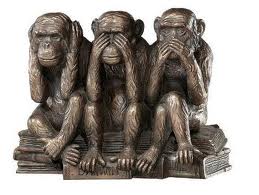
I am reading Robert Trivers’ The Logic of Deceit and Self-Deception. It is a lot of fun and incredibly interesting – my wife keeps on nabbing it, she is enjoying it so much.
His main thesis is simple: In our evolutionary past, we had to lie a lot to get ahead, to deal with parent-offspring conflict etc. We are better liars if we can convince ourselves that we are not liars. Hence, this leads to self-deception. I was reminded of the strength of this claim today.
I set an old question to my students (not one of my own but inherited from the past cohorts of teachers). This question has been used recently by many fellow teachers and it has been taught by TAs. I happened to look at the historical answer to the question and found a mistake. And the topic had not really been covered in class. A student then came to ask me about precisely this question. I decided to pretend the answer in the answer key was right – it would only have confused him more if I had gone into the right answer and I had not taught the subtlety in class, I rationalized to myself. A few minutes later he came back and asked me why the answer wasn’t in fact the one I had found earlier. I was found out. I told him his answer was correct too.
But the question and (incorrect) answer had been posed unchanged for 8 or so years without anyone pointing out the answer was wrong. Why was it discovered now? I suppose the student who spotted the right answer could be quite smart – and he is. But there are many smart students in previous generations who never found the right answer.
So, my explanation is really the Trivers’ explanation. I did not lie convincingly. My doubts about the answer manifested themselves somehow to the student. He investigated further and cracked the problem. In previous years, the teachers were convinced the answer was right and never even questioned it. They never had to lie because they truly believed they were telling the truth, just like the Trivers’ thesis on self-deception. Students left convinced. If they had doubts, they stifled them.
The student who spotted the error will be on the PhD market soon. I will write him a strong letter.
Gingrich, Santorum (and I guess also Ron Paul) keep splitting the conservative vote in the Republican primaries. Romney gets through because of the split.
Gingrich and Santorum are playing a dynamic version of Chicken (a war of attrition) with budget constraints. With complete information, a war of attrition has the player with the lower budget dropping out immediately in equilibrium. He knows that eventually there will be a penultimate stage where the player with the bigger budget will definitely fight because he knows he will be the only player left standing the next and final period and hence will win the prize with certainty. The player with the dwindling budget might as well drop out and save his money at the penultimate stage. But then we can backward induct to the pen-penultimate stage etc. and the player with the smaller budget drops out immediately.
This solution relies on a lot of rationality and complete information. Both of these are suspect in the Republican primaries. On the one hand Gingrich seems to be in the better financial position. He has a billionaire bankrolling him, Santorum does not. But on he other hand, the billionaire might not want to waste money on a lost cause. And it appears Santorum does have more money in the bank than Gingrich because he does have some support. And both men display the mixture of nutty self-belief and guile that is characteristic of politicians. Plenty of reason for the race to go on for along time.
Perhaps too long for Obama supporters. I think they should prefer Gingrich as the Republican candidate in the general election not Romney. In Florida, Romney showed that he has strong support among moderates. Moderates are the key to victory in the general election. A Democratic billionaire has to pitch in, help out the casino billionaire and bankroll the Gingrich SuperPac. They can do this by setting up an anonymous company with a PO box, keep their identity hidden and sign over a check. A big enough donation should trigger a Santorum exit as in analysis above. Then, it’s Romney vs Gingrich the rest of the way (with fringe support for Paul).
My family have decided that I am too sarcastic. I concurred. So, I agreed to sign an anti-sarcasm contract :
“Under pain of having to donate $1 toward Lego for every infraction, I hereby declare my intention to eschew sarcasm.”
The kids were making $8/day for the first few days till I learned a little self-control. So far so good.
Then, weird little things started happening. A child would ask innocently: “Can we have second dessert?” Or “Can I skip homework today?” etc. I would unfortunately respond with sarcasm.
I realized that the attempt to deal with my sarcasm by giving me incentives had created another incentive problem. I tried to change the contract so the money goes to charity but my kids refused to renegotiate….Is there some corollary of the Holmstrom moral hazard in teams model that says our it is impossible to implement optimal incentives with budget balance?
You are managing a small team. You are meant to make sure they work hard. Monitoring is costly and you would like to shirk your responsibilities. But your monitoring is observable to the worker bees. They incur no costs to observe your effort. If you shirk your duties, there will be payback from the workers. There is always the possibility that they turn you in to your supervisor. This could be a deliberate act. More likely, it is inadvertent because “loose lips” that sink ships. So, you are left with no choice but to monitor. And since you are monitoring, the workers are left with no option but to work. Everyone is worse off. If only the workers could keep their mouths shut and the manager could shirk.
My colleaque, political scientist Tim Feddersen, says he does not understand recent U.S. elections. He understood Bill Clinton, Dick Morris and triangulation. He understood George W Bush and “compassionate conservatism”. These are all consistent with the logic suggested by the median voter theorem: politicians should adopt policies that will win the support of the median voter (forget the fact that the politicians will renege on their promises as soon as they get in office!). But George W Bush was not a compassionate conservative in 2004. And for some reason, Tim can’t rationalize how President Obama got elected via the median voter theorem.
So there is a competing theory which is less well worked out, the ideological voter theory. In this theory, it is the extremes that determine elections so the candidate must play to them. One version of the theory would include turnout as a second dimension of voting strategy as well as how the citizen actually votes once she gets in the voting booth. Extremists have lower costs of turning out so the payoff to motivating them at the cost of alienating independents is greater than the benefit to motivating independents at the cost of not motivating extremists. This theory would say Santorum is the biggest threat to Obama. Watching Santorum’s speech the other night, I was moved by his story about his grandfather’s life as a coal-miner while I found Romney’s speech formulaic and artificial. So, I have some sympathy for this theory. (Of course, Jon Stewart has yet to fully explain to me what Santorum’s policy positions are If they are as extreme as my preliminary google search suggests, I might switch back to the median voter theory.)
So, the ideological voter theory suggests that Santorum is Obama’s most potent adversary. This implies Obama supporters should hope that Romney comes out alive from the Republican primaries. (I have yet to incorporate Larry Kotlikoff’s candidacy in my world view though I completely endorse Jeff’s fulsome praise. I visited BU Econ a couple of years ago and it has a great “corporate culture” that I too attribute to Kotlikoff.) But Romney has plenty of money so no need to bankroll him. Just give it to Obama.
 Suppose you think centrist, independent voters decide elections. This is the median voter theory of elections. If you believe this theory, then Mitt Romney is the biggest threat to Obama. He is probably a moderate, like the father he hero-worships. He is responsible for Romneycare, the model for Obamacare etc. So, Obama supporters fear Romney as the Republican candidate. They should seek to weaken him as much as possible in the primaries or even try to ensure another candidate is left standing at the end of the primaries.
The strategy of Obama supporters who subscribe to this theory is simple: Give money to Newt Gingrich. He is promising to help Santorum and fight Romney. At worse, he will weaken Romney and at best, given Gingrich’s efforts, Santorum may squeak through.
They were all inspired by Isaac Asimov psychohistorian Hari Seldon:



Next Iron Chef is much better than Iron Chef. The latter almost always has Bobby Flay matching his Southwestern style cuisine against some hapless contestant who usually loses. Next Iron Chef has more uncertainty, some new faces and some better chefs. Last night’s episode had fun twists and turns coming out of the mechanism design and a tragic-comic outcome.
First, the chefs had to “bid” for ingredients in a Dutch auction with time allowed for cooking as the “currency”. There were five chefs and five ingredients. The lowest bid won for each of the first four ingredients. The chef who “won” the last ingredient was by the rules of the mechanism left with a cooking time of the lowest bid on the first four ingredients minus 5 minutes. The ingredients were revealed one by one. That was the first twist. The second was that the Chef Anne Burrell had “won” the previous episode and had an advantage coming into this one (more on this below).
Equilibrium analysis for the first twist is not available but instinct suggests very aggressive bidding towards the end since you begin bidding on the fourth ingredient knowing the maximum time you will have with the fifth. This will trigger aggressive bidding all the way through. This was true for all ingredients except sardines which Anne Burrell won for a bid of 50 minutes. Chef Alex Guarnaschelli got the last ingredient, lamb chops, with 25 minutes to cook. Since, Chef Anne had about 20 minutes more than the other chefs, she made three sardine dishes. It is always an error to make multiple dishes in this competition. The judges seem to use a lexicographic criterion. They compare your worst dish with the those of the other chefs. If your worst dish is tied with others’ dishes, then your best dish comes into play and you win. So, doing multiple dishes typically backfires because you cannot spend enough time perfecting each of your dishes so you invariably end up with the worst dish and your best dish gets ignored. The First Irony is that having more time made Chef Anne think she had to do more dishes (she did three) and one of them was Yuk.
Now the second twist: Chef Anne’s advantage was that she got to taste the other four dishes and decide which was of them was the worst. The theme of the episode was “Risk” and she decided, in my opinion voting honestly according to her preferences, that Chef Jeffrey Zakarian had the least risky dish. The two worst chefs from the first part of the competition face off in the second part. And the loser gets eliminated. Chef Anne got to chose one of the two potential losers. What if Chef Anne had voted strategically? The first instinct is to put the best chef in the knockout round but this is wrong. This chef will face one of the worst chefs in all likelihood, beat them and come back the next episode. It is is better to chose the chef you would like to face in case your dish ends up at the bottom. That chef is Chef Alex in my opinion. But Chef Anne chose Zakarian who is a star. And he defeated her in the knockout round. This is Second Irony.
Who would the judges have chosen if they had leeway? It seems Chef Alex would have been in the knockout round and probably Chef Anne would have dealt with her. This is Third Irony. This episode was Shakespearean, as Chef Alex pointed out.
At every OxBridge college, there is a Wine Committee. Many people want to get on it but first you have to serve on the Use of Space Committee. It might be fun if the latter plotted how the College could go to Mars. But what the committee really does is meet bi-monthly to decide where to put the photocopier. You grumble and serve as there is a chance you get on the Wine Committee.
Kellogg, as far as I am aware (!), has no Wine Committee so this cannot be used to give incentives. Monetary incentives are weak. This leaves moral suasion as the main instrument. For example, if a Dean looks miserable when he or she asks you to do something, you are likely to say yes. They look very, very sad after all, and so you would feel terrible if you refused them. To make Deans credibly miserable, they should be treated badly. QED.
This leaves open the question of why anyone would then want to become Dean. No-one has asked me (and no-one ever will!) so I have no practical experience. I guess moral suasion and guilt also operate there but am less clear as to the exact mechanism (e.g. “This institution has done so much for me, I should serve.”).
But I do have a solution that could make everyone happy – start a Wine Committee. Regular visits and tastings with wine distributors are enough to make many of us serve on the “where should the photocopiers be in the new building committee”. Then, we can treat the deans well, as they deserve, without unraveling incentives and run everything more efficiently.
I just caught the first episode, “Heat and Meat”, of the new season of Next Iron Chef. There were two parts to the competition. In the first part, chefs worked in pairs cooking a pig (the meat) over an open fire (the heat) in the wilderness. In the second part, the two chefs in the losing team had to face each other in a sudden death cookoff. If you get to choose your teammate, one obvious strategy is to pick the best chef standing. This maximizes your chance of winning outright and hence avoiding the elimination round. In fact, chef-contestant Spike got to pick the teams and did exactly this by picking Marcus Samuelsson whom he took to be the best chef. (I missed the start of the episode so I do not know how Spike got chosen to be in this powerful position).
Things did not work out as Spike hoped. Marcus and Spike ended up at the bottom of the pile. Spike then lost to Marcus in “battle scallop”.
What did Spike do wrong? Obviously, picking the best chef as your partner carries a big risk – if you end up in the elimination round, you will likely lose. Better to hedge by choosing a worse chef. This increases the chance you get into the elimination round but also decreases the chance you do not make it out of the round. Spike should have picked Alex Guarnaschelli. She is a good cook but she gets tense and nervous. A good partner for round 1 and also a weak competitor in round 2. Perfect.

Social Choice Theorists are going to see an experiment in action as San Francisco votes for a new mayor using rank-order voting. Here is how it works:
Each voter lists up to three candidates in ranked order: First, second and third choice.
If one candidate gets more than 50 percent of the first-place votes in the first round of counting, he’s the winner and there’s no need to look at the second and third choices.
But if no one has a majority, the candidate with the fewest number of votes is eliminated from the future count and his second-choice votes are distributed to the remaining candidates.
If still no one cracks the 50 percent mark, then the candidate with the second-lowest vote total is eliminated and his second-place votes are distributed. If the voters’ second choice already was eliminated, it’s the third-choice vote that goes back into the pool.
This continues until one candidate has a majority of the remaining votes. Last November, it took 20 rounds before Malia Cohen finally was elected as supervisor from San Francisco’s District 10.
There are two strategic issues. First, there must be an incentive for strategic voting via Gibbard-Satterthwaite/Arrow. Hence, sincere voting and strategic voting will differ. Second, the candidate positions and in fact the issue of who enters as a candidate is a key factor in the rationale for switching to rank order voting in the first place. Some voters must hope that third party candidates can now enter and have a chance of winning. Others must hope that more centrist policies are adopted by the candidates in the hope of being voters’ second or third choice.
I assume there are many formal theory papers in political science on this but am not familiar with them…anyone have any ideas?
Bruce Riedel who ran President Obama’s AfPak review now favors containment over engagement:
It is time to move to a policy of containment, which would mean a more hostile relationship. But it should be a focused hostility, aimed not at hurting Pakistan’s people but at holding its army and intelligence branches accountable. When we learn that an officer from Pakistan’s Inter-Services Intelligence, or ISI, is aiding terrorism, whether in Afghanistan or India, we should put him on wanted lists, sanction him at the United Nations and, if he is dangerous enough, track him down. Putting sanctions on organizations in Pakistan has not worked in the past, but sanctioning individuals has — as the nuclear proliferator Abdul Qadeer Khan could attest.
It is useful to think of the US-Pakistan game as a principal-agent relationship. The US (principal) would like to “pay for performance” and make a transfer if and only if the Pakistani army (agent) capture terrorists and quash the Taliban. Performing this task is costly for Pakistan for many reasons. For one, they use the terrorists as proxies in their fight against India. But if the US values elimination of terrorists enough, there is a transfer or sequence of transfers that are large enough to persuade Pakistan to work hard on America’s behalf. For the transfer scheme to work, the US has to be able to commit to pay. If Pakistan is too successful, then the US has no incentive continue paying them. Knowing this, Pakistan does not want to work too hard on America’s behalf. Do enough work to keep the money rolling in but not enough to kill off the goose laying golden eggs.
This delicate balancing act can tip one way or another with random events. After one huge such event, the capture of Osama Bin Laden, the relationship has gone sour. Perhaps, we are in a new phase, that is the gist of Riedel’s column. But how should this be managed? I need to think about part 2….
Why would a narrow elite ever extend the vote to the masses? Perhaps the hand of the elite is forced by the threat of revolution. To convince the masses that the elite is committed to giving them surplus, the elite extend the franchise. This is argument of Acemoglu and Robinson.
Lizzeri and Persico have a quite different argument which has particular resonance for Britain’s Age of Reform in the nineteenth century. Suppose only a fraction of the population can vote. Two parties, the Whigs and the Tories compete for their vote. The parties can either offer a public good or a transfer with revenue generated via taxation. When the enfranchised group is a small elite, there is an incentive to tax the entire population and then target transfers to swing voters in the elite. That way a party can give them as much as they would get with pubic good provision and get into power. The mass of the elite that is not targeted gets no transfer.
When the franchise is extended pork barrel politics is not as powerful as the taxable endowment is not large enough to offer the now larger majority enough to compensate them for zero pubic good production. Each political party can at least get a 50% chance of getting elected by offering public goods. Hence, an extension of the franchise leads to less pork barrel politics and more public good production. Some members of the elite are indifferent to this change and others – those who were not receiving transfers when the franchise was small – strictly prefer it. Hence, extension of the franchise Pareto-dominates a small franchise. The franchise can be extended even when there is no threat of revolution by the disenfranchised masses.
The Pareto-domination property does not obtain in general (when voters are ideological and pubic good production is not zero-one) but the majority of the elite prefers extension of the franchise. In nineteenth century Britain, members of the elite clamoured for the extension of the franchise. There was less pork barrel transfer and more public good production after the franchise was extended.
Many homeowners are taking advantage of low interest rates to refinance their mortgage. One group is conspicuously absent: low income homeowners with a history of shaky credit. Refinancing would help them and the economy at large but the costs of refinancing plus the reluctance of lenders to lend has compromised the availability of credit to this group. What is the solution? There are three proposals that are in the public domain.
1. Inflation: This has been proposed by Ken Rogoff. He would use inflation to reduce the value of debt and get borrowing moving again. The difficulty is that the FED has carefully nurtured a reputation as an inflation fighter for the last couple of decades. Once it loses that reputation can it recover in time for an inflationary period? This issue makes he Rogoff solution unpopular with many central bankers.
2. Loan Modification: Posner and Zingales propose a loan modification program. The details are complex but require some Congressional input to change bankruptcy law or pass new legislation. This is politically impossible in the current political climate so whatever the merits of the plan, it does not seem feasible.
3. Refinance: Boyce, Hubbard and Mayer propose to ease lending rules and offer loans at 4% to eligible homeowners whose loans are guaranteed by Fannie and Freddie. How much if this plan is implementable by the President without Congressional approval? That is the question. On first blush, this plan seems the most politically feasible to me.
The end of summer heralds the annual ritual of the suburban block party. The street has to be blocked off, notices have to be put up so no-one parks on the street, food has to be ordered or cooked etc. The burden falls on the people with kids because “The block party’s for the kids” we all say. Obviously, there is a huge free-rider problem – we can all enjoy the benefits of the block party without spending time on setting things up. If you don’t hang out with your neighbors much, “repeated game” effects are minor. Hence, morality and peer pressure must step in to provide incentives.
For example, suppose you sign up to put up notices warning people not to park on the street on the day of the block party. You write up some flyers and put them under car windscreen wipers. You print off notices and staple them to trees. You think you’ve done a pretty good job. The next day you wander round putting in new flyers 
 under car wipers and check on the notices. Mysteriously, someone has taken it upon themselves to put up their own notices. These are taped to the trees not stapled. Is that really superior? You are not sure but you see the implicit rebuke in the intervention. Homo economicus would revel in the intervention – he could slack off even more knowing someone will do his job for him. But homo normalicus feels a tad pissed off and even a bit guilty, even though no guilt is truly warranted. Next year, normalicus will go back to picking up the fried chicken from Jewel-Osco. But if economicus/evilicus pops out, he will do the same job worse out of rationality or spite.
Related to my earlier post, where I suggested there as advantage to each chamber from delaying debt limit proposal as long as possible, Pelosi says:
[I]f we had days, instead of backed up to hours, we could have said ‘you don’t have the votes, let’s go back in and how do we move this way in order to cut some of those cuts and have a better bill and get the votes.’ So I think we could’ve done better. I think they were successful at just prolonging it to the last minute so that we didn’t have that option and it was default or no default.

When the debt limit increase finally passed, the law included the creation of a 12 person committee, the SuperCongress, which will negotiate the next round of spending cuts and tax increases. If they fail to agree, automatic spending cuts go into effect. These spending cuts include elements that are painful to both parties and this punishment is meant to help the committee members compromise. Also, the automatic spending cuts that kick in if there is no compromise are not as painful for the economy as a failure to increase the debt limit. This seems to be the idea. I have a couple of points.
First, the Democrats partly caved this time around because they feared the Tea Party wing of the Republican House members were “crazy types” who were willing to destroy ratings of American Treasury bonds to get dramatic spending cuts. Next time around, the threat of disagreement has to police the Tea Partiers. Do they really care about defense? If they care about small government and less foreign intervention, they may actually want defense spending cuts. To get these guys to compromise, the disagreement point should have included libertarian-unfriendly policies. Federally mandated rules that everyone should brush their teeth twice a day, extra additives in drinking water, gun control laws and perhaps a constitutional amendment to eliminate the right to bear arms. Stuff like that should have been in the disagreement point.
Second, the parties face a choice of whom to put onto the SuperCongress. Each party will have six members, three drawn from each chamber. The strategic problem is fairly familiar as it resembles Schelling’s discussion of delegated bargaining. Each party has the incentive to appoint extreme members with tough bargaining stances so the other side will be more likely to give in. Paul Ryan is an obvious choices for the Republicans. Dick Durbin is an obvious choice for the Democrats. If both parties pursue this strategy, there will be deadlock and the disagreement point will come out of the SuperCongress (another example of Prisoner’s Dilemma everywhere).
This analysis is normative – it does not account for strategic errors. And there have been plenty of those. During the health care negotiations we had Max Baucus fruitlessly pursuing his Republican friends trying to get them to sign on. Olympia Snowe got a lot of one-one-one face time with the President. As Krugman points out (see also Jon Stewart a couple of nights ago!), the debt limit extension could have been folded into the extension of the Bush tax cuts last December but the President believed John Boehner at his word. So, my guess is that while Nancy Pelosi and the Republicans will follow the rational choice predictions because they are quite clearheaded, Harry Reid will try to forge a bipartisan compromise. Max Baucus is on (and Kent Conrad would have been if he were not retiring). Ben Nelson is a maybe. Why not go take the extra step Harry and nominate Susan Collins or Olympia Snowe to show that you mean well? With that kind of strategy, the Bush tax cuts may get extended again as part of the SuperCongress compromise and remarkably the Democrats might be forced to implement a compromise that is worse for them than the disagreement point.
 Cheap Talk